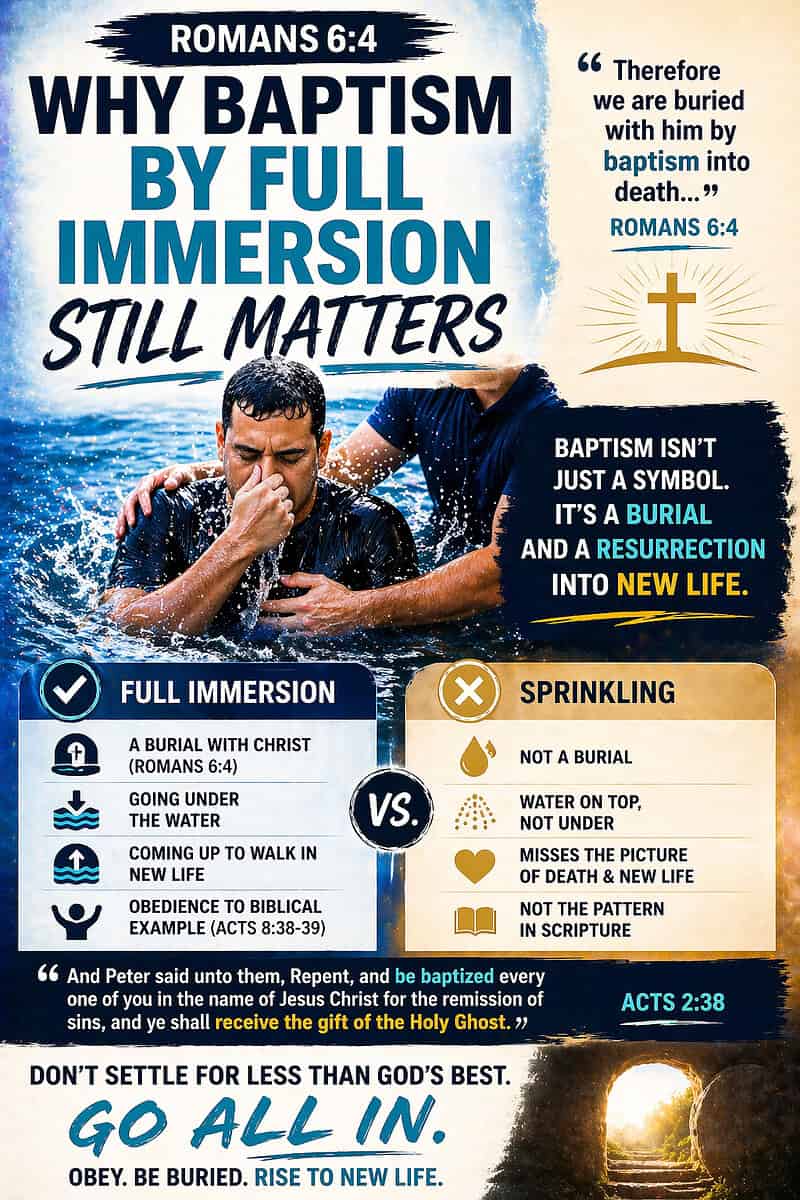
A lot of people see baptism as a symbol.
Something meaningful, maybe even important… but not essential. A ceremony that represents something that already happened.
But when you look at Scripture, baptism is never treated like that.
It’s not presented as a picture of salvation.
It’s presented as part of it.
The Bible says, “We are buried with him by baptism into death… that like as Christ was raised… even so we also should walk in newness of life.”
Buried.
Not sprinkled. Not touched. Buried.
That word matters, because burial requires full immersion. You don’t bury something by placing a little dirt on top of it. You cover it completely. You place it out of sight. You leave it behind.
That’s what baptism is.
It’s not just water on your body. It’s your old life going down.
And when you come up, you’re not the same person.
That’s why full immersion still matters.
Because it aligns with what God is actually doing.
In Acts 8, when Philip baptized the Ethiopian eunuch, the Bible says they went down both into the water… and came up out of the water. That wasn’t an accident. That was the pattern.
And it matches everything else we see.
Jesus Himself was baptized, and He came up out of the water. The early church followed that same example. No variations. No alternatives. Just obedience.
Why?
Because baptism isn’t just about the act. It’s about the meaning behind the act.
When you go fully under, you are identifying with the death of Jesus. Your sins, your past, your old identity—everything goes down into that water.
And when you rise, you’re stepping into resurrection life.
That’s not something a few drops can express.
That’s something only immersion can declare.
But it’s more than symbolism.
Acts 2:38 says, “Repent, and be baptized… for the remission of sins.”
Acts 22:16 says, “Arise, and be baptized, and wash away thy sins.”
That’s not describing a symbol.
That’s describing a moment where something real happens.
Forgiveness is applied. The past is dealt with. The name of Jesus is placed on your life.
And this is where many people struggle.
They’ve believed. They’ve prayed. They’ve tried to live right. But they’ve never fully obeyed what Jesus and the apostles actually did.
And because of that, there’s still uncertainty.
Because something is unfinished.
Full immersion isn’t about being extreme. It’s about being complete.
It’s about trusting that God knew what He was doing when He gave the pattern.
Water that covers.
A burial that’s final.
A rising that’s new.
And when you step into that in faith, something settles inside you.
You’re not holding onto the old life anymore. You’ve buried it.
You’re not trying to improve what God wanted to remove. You’ve let it go.
And from that place, when the Spirit fills you, it all makes sense.
Water buries.
The Spirit raises.
And together, they bring you into something real.
So no, full immersion isn’t outdated.
It’s not tradition.
It’s not optional detail.
It’s the way God designed the moment where your old life ends… and your new one begins.
And when you’ve walked through it, not partially, not symbolically, but fully, you don’t have to wonder anymore.
Because you know what you left behind.
And you know what you stepped into.
And that’s something you can know for sure.