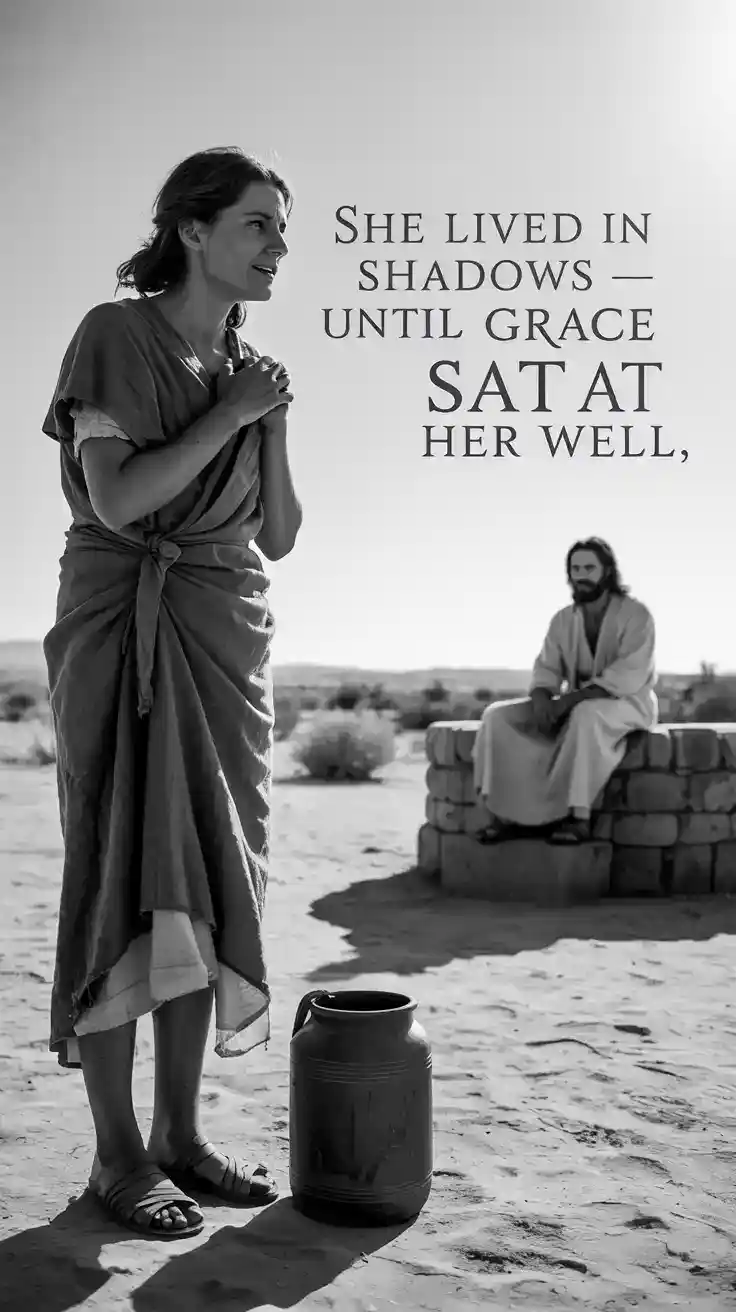
We believe in a Savior who shows up where others avoid going. The same Jesus who sat down at Jacob’s well still sits at the edges of shame, waiting for the outcast, the weary, and the ones who fetch water at the wrong time of day. He does not demand that we climb the mountain of respectability; He brings heaven’s mercy into our noon heat.
We believe that grace is not found in perfect timing or spotless record, but in honest thirst. The woman at the well was not met with condemnation, but conversation. Not with judgment, but invitation. When He said, “Give me to drink,” He wasn’t asking for water – He was asking for her heart. And when she dropped her jar, it wasn’t neglect – it was freedom.
We believe that truth and grace walk together. Jesus named her reality without crushing her beneath it. He exposed what she hid so He could heal what she thought was beyond repair.
The Living Water does not shame – it cleanses, revives, and overflows. The old argument of where to worship ends when the Well Himself speaks: “God is a Spirit, and they that worship Him must worship in spirit and in truth.”
We believe that encounter turns into calling. The same woman who avoided crowds became the first evangelist of her village. Transformation doesn’t wait for reputation to catch up. When the heart encounters Christ, it runs – jar forgotten, message blazing.
We believe that the harvest is already white. The ones society ignores are the very ones God is preparing. Samaria is still full of thirsty hearts, and Jesus still says, “Lift up your eyes.” We cannot separate mission from mercy. We cannot call ourselves followers of Christ and ignore the wells where outcasts draw water.
We believe the gospel still flows like a river through desert souls. From Jacob’s well to Calvary’s cross, from Calvary’s cross to our generation’s screens and streets, the same voice still speaks: “If any man thirst, let him come unto me, and drink.”
We believe it’s time to drop our jars – the jars of self-defense, reputation, and religious routine – and run toward the thirsty. To speak of the One who told us all we ever did, yet loved us anyway.
Because grace still sits at the well.
Because the Living Water still flows.
Because the story is still unfolding.
And we – once wanderers, now wells ourselves – will not stay silent.
The Hour No One Chose
She waited until the sun sat high and burned the dust into the air. Noon was safe. Noon was empty. Noon was the hour when decent people were behind cool walls and quiet courtyards, when the gossip cooled off, when the stares went home.
She lifted the water jar that had dug a familiar groove into her shoulder and walked the road she had walked a hundred times, the path to Jacob’s well. Each step felt like a reminder. Every footfall said, you know why you come alone.
Heat, Dust, and an Old Well
The earth shone white under the light. Heat shimmered over the stones. The well stood where it had stood for centuries, a sturdy circle of memories, carved by hands that believed in a future.
Jacob dug it. Generations drank from it. Fathers told sons that God had chosen a people. Mothers told daughters not to get their hopes up. She touched the cool rim and looked into the dark throat of the water.
Here was a gift from the past, faithful and old, but it could never do more than quiet a thirst for a few hours. By evening the cravings would return, not just in her throat, but in her chest, where an ache sat and would not move.
When A Stranger Asked For Water
She had a story, though she did not enjoy telling it. People in town told it for her. Five marriages. That is how they said it, like a score. Five rings that had come and gone. Five letters of goodbye. Some left her. Some she left. None lasted.
The man in her house now did not ask for vows and she did not ask for promises because promises had become heavy. She had learned to stop making eye contact with the women who gathered at dawn. She had learned to carry her jar and her shame at the same time.
She noticed him by the well before he spoke. A Jewish man. You could see it in his clothes and in the angle of his accent when he finally asked, soft and plain, “Give me to drink.” She stood still. The request landed like a stone in still water and sent circles through everything she thought she knew.
Greater Than Jacob After All
“How is it,” she said, tasting the old wall between their peoples, “that thou, being a Jew, askest drink of me, which am a woman of Samaria?” She tried to sound steady. The heat, the light, the years, all of it pressed close while the stranger sat, tired from walking, and looked into her eyes without flinching.
“If thou knewest the gift of God,” he said, “and who it is that saith to thee, Give me to drink; thou wouldest have asked of him, and he would have given thee living water.”
The words opened a door she had not seen. Gift. Living water. Ask. The verbs felt new on her tongue, like water after a long fast.
He Named What She Hid
“Sir,” she said, “thou hast nothing to draw with, and the well is deep.” Then the question that kept her guard up while her hope pried at the latch. “Art thou greater than our father Jacob?”
He answered with something that sounded eternal. “Whosoever drinketh of this water shall thirst again. But whosoever drinketh of the water that I shall give him shall never thirst.”
“Sir,” she said, smiling through disbelief, “give me this water.”
Then He asked her to bring her husband. The request sliced through her defenses. “I have no husband,” she said.
And truth, once spoken in the presence of Truth, does not sit quiet for long. “Thou hast well said, I have no husband.”
He named every scar she thought was hidden. Five husbands. The man she lived with now. He knew. And yet, He stayed.
Spirit And Truth Opened The Door
“Sir, I perceive that thou art a prophet,” she said. It was all she could manage. Prophets knew things. Prophets made people uncomfortable with the truth. So she tried to shift the topic to safer ground – theology. “Our fathers worshipped in this mountain, and ye say that in Jerusalem is the place where men ought to worship.”
He answered in words that made mountains and cities seem small. “The hour cometh, when ye shall neither in this mountain, nor yet at Jerusalem, worship the Father… The true worshippers shall worship the Father in spirit and in truth.”
She whispered the hope of generations. “I know that Messias cometh… When he is come, he will tell us all things.”
“I that speak unto thee am he.”
She Left The Jar Behind
He said it like sunrise breaking stone. And something in her cracked open. The Messiah – here. Speaking to her. A woman with a past.
The disciples arrived, eyes wide, whispering questions they did not dare voice. She did not wait for them to understand. She left her water jar. The jar that symbolized her daily shame. The jar that no longer mattered.
She ran back into the very town she had avoided and cried out, “Come, see a man, which told me all things that ever I did. Is not this the Christ?”
Come See The Man Who Knew
Her voice carried across alleys and markets. People turned. Men who had dismissed her listened. Women who had pitied her followed. Something about her eyes said she had found what everyone else was dying of thirst for.
They came to see Him. And they found Him as she had said – not with judgment, but with life. He stayed two days. Long enough for the gossip to die and grace to bloom.
Two Days That Changed A Town
The disciples offered food, and He told them, “I have meat to eat that ye know not of.” His nourishment was obedience. His feast was a heart transformed at a well. “Lift up your eyes,” He told them, “the fields are white already to harvest.”
And there they were – the people she had once feared, walking down the dusty road to meet the Savior.
The Fields Were Already White
That night, she must have replayed every word. He knew me. He didn’t walk away. He saw everything, and instead of shame, I found peace. She had come to the well for water and left with a spring that could never run dry.
Wells Where God Writes Chapters
It has always been at wells. Rebekah. Rachel. Moses. And now, her. The bridegroom of heaven meeting a woman who thought she was unworthy. The place of thirst becoming the birthplace of worship.
The River Still Runs
If you’ve ever carried your own jar to a well of temporary fixes, you know her story. Shame makes us walk at noon. Grace meets us there. The Christ who sat beside Jacob’s well still waits beside ours. He doesn’t ask where you’ve been – He asks for a drink, so He can fill you instead.
The river that began in Samaria still runs through the world today. The same living water that found her finds you now. The same voice still says, tender and strong, “If any man thirst, let him come unto me, and drink.”
And somewhere, a woman steps into the light, sets down her jar, and begins to sing.
Call to Action: The Question That Demands an AnswerIn Acts 2:37 Peter and the Apostles were asked the question – What Shall We do? And in Acts 2:38 Peter answered, Repent, and be baptized every one of you in the name of Jesus Christ for the remission of sins, and ye shall receive the gift of the Holy Ghost. For the promise is unto you, and to your children, and to all that are afar off, even as many as the Lord our God shall call. Do you understand this? After hearing the gospel and believing, they asked what should would do. The answer hasn’t changed friend, Peter clearly gave the answer. The question for you today is, Have you receieved the Holy Spirit Since you believed? If you’re ready to take that step, or you want to learn more about what it means to be born again of water and Spirit, visit: Come, and let the Spirit make you new. |