
Quick Overview of This Bible Study…
Short on time? I have created a short slide show presentation of some key takeways in our study. The complete, more comprehensive bible study is below…
Ever notice how your stomach suddenly becomes a percussion section the moment you whisper “I’m fasting” to the Lord? Those grumbles can feel louder than a Sunday‑morning sound check—but here’s the good news: every growl is a drumbeat calling us deeper into God’s presence.
Fasting isn’t some dusty religious relic reserved for monks and prophets; it’s a down‑to‑earth invitation for everyday believers like you and me to trade a plate of food for a feast of grace.
In the study ahead we’ll unpack what the Bible says about fasting—its Hebrew and Greek roots, its cameo moments from Genesis to Acts, and the holy rewards Jesus Himself promised.
Expect real‑talk about repentance, breakthrough prayers, and the Bridegroom‑kind of longing that turns empty stomachs into overflowing hearts. Hungry yet?
Let’s discover why denying the flesh just might be the richest meal your soul ever tastes.
What Does Fasting Mean in Scripture?
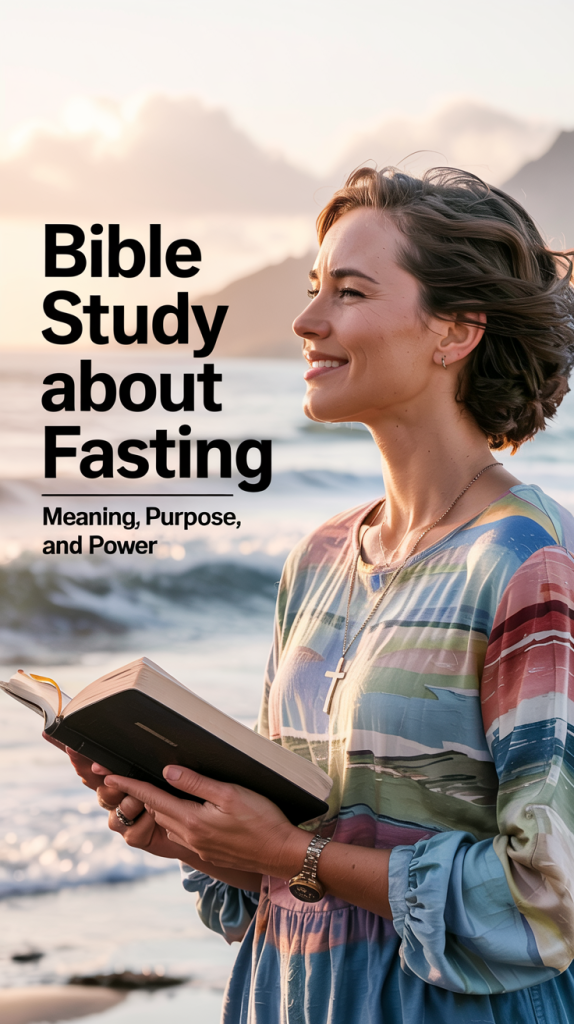
Fasting, in the biblical sense, means voluntarily going without food (and sometimes water) for a period of time to focus on God. In Scripture we see that a fast literally involves abstaining from eating.
- For example, Queen Esther instructed the Jews, “fast ye for me, and neither eat nor drink three days” (Esther 4:16 KJV).
The Hebrew word for fast (tsom) carries the idea of covering one’s mouth or denying oneself food, and the Greek word (nēsteia) similarly means “not eating”.
In essence, to fast is to deny the physical to strengthen the spiritual – choosing to set aside meals in order to seek the Lord with greater focus.
Importantly, fasting is always linked with a spiritual purpose. It’s not just skipping meals for health or protest; biblically, fasting is an act of humility and worship.
- The Psalmist David wrote, “I humbled my soul with fasting” (Psalm 35:13 KJV), indicating that fasting was a way to “afflict” or humble the soul before God.
By foregoing food, people in Scripture humbled themselves, expressing repentance, dependence, and deep longing for God.
- Jesus Himself demonstrated this when He fasted forty days in the wilderness – He hungered physically, but declared, “Man shall not live by bread alone, but by every word that proceedeth out of the mouth of God” (Matthew 4:4 KJV).
In other words, our lives are sustained even more by God’s Word and presence than by physical bread. Fasting, at its core, means trading the material for the spiritual, saying “Lord, You are my sustenance.”
Why Did People Fast? – Different Ways and Reasons for Fasting in the Bible
Throughout the Bible, people fasted for many reasons. From Genesis to Revelation, fasting appears in different forms and situations. Here are some of the main purposes and ways fasting was used, each illustrated with biblical examples:
Repentance and Confession:
Often God’s people fasted to show sincere repentance for sin. For instance, the people of Nineveh proclaimed a fast in response to Jonah’s warning, covering themselves in sackcloth and ashes as they cried out to God.
- Their fasting was an outward sign of a humbled heart, and God heard their plea and spared them (Jonah 3:5-10).
- Similarly, the prophet Daniel “set [his] face unto the Lord God, to seek by prayer and supplications, with fasting, and sackcloth, and ashes” as he confessed the sins of Israel (Daniel 9:3-5 KJV).
In these cases, fasting was a way to say “we’re sorry” with sincerity, demonstrating godly sorrow and a desire to turn from wickedness.
Seeking God’s Guidance and Help (Petition):
Fasting was often coupled with urgent prayer for deliverance or direction.
- When King Jehoshaphat faced a vast invading army, he “proclaimed a fast throughout all Judah” so everyone could seek God’s help. As they fasted and prayed, God answered with a promise of victory (2 Chronicles 20:3-17).
- Queen Esther likewise asked her people to fast for three days before she approached the king, seeking God’s protection in a life-or-death situation (Esther 4:16).
- In the New Testament, the church in Antioch fasted and prayed for guidance, and the Holy Spirit revealed that Barnabas and Saul should be set apart for missionary work (Acts 13:2-3).
In such examples, fasting functioned as an intensifier of prayer, a way of saying “God, we earnestly need You to intervene or lead us.”
Grief and Mourning:
In times of great sorrow or loss, people would fast as they mourned.
- After King Saul and Jonathan died in battle, David and his men “mourned, and wept, and fasted until even” (2 Samuel 1:12 KJV) to lament the tragedy.
Fasting was a natural companion to grief – food lost its appeal in the face of heartbreak, and abstaining became part of expressing that sorrow to God.
- Likewise, Nehemiah “sat down and wept, and mourned certain days, and fasted” upon hearing Jerusalem’s walls were broken (Nehemiah 1:4).
In these stories, fasting is a language of grief, a way to process pain in God’s presence. It often goes hand-in-hand with wearing sackcloth or ashes as a sign of deep mourning (Joel 2:12, Esther 4:3).
Humbling Oneself (Seeking Forgiveness or Favor):
Fasting is repeatedly shown as a means to humble oneself before God, essentially to “afflict the soul.” The outward act of denying food represented an inward posture of lowliness.
- The Bible notes that even the wicked King Ahab, after hearing Elijah’s judgment, “rent his clothes, and put sackcloth upon his flesh, and fasted” to humble himself, and God took notice of his contrition (1 Kings 21:27-29).
In the Psalms, David said he chastened himself with fasting when praying for others. True fasting was meant to be accompanied by humility, repentance, and obedience.
- Isaiah 58 teaches that merely bowing one’s head and going hungry isn’t the goal – rather, God desires a fast that leads us to “loose the bands of wickedness… and break every yoke,” to treat others justly and show compassion while we abstain (Isaiah 58:6).
In short, people fasted to humble themselves under God’s mighty hand, acknowledging their dependence and yielding their pride.
Worship and Devotion:
Some fasts were acts of pure worship and longing for God’s presence.
- The prophetess Anna is a beautiful example – as an 84-year-old widow in the New Testament, she “served God with fastings and prayers night and day” (Luke 2:37 KJV). Her fasting was part of her regular devotion and love for God as she waited for the Messiah.
Likewise, Jesus taught that His disciples would fast out of longing for Him. When asked why His followers weren’t fasting like others, Jesus replied that while He (the Bridegroom) was with them it was a time for joy...
- “but the days will come, when the bridegroom shall be taken from them, and then shall they fast” (Matthew 9:15 KJV).
This indicates that fasting for believers would be motivated not by ritual duty but by desire for closeness to Jesus – a way to say “Lord, I miss You and need You” until He returns. Thus, fasting can be an act of worshipful devotion, creating space to draw near to God.
Spiritual Strength and Preparation:
Fasting often preceded major spiritual victories or assignments in Scripture. Moses fasted forty days on Mount Sinai as he communed with God and received the Ten Commandments.
- Elijah, after a miraculous meal, journeyed “in the strength of that meat forty days and forty nights” to Horeb where he encountered God’s whisper (1 Kings 19:8 KJV).
- And Jesus, before launching His public ministry, fasted forty days in the wilderness, triumphing over intense temptation by clinging to God’s Word (Luke 4:1-14, Matthew 4:2).
In each case, fasting was like a spiritual boot camp – a season of self-denial that resulted in greater spiritual power and clarity.
- After those forty days, Jesus returned “in the power of the Spirit” (Luke 4:14) to begin preaching.
The pattern suggests that fasting can sharpen our spiritual senses and prepare us for greater effectiveness in God’s calling. It’s a way to say, “Lord, strengthen my spirit as I weaken my flesh.”
These examples show that biblical fasting was used in varied ways – as a response to sorrow or sin, as a plea for help, as preparation for ministry, or simply as a passionate pursuit of God.
Whether as a community or alone, for a day or for weeks, God’s people turned to fasting whenever they felt a deep need for God’s mercy and guidance. And in each scenario, fasting was never an empty ritual but a catalyst for heartfelt prayer and change.
The Blessings and Spiritual Benefits of Fasting
Does fasting “do” anything spiritually? According to the Bible, yes – when done with the right heart, fasting yields many benefits and blessings.
Jesus promised that God responds to sincere fasting done in secret: “Thy Father, which seeth in secret, shall reward thee openly” (Matthew 6:18 KJV). Scripture gives us several positive outcomes linked with fasting:
Answered Prayer and Deliverance:
Time and again, when God’s people fasted and prayed, He answered. We saw this with Queen Esther – after the three-day fast, she received favor from the king and the Jewish people were saved from destruction.
- In Ezra’s day, the exiles fasted at the river Ahava, asking God for a safe journey, and “He was intreated of us” (Ezra 8:21-23 KJV) – God granted their request.
Fasting doesn’t force God’s hand, but it often accompanies the kind of earnest, faith-filled prayer that God loves to answer.
- “Then shalt thou call, and the Lord shall answer,” says Isaiah 58:9 of those who fast with pure hearts.
There is power in combining prayer with fasting; it can lead to breakthroughs where ordinary prayer alone had tarried.
Spiritual Clarity and Guidance:
Fasting can make our spiritual ears more attentive. In the book of Acts, the church leaders were “ministering to the Lord, and fasting” when the Holy Spirit spoke clearly about sending out Barnabas and Saul.
By setting aside earthly distractions, they were primed to hear God’s voice. Many believers find that during a fast, Scripture comes alive and God-given insight flows more freely.
The clutter of life is quieted, and the “still small voice” of the Holy Spirit can ring louder in our hearts.
- Daniel, for example, received profound visions and understanding after a period of fasting and prayer (Daniel 9:20-22; 10:2-3, 11-12). Thus fasting is often tied to greater discernment of God’s will and Word.
Personal Revival and Strength:
Fasting has a way of re-aligning our priorities with God’s.
- David noted that in fasting “I humbled my soul” and his zeal was renewed (Psalm 35:13, 69:10).
- Jesus taught that fasting, done rightly, brings reward from God (Matthew 6:18), and we see one reward is a rekindled spiritual fire.
It reminds us how dependent we are on God. Each hunger pang can prompt prayer, saying, “Lord, fill me; I need You more than food.”
- James 4:8 tells us, “Draw nigh to God, and He will draw nigh to you.”
Fasting is one way to draw near, and the “reward” is often a closer walk with God, a tender heart, and renewed spiritual vitality.
After a fast, many testify to increased self-control (a fruit of the Spirit) and victory over certain temptations – the spirit gains a fuller dominance over the flesh. It’s like a spiritual reset.
Healing and Justice (the Isaiah 58 promises):
- In Isaiah 58, God describes the wonderful results of a sincere fast: “Then shall thy light break forth as the morning, and thine health shall spring forth speedily… and the glory of the Lord shall be thy reward (rear guard). Then shalt thou call, and the Lord shall answer” (Isaiah 58:8-9 KJV).
Here we see fasting linked to healing and restoration (both personal and societal), to righteousness shining forth, and to prayers being answered quickly.
When we fast in a way that leads us to care for others (sharing bread with the hungry, etc., as that chapter says), God promises blessings: guidance, satisfaction of soul, strength, and rebuilding of ruins (Isaiah 58:10-12).
In other words, a godly fast can transform our lives and communities, unleashing God’s power to heal, to bring justice, and to restore what was broken.
It’s not that our fasting earns these blessings, but it postures us to receive what God is eager to give when our hearts are right.
Greater Faith and Spiritual Authority:
- In the New Testament, there’s an account where Jesus’ disciples couldn’t cast out a tough demon, and Jesus said, “This kind can come forth by nothing, but by prayer and fasting” (Mark 9:29 KJV).
Fasting, paired with prayer, can increase our faith and dependence on God’s power, enabling us to face spiritual battles more effectively. It is an aid to prevailing prayer.
While some manuscripts omit “and fasting” in that verse, the KJV includes it, echoing a truth many have found: fasting can accompany desperate intercession for someone’s deliverance.
By denying ourselves, we take up a form of cross-bearing that can release God’s power in and through us.
In summary, the Bible depicts fasting as spiritually fruitful. It humbles us (which invites God’s grace – “God giveth grace unto the humble”, James 4:6), helps us resist the devil (Matthew 4:11, Jesus sent Satan away after fasting and resisting temptation), and can bring clarity, guidance, and renewed strength.
And ultimately, the greatest “benefit” of fasting is God Himself – experiencing His presence more deeply. Fasting is not a transactional tool to get stuff from God; it’s a relational tool to get closer to God. The other blessings (answers, healing, etc.) flow from that central aim.
Patterns and Symbolism: What Fasting Signifies in the Bible
When we survey all of Scripture, several patterns and symbols emerge around fasting:
1. Fasting as Humbling and “Afflicting” the Soul:
We’ve touched on this, but it bears repeating: the consistent symbolic meaning of fasting is self-humbling.
- The phrase “afflict your souls” appears in the context of fasting, especially on the Day of Atonement (Leviticus 16:29-31).
While the Law didn’t use the word “fast” there, Jewish tradition understood “afflicting the soul” to mean denying oneself food as an act of penitence.
- Psalm 35:13 confirms this by paralleling “I humbled (afflicted) my soul with fasting”.
So fasting symbolizes an inward affliction – we voluntarily embrace physical weakness to acknowledge our spiritual weakness and need for God. It’s like saying, “Lord, without You I’m empty. I lower myself before You.” This posture of humility is what God responds to.
- In fact, fasting is often associated with sackcloth and ashes in Scripture – outward signs of inner humility (Nehemiah 9:1-2, Esther 4:3, Daniel 9:3).
People would put on rough cloth and even sprinkle ashes on their heads along with fasting to visibly show repentance and grief.
The ashes and sackcloth were metaphors for desolation and mourning, and the fast tied into that, saying “not only is my clothing rough, but I refuse pleasant food – I am utterly cast down before You, God.”
While we may not wear sackcloth today, the essence remains: true fasting involves a humbled heart.
2. Accompanied by Prayer, Weeping, and Confession:
A clear pattern is that fasting rarely stands alone – it’s almost always coupled with fervent prayer and often with tears or confession of sin.
- “Turn ye to me with all your heart, and with fasting, and with weeping, and with mourning,” says the Lord in Joel 2:12.
- In Judges 20:26, all Israel fasted and “wept” before the Lord in a time of national crisis.
- In Daniel 9 and Nehemiah 9, fasting is joined with confessing sins.
This pattern tells us that fasting is really prayer in another form – it is prayer intensified. Skipping meals frees up time and energy to pray more, and the physical weakness can tenderize our hearts to pray with sincerity.
The tears and confession that often accompany fasting indicate a heart truly yielded and open before God. Fasting without prayer is just going hungry; but fasting with prayer is powerful. The two together are like two sides of one coin in biblical narratives.
3. Sincerity vs. Hypocrisy – The Heart Matters:
Throughout Scripture, God emphasizes that why and how we fast matters more than how long we fast.
- There’s a pattern of contrasting true and false fasting. Isaiah 58 is the classic example: the people complained, “Why have we fasted and You have not seen? Why have we afflicted our soul and You take no notice?” (Isa 58:3).
- God responded that their fasting was only external – they were still fighting, oppressing workers, and seeking selfish ends while fasting (58:4).
Such a “fast” was not acceptable.
- Instead, God described the “fast that I have chosen”: one paired with righteousness, freeing the oppressed, feeding the hungry, clothing the naked (58:6-7).
The pattern is clear: fasting is not a spiritual merit badge or a show. If done for pride or pretense, it’s empty.
- Jesus echoed this when He taught, “When ye fast, be not as the hypocrites, of a sad countenance: for they disfigure their faces, that they may appear unto men to fast” (Matthew 6:16).
In Jesus’ day, some Pharisees would look gloomy and maybe smear ashes to make it obvious they were fasting, hoping to impress others with their piety.
Jesus said they had their reward (people’s admiration) but would miss God’s reward.
- Instead, He told us to fast secretly – “wash your face” and don’t advertise it (Matt 6:17-18).
The only audience that matters is God. Thus, the enduring principle is that authenticity is key.
A fast should be about seeking God, not about being seen. It’s a private devotion (even when done in a group, the heart of each person should be genuine before God).
When our fasting is sincere, God sees and responds. When it’s fake or prideful, it gains nothing spiritually. This pattern warns us to check our motives and combine fasting with obedience, compassion, and genuine devotion.
4. “New Wine in New Wineskins” – Fasting Transformed by Christ:
- Another symbolic pattern emerges with Jesus’ teaching on the bridegroom (Matthew 9:15).
- Right after saying His disciples would fast after He was taken away, Jesus spoke of not putting new wine into old wineskins (Matt 9:16-17).
This suggests that with Jesus’ coming, the practice of fasting (like many religious practices) would be given fresh meaning.
Under the Old Covenant, fasting was often associated with mourning and longing for the Messiah and for redemption. Under the New Covenant, we fast with the knowledge that the Messiah has come and redeemed us.
Thus, Christian fasting has a bittersweet quality: we have the “new wine” of the Holy Spirit and the joy of salvation, yet we still experience Jesus’ physical absence and a broken world, so we fast at times as we long for the full realization of His kingdom.
It’s not the legalistic ritual that some had made it, but a “new wineskin” of grace-filled devotion.
- The Pharisee in Jesus’ parable who boasted “I fast twice in the week” (Luke 18:12) exemplified an old wineskin mentality – using fasting as a point of pride and self-righteousness.
- Jesus flipped the script, praising instead the humble tax collector who simply cried for mercy (Luke 18:13-14).
The implication is that our fasting must fit the new reality of Christ’s grace: it’s done in liberty, love, and hope, not to prove ourselves. This is a significant shift in pattern from Old to New Testament. The practice of fasting continues, but its spirit is renewed by the gospel.
5. The 40-Day Pattern – Echoes of Moses, Elijah, and Jesus:
We can’t help but notice a special pattern of forty-day fasts by key figures.
- Moses’ 40-day fast on Sinai
- Elijah’s 40-day journey to Horeb
- and Jesus’ 40 days in the wilderness form a thread across Scripture.
Remarkably, Moses (the representative of the Law) and Elijah (the representative of the Prophets) both appeared with Jesus at the Mount of Transfiguration – and all three had undertaken these prolonged fasts empowered by God.
It’s as if those 40-day fasts foreshadowed or pointed to Christ.
Moses fasting while receiving the Law hinted that humanity cannot live by bread but by God’s word – something Jesus confirmed during His fast by quoting “Man shall not live by bread alone”.
Elijah’s fast led him to hear God in a gentle whisper, and Jesus, in His fast, experienced the Father’s ministering angels after defeating Satan’s temptations.
The number 40 in the Bible often symbolizes testing or preparation (Israel wandered 40 years in the desert, etc.), so these fasts fit that motif: a period of testing culminating in a work of God.
Jesus’ 40-day fast is the ultimate example – He succeeded in righteousness where Israel had failed in their 40-year test, showing Himself to be the true obedient Son.
While most of us are not called to emulate a 40-day total fast (these were extraordinary and divinely sustained), the pattern highlights that great revelations and victories often come after seasons of intense devotion.
It underlines fasting as a tool for spiritual breakthrough and alignment with God’s purposes.
In all these patterns and symbols, we see that fasting in Scripture is rich with meaning. It’s never an empty duty; it always points to deeper spiritual realities: humility, dependence, longing, and dedication to God.
Even the act of hunger is symbolic – it reminds us that we are hungry for God. Every time your stomach growls in a fast, it’s like a physical prayer: “Lord, as my body desires food, my soul desires You.”
This heart of fasting is beautifully summarized in Jesus’ beatitude: “Blessed are they which do hunger and thirst after righteousness: for they shall be filled” (Matthew 5:6).
Fasting embodies that hunger for God’s righteousness, and the promise is a filling that food could never give.
Fasting in the Old and New Testaments: Continuity and Change
Fasting is one of those spiritual disciplines that spans both Old and New Testaments, showing both continuity and a shift in understanding with the coming of Christ.
What stayed the same?
The essence of fasting as a way to seek God, repent, and pray remained constant. We find believers in the New Testament fasting for the same core reasons as in the Old.
- For example, after Jesus ascended, the early Christians fasted when facing important decisions or challenges (as in Acts 13:3 and 14:23 where they fasted when appointing elders).
Fasting was still very much a part of a devout life – it didn’t disappear with the Old Covenant.
- In fact, Jesus assumed His followers would fast (“When you fast…”, not “if you fast,” in Matthew 6:16).
And as noted, He said they “shall fast” once He was gone. So the practice continued, and the spiritual purpose (to humble oneself, draw near to God, and seek His intervention) carried over.
We even see that the timing of the Jewish fast day known as the Day of Atonement was familiar enough that Luke in Acts 27:9 refers to it simply as “the fast” (indicating it was around that time of year).
Early Jewish Christians likely observed that annual fast day, at least until it became clear that Christ’s atonement fulfilled what it symbolized.
What changed then?
Primarily, the context and mindset of fasting changed in the New Testament era. Under the Old Testament Law, the only commanded fast was on the Day of Atonement (Leviticus 16:29-31), which was a nation-wide sacrificial fasting day for repentance and seeking forgiveness.
After Christ’s sacrifice on the cross, there was no longer a need for an annual ritual to secure atonement – Jesus accomplished forgiveness for us once for all.
Thus, Christians are not under the Law to keep certain fast days as a requirement for righteousness. Fasting became entirely voluntary and Spirit-led, a matter of devotion rather than obligation.
This is a significant shift: from fasting under the Law to fasting under Grace.
We fast not to obtain forgiveness (we receive that through Christ’s blood, 1 John 1:7-9), but to respond to God’s grace with devotion, to war against our ongoing fleshly tendencies, and to intercede for God’s kingdom to advance.
Another change is the tone of fasting.
In the Old Testament, many fasts were characterized by a sense of lament and longing for redemption.
In the New Testament, while there is still sorrow over sin and brokenness, there is also a prevailing joy because the Savior has come.
Jesus highlighted this by comparing His presence to a wedding feast – it wasn’t a time to fast when He was with His disciples, because it was a time of joy (Matthew 9:15).
After He ascended, Christians did fast, but their fasting was now tempered by the joy and hope of the Resurrection.
We see this balanced perspective in passages like Acts 13: the church leaders fasted in worship (“ministering to the Lord” implies a joyful service), not just in sorrow.
Christian fasting is thus often “happy mourning” – we grieve over sin and yearn for Christ’s return, yet we rejoice that we are His and that He hears us.
Jesus taught that we shouldn’t make a spectacle of gloom when we fast (Matthew 6:16); instead, we can anoint our head and wash our face (6:17), which in that culture were acts of normal grooming – implying a peaceful, hopeful demeanor even as we fast.
Furthermore, the New Testament places fasting in the context of the Holy Spirit’s guidance. Believers now have the indwelling Spirit, who can prompt when and how to fast. There isn’t a legal schedule; it’s as the Lord leads.
- For instance, Paul mentioned his own frequent fastings (2 Corinthians 11:27) as part of his life of serving Christ – sometimes voluntary, sometimes due to lack of food, but he included them among the hardships he embraced for the gospel’s sake.
- Fasting had become part of the rhythm of grace-empowered discipline (Paul also talks about disciplining the body in 1 Corinthians 9:27, which resonates with fasting practices).
In summary, the continuity is that fasting remains a powerful way to seek God and devote oneself to Him; the change is that it’s no longer a commanded ritual for atonement or self-righteous display, but a freewill offering of love and faith.
The focus shifts from merely mourning and desperation to also include anticipation and spiritual renewal. We fast not as those in darkness pleading for light, but as children of light wanting to shine brighter. Yet, whenever we do mourn and plead in fasting, we have the confidence of the cross.
This new covenant understanding infuses fasting with even deeper meaning: we fast in the liberty of knowing we are already accepted in Christ. Thus, fasting becomes not about achieving something but about receiving more of what God has already given and aligning ourselves with His will.
Fasting as a Foreshadow and Fulfillment in Christ
Finally, let’s explore how fasting in the Bible connects to types, shadows, and fulfillments related to Christ. It’s fascinating to see that many threads of biblical fasting find their ultimate meaning in Jesus.
Christ, the Ultimate Atonement – Fulfilling the “Fast Day”:
As mentioned, the Day of Atonement was the one day Israel was commanded to fast (“afflict your souls”). This solemn fast day each year foreshadowed the coming work of Christ.
- On that day the high priest made atonement for the sins of the people, and everyone humbled themselves, doing no work and fasting, essentially casting themselves on God’s mercy (Leviticus 16:29-30).
This points to Jesus because He is our High Priest and sacrifice, obtaining eternal atonement for us.
- Once Jesus died and rose again, the shadow gave way to reality – we no longer need an annual fast to receive forgiveness, because “we have redemption through His blood, the forgiveness of sins” (Ephesians 1:7).
In the New Testament, we see a hint of this transition: Acts 27:9 notes “the fast was now already past” (referring to Yom Kippur) as Paul sailed to Rome, yet there’s no instruction for Christians to observe it.
The early church understood that Christ fulfilled the meaning of that fast.
Now, when Christians do choose to fast in repentance, it’s not to add to Christ’s work but to apply it – to humble ourselves, confess, and rejoice in the forgiveness He purchased.
In a way, every time we fast in repentance, we are acknowledging Christ’s sufficient sacrifice (saying “Jesus, You paid for this sin; I repent in light of Your mercy”). Thus, Christ gave fasting a new foundation – grace instead of law, relationship instead of ritual.
Jesus’ 40-Day Fast – Recapitulating Israel and Overcoming Temptation:
Jesus’ own fasting in the wilderness is rich in typological significance. He fasted 40 days, directly recalling Israel’s 40 years in the wilderness. Where Israel often failed – grumbling over hunger, doubting God – Jesus succeeded, refusing to use His power to create bread and choosing to trust the Father’s provision.
He quoted Deuteronomy (“Man shall not live by bread alone…”), showing He was consciously living out the lesson Israel was supposed to learn (Deut 8:3) but never fully did.
In this sense, Jesus fulfilled what Israel’s fasting in the wilderness was meant to teach: complete reliance on God.
Moreover, His victory over the devil’s temptations during that fast (Matthew 4:1-11) foreshadows the greater victory over sin and Satan He would win at the cross.
It’s as if the wilderness fast was a preview of the spiritual conquest of Calvary – Jesus bound the “strong man.”
This is why after the fast, the Gospels say angels came and ministered to Him, and He began His ministry with power. For us, Christ’s successful fast and temptation means that through Him we too can overcome.
We don’t fast to defeat Satan – Jesus already dealt the decisive blow – but we do fast to apply Jesus’ victory in areas of our lives. Because Jesus triumphed, our fasting is not in vain; it partakes in the power of His triumph.
The link between Jesus and Moses/Elijah (as mentioned earlier) also highlights Jesus as the greater One who fulfills the Law and the Prophets.
Moses’ law can point out sin and call for fasting in repentance; Elijah’s prophetic message can call a nation to fast; but Jesus actually provides the cleansing and Spirit power that those fasts sought. He fulfills their deepest purpose.
The Bridegroom and the Wedding Feast:
Another beautiful connection is Jesus referring to Himself as the Bridegroom (Matthew 9:15). In the Old Testament, fasting was sometimes connected with mourning a loss or yearning for God’s deliverance.
By using the bridegroom imagery, Jesus cast Himself as the reason for both feasting and fasting – feasting while He was present on earth, and fasting after He was “taken away” (which alludes to His death and ascension).
This is laden with meaning: Christ is the Bridegroom of the Church. When we fast now, it’s often with an eye toward that wedding feast to come – the Marriage Supper of the Lamb (Revelation 19:7-9).
In that day, all fasting will forever cease because we’ll be in the immediate joyful presence of our Bridegroom King! Thus, our fasting carries a prophetic significance – it’s a longing for the return of Christ.
In a sense, fasting is a shadow of our current pilgrimage: we are in the “in-between” time, betrothed to Christ but awaiting the wedding day. Just as one might fast in anticipation or in preparation for a great celebration, we fast looking forward to the ultimate celebration with Jesus.
Once He comes and wipes away every tear, fasting will be no more. This perspective can actually fill our fasting with joy, because we know it’s temporary and anticipatory. Every fast day is one less until the eternal feast!
Fasting and the Cross – Self-Denial in Discipleship:
Jesus taught that to follow Him, we each must “take up [our] cross” (Luke 9:23). Fasting is a practical way we identify with Christ’s suffering and practice self-denial for the sake of the Kingdom.
It’s not that by fasting we are literally sharing in the atonement (Christ’s work is unique), but we are obeying His call to deny ourselves, even if in a small way, to focus on higher things. In that way, fasting is a shadow of the cross-life all believers live.
The small pains of fasting (hunger, weakness) remind us of the much greater pain Jesus endured to conquer sin.
It helps us “crucify” our fleshly desires (Galatians 5:24) and align with the Holy Spirit. We might even say fasting is a form of fellowship with Christ’s sufferings (Philippians 3:10) insofar as we willingly lay aside comfort out of love for God.
Of course, this is done looking to Christ, not our own strength. The joy is that any suffering in fasting points us to the One who suffered for us and is now our strength.
In all these ways, Christ is central. He fulfilled the righteousness that all previous fasting could only yearn for. He gives us the Holy Spirit, who empowers our fasting to be effective and genuine. And He is the object of our deepest longing that fasting expresses.
Therefore, Christian fasting is inherently Christ-centered fasting. We fast with our eyes on Jesus – His example, His presence, and His return. This Christ-focus ensures our fasting doesn’t become a source of pride or an end in itself, but rather a means to more love for Christ and others.
Conclusion: Fasting as a Faith-Filled Pursuit
As we conclude this deep dive, we find that biblical fasting is so much more than just skipping meals.
It’s a thread woven through the tapestry of Scripture, connecting the experiences of people like Moses, David, Esther, Anna, Paul – and connecting us ultimately to Jesus Himself.
Fasting is an invitation to slow down and seek God wholeheartedly. It’s an ancient practice, but its purpose is ever relevant: to remind us that our truest hunger is for God.
Maybe you’ve never tried fasting, or perhaps you have but wondered if it really mattered. Be encouraged that even the smallest fast, done in faith, is noticed by your Father in heaven. The Bible’s testimony is that God responds to those who earnestly seek Him.
Fasting is a way to say, “Lord, You are my priority right now.” It clears the clutter, increases our spiritual sensitivity, and can even be an act of love – love for God’s presence, or love for others as we pray and even share our bread during a fast (Isaiah 58:7).
If you feel a tug on your heart to draw nearer to God or to intercede for a situation, consider responding with fasting and prayer.
It could be skipping one meal a week to pray for a lost loved one, or a day of fasting as you repent and reset your heart, or a longer fast as you seek direction – let the Holy Spirit lead you.
Remember, the goal is not to perform for God or others; the goal is to connect with God. Fasting is a tool for that – sometimes a challenging tool, yes – but also a deeply rewarding one.
In the discomfort of hunger, you may find a sweeter communion with Jesus. In the weakness of an empty stomach, you may discover the strength of God filling your spirit.
The Bible ends with God’s people feasting in the New Jerusalem, no longer needing to fast. Until that day, fasting remains a valuable practice for believers. It teaches us discipline, increases our gratitude for what God provides, and directs our focus to the spiritual realm.
It also has a way of exposing what controls us – whether we run to food for comfort or truly rely on God. In that sense, fasting can lead to personal purification and growth in holiness.
So, approach fasting not as a burden but as a gift – a grace-enabled opportunity to know God more. As Jesus hinted, there is a new wine of intimacy with Him waiting for those who devote themselves in this way. You might start out feeling dry or distracted in a fast, but stick with it in prayer; you’ll find that God honors the humble seeker.
“They that wait upon the Lord shall renew their strength” (Isaiah 40:31), and waiting on Him sometimes means saying “no” to lunch so you can say a fuller “yes” to Him.
In a friendly, down-to-earth sense: why not give it a try? Fasting is hard, yes – your stomach will surely remind you of that! – but it is also holy. It’s a journey many believers before you have taken, and they testify of its spiritual fruit. You don’t have to be a super-saint.
Start where you are. God sees your heart. Even if you falter (maybe you meant to fast till sundown but caved at 3 PM), don’t beat yourself up. It’s not about legalism, it’s about love. Turn back to the Lord and continue. He is gracious.
Ultimately, biblical fasting leads to feasting – feasting on the goodness of God. Job said, “I have esteemed the words of His mouth more than my necessary food” (Job 23:12).
That’s the attitude we’re after. When you reach the point where God’s Word, God’s presence, and God’s will truly satisfy you more than the richest meal, you have tapped into the true power of fasting.
And the beautiful thing is, God promises that those who hunger for Him “shall be filled.” He will fill your soul with peace, strength, and joy. He will honor the sacrifice that nobody else sees.
So, be encouraged to seek the Lord in fasting as He leads you. The Bible gives us both the example and the expectation that fasting can be a normal part of a healthy Christian life. It’s not a magic formula, but it is a tried-and-true path of devotion.
Approach it with faith and expectation. God may reveal things to you, break chains in your life or others’, or simply draw you closer to His heart. Even Jesus said some breakthroughs happen only through prayer and fasting.
In our busy modern world, fasting is like stepping into a quiet, ancient chapel where our spirit can breathe. It’s counter-cultural (when everyone else lives to indulge, we voluntarily abstain for something greater), but that’s part of its power.
It recenters us on what truly matters – “Seek ye first the kingdom of God” (Matt 6:33). And don’t forget to combine it with practical kindness (Isaiah 58 reminds us true fasting isn’t just about not eating, but also about sharing and caring). Let fasting make you more sensitive to God and to people.
Dear reader, if you undertake a fast, do so with a friendly conversation with God in your heart. Ask Him questions, pour out your concerns, meditate on Scripture. Journal what you sense He’s showing you.
And when you feel weak, remember the words, “My grace is sufficient for thee, for My strength is made perfect in weakness” (2 Corinthians 12:9). In our weakness, He is strong – that could sum up the spiritual secret of fasting.
May your fasting, whenever and however you practice it, be filled with God’s grace. May it draw you into deeper fellowship with the Lord, unlock blessings in and through you, and conform you more to the image of Christ.
The King James Bible gives us this timeless call: “Therefore also now, saith the LORD, turn ye even to me with all your heart, and with fasting…” (Joel 2:12). Fasting is one way to turn our whole heart to Him. And when we do, we can trust that He will turn His face toward us.
Be blessed as you seek to implement this ancient discipline in a fresh, faith-filled way. Fasting might empty our stomach, but it fills our soul – with more of God’s presence, power, and peace. And that is a meal well worth the wait. Amen.
Citations
- Esther 4:16 (KJV) – “Go, gather together all the Jews that are present in Shushan, and fast ye for me, and neither eat nor drink three days, night or day…”biblegateway.com
- Psalm 35:13 (KJV) – “But as for me, when they were sick, my clothing was sackcloth: I humbled my soul with fasting; and my prayer returned into mine own bosom.”biblehub.com
- Matthew 4:4 (KJV) – “But he answered and said, It is written, Man shall not live by bread alone, but by every word that proceedeth out of the mouth of God.”biblegateway.com
- Jonah 3:5-8 (KJV) – The people of Nineveh believed God’s warning “and proclaimed a fast, and put on sackcloth…”; the king decreed, “Let neither man nor beast… taste any thing: let them not feed, nor drink water”biblegateway.com.
- 2 Chronicles 20:3-4 (KJV) – “And Jehoshaphat feared, and set himself to seek the LORD, and proclaimed a fast throughout all Judah. And Judah gathered themselves together, to ask help of the LORD…”
- Daniel 9:3 (KJV) – “And I set my face unto the Lord God, to seek by prayer and supplications, with fasting, and sackcloth, and ashes.”
- 2 Samuel 1:12 (KJV) – “And they mourned, and wept, and fasted until even, for Saul, and for Jonathan his son…”
- Nehemiah 1:4 (KJV) – “And it came to pass, when I heard these words, that I sat down and wept, and mourned certain days, and fasted, and prayed before the God of heaven.”
- Isaiah 58:6-9 (KJV) – “Is not this the fast that I have chosen? to loose the bands of wickedness… Is it not to deal thy bread to the hungry…? Then shall thy light break forth as the morning, and thine health shall spring forth speedily… Then shalt thou call, and the LORD shall answer…”biblegateway.combiblegateway.com
- Matthew 6:16-18 (KJV) – “Moreover when ye fast, be not, as the hypocrites, of a sad countenance… But thou, when thou fastest, anoint thine head, and wash thy face; That thou appear not unto men to fast, but unto thy Father… and thy Father, which seeth in secret, shall reward thee openly.”biblegateway.com
- Matthew 9:14-15 (KJV) – “And Jesus said unto them, Can the children of the bridechamber mourn, as long as the bridegroom is with them? but the days will come, when the bridegroom shall be taken from them, and then shall they fast.”biblegateway.com
- Acts 13:2-3 (KJV) – “As they ministered to the Lord, and fasted, the Holy Ghost said, Separate me Barnabas and Saul… And when they had fasted and prayed, and laid their hands on them, they sent them away.”
- Acts 14:23 (KJV) – “And when they had ordained them elders in every church, and had prayed with fasting, they commended them to the Lord…”
- Exodus 34:28 (KJV) – “And he [Moses] was there with the LORD forty days and forty nights; he did neither eat bread, nor drink water. And he wrote upon the tables the words of the covenant, the ten commandments.”biblegateway.com
- 1 Kings 19:8 (KJV) – “And [Elijah] arose, and did eat and drink, and went in the strength of that meat forty days and forty nights unto Horeb the mount of God.”
- Matthew 4:2 (KJV) – “And when [Jesus] had fasted forty days and forty nights, he was afterward an hungred.”
- Mark 9:29 (KJV) – “And he said unto them, This kind can come forth by nothing, but by prayer and fasting.”
- Joel 2:12 (KJV) – “Therefore also now, saith the LORD, turn ye even to me with all your heart, and with fasting, and with weeping, and with mourning.”
- Acts 27:9 (KJV) – “Now when much time was spent, and when sailing was now dangerous, because the fast was now already past…”kingjamesbibleonline.org
- Luke 2:37 (KJV) – “And she [Anna] was a widow of about fourscore and four years… which departed not from the temple, but served God with fastings and prayers night and day.”