John 1 starts with words almost every Christian recognizes:
“In the beginning was the Word, and the Word was with God, and the Word was God.”
And immediately, we’re back in Genesis.
But keep reading, because Genesis isn’t the only Old Testament book sitting behind John 1.
Exodus is here.
Isaiah is here.
Moses is here.
The Passover lamb is here.
Psalm 2 is sitting quietly in the background.
And by the end of the chapter, Jesus takes us all the way back to Jacob lying on the ground at Bethel, watching angels ascend and descend between heaven and earth.
Once you start seeing these connections, John 1 becomes a very different chapter.
John isn’t merely introducing Jesus.
He’s taking some of the biggest pictures, promises, events and themes in the Old Testament and showing us where they were pointing.
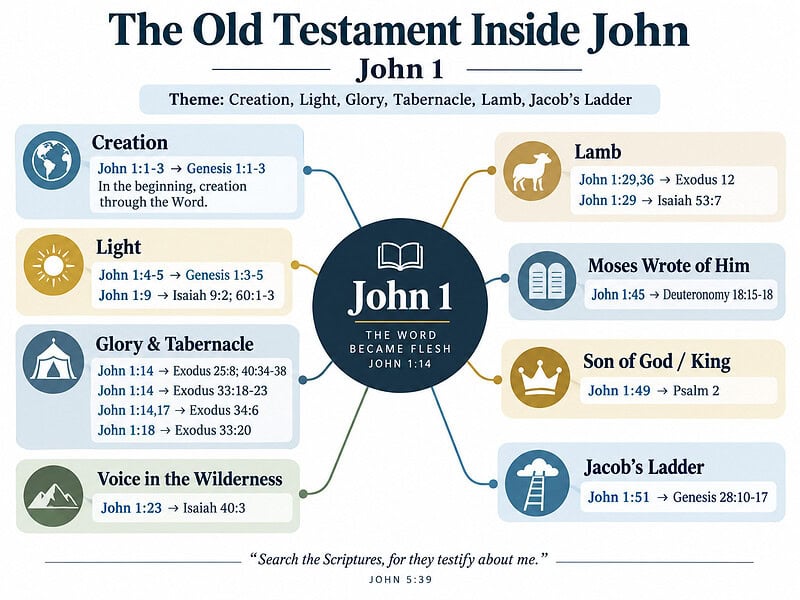
John 1 Old Testament Connections at a Glance
Here’s the whole chapter laid out in one table.
| John Passage | Old Testament | Connection | Strength |
|---|---|---|---|
| John 1:1-3 | Genesis 1:1-3 | “In the beginning,” creation through the Word | Strong |
| John 1:4-5 | Genesis 1:3-5 | Light appearing in darkness | Strong |
| John 1:9 | Isaiah 9:2; 60:1-3 | Light coming into a dark world | Theme |
| John 1:14 | Exodus 25:8; 40:34-38 | The Word “dwelt” among us, tabernacle imagery | Strong |
| John 1:14 | Exodus 33:18-23 | Moses asks to see God’s glory, John says glory has now been seen | Strong |
| John 1:14, 17 | Exodus 34:6 | Grace and truth echo God’s covenant character | Strong |
| John 1:18 | Exodus 33:20 | No man can see God, yet the Son reveals Him | Strong |
| John 1:23 | Isaiah 40:3 | John the Baptist is the voice in the wilderness | Direct |
| John 1:29, 36 | Exodus 12 | Jesus as the Lamb | Strong |
| John 1:29 | Isaiah 53:7 | Lamb led to slaughter | Strong |
| John 1:45 | Deuteronomy 18:15-18 | The One “Moses in the law” wrote about | Theme |
| John 1:49 | Psalm 2 | Son of God and King language | Theme |
| John 1:51 | Genesis 28:10-17 | Jacob’s ladder, heaven opened, angels ascending and descending | Strong |
John 1 Takes Us Back to Genesis
John doesn’t slowly introduce Jesus.
He starts at creation.
John 1:1 says:
“In the beginning was the Word, and the Word was with God, and the Word was God.”
Compare that with Genesis 1:1:
“In the beginning God created the heaven and the earth.”
Those opening words aren’t easy to miss.
“In the beginning.”
John wants our minds going back to Genesis.
Then he makes the connection even stronger.
John 1:3 says:
“All things were made by him; and without him was not any thing made that was made.”
Go back to Genesis and watch how creation happens.
God speaks.
“And God said, Let there be light: and there was light.”
Genesis 1:3
God speaks and creation responds.
Now John introduces Jesus as the Word and tells us that everything was made by Him.
Think about what John has already told us before Jesus has walked through Galilee, called a disciple, performed a miracle or preached a sermon.
The One we’re about to meet isn’t simply another man appearing in Israel’s history.
He was there in the beginning.
Creation came through Him.
John’s story of Jesus doesn’t begin at Bethlehem.
It begins before Bethlehem.
Before Moses.
Before Abraham.
Before Adam.
Before there was an earth to stand on.
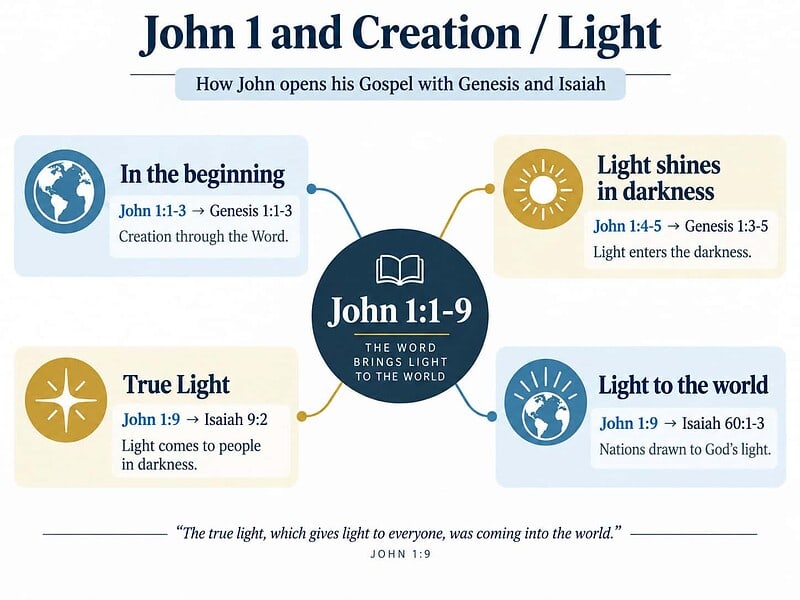
The Light of Genesis Appears Again
John then picks up another huge Genesis theme.
Light.
John 1:4-5 says:
“In him was life; and the life was the light of men.
And the light shineth in darkness; and the darkness comprehended it not.”
Genesis begins with darkness.
“And darkness was upon the face of the deep.”
Then God speaks.
“Let there be light.”
Darkness.
Then light.
Now look at the opening of John.
Darkness.
Then light.
But this time the light isn’t the sun.
It isn’t the moon.
It isn’t a lamp.
The Light is a Person.
John 1:9 says:
“That was the true Light, which lighteth every man that cometh into the world.”
It looks like John is describing something bigger than the original creation.
The God who brought light into the darkness in Genesis is bringing light into darkness again.
Only now the Light has entered the world.
And that brings Isaiah into the picture.
Isaiah 9:2 says:
“The people that walked in darkness have seen a great light.”
Isaiah 60:1 says:
“Arise, shine; for thy light is come, and the glory of the LORD is risen upon thee.”
Darkness.
Light.
Glory.
Those ideas start piling up very quickly in John 1.
The Tabernacle Appears in John 1
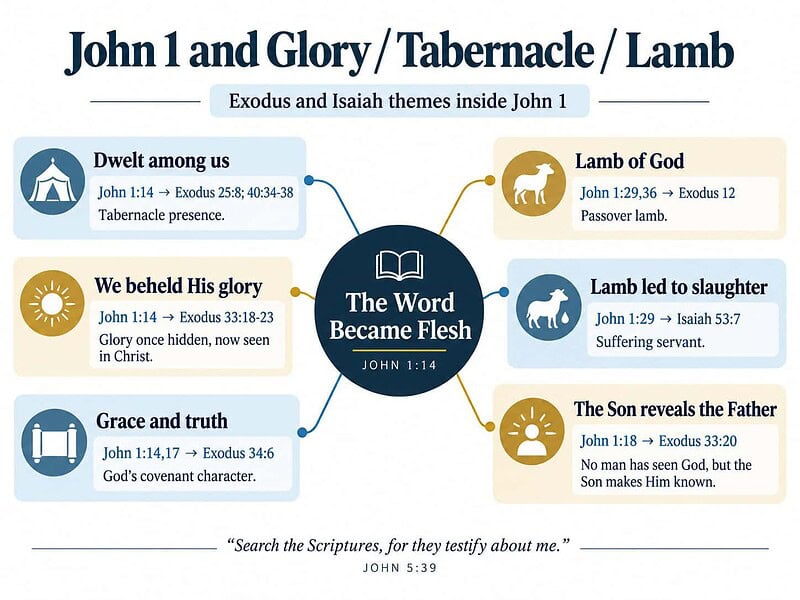
Then we reach John 1:14:
“And the Word was made flesh, and dwelt among us…”
We’ve heard that verse so often that “dwelt among us” can sound like John simply means Jesus lived among people.
That’s true.
But there’s more going on.
The language carries the idea of tabernacling among us.
And once you see that, Exodus comes rushing into John 1.
God said in Exodus 25:8:
“And let them make me a sanctuary; that I may dwell among them.”
Think about Israel travelling through the wilderness.
Right in the middle of their camp stood the tabernacle.
It represented God’s dwelling among His people.
Now John says:
“The Word was made flesh, and dwelt among us.”
God dwelling among His people again.
But now the dwelling place isn’t a tent made from curtains, boards and animal skins.
The Word has become flesh.
And John isn’t finished.
Because the next words are:
“and we beheld his glory…”
Now we’re right back in Exodus again.
Moses Asked to See God’s Glory
In Exodus 33:18 Moses makes an extraordinary request:
“I beseech thee, shew me thy glory.”
Moses wants to see God’s glory.
God answers:
“Thou canst not see my face: for there shall no man see me, and live.”
Exodus 33:20
Moses is placed in the cleft of the rock.
God covers him.
Moses sees only what God allows him to see.
Now come back to John.
“And we beheld his glory…”
Moses said:
“Show me thy glory.”
John says:
“We beheld his glory.”
That’s a massive statement.
John isn’t merely saying Jesus was impressive.
He’s using language filled with the story of Moses and the presence of God.
The Word became flesh.
He tabernacled among us.
And His glory was seen.
Grace and Truth Take Us Back to Exodus 34
John then describes Jesus as:
“full of grace and truth.”
And in John 1:17 he writes:
“For the law was given by Moses, but grace and truth came by Jesus Christ.”
That language should take us back to what happened immediately after Moses asked to see God’s glory.
Exodus 34:6 says:
“And the LORD passed by before him, and proclaimed, The LORD, The LORD God, merciful and gracious, longsuffering, and abundant in goodness and truth.”
Look at the language.
Gracious.
Goodness.
Truth.
Now look at John.
Grace.
Truth.
This isn’t one isolated cross-reference.
A whole Exodus picture is forming.
God dwells among His people.
Moses asks to see God’s glory.
God reveals His character.
Then John tells us:
The Word became flesh.
He dwelt among us.
We beheld His glory.
He was full of grace and truth.
The God Moses Couldn’t See Has Been Revealed
John 1:18 says:
“No man hath seen God at any time…”
We’ve already heard something very similar.
Exodus 33:20:
“Thou canst not see my face: for there shall no man see me, and live.”
But John continues:
“the only begotten Son, which is in the bosom of the Father, he hath declared him.”
Moses couldn’t simply look upon God.
But John says the Son has declared Him.
He has made Him known.
The chapter has now taken us from creation to light, from the tabernacle to glory, from glory to Moses, and from Moses to the revelation of God in Christ.
Isaiah’s Voice Cries in the Wilderness
The scene then changes.
People begin questioning John the Baptist.
Who are you?
Are you the Christ?
Are you Elijah?
Are you that prophet?
John says no.
Then they ask:
“Who art thou?”
John answers in John 1:23:
“I am the voice of one crying in the wilderness, Make straight the way of the Lord…”
And John tells us exactly where that statement comes from.
Isaiah 40:3:
“The voice of him that crieth in the wilderness, Prepare ye the way of the LORD, make straight in the desert a highway for our God.”
This connection is direct.
There’s no guessing involved.
But notice exactly what Isaiah says.
Prepare the way of whom?
The LORD.
Make a highway for whom?
Our God.
John the Baptist says that’s what he’s doing.
He’s the voice preparing the way.
Then Jesus arrives.
That’s a connection worth sitting with for a moment.
Then John Sees the Lamb
John 1:29 gives us another Old Testament picture:
“Behold the Lamb of God, which taketh away the sin of the world.”
We’ve heard “Lamb of God” so often that it’s easy to read straight past it.
But imagine hearing it for the first time.
Why a lamb?
The Old Testament is full of lambs, but one of the greatest lamb stories is the Passover.
Israel is trapped in Egypt.
Judgment is coming.
God tells every household to take a lamb.
Exodus 12:5 says:
“Your lamb shall be without blemish…”
The lamb is killed.
Its blood is placed on the door.
Then God says:
“when I see the blood, I will pass over you…”
Exodus 12:13
A lamb dies.
Blood is shed.
Judgment passes over.
Then John looks at Jesus and says:
“Behold the Lamb of God.”
And he immediately explains what this Lamb will do.
“which taketh away the sin of the world.”
Isaiah Has a Lamb Too
Exodus isn’t the only Old Testament passage sitting behind John’s words.
Isaiah 53:7 says:
“He was oppressed, and he was afflicted, yet he opened not his mouth: he is brought as a lamb to the slaughter…”
A lamb.
Going to slaughter.
And Isaiah has already explained why the Servant suffers.
“But he was wounded for our transgressions, he was bruised for our iniquities…”
Isaiah 53:5
Then:
“the LORD hath laid on him the iniquity of us all.”
Isaiah 53:6
Now put that beside John the Baptist’s words:
“Behold the Lamb of God, which taketh away the sin of the world.”
Suddenly “Lamb of God” carries enormous weight.
Passover.
Sacrifice.
Blood.
Sin.
Substitution.
The suffering Servant.
And John points at Jesus and basically says:
There He is.
Moses Had Written About Someone Coming
Philip later finds Nathanael and says:
“We have found him, of whom Moses in the law, and the prophets, did write, Jesus of Nazareth…”
John 1:45
“Moses in the law.”
Where had Moses written about someone coming?
One obvious connection is Deuteronomy 18:15:
“The LORD thy God will raise up unto thee a Prophet from the midst of thee, of thy brethren, like unto me; unto him ye shall hearken.”
God then says:
“I will raise them up a Prophet from among their brethren, like unto thee, and will put my words in his mouth…”
Deuteronomy 18:18
Israel was waiting for this Prophet.
We can actually see that expectation earlier in John 1 when the priests and Levites ask John the Baptist:
“Art thou that prophet?”
John answers:
“No.”
Why ask the question?
Because Moses had said a Prophet was coming.
So when Philip later says:
“We have found him, of whom Moses in the law, and the prophets, did write…”
John has already prepared us for the possibility.
Could Jesus be the One?
The Son of God and King of Israel
Nathanael then says something remarkable in John 1:49:
“Rabbi, thou art the Son of God; thou art the King of Israel.”
Those two ideas come together beautifully in Psalm 2.
Psalm 2:6 says:
“Yet have I set my king upon my holy hill of Zion.”
Then Psalm 2:7 says:
“The LORD hath said unto me, Thou art my Son…”
King.
Son.
Nathanael says to Jesus:
“thou art the Son of God; thou art the King of Israel.”
The language fits perfectly with the Old Testament expectation of God’s promised King.
But Jesus then tells Nathanael that something even greater is coming.
Jesus Takes Us Back to Jacob’s Ladder
John 1 ends with one of the most fascinating Old Testament connections in the entire chapter.
Jesus says:
“Hereafter ye shall see heaven open, and the angels of God ascending and descending upon the Son of man.”
John 1:51
Where have we seen that picture before?
Genesis 28.
Jacob is travelling.
He stops for the night.
He takes stones for pillows, which has never sounded particularly comfortable, and falls asleep.
Then he dreams.
Genesis 28:12 says:
“And he dreamed, and behold a ladder set up on the earth, and the top of it reached to heaven: and behold the angels of God ascending and descending on it.”
There it is.
Heaven.
Earth.
Angels ascending and descending.
Now listen again to Jesus:
“ye shall see heaven open, and the angels of God ascending and descending upon the Son of man.”
Did you notice what changed?
In Genesis, the angels ascend and descend upon the ladder.
In John, Jesus says they’re ascending and descending upon the Son of Man.
Jesus has put Himself where the ladder was.
That’s huge.
Jacob’s ladder represented the connection between heaven and earth.
Jacob wakes up and says:
“Surely the LORD is in this place; and I knew it not.”
Genesis 28:16
Then:
“this is none other but the house of God, and this is the gate of heaven.”
Genesis 28:17
The meeting place between heaven and earth.
The house of God.
The gate of heaven.
And now Jesus tells Nathanael:
You’re going to see heaven opened.
You’re going to see angels ascending and descending.
But not upon a ladder.
Upon the Son of Man.
Jesus is the meeting place between heaven and earth.
Look at How Much of the Old Testament Is Sitting Inside One Chapter
Now put the whole chapter together.
Genesis gives us creation.
John puts Jesus there.
Genesis gives us light appearing in darkness.
John calls Jesus the true Light.
Exodus gives us the tabernacle where God dwells among His people.
John says the Word became flesh and dwelt among us.
Moses asks to see God’s glory.
John says:
“we beheld his glory.”
God reveals Himself to Moses as gracious and abundant in goodness and truth.
John describes Jesus as:
“full of grace and truth.”
Isaiah says to prepare the way of the LORD.
John the Baptist says he’s that voice.
Then Jesus arrives.
Exodus gives us the Passover lamb.
Isaiah gives us the lamb led to slaughter.
John points to Jesus:
“Behold the Lamb of God.”
Moses says a Prophet is coming.
Philip says:
“We have found him, of whom Moses in the law, and the prophets, did write.”
Psalm 2 gives us God’s Son and God’s King.
Nathanael says:
“thou art the Son of God; thou art the King of Israel.”
Genesis gives Jacob a ladder connecting heaven and earth.
Jesus tells Nathanael that the angels will ascend and descend upon the Son of Man.
That’s a lot of Old Testament for one chapter.
John Isn’t Just Giving Us Facts About Jesus
This might be the biggest thing to notice.
John isn’t simply introducing Jesus by handing us a list of facts.
He’s opening the Old Testament and saying:
Remember creation?
Look at Jesus.
Remember the Light?
Look at Jesus.
Remember the tabernacle?
Look at Jesus.
Remember the glory Moses wanted to see?
Look at Jesus.
Remember the Passover lamb?
Look at Jesus.
Remember Isaiah’s suffering Servant?
Look at Jesus.
Remember the Prophet Moses promised?
Look at Jesus.
Remember God’s promised Son and King?
Look at Jesus.
Remember Jacob’s ladder joining heaven and earth?
Look at Jesus.
All through John 1, these Old Testament pictures keep converging on one Person.
Jesus Christ.
And once you see that, John 1 becomes very hard to read the same way again.
The Old Testament was sitting inside the chapter the whole time.
We just had to know where to look.