The Storm Inside the Man
Jonah thought he could run from the Lord. That thought alone shows how deep his struggle had gone. God had given him a clear word – go to Nineveh, preach repentance, warn them before judgment falls.
But Jonah’s heart was not in step with God’s mercy. He wasn’t afraid of the mission. He was angry about it. He couldn’t bear the thought of God forgiving people he despised. So instead of running toward obedience, he ran toward a ship headed for Tarshish – away from the presence of the Lord.
The sea was calm when he boarded. Maybe Jonah took that as a sign he was in the clear. But peace built on rebellion always has an expiration date. Soon the wind began to rise, the waves crashed harder, and that ship turned into a floating judgment.
Sailors cried out to their gods while Jonah slept below deck, hoping unconsciousness might drown his guilt. But when they cast lots, his secret surfaced. Jonah confessed, “I fear the Lord, the God of heaven, who made the sea and the dry land.” The irony was heavy – he feared the Lord, yet fled from Him.
Swallowed by Consequence
When the sailors tossed Jonah overboard, the sea immediately calmed. The mercy that Jonah resisted now spared others. But Jonah sank lower and lower, swallowed by waters that mirrored his spiritual collapse. Then came the creature God had prepared – a great fish, not to destroy him, but to keep him alive in the dark.
Inside that belly, the sound of the waves became the rhythm of regret. The smell of decay matched his shame. Seaweed wrapped around his head like a crown of consequence.
For three days and nights, Jonah faced himself and the God he’d tried to escape. He was buried in the deep, cut off from the world, trapped between death and life. And yet – even there – God heard him.
Jonah prayed, “Out of the belly of hell cried I, and Thou heardest my voice.” He remembered the Lord. That’s where repentance always starts – not with perfect words, but with remembering who God is when you’ve forgotten who you were called to be.
The Turning Point in the Deep
Jonah’s prayer wasn’t poetic. It was raw. It was the cry of a man who’d run out of places to hide. “When my soul fainted within me, I remembered the Lord: and my prayer came in unto Thee, into Thine holy temple.”
That was the moment heaven moved. The same God who sent the storm now commanded the fish to release him.
Jonah was spit onto dry land, drenched in mercy, covered in seaweed and grace. He had been buried and resurrected in the belly of regret – a foreshadowing of another who would spend three days in the depths for mankind’s salvation.
Jonah stumbled onto the shore not as a perfect prophet but as a living testimony that you can’t outrun the purpose of God.
Obedience Restored
When the word of the Lord came to Jonah a second time, the tone was the same, but the man was different. Brokenness had softened his resistance. He rose and went to Nineveh, this time without detours.
His message was short and sharp – “Yet forty days, and Nineveh shall be overthrown.” No clever phrasing, no emotion – just truth delivered by a man who’d been swallowed by it.
And then the unthinkable happened. The people believed God. From the king to the beggar, they fasted, mourned, and repented. Even the animals were clothed in sackcloth.
Jonah’s reluctant obedience became the spark of the greatest revival in the Old Testament. God saw their repentance and turned away His wrath. Heaven celebrated mercy. But Jonah? He sat outside the city, angry again, frustrated that grace reached people he thought didn’t deserve it.
A Lesson in Mercy
Under the shade of a vine God had prepared, Jonah sulked. When that vine withered, he complained. God used that moment to expose the narrowness of Jonah’s heart. “Doest thou well to be angry?” the Lord asked.
Jonah pitied a plant more than souls. The Lord replied, “Should not I spare Nineveh, that great city, wherein are more than sixscore thousand persons that cannot discern between their right hand and their left hand?”
God’s final words hung in the air – a question without an answer. It’s as if He wanted Jonah, and us, to wrestle with it. How can we receive mercy so freely and yet resist giving it to others?
Jonah’s story ends without resolution, but maybe that’s the point. Repentance is never a one-time event. It’s a posture of heart – an ongoing turning toward God even when He leads us somewhere we don’t want to go.
Reflection and Modern Connection
Every believer has a bit of Jonah in them. We all have moments when we know exactly what God wants and still board a ship in the opposite direction. Maybe it’s forgiving someone who hurt us, stepping out in faith when it’s easier to stay safe, or speaking truth when silence feels comfortable. The journey of Jonah reminds us that God doesn’t abandon His people when they run – He pursues, corrects, and restores.
Sometimes the “fish” in our lives isn’t punishment – it’s preservation. The dark, smelly places where we feel forgotten are often the womb of transformation. God allows us to sit in the discomfort of our own choices so that when He delivers us, we come out not just alive but changed.
And when we finally obey, even half-heartedly at first, God still moves. His mercy doesn’t depend on our perfection; it flows from His compassion. Jonah’s second chance wasn’t just for him – it was for an entire city waiting to hear that God still forgives.
Closing Parallels to Christ
Centuries later, Jesus referenced Jonah when speaking to those who doubted Him. “As Jonah was three days and three nights in the whale’s belly; so shall the Son of man be three days and three nights in the heart of the earth.” Jonah’s descent into the deep was a shadow of the ultimate descent – the Son of God entering death itself to bring life to the lost.
Jonah’s deliverance pointed forward to resurrection power. The difference was motive: Jonah ran from sinners; Jesus ran toward them. Jonah sat outside a city angry at grace; Jesus wept over Jerusalem longing to save. Jonah’s story ended in frustration, but Christ’s ended with an empty tomb and eternal hope.
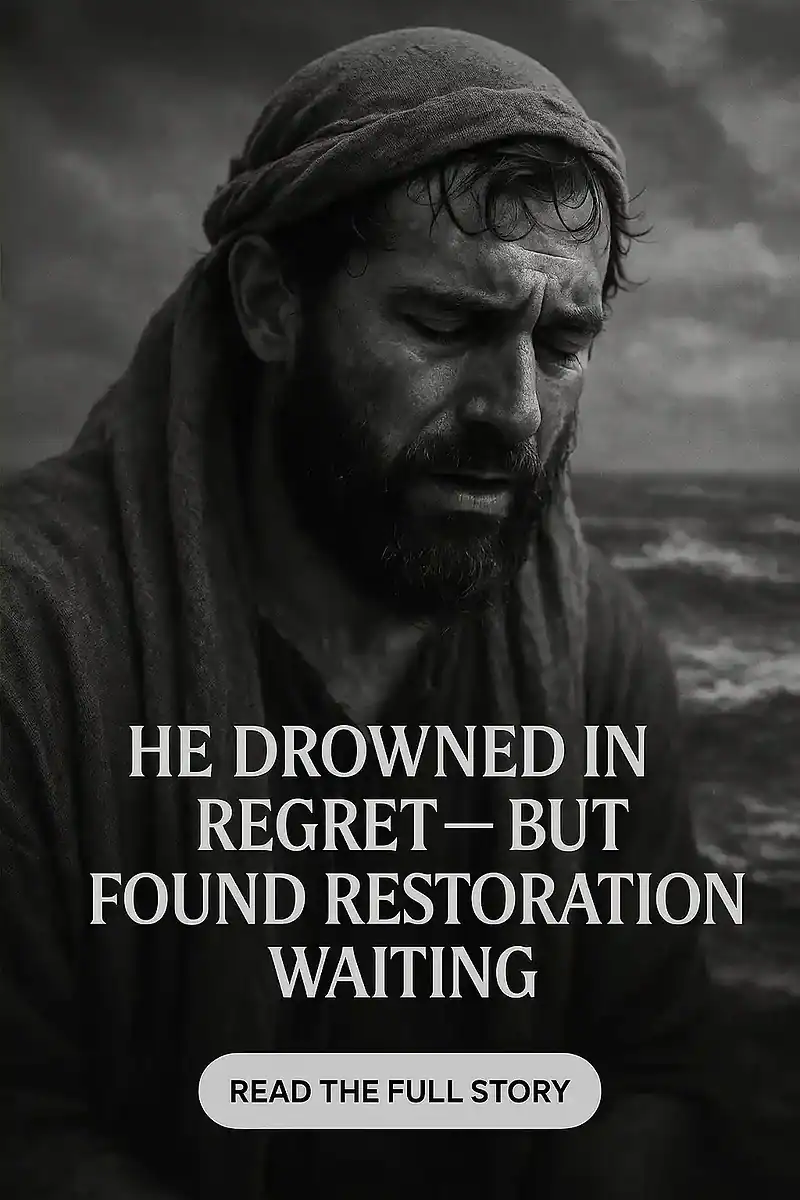
The man who drowned in regret found restoration waiting on the shore – and that same mercy still waits for every heart that turns back toward the Lord.
Scripture References:
Jonah 1–4; Matthew 12:40; Psalm 139:7–10.
MANIFESTO – HE DROWNED IN REGRET, BUT FOUND RESTORATION WAITING
Jonah’s Repentance
There’s no distance too far for the reach of God’s mercy. Jonah tried. He bought a ticket to rebellion, boarded a ship of excuses, and sailed straight into a storm of his own making. He didn’t just flee a city – he fled the call, the responsibility, the heart of God Himself. And yet, even there, grace pursued him.
This is for every believer who’s ever run in the wrong direction and found themselves swallowed by consequences. For the one who feels stuck in the belly of regret, surrounded by darkness that smells like failure. You may feel forgotten, but God has already prepared your rescue. The same storm that exposed your disobedience is the one steering you back toward purpose.
Repentance is not punishment – it’s invitation. It’s God saying, “Let’s start again.” Jonah’s story proves that restoration doesn’t wait until you’re cleaned up; it meets you in the mess. He was a prophet covered in seaweed and shame, yet he was still God’s messenger. And when he obeyed, revival broke out among the least likely people.
This is the mercy of the Lord – He doesn’t discard runners; He redeems them. He doesn’t waste failure; He repurposes it. The God who sent the storm also sent the fish, the shore, and the second chance.
So if you’re tired of running, stop. If you’re drowning in regret, call out. If you’re buried in consequences, look up. The same God who met Jonah in the deep still meets His children today. Mercy is not a myth – it’s a Person. And He’s already waiting on the shore.
Let this be our declaration: we will no longer run from the presence of the Lord but into it. We will rise from our regret and walk in restoration. We will speak the message we once resisted and trust that God’s mercy still works wonders – even through imperfect people like us.
Because the story of Jonah isn’t about the man who ran away.
It’s about the God who never gave up running after him.
Call to Action: The Question That Demands an AnswerIn Acts 2:37 Peter and the Apostles were asked the question – What Shall We do? And in Acts 2:38 Peter answered, Repent, and be baptized every one of you in the name of Jesus Christ for the remission of sins, and ye shall receive the gift of the Holy Ghost. For the promise is unto you, and to your children, and to all that are afar off, even as many as the Lord our God shall call. Do you understand this? After hearing the gospel and believing, they asked what should would do. The answer hasn’t changed friend, Peter clearly gave the answer. The question for you today is, Have you receieved the Holy Spirit Since you believed? If you’re ready to take that step, or you want to learn more about what it means to be born again of water and Spirit, visit: Come, and let the Spirit make you new. |