A Stranger Before the Judgment Seat
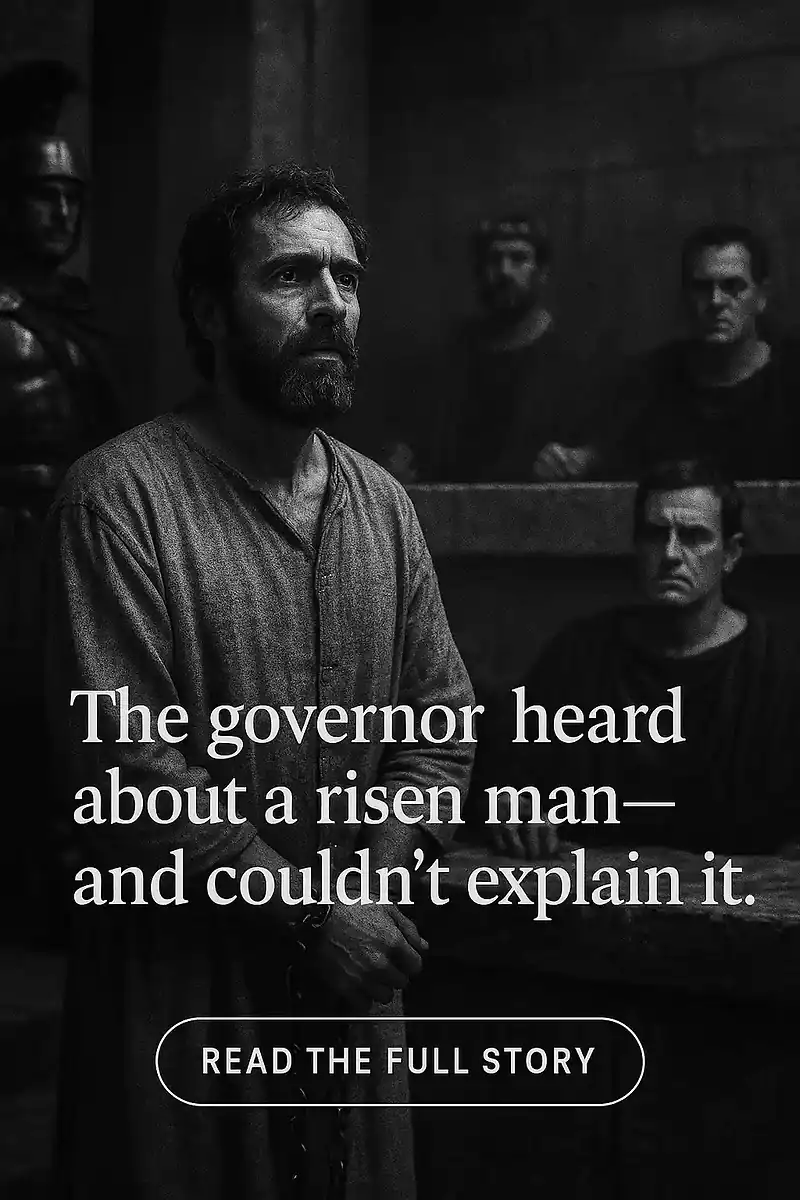
He’d heard strange cases before – but none like this. The governor, Porcius Festus, had seen men plead for money, mercy, and power. But never resurrection.
When Paul the prisoner was brought before him, bound in chains yet standing with a calm that unsettled the room, Festus realized this was no ordinary trial. The man spoke not in defense, but in testimony. It wasn’t about rebellion or law – it was about life after death.
Jerusalem was still restless. Rumors of uprisings and prophets floated like dust in the heat. Rome demanded order, not philosophy. But Paul’s accusers weren’t seeking justice; they wanted silence.
They shouted about a man named Jesus who had died – and whom Paul declared to be alive. Festus felt the ground shift beneath his logic. How do you judge a man for believing someone rose from the dead?
He sat back, robe heavy on his shoulders, eyes searching for reason. Paul’s words were measured, his tone unshaken. “Why should it be thought a thing incredible that God should raise the dead?” The question hung in the air like a spark that wouldn’t die out.
Rome’s New Governor Meets an Old Faith
Festus had only recently taken his post, inheriting a province ripe with religious tension. Judea wasn’t an easy appointment – too much faith, too little reason, and every man convinced his God would prove him right.
When the chief priests came accusing Paul, Festus assumed it was political. But as he listened, it became clear this wasn’t about empire. This was about eternity.
Paul spoke of visions, of a voice on the road to Damascus, of being blinded and healed by a light brighter than the sun. Festus’s pen paused midair. This wasn’t the language of deceit – it was the confession of a man convinced he’d met God. Yet Festus, a Roman skeptic, didn’t know what to do with such certainty.
He tried to keep the peace, to play the diplomat. He offered to send Paul back to Jerusalem for trial, but Paul’s eyes didn’t waver. “I stand at Caesar’s judgment seat,” he said. “To the Jews I have done no wrong.” Then came the moment that changed everything: “I appeal unto Caesar.”
The room went still. Festus nodded slowly, masking his relief. The case was off his hands – or so he thought.
A King, A Queen, And A Question
Days later, Festus received visitors: King Agrippa and his sister Bernice. They came with pomp – trumpets, purple robes, gold-threaded banners – but Festus saw in Agrippa a man who understood these religious disputes better than he ever could. He wasted no time explaining Paul’s case.
“There’s a man left prisoner by Felix,” Festus said. “The accusers brought no crime against him as I supposed – but only questions of their own superstition, and of one Jesus, which was dead, whom Paul affirmed to be alive.”
Agrippa’s brows lifted slightly. He’d heard of this Jesus. The stories hadn’t died with the crucifixion. Curiosity stirred, and Agrippa said, “I would also hear the man myself.”
The next day, the hall was filled with ceremony – soldiers in armor, officials in white, the faint smell of incense. Paul stood among them, a prisoner surrounded by power, yet freer than them all. When Agrippa invited him to speak, Paul didn’t beg. He preached.
The Testimony That Shook a Throne Room
Paul’s voice carried across marble walls as he told of his former life – how he’d once hunted believers, how he’d seen a light and heard a voice saying, “I am Jesus whom thou persecutest.” He spoke of repentance, of turning from darkness to light, and of the hope promised by the prophets.
Festus listened at first with curiosity, then unease. Every word pulled him deeper into a story that didn’t fit Roman categories. When Paul spoke of Christ’s suffering and resurrection, Festus could take no more. “Paul, thou art beside thyself; much learning doth make thee mad!”
But Paul turned toward him, eyes steady. “I am not mad, most noble Festus,” he said, “but speak forth the words of truth and soberness.”
The hall fell quiet. Festus glanced at Agrippa, hoping for reason, but the king’s expression was unreadable. Paul continued, saying the prophets had foretold these things, that Christ should suffer and rise again.
Something in Festus’s chest tightened. He didn’t understand this kind of conviction. He’d seen power, pride, ambition – but never peace like this.
The Unsettled Judge
When Paul finished, Agrippa leaned back and said softly, “Almost thou persuadest me to be a Christian.” Festus didn’t laugh. He didn’t mock. He only shifted in his seat, troubled.
They left the chamber soon after. The torches flickered as soldiers escorted Paul away, his chains catching the light like silver threads. Festus stood silent. Agrippa turned to him and said, “This man might have been set at liberty, if he had not appealed unto Caesar.”
Festus nodded, but his thoughts were elsewhere. He had judged men for theft, murder, and rebellion. But this man – this Paul – was being judged for hope.
The Night After the Trial
That night, Festus sat alone in his quarters. The laughter of soldiers echoed faintly down the hall, but he couldn’t join them. On his table lay scrolls and wax tablets, but his mind replayed Paul’s words. “Why should it be thought incredible that God should raise the dead?”
He tried to dismiss it, to shake off the weight of it. But the question followed him like a shadow. Rome had its gods, its rituals, its philosophies – but none offered the certainty Paul carried.
Festus wasn’t converted. Not that night. Maybe not ever. But something shifted. The idea of resurrection – of a man who died and lived again – refused to die in his mind.
Reflection – When Logic Meets Faith
Festus represents the mind that wants to believe but can’t yet let go of control. He saw the truth standing before him and still labeled it madness. Isn’t that like us sometimes? We demand evidence, signs, certainty – while ignoring the quiet proof that God is already at work.
Paul’s boldness before power reminds us that the gospel isn’t confined to pulpits or temples. It enters judgment halls, boardrooms, and hearts unprepared to receive it. Sometimes the miracle isn’t that someone believes immediately – but that the seed of truth is planted at all.
God doesn’t waste encounters. Festus didn’t leave converted, but he left changed. And so do we, when we dare to listen to the impossible and let it question our unbelief.
Closing Parallels – The Judge Who Heard the Truth
Festus heard about a risen man and walked away puzzled. Today, the world still sits in judgment of Jesus, trying to reason out what only faith can grasp. The resurrection remains God’s greatest paradox – beyond logic, yet undeniable in power.
Paul stood before a governor and spoke of life beyond death. Centuries later, we stand before the same truth: the tomb is empty, and the King still lives.
Faith begins where reason ends. Festus judged the case – but God was judging hearts.
And somewhere in eternity, that quiet question still echoes through every courtroom, every skeptic’s soul, every restless night of searching: “Why should it be thought incredible that God should raise the dead?”
MANIFESTO: THE WORLD CALLS IT MADNESS – GOD CALLS IT FAITH
The world says faith makes no sense. It tells us to see before we believe, to measure before we move, to analyze before we trust. It mocks conviction as foolish and calls truth “a matter of opinion.” But God’s Word flips the whole thing on its head. Faith doesn’t start with sight – it creates sight. It’s the lens that lets us see what reason alone never could.
The world tells us to protect our comfort, climb for power, and chase the applause of men. But the Lord says, “He that findeth his life shall lose it, and he that loseth his life for my sake shall find it.” The world builds thrones out of ego. God builds kingdoms out of surrender. Festus sat in judgment that day, thinking Paul was the prisoner – but in God’s courtroom, the chains were reversed. Paul was free. Festus was bound by unbelief.
The world says, “Keep your options open.” God says, “Follow Me.” The world says, “Play it safe.” God says, “Step out of the boat.” The world says, “Trust your heart.” God says, “Your heart is deceitful – trust Mine.” And in every generation, those who take God at His Word are labeled “mad” by those who can’t imagine heaven breaking into earth.
Yet faith keeps standing. Faith keeps speaking. Faith keeps shining when the lights of reason go out. Because truth isn’t up for debate – it’s already been declared. The tomb is empty. The King is alive. And every earthly ruler, every skeptic, every modern Festus will one day bow before the name of Jesus.
We don’t serve a theory. We serve the risen Lord.
We don’t preach a philosophy. We preach the power of God unto salvation.
We don’t live by logic alone – we live by the Word that spoke light into darkness.
Let the world call it madness. We’ll call it what heaven calls it – faith.
Praise be to the Lord, who opens blind eyes, softens hard hearts, and still raises the dead.
Call to Action: The Question That Demands an AnswerIn Acts 2:37 Peter and the Apostles were asked the question – What Shall We do? And in Acts 2:38 Peter answered, Repent, and be baptized every one of you in the name of Jesus Christ for the remission of sins, and ye shall receive the gift of the Holy Ghost. For the promise is unto you, and to your children, and to all that are afar off, even as many as the Lord our God shall call. Do you understand this? After hearing the gospel and believing, they asked what should would do. The answer hasn’t changed friend, Peter clearly gave the answer. The question for you today is, Have you receieved the Holy Spirit Since you believed? If you’re ready to take that step, or you want to learn more about what it means to be born again of water and Spirit, visit: Come, and let the Spirit make you new. |