The Empire of Gold and Glass
The palace of Shushan shimmered under the Persian sun, its marble pillars reflecting the light like mirrors of wealth and power. It was a place where everything glittered – golden goblets, silver couches, and curtains of fine linen fastened with purple cords.
King Ahasuerus, known also as Xerxes, ruled from India to Ethiopia, over a hundred and twenty-seven provinces. When he threw a feast, the whole world seemed invited. His kingdom was a monument to excess, and his word was law.
For six months he displayed his glory to princes and nobles, a living spectacle of pride. The wine flowed freely, and the laughter echoed through the halls. Yet beneath the splendor lay something hollow.
Ahasuerus had everything but contentment. His feasts masked a restless heart that sought validation in applause and authority. The man who could command armies could not command peace within his own walls.
A Queen’s Refusal
Queen Vashti, beautiful and dignified, held her own banquet for the women. When the king, flushed with wine and ego, demanded her presence before his drunken court to display her beauty, she refused.
It was a simple word, but it shook the empire. In that defiance, Vashti exposed what no one dared to say – that the king’s glory was fragile, built on pride more than power.
Ahasuerus’ pride burned hotter than his temper. His advisors, fearing rebellion in every household, urged him to make an example. “Let the king give her royal estate unto another that is better than she.”
So Vashti was banished, and her name became a whisper in the palace halls. The decree went out across the empire: every man should rule in his own house. Yet behind the king’s authority lingered the sting of rejection. The banquet king, surrounded by admirers, sat alone with his pride and his regret.
The Search for a New Crown
In time, his anger cooled, but the emptiness remained. The courtiers saw it and suggested a plan – a search for a new queen. From every corner of the empire, young women were brought to Shushan, prepared with perfumes and oils for twelve long months before they could even stand before the king.
Among them was a young Jewish woman named Hadassah, called Esther. She was an orphan, raised by her cousin Mordecai, a man of quiet conviction who feared God more than the king. Esther’s beauty was striking, but her heart was humble. When she entered the palace, she carried not ambition but grace – an inner strength that came from faith, not favor.
And the king, who had tasted every luxury and still found none satisfying, saw something in her that calmed the storm within him. Esther found favor in his eyes, and he set the royal crown upon her head.
The empire celebrated, yet heaven was preparing a story far beyond any human feast – a story where courage would confront decree and faith would confront fear.
The Shadow Over Shushan
Not long after Esther’s coronation, another man rose to power: Haman, proud and cunning, elevated above all the princes. When Mordecai refused to bow to him at the king’s gate, Haman’s pride turned to hatred – not just for Mordecai, but for all the Jews scattered through the empire.
With deception cloaked in loyalty, Haman approached the king and said, “There is a certain people scattered abroad… their laws are different from all others. It is not for the king’s profit to tolerate them.”
Ahasuerus, trusting Haman’s counsel, handed him his signet ring – the symbol of royal authority – and with one careless gesture, sealed the fate of an entire people. Letters went out with the king’s seal, declaring that all Jews – young and old, men and women – were to be destroyed.
The city of Shushan fell into confusion, but the king and Haman sat down to drink. The banquet king once again sought comfort in wine while an empire trembled under his decree.
The Silent Queen Breaks Her Silence
When Mordecai learned of the decree, he tore his clothes and sat in ashes at the gate. Through messengers, he urged Esther to plead for her people. But fear gripped her heart. “All the king’s servants know,” she said, “that whoever shall come unto the king into the inner court, who is not called, there is one law – to put him to death.”
Then came Mordecai’s challenge that would echo through generations: “Who knows whether you are come to the kingdom for such a time as this?”
Esther’s hesitation turned into holy resolve. She called for a fast, saying, “Go, gather all the Jews… fast for me, neither eat nor drink three days. I also and my maidens will fast likewise. And so will I go unto the king, which is not according to the law, and if I perish, I perish.”
The Courage to Step In
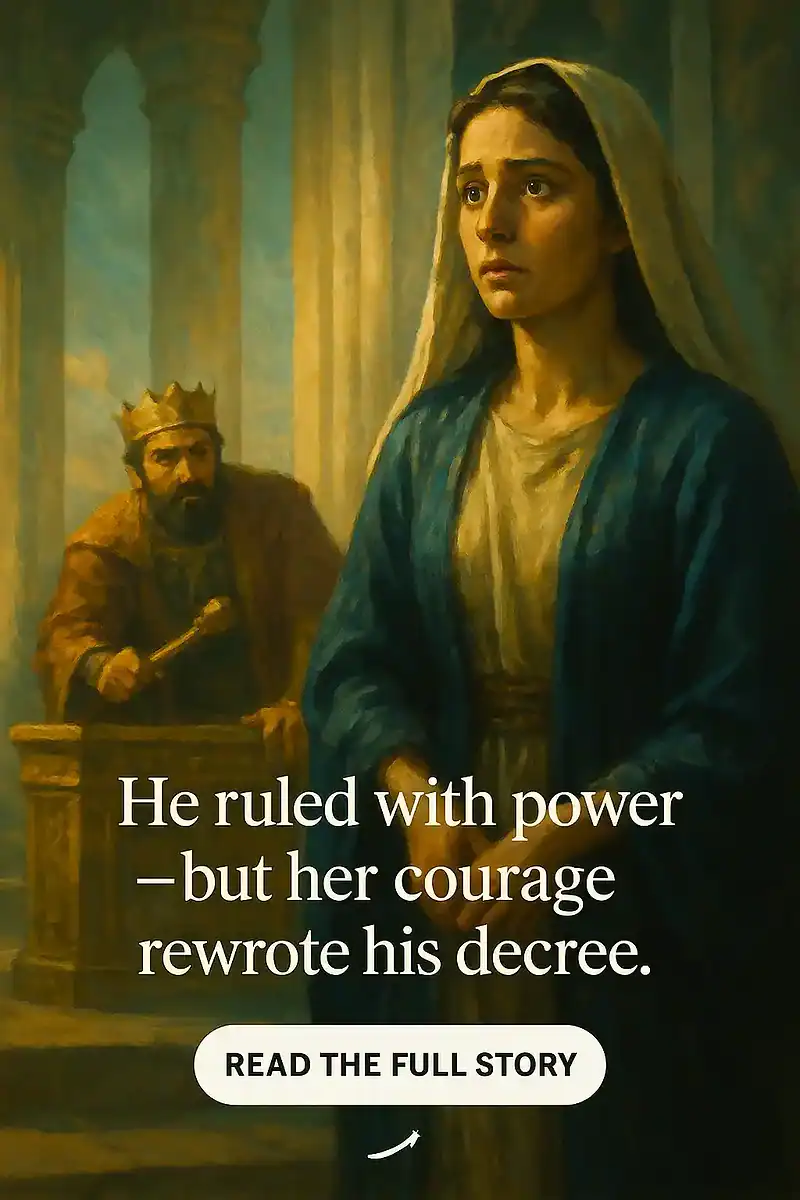
Three days later, Esther stood in the royal court. Her heart pounded as she faced the throne, but her faith was louder than her fear. Ahasuerus looked upon her – and instead of wrath, his eyes softened. He held out the golden scepter. Grace triumphed over law. “What wilt thou, Queen Esther? And what is thy request? It shall be given thee to the half of the kingdom.”
She did not rush. Wisdom led her steps. “If it seem good unto the king, let the king and Haman come this day unto the banquet that I have prepared.” She met the decree of destruction with a banquet of deliverance.
The Banquet of Revelation
At the first feast, Esther remained silent. Timing matters in God’s plan, and her patience was divine strategy. That night, the king could not sleep. He called for the book of records and found written how Mordecai had once saved his life.
Meanwhile, Haman was building a gallows for Mordecai. The prideful man plotted death, unaware that his own downfall was already written by an unseen hand.
At the second banquet, Esther revealed her secret. “We are sold, I and my people, to be destroyed.” The king’s face changed. “Who is he, and where is he, that durst presume in his heart to do so?” Esther’s words pierced the room: “The adversary and enemy is this wicked Haman.”
The banquet king, who once gave careless decrees, now issued one fueled by justice. Haman was hanged on the very gallows he built for Mordecai. The house of the proud became the inheritance of the humble.
The Decree Reversed
But the law of the Medes and Persians could not be revoked. Once written, it could not be undone. Yet the same king who once sealed death now gave his ring to Mordecai to write life. New letters went out, authorizing the Jews to defend themselves. The day meant for their destruction became a day of victory. Mourning turned to joy.
Esther’s courage didn’t just save her people – it redeemed the very system that once condemned them. The banquet king’s name, once tied to pride and rashness, became linked to mercy and deliverance through the faith of a queen who believed God’s timing was greater than fear.
The Reflection: When Power Meets Purpose
It’s a strange thing – how God can use a man like Ahasuerus. The same king who ruled with indulgence became an instrument of deliverance. His decrees framed disaster, but God wrote redemption between the lines. We often forget that God can use the imperfect, even the reckless, to move His perfect plan forward.
And Esther – she reminds us that courage often looks quiet before it becomes public. She didn’t start brave; she became brave by trusting the God who placed her where she was. Every believer who’s ever felt afraid to speak, afraid to stand, finds a mirror in her story. God doesn’t need perfect confidence – He needs surrendered hearts.
The Final Parallels: A Greater King and a Greater Intercessor
Ahasuerus extended a golden scepter to one trembling woman. Christ extends His pierced hands to a trembling world. Esther risked her life to intercede for her people. Christ gave His life to redeem His own. The king’s favor was limited to half the kingdom; Christ offers the fullness of heaven.
In the grand story, Ahasuerus’ throne fades, but the mercy shown through Esther points forward to a King whose decrees bring life everlasting.
And so we stand, not in the courts of Persia, but before the throne of grace – where the scepter is always extended, and mercy is never denied.
MANIFESTO: WHEN GOD MOVES THROUGH IMPERFECT KINGS AND BRAVE QUEENS
The story of Ahasuerus and Esther is a mirror for every believer who’s ever wondered if God can work through chaos, pride, or pain. Look closely – you’ll see it.
The mighty king who once ruled by ego became part of a divine rescue plan he didn’t even understand. The orphaned girl, hidden behind palace walls, became the voice of courage the world needed. And through both, God wrote redemption across a pagan empire.
This story shouts a truth that should steady our hearts: God’s sovereignty doesn’t depend on the goodness of men but on His own unshakable will. He weaves purpose through imperfect people, through flawed leaders and fearful servants, through decrees written in arrogance and prayers whispered in trembling faith.
The same hand that guided a crown onto Esther’s head guided the pen that reversed the decree of death. Nothing escapes His reach.
When life feels ruled by the proud or when fear tempts you into silence, remember this – Esther didn’t have certainty, she had calling.
She didn’t have control, she had courage. Her “if I perish, I perish” wasn’t resignation; it was faith unafraid of consequence. And Ahasuerus? His transformation reminds us that even the proudest heart can bend when God’s timing collides with purpose.
So let this be our confession:
We believe God still turns banquets into battlegrounds of faith.
We believe one obedient act of courage can change generations.
We believe His providence reaches into palaces and prisons alike.
And we believe no decree – political, spiritual, or personal – can override what God has ordained.
We live not by the whims of kings but by the Word of the King of Kings.
We rise when called, speak when afraid, and trust when we can’t see the end.
Because like Esther, we were brought into the kingdom for such a time as this.
Call to Action: The Question That Demands an AnswerIn Acts 2:37 Peter and the Apostles were asked the question – What Shall We do? And in Acts 2:38 Peter answered, Repent, and be baptized every one of you in the name of Jesus Christ for the remission of sins, and ye shall receive the gift of the Holy Ghost. For the promise is unto you, and to your children, and to all that are afar off, even as many as the Lord our God shall call. Do you understand this? After hearing the gospel and believing, they asked what should would do. The answer hasn’t changed friend, Peter clearly gave the answer. The question for you today is, Have you receieved the Holy Spirit Since you believed? If you’re ready to take that step, or you want to learn more about what it means to be born again of water and Spirit, visit: Come, and let the Spirit make you new. |