Fear has a smell. In the royal courts of Moab, it smelled like dust, sweat, and the sour tang of panicked whispers. King Balak, son of Zippor, was paralyzed by it.
He wasn’t a coward by nature, but what he saw from his high walls wasn’t a skirmish; it was a sea. A moving, breathing, consuming sea of people – the children of Israel. They were camped on his doorstep, having just finished utterly destroying the Amorites.
Balak and his people, the Moabites, watched this endless swarm of tents and livestock, and the Bible tells us they “were sore afraid… and Moab was distressed because of the children of Israel.” (Numbers 22:3)
Distress is a mild word for it. This was existential terror. Balak knew his armies were no match. His diplomacy was useless. When military and political power fails, a king has only one option left: spiritual power.
He needed to curse them. And to do that, he needed the best.
He needed Balaam.
The Prophet for Hire
Balaam, son of Beor, wasn’t an Israelite. He lived hundreds of miles away in Pethor, by the Euphrates river. But his reputation was legendary. He was a man who talked to the divine, a prophet for hire whose words had weight. The word on the street was simple: “for I know that he whom you bless is blessed, and he whom you curse is cursed.” (Numbers 22:6)
So Balak assembled a delegation of his most important elders, loaded them up with “the rewards of divination” (a hefty bag of cash), and sent them on the long journey.
When they arrived, Balaam played the part of the spiritual man. He housed them, listened to their king’s desperate request, and said, “Lodge here this night, and I will bring you word again, as the LORD shall speak unto me.” (Numbers 22:8)
That night, God did come to Balaam. And His message was not ambiguous. It was a brick wall. “You shall not go with them; you shall not curse the people: for they are blessed.” (Numbers 22:12)
Simple enough, right?
Balaam returned to the princes, put on his ‘regretful’ face, and told them, “The LORD refuses to give me leave to go with you.” He sent them away. But you can almost hear the unspoken tension. Balaam, a man who clearly liked wealth and prestige, just had to turn down the payday of a lifetime.
Balak, being a king, didn’t understand “no.” He only understood “not enough.” He assumed Balaam’s price was just higher. So, he sent more princes, more honorable princes, with a blank check. “Let nothing, I pray you, hinder you from coming to me: for I will promote you unto very great honor, and I will do whatever you say to me: come therefore, I pray you, curse me this people.” (Numbers 22:16-17)
This was the real test. And Balaam… failed.
He should have said, “God already told me no. They are blessed. Get out.” Instead, he gave a pious-sounding speech that was really a negotiation. “If Balak would give me his house full of silver and gold, I cannot go beyond the word of the LORD my God, to do less or more.” (Numbers 22:18) It sounds good, but then he says, “Now therefore, I pray you, tarry you also here this night, that I may know what the LORD will say unto me more.”
He was asking God again, hoping for a different answer. He was trying to get God to change His mind, just so he could get that paycheck.
This time, God’s answer was different. And terrifying. “If the men come to call you, rise up, and go with them; but yet the word which I shall say unto you, that shall you do.” (Numbers 22:20)
It was a “yes,” but it was the kind of “yes” a parent gives when they know the child is about to learn a very hard lesson. God would permit him to go, but He would not change the message.
The Donkey and the Angel
Balaam was thrilled. He saddled his donkey at the crack of dawn, ready to go get his promotion. He thought he’d won. He thought he’d successfully manipulated the God of the universe.
And “God’s anger was kindled because he went.” (Numbers 22:22)
This is one of the most cinematic, humbling, and frankly wild moments in the whole Bible. Balaam, the great spiritual seer, is riding down the path, and the Angel of the LORD stands in the way, sword drawn.
But Balaam, his eyes blinded by greed and ambition, doesn’t see a thing.
His donkey does.
The donkey, seeing a celestial being with a sword of judgment, veers off the path into a field. Balaam, annoyed, beats the donkey to get it back on the road.
They continue. The Angel moves to a narrow path between two vineyard walls. The donkey, with nowhere to turn, presses itself against the wall, crushing Balaam’s foot. Balaam, in a rage, beats the donkey again.
Finally, the Angel moves to a place so narrow there is no room to turn left or right. The donkey, seeing the impasse, simply lays down in the dirt.
Balaam loses it. His ‘divine’ payday is being ruined by this stubborn animal. He beats the donkey with his staff.
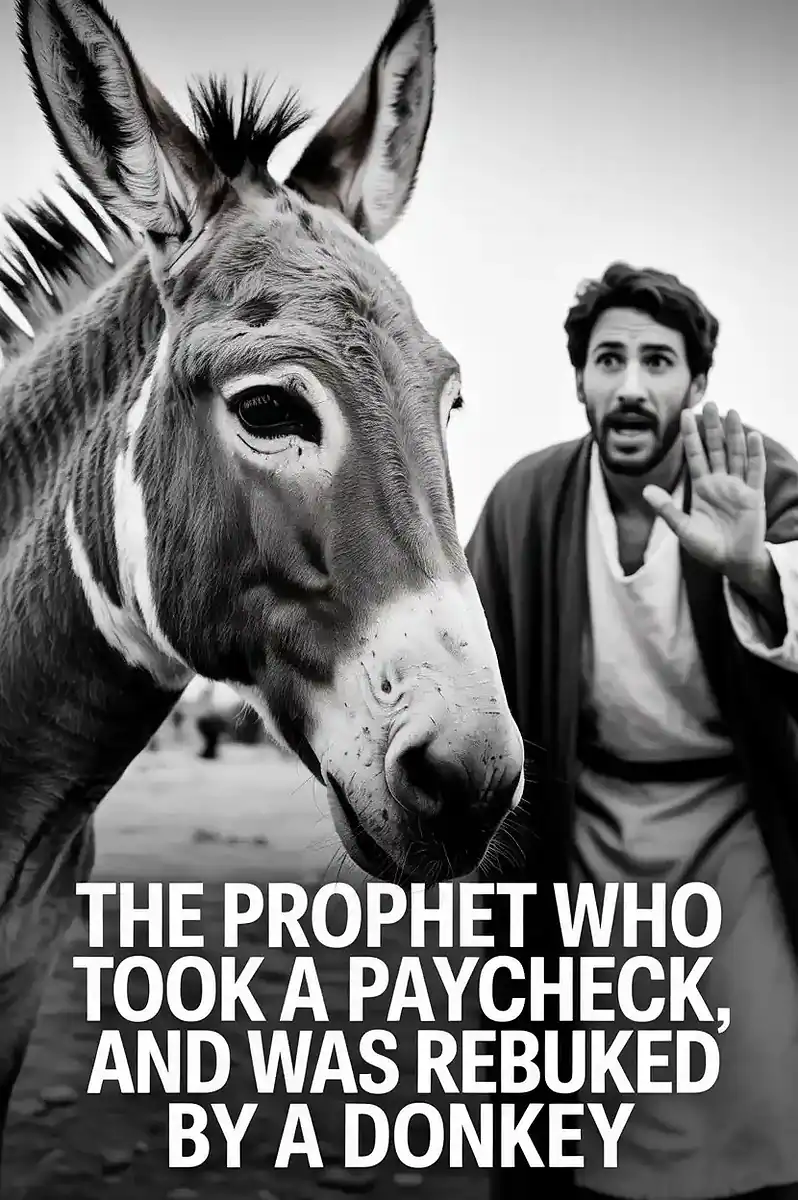
And then the LORD opened the mouth of the donkey.
“What have I done to you, that you have smitten me these three times?” (Numbers 22:28)
We often gloss over this, but imagine. Imagine the sheer, mind-bending shock. And what’s crazier? Balaam answers back! He’s so consumed by his own rage that he argues with his transportation. “Because you have mocked me! I wish there were a sword in my hand, for now I would kill you!” (Numbers 22:29)
The donkey, with perfect, simple logic, replies, “Am I not your donkey, upon which you have ridden ever since I was yours unto this day? Was I ever wont to do so unto you?”
And Balaam, breathless, has to admit… “No.”
In that moment, “the LORD opened the eyes of Balaam, and he saw the Angel of the LORD standing in the way, and his sword drawn in his hand.” (Numbers 22:31)
The great prophet falls on his face. The Angel’s rebuke is scathing. “Why have you smitten your donkey these three times? Behold, I went out to withstand you, because your way is perverse before me.” The Angel tells him flat-out that if the donkey hadn’t turned aside, “surely now also I would have slain you, and saved her alive.”
The donkey was more spiritually aware than the prophet. The animal saw the divine, while the man saw only the paycheck. It was the ultimate humiliation, and it was exactly what Balaam needed. He was broken. Terrified and humbled, he finally understood. He was not in charge.
“Go with the men,” the Angel commands, “but only the word that I shall speak unto you, that you shall speak.” (Numbers 22:35)
Three Mountains, Three Blessings
When Balaam finally arrives, King Balak is relieved. He rushes out to meet him. “Let’s get to the cursing!”
Balaam, no longer the swaggering prophet-for-hire, gives him a warning. “Lo, I am come unto you: have I now any power at all to say any thing? The word that God puts in my mouth, that shall I speak.” (Numbers 22:38) Balak doesn’t care. He’s a man of ritual. He just needs to go through the motions.
Attempt #1: The High Places of Baal
Balak takes Balaam to a high place overlooking the edge of the massive Israelite camp. “Maybe if you only see a part of them, it’ll be easier to curse,” he reasons.
They build seven altars. They sacrifice seven bulls and seven rams. The air is thick with smoke and the smell of blood. Balak is vibrating with anticipation.
Balaam goes aside to “meet the LORD.” When he returns, his face is set. Balak leans in.
Balaam opens his mouth, and a poem, a prophecy, a blessing pours out.
“How shall I curse, whom God has not cursed? Or how shall I defy, whom the LORD has not defied? …Let me die the death of the righteous, and let my last end be like his!” (Numbers 23:8, 10)
Balak is horrified. “What have you done to me! I took you to curse my enemies, and, behold, you have blessed them altogether!” (Numbers 23:11)
Balaam just shrugs. “Must I not take heed to speak that which the LORD has put in my mouth?”
Attempt #2: The Field of Zophim
Balak is sweating now. “It’s the location! Bad location. Let’s try another place.”
He drags Balaam to the top of Mount Pisgah. More altars (seven). More sacrifices (seven bulls, seven rams). More smoke. More tension.
Again, Balaam goes. Again, he returns. Balak, desperate, searches his face. “What has the LORD spoken?”
This time, the blessing is even stronger. It’s a thunderclap of theology.
“God is not a man, that he should lie; neither the son of man, that he should repent… Behold, he has blessed; and I cannot reverse it. He has not beheld iniquity in Jacob, neither has he seen perverseness in Israel: the LORD their God is with them… Surely there is no enchantment against Jacob, neither is there any divination against Israel.” (Numbers 23:19, 20-21, 23)
Balaam is essentially telling Balak, “You are wasting your time. Your magic doesn’t work on God’s people. He likes them. He is with them.”
Balak completely loses it. He’s in a full-blown panic. “Neither curse them at all, nor bless them at all!” (Numbers 23:25) He’s screaming at the prophet he just paid a fortune for. “Just shut up! Stop talking!”
Attempt #3: The Peak of Peor
Balak, in one last, desperate attempt, says, “Come, let’s just try one more spot. Maybe God will finally change His mind.”
He takes him to the peak of Peor, which overlooks the entire valley. This time, Balaam sees all of Israel, tent by tent, tribe by tribe, arrayed in perfect order.
They build the seven altars. They make the seven sacrifices.
But this time, something shifts in Balaam. He doesn’t go off to “seek for enchantments.” He doesn’t need to. He just stands there, looks at the people of God, and “the Spirit of God came upon him.” (Numbers 24:2)
He is no longer a prophet-for-hire. He is a prophet.
And what comes out of his mouth is pure, Spirit-filled power. “How goodly are your tents, O Jacob, and your tabernacles, O Israel! As the valleys are they spread forth, as gardens by the river’s side…” (Numbers 24:5-6) He blesses them with water, with strength, with victory. “Blessed is he that blesses you, and cursed is he that curses you.” (Numbers 24:9)
This is the exact opposite of what Balak paid for.
Balak’s rage is so total, he smites his hands together. He is done. “I called you to curse my enemies, and, behold, you have altogether blessed them these three times. Therefore now flee… I thought to promote you unto great honor; but, lo, the LORD has kept you back from honor.” (Numbers 24:10-11)
He blames God for Balaam’s failed contract.
The Star and the Scepter
But Balaam isn’t finished. The Spirit is still on him. He’s not speaking for Balak’s money anymore. He’s not even speaking for his own safety. He is speaking for the King of Heaven.
He turns to the furious Moabite king and delivers one of the most breathtaking prophecies in the entire Old Testament.
“I shall see him, but not now: I shall behold him, but not nigh: there shall come a Star out of Jacob, and a Scepter shall rise out of Israel, and shall smite the corners of Moab…” (Numbers 24:17)
Balaam, the pagan prophet, just prophesied the coming of the Messiah.
Balak hired a man to curse his military problem, and instead, he got a front-row seat to a prophecy about the coming King of all kings, Jesus Christ. He was worried about losing a patch of dirt, and God used the moment to announce the plan for eternal salvation.
Balak wanted a small curse. God delivered an eternal blessing.
What Man Curses, God Can Bless
This story is a powerful, raw look at the sovereignty of God. Balak tried everything to get his way. He used money, power, politics, and religion. He was desperate to make God curse what God had already decided to bless. And he failed, spectacularly.
How often are we just like Balak? We see a “problem” in our lives – a difficult neighbor, a financial crisis, a camp of ‘enemies’ – and we ask God to curse it. To smite it. To get rid of it. We try to manipulate our circumstances, to build our own altars, to get God to do our bidding.
Or sometimes, we’re Balaam. We know what God has said, but the world is offering us such a sweet deal. We’re tempted to compromise, to shade the truth, to ask God just one more time if maybe He’s changed His mind about that thing He was clear on. We let our greed, our ambition, or our fear blind us to the angels standing in our path.
The good news is that God’s plan is not fragile. It cannot be derailed by our panic or our perversity. It cannot be bought off by a king’s ransom or stopped by a prophet’s greed.
Balak saw a threat; God saw a bloodline. Balak saw an army; God saw the lineage of the “Star” who was coming. That Star, Jesus, would one day rise, not to “smite the corners of Moab,” but to defeat the one true enemy – sin and death – forever.
What God has blessed, no man, no king, and no demon can curse.
Call to Action: The Question That Demands an AnswerIn Acts 2:37 Peter and the Apostles were asked the question – What Shall We do? And in Acts 2:38 Peter answered, Repent, and be baptized every one of you in the name of Jesus Christ for the remission of sins, and ye shall receive the gift of the Holy Ghost. For the promise is unto you, and to your children, and to all that are afar off, even as many as the Lord our God shall call. Do you understand this? After hearing the gospel and believing, they asked what should would do. The answer hasn’t changed friend, Peter clearly gave the answer. The question for you today is, Have you receieved the Holy Spirit Since you believed? If you’re ready to take that step, or you want to learn more about what it means to be born again of water and Spirit, visit: Come, and let the Spirit make you new. |