Ezekiel, Moses, Abraham… Here?
John 3 contains one of the most famous verses in the Bible.
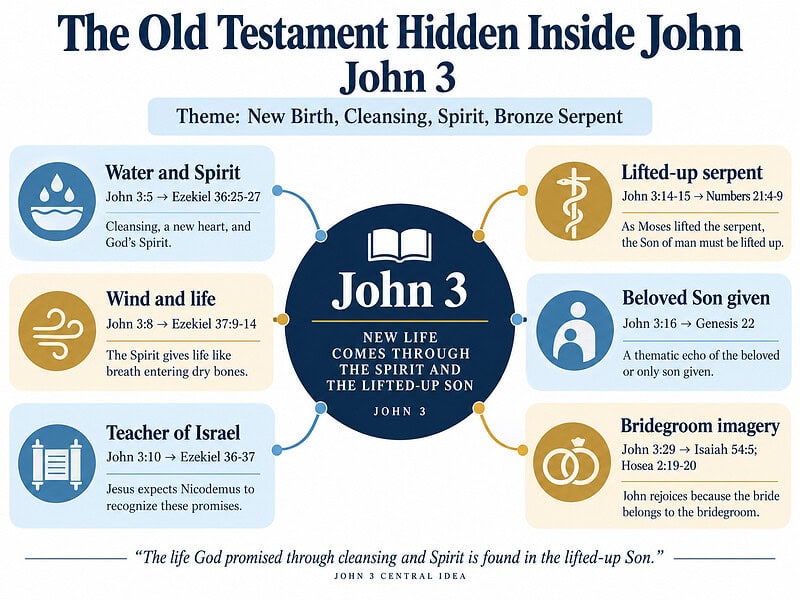
But before we ever reach “For God so loved the world,” Jesus has already taken us back into Ezekiel.
Then He takes us into the wilderness with Moses.
Then John the Baptist starts talking about a bridegroom.
And once you put all of that together, John 3 stops looking like a chapter made up of separate sayings.
It starts to look like one big Old Testament picture.
Cleansing.
Spirit.
New life.
Healing.
A Son given.
A Bridegroom arriving.
And right in the middle of it all is Jesus explaining something Israel should’ve already been waiting for.
NICODEMUS COMES AT NIGHT
John 3 opens with Nicodemus.
John 3:1:
“There was a man of the Pharisees, named Nicodemus, a ruler of the Jews.”
Then verse 2:
“The same came to Jesus by night…”
Nicodemus isn’t some random man asking basic questions.
He’s educated.
Religious.
A Pharisee.
A ruler of the Jews.
Later Jesus calls him:
“a master of Israel”
So this is someone who knows the Scriptures.
He knows Moses.
He knows the prophets.
He knows the promises given to Israel.
And Nicodemus begins respectfully.
“Rabbi, we know that thou art a teacher come from God…”
But Jesus immediately takes the conversation somewhere Nicodemus doesn’t expect.
John 3:3:
“Except a man be born again, he cannot see the kingdom of God.”
And Nicodemus is confused.
He starts thinking physically.
How can a man be born when he’s old?
Can he enter his mother’s womb again?
But Jesus isn’t talking about another physical birth.
He’s talking about something God had already promised.
WATER AND SPIRIT SHOULD SOUND FAMILIAR
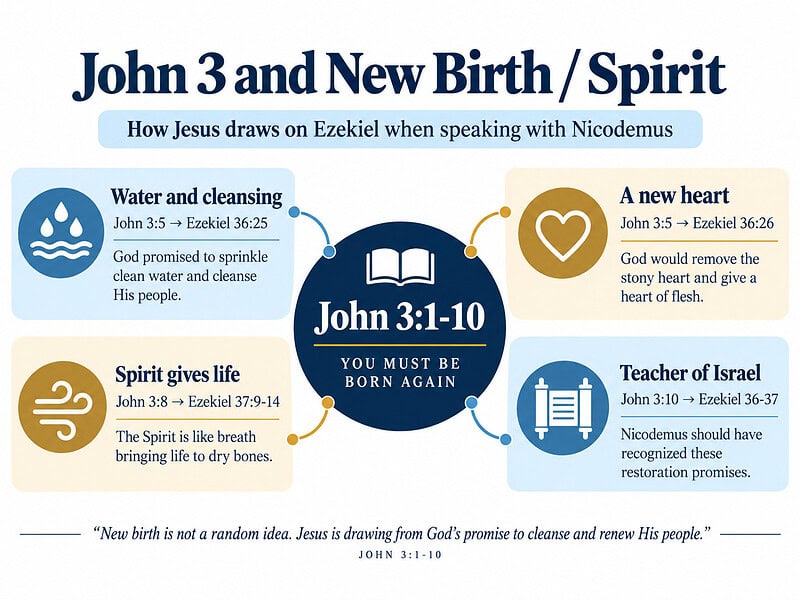
Jesus says in John 3:5:
“Except a man be born of water and of the Spirit, he cannot enter into the kingdom of God.”
Water.
Spirit.
Where have we seen those ideas together before?
Ezekiel 36.
Listen to Ezekiel 36:25:
“Then will I sprinkle clean water upon you, and ye shall be clean…”
There’s the water.
And notice what the water is doing.
Cleansing.
“from all your filthiness, and from all your idols, will I cleanse you.”
Then God continues.
Ezekiel 36:26:
“A new heart also will I give you, and a new spirit will I put within you…”
Then verse 27:
“And I will put my spirit within you, and cause you to walk in my statutes…”
Clean water.
A new heart.
A new spirit.
God’s Spirit within His people.
Now listen again to Jesus.
“Except a man be born of water and of the Spirit…”
That should immediately make us think of Ezekiel.
Jesus isn’t inventing some completely new idea out of nowhere.
He’s talking about the inward renewal God had promised Israel.
A cleansing that reaches deeper than washing hands.
A new heart.
A new spirit.
The Spirit of God within.
And that makes Jesus’ next question to Nicodemus especially important.
JESUS EXPECTED NICODEMUS TO KNOW THIS
Nicodemus asks in John 3:9:
“How can these things be?”
Jesus answers in verse 10:
“Art thou a master of Israel, and knowest not these things?”
That’s a fascinating response.
Why should Nicodemus know?
If Jesus were revealing something that had never appeared anywhere in Scripture before, why rebuke him?
But if Jesus is drawing from Ezekiel, it makes perfect sense.
Nicodemus is a teacher of Israel.
He should know the promises made to Israel.
He should know Ezekiel 36.
Cleansing.
New heart.
New spirit.
God’s Spirit dwelling within His people.
Jesus is basically saying:
Nicodemus, this shouldn’t be completely foreign to you.
Your own Scriptures have been preparing you for it.
But Ezekiel isn’t finished.
Because Jesus next starts talking about the Spirit like wind.
And Ezekiel does the same thing.
THE WIND STARTS BLOWING
John 3:8:
“The wind bloweth where it listeth, and thou hearest the sound thereof, but canst not tell whence it cometh, and whither it goeth: so is every one that is born of the Spirit.”
Wind.
Spirit.
Breath.
These ideas are closely connected in biblical language.
And Ezekiel 37 gives us one of the most dramatic pictures of that connection anywhere in Scripture.
Ezekiel is standing in a valley full of dry bones.
Not sick people.
Not wounded people.
Bones.
Very dry bones.
God asks him:
“Son of man, can these bones live?”
Then Ezekiel prophesies.
The bones come together.
Sinews appear.
Flesh comes upon them.
Skin covers them.
But there’s still a problem.
Ezekiel 37:8 says:
“but there was no breath in them.”
They look alive.
But they aren’t alive.
Then God says in verse 9:
“Prophesy unto the wind…”
And then:
“Come from the four winds, O breath, and breathe upon these slain, that they may live.”
Verse 10:
“So I prophesied as he commanded me, and the breath came into them, and they lived…”
Do you see the picture?
Breath.
Wind.
Spirit.
Life.
Then God explains it.
Ezekiel 37:14:
“And shall put my spirit in you, and ye shall live…”
Now come back to John 3.
Jesus says:
“The wind bloweth where it listeth…”
Then:
“so is every one that is born of the Spirit.”
Ezekiel gives us dead bones receiving breath and life.
Jesus talks about birth by the Spirit.
Again, the idea isn’t coming from nowhere.
God had promised a people cleansed by water.
Given a new heart.
Given His Spirit.
Brought from death into life.
And now Jesus is standing in front of a teacher of Israel saying:
You must be born again.
NEW BIRTH ISN’T SELF-IMPROVEMENT
This is where I think we can easily water down what Jesus is saying.
Being born again isn’t Jesus saying:
Try harder.
Become nicer.
Clean up a few bad habits.
Turn over a new leaf.
Nicodemus already had religion.
He already had Scripture knowledge.
He already had moral discipline.
He already had position.
And Jesus still says:
“Ye must be born again.”
That’s far more radical.
Ezekiel 36 says we need cleansing.
A new heart.
A new spirit.
Ezekiel 37 says dry bones need the breath of God before they can live.
That’s the picture.
We don’t need a small religious adjustment.
We need life from God.
And then Jesus suddenly changes the image.
We’ve gone from water and Spirit to something very strange.
A serpent lifted up in the wilderness.
THEN JESUS TAKES NICODEMUS BACK TO NUMBERS
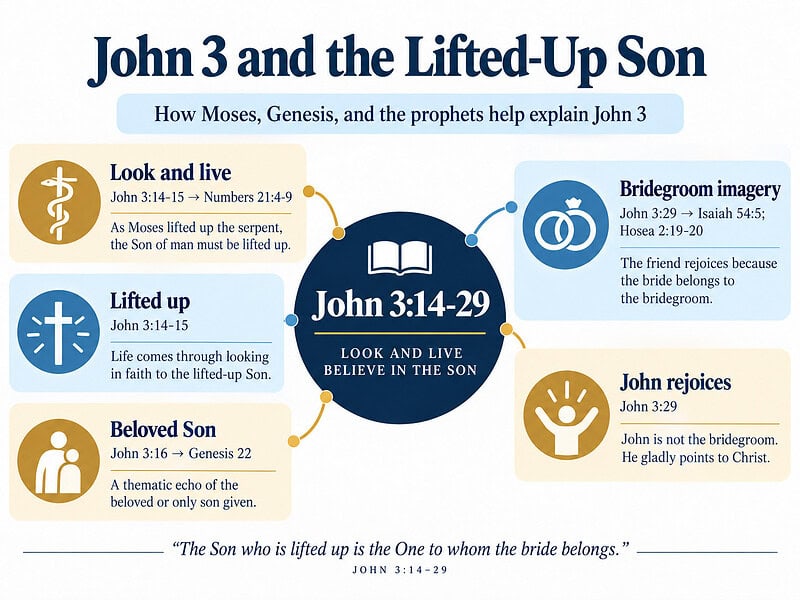
John 3:14:
“And as Moses lifted up the serpent in the wilderness, even so must the Son of man be lifted up.”
This one isn’t merely thematic.
Jesus directly tells us where to look.
Moses.
The wilderness.
The serpent.
That’s Numbers 21.
Israel is travelling through the wilderness.
The people become discouraged.
They speak against God and against Moses.
Numbers 21:5:
“Wherefore have ye brought us up out of Egypt to die in the wilderness?”
Then judgment comes.
Verse 6:
“And the LORD sent fiery serpents among the people, and they bit the people; and much people of Israel died.”
The people realize they’ve sinned.
They ask Moses to pray.
Then God gives an unusual instruction.
Numbers 21:8:
“Make thee a fiery serpent, and set it upon a pole…”
And then God says:
“every one that is bitten, when he looketh upon it, shall live.”
Moses obeys.
Verse 9:
“And Moses made a serpent of brass, and put it upon a pole…”
Then:
“if a serpent had bitten any man, when he beheld the serpent of brass, he lived.”
Now listen again to Jesus.
“As Moses lifted up the serpent in the wilderness, even so must the Son of man be lifted up.”
That’s incredible.
The people were dying.
God provided a way of life.
The serpent was lifted up.
Whoever looked lived.
And Jesus says:
That’s pointing toward Me.
LOOK AND LIVE
Jesus continues in John 3:15:
“That whosoever believeth in him should not perish, but have eternal life.”
Now put the two scenes beside each other.
Numbers 21.
People are dying.
God provides a lifted-up object.
They look.
They live.
John 3.
Humanity is perishing.
The Son of man will be lifted up.
Whoever believes has eternal life.
Jesus takes an old wilderness story and makes Himself the centre of it.
And notice the language.
“must the Son of man be lifted up”
Must.
This wasn’t an accident waiting to happen.
Jesus’ death was part of God’s saving purpose.
John is already moving us toward the cross.
And right after Jesus talks about being lifted up, we reach the verse nearly everybody knows.
NOW JOHN 3:16 SITS INSIDE A MUCH BIGGER STORY
John 3:16:
“For God so loved the world, that he gave his only begotten Son…”
We usually read that verse by itself.
And it’s beautiful by itself.
But look at where John has brought us.
New birth.
Cleansing.
Spirit.
Life.
The serpent lifted up.
People perishing.
Life given to those who believe.
Then:
“For God so loved the world…”
This is the explanation behind the rescue.
God loved.
God gave.
The Son was given.
And there’s another Old Testament story that can come to mind when we hear about a beloved, unique son being given.
Genesis 22.
ABRAHAM AND ISAAC MAY BE ECHOING IN THE BACKGROUND
Genesis 22 begins with God speaking to Abraham.
Verse 2:
“Take now thy son, thine only son Isaac, whom thou lovest…”
Your son.
Your only son.
Whom you love.
And Abraham is told to offer him.
Now, we need to be careful here.
John doesn’t say:
“This is a quotation from Genesis 22.”
It isn’t.
But when John speaks of God giving His only begotten Son, it’s hard not to hear at least an echo of Abraham and Isaac.
Especially because later Scripture connects Isaac’s offering with faith and resurrection imagery.
Abraham is willing to give the son of promise.
But Isaac isn’t finally sacrificed.
God provides a ram.
In John 3, the Father gives the Son.
And this time the sacrifice will actually take place.
So Genesis 22 may sit quietly in the background.
Not as a direct quotation.
But as part of the larger biblical story of the beloved Son and sacrifice.
And John keeps moving.
Because once Jesus has been presented as the giver of life, John the Baptist gives us another Old Testament picture.
A bridegroom.
THEN A BRIDEGROOM APPEARS
Later in the chapter, John’s disciples become concerned.
People are going to Jesus.
Jesus is attracting attention.
And John answers them in John 3:29:
“He that hath the bride is the bridegroom…”
Then John says:
“the friend of the bridegroom, which standeth and heareth him, rejoiceth greatly because of the bridegroom’s voice…”
That’s an important image.
Because in the Old Testament, God Himself is repeatedly pictured as the husband or bridegroom of His people.
Isaiah 54:5 says:
“For thy Maker is thine husband; the LORD of hosts is his name…”
Then Hosea 2:19:
“And I will betroth thee unto me for ever…”
Verse 20:
“I will even betroth thee unto me in faithfulness: and thou shalt know the LORD.”
God as husband.
God restoring His unfaithful people.
God entering covenant relationship with them.
Then John the Baptist says:
Jesus is the Bridegroom.
Again, don’t race past that.
John isn’t merely saying Jesus is popular.
He’s using an image loaded with Old Testament meaning.
The Bridegroom has arrived.
And John knows his own role.
He’s the friend.
Not the Bridegroom.
That’s why he says in verse 30:
“He must increase, but I must decrease.”
John isn’t losing his ministry.
He’s recognizing whose wedding it is.
JOHN 3 IS FULL OF OLD TESTAMENT EXPECTATION
Now look at how much has happened in one chapter.
Jesus tells Nicodemus he must be born again.
Ezekiel had promised cleansing.
A new heart.
A new spirit.
God’s Spirit dwelling within His people.
Jesus talks about wind and Spirit.
Ezekiel had stood in a valley of dry bones and watched breath bring the dead to life.
Jesus tells Nicodemus he should understand these things.
Then Jesus reaches back to Numbers 21.
A serpent lifted up.
Dying people look.
They live.
Jesus says the Son of man must be lifted up.
Then comes:
“For God so loved the world…”
A Son given.
And maybe, quietly in the background, Abraham and Isaac.
Then John the Baptist calls Jesus the Bridegroom.
And Isaiah and Hosea had already used marriage imagery for God’s relationship with His people.
These aren’t disconnected ideas.
They’re converging.
CLEANSING, LIFE, AND RESCUE ALL MEET IN JESUS
What does a person need in John 3?
Cleansing.
A new heart.
The Spirit.
Life.
Healing from death.
Rescue from perishing.
And Jesus places Himself in the middle of every one of those needs.
You need new birth?
It’s through the Spirit.
You need life?
The Son gives eternal life.
You’re perishing?
Look to the One who will be lifted up.
You need to know God’s love?
Look at the Son He gave.
You want to know who has arrived?
The Bridegroom is here.
And that helps us understand why Jesus is so surprised Nicodemus doesn’t see it.
The pieces were already sitting in the Old Testament.
Ezekiel had promised cleansing and Spirit.
Ezekiel had shown breath bringing the dead to life.
Numbers had shown dying people looking at God’s provision and living.
The prophets had spoken about God as the husband of His people.
Now Jesus is saying:
All of that is coming together.
EZEKIEL 36 AND 37 CHANGE HOW WE READ JOHN 3
I think this is one of the biggest discoveries in the chapter.
If we read John 3 without Ezekiel, “born of water and of the Spirit” can feel mysterious.
People can get stuck arguing over what the water means.
Physical birth?
Baptism?
Something else?
But once you put Ezekiel 36 beside John 3, the picture becomes much clearer.
Ezekiel says:
“I will sprinkle clean water upon you, and ye shall be clean…”
Then:
“a new spirit will I put within you…”
Then:
“I will put my spirit within you…”
Then Ezekiel 37 shows the Spirit bringing life to what was dead.
And Jesus tells a teacher of Israel:
“Ye must be born again.”
That’s not a random metaphor.
It’s the promised work of God.
Cleanse them.
Give them a new heart.
Put My Spirit within them.
Make the dead live.
That’s new birth.
THEN THE SERPENT SHOWS US HOW LIFE COMES
But Jesus doesn’t stop with the need for new life.
He tells Nicodemus how eternal life will become available.
The Son of man must be lifted up.
Just as Moses lifted up the serpent.
The wilderness story wasn’t about people curing themselves.
They’d been bitten.
They were dying.
God provided the remedy.
Their part was to trust what God had provided.
Look and live.
Jesus says:
“That whosoever believeth in him should not perish, but have eternal life.”
That’s the Gospel sitting inside a wilderness story.
And then:
“For God so loved the world…”
Now John 3:16 lands with even more force.
God loved.
God gave.
The Son was lifted up.
Whoever believes lives.
THE OLD TESTAMENT WAS PREPARING US FOR JOHN 3
John 3 isn’t Jesus throwing completely new religious ideas at Nicodemus.
He’s bringing Israel’s Scriptures to their fulfilment.
Ezekiel’s cleansing.
Ezekiel’s Spirit.
Ezekiel’s breath giving life.
Moses’ lifted serpent.
The beloved Son.
The Bridegroom promised in the prophets.
And Jesus stands in the centre of all of it.
That’s why John 3 is about far more than one famous verse.
It’s about God doing what He promised.
Cleaning what was defiled.
Giving life to what was dead.
Giving His Spirit.
Providing salvation.
Giving His Son.
And bringing the Bridegroom to His people.
The Old Testament was sitting inside John 3 the whole time.
And once you see Ezekiel 36 and 37 behind Jesus’ words, the whole conversation with Nicodemus suddenly opens up.
Call to Action: The Question That Demands an AnswerIn Acts 2:37 Peter and the Apostles were asked the question – What Shall We do? And in Acts 2:38 Peter answered, Repent, and be baptized every one of you in the name of Jesus Christ for the remission of sins, and ye shall receive the gift of the Holy Ghost. For the promise is unto you, and to your children, and to all that are afar off, even as many as the Lord our God shall call. Do you understand this? After hearing the gospel and believing, they asked what should would do. The answer hasn’t changed friend, Peter clearly gave the answer. The question for you today is, Have you receieved the Holy Spirit Since you believed? If you’re ready to take that step, or you want to learn more about what it means to be born again of water and Spirit, visit: Come, and let the Spirit make you new. |