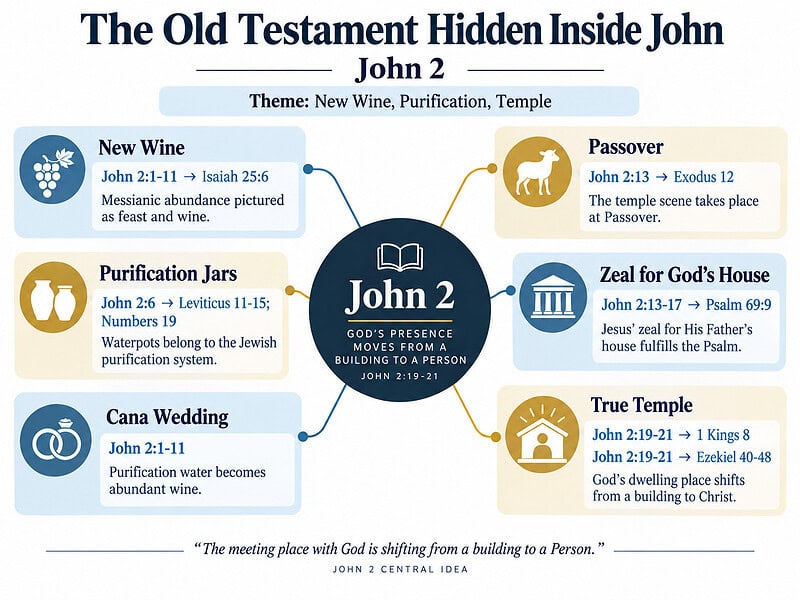
Theme: New Wine, Purification, Temple
| John | Old Testament | Connection | Strength |
|---|---|---|---|
| John 2:1-11 | Isaiah 25:6 | Messianic abundance pictured as a feast and wine | Theme |
| John 2:6 | Leviticus 11-15; Numbers 19 | Jewish purification system | Strong |
| John 2:13 | Exodus 12 | Passover setting | Direct setting |
| John 2:13-17 | Psalm 69:9 | Zeal for God’s house | Direct |
| John 2:19-21 | 1 Kings 8 | Temple as God’s dwelling place | Strong |
| John 2:19-21 | Ezekiel 40-48 | Temple theology shifts toward Christ | Theme |
Central idea
John starts moving God’s presence away from a building and toward a person.
That becomes massive later in the Gospel.
Wine, Passover, Temple… Here?
John 2 looks like two completely different stories.
First, Jesus is at a wedding.
They run out of wine.
He turns water into wine.
Then suddenly we’re in Jerusalem.
It’s Passover.
Jesus walks into the temple, drives out the sellers, overturns the tables, and starts talking about destroying the temple and raising it again in three days.
A wedding.
Wine.
Purification water.
Passover.
The temple.
At first, they don’t seem to belong together.
But once we start putting the Old Testament beside John 2, something begins to emerge.
God’s blessing.
God’s cleansing.
God’s house.
God’s presence.
And by the end of the chapter, Jesus is quietly moving something enormous.
The meeting place with God is shifting from a building to a Person.
Let’s start at a wedding.
THE WINE RUNS OUT
John 2:1-3:
“And the third day there was a marriage in Cana of Galilee; and the mother of Jesus was there:
And both Jesus was called, and his disciples, to the marriage.
And when they wanted wine, the mother of Jesus saith unto him, They have no wine.”
That’s the problem.
The wine is gone.
Now to us, that might sound like an inconvenience.
Bit embarrassing.
Someone didn’t order enough.
But in that culture, this would’ve been a major failure of hospitality.
And this wedding is about to become the setting for Jesus’ first recorded miracle in John’s Gospel.
But notice what Jesus uses.
John 2:6:
“And there were set there six waterpots of stone, after the manner of the purifying of the Jews…”
Don’t race past that.
These weren’t ordinary empty jars Jesus happened to find sitting nearby.
John tells us what they were for.
Purification.
And that’s our first clue.
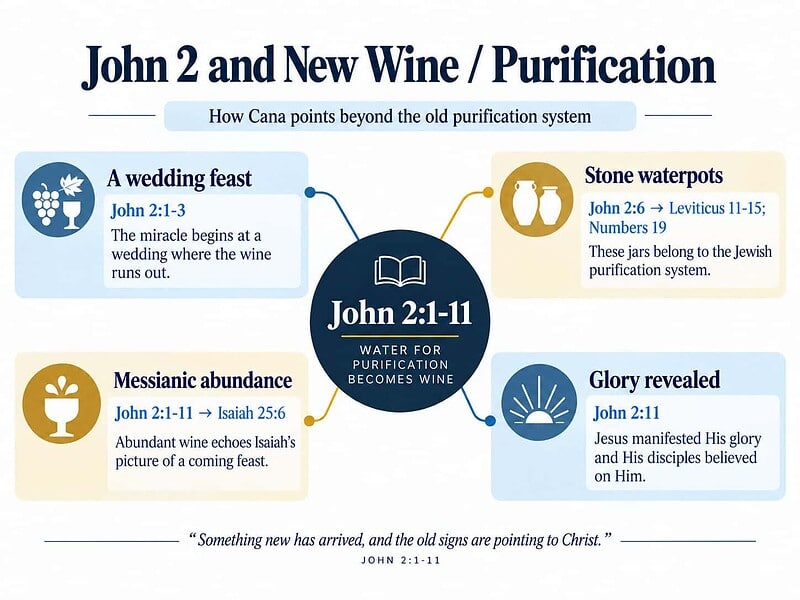
THESE JARS BELONG TO THE OLD PURIFICATION SYSTEM
Purification runs all through the law of Moses.
Leviticus repeatedly deals with what made a person clean or unclean.
Contact with certain things.
Disease.
Bodily discharges.
Death.
Defilement.
Then there were washings and purification procedures connected with becoming ceremonially clean again.
Numbers 19 gives us a particularly clear example.
If someone became unclean through contact with death, water was involved in purification.
Numbers 19:19 says:
“and on the seventh day he shall purify himself, and wash his clothes, and bathe himself in water, and shall be clean at even.”
So when John tells us that these stone vessels were:
“after the manner of the purifying of the Jews”
he’s pointing us toward that whole world of ceremonial cleansing.
And then Jesus does something very interesting.
He has them filled.
John 2:7:
“Jesus saith unto them, Fill the waterpots with water. And they filled them up to the brim.”
Not halfway.
Not enough for the immediate need.
To the brim.
Then Jesus tells them to draw some out and take it to the governor of the feast.
And somewhere between the filling and the tasting, the water becomes wine.
John 2:9 says:
“the ruler of the feast had tasted the water that was made wine…”
Now stop there.
Jesus has taken water associated with purification and turned it into wine.
And not just a little wine.
A lot.
Those six stone waterpots held an enormous amount.
John seems to want us to notice the abundance.
And abundance of wine has an Old Testament background too.
ISAIAH HAD DESCRIBED A COMING FEAST
Isaiah 25 looks forward to a day when God would prepare an incredible feast.
Isaiah 25:6:
“And in this mountain shall the LORD of hosts make unto all people a feast of fat things, a feast of wines on the lees…”
A feast.
Wine.
Abundance.
And this isn’t simply Isaiah describing a good dinner.
Keep reading.
Verse 7 speaks of the covering cast over all people being destroyed.
Verse 8 says:
“He will swallow up death in victory; and the Lord GOD will wipe away tears from off all faces…”
So the feast belongs to a much bigger picture.
God’s salvation.
God’s kingdom.
Death defeated.
Tears wiped away.
And now John opens Jesus’ public ministry at a wedding feast where the wine runs out.
Then Jesus produces abundance.
Does that mean John is saying, “Isaiah 25 is directly fulfilled right here at Cana”?
He doesn’t say that.
But the picture certainly belongs to the same Old Testament world.
Messianic blessing is arriving.
And there’s another detail I love.
The quality.
JESUS DOESN’T JUST REPLACE WHAT RAN OUT
The governor tastes the wine and says to the bridegroom in John 2:10:
“Every man at the beginning doth set forth good wine; and when men have well drunk, then that which is worse: but thou hast kept the good wine until now.”
That’s interesting.
The best has arrived last.
The servants know where it came from.
The governor doesn’t.
The bridegroom gets the credit.
But Jesus supplied it.
And John tells us why this miracle matters.
Verse 11:
“This beginning of miracles did Jesus in Cana of Galilee, and manifested forth his glory; and his disciples believed on him.”
There’s that word again.
Glory.
John 1:
“we beheld his glory.”
John 2:
Jesus:
“manifested forth his glory.”
So the wedding miracle isn’t just about saving a family from embarrassment.
John is showing us who Jesus is.
And look at the picture.
Purification water becomes abundant wine.
Something new has arrived.
Then John moves almost immediately to Passover.
And that’s where the chapter becomes even more interesting.
NOW JOHN TAKES US TO PASSOVER
John 2:13:
“And the Jews’ passover was at hand, and Jesus went up to Jerusalem.”
Passover takes us straight back to Exodus 12.
Israel was still in Egypt.
Judgment was coming.
A lamb was killed.
Blood was placed upon the doorposts.
God said in Exodus 12:13:
“when I see the blood, I will pass over you…”
Then Israel was delivered.
So when John tells us this scene takes place at Passover, that isn’t meaningless background.
We’re standing inside one of Israel’s greatest memorials.
A celebration of redemption.
A celebration of deliverance.
A celebration built around sacrifice.
And remember what John the Baptist called Jesus in the previous chapter.
“Behold the Lamb of God…”
Now we arrive at Passover.
John is starting to connect these images.
But instead of focusing first on lambs or blood, Jesus walks into the temple.
And He doesn’t like what He sees.
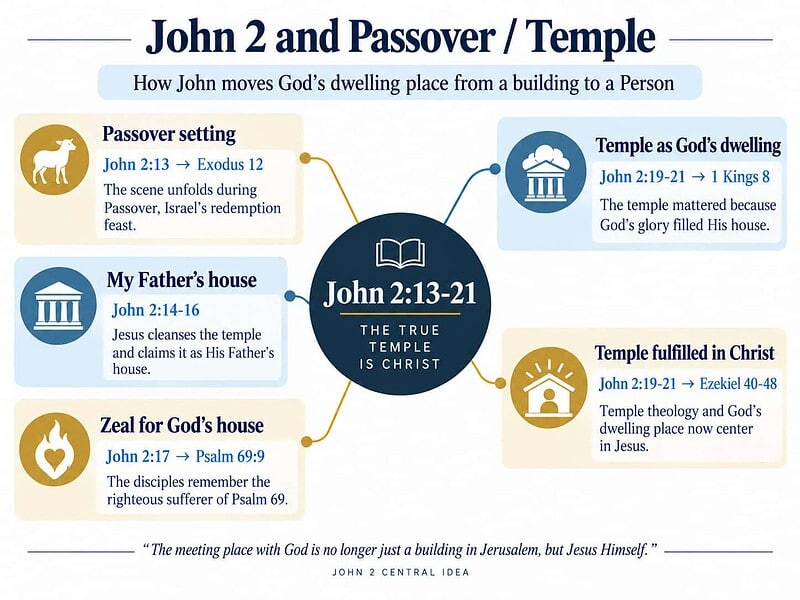
JESUS ENTERS HIS FATHER’S HOUSE
John 2:14:
“And found in the temple those that sold oxen and sheep and doves, and the changers of money sitting.”
Then verse 15:
“And when he had made a scourge of small cords, he drove them all out of the temple…”
Jesus overturns the tables.
Pours out the money.
Drives out the animals.
Then He says in verse 16:
“Take these things hence; make not my Father’s house an house of merchandise.”
“My Father’s house.”
That’s a strong statement.
This isn’t simply religious outrage.
Jesus talks about the temple as belonging to His Father.
And His disciples immediately remember an Old Testament passage.
John 2:17:
“And his disciples remembered that it was written, The zeal of thine house hath eaten me up.”
That’s Psalm 69.
PSALM 69 WAS SITTING BEHIND THE SCENE
Psalm 69:9 says:
“For the zeal of thine house hath eaten me up…”
John tells us directly that the disciples connected Jesus’ actions with that Psalm.
And Psalm 69 is fascinating because it describes a righteous sufferer whose devotion to God brings reproach.
Listen to the rest of verse 9:
“and the reproaches of them that reproached thee are fallen upon me.”
Then later Psalm 69:21 says:
“They gave me also gall for my meat; and in my thirst they gave me vinegar to drink.”
John will come back to that language later in his Gospel when Jesus is on the cross.
So here in John 2, at the very beginning of Jesus’ public ministry, the disciples remember Psalm 69.
Zeal for God’s house.
Later, the suffering language in that same Psalm will appear around the cross.
John is laying threads down very early.
But now comes the part nobody in the temple understands.
Jesus starts talking about destroying the temple.
THEN JESUS SAYS SOMETHING THEY COMPLETELY MISUNDERSTAND
The Jews ask Jesus for a sign.
John 2:19:
“Jesus answered and said unto them, Destroy this temple, and in three days I will raise it up.”
Naturally, they think He’s talking about the building.
Verse 20:
“Then said the Jews, Forty and six years was this temple in building, and wilt thou rear it up in three days?”
Fair question.
If you’re looking at stone walls.
Columns.
Courtyards.
Massive construction.
Three days sounds ridiculous.
But John tells us they were looking at the wrong temple.
Verse 21:
“But he spake of the temple of his body.”
There it is.
That’s the turning point of John 2.
The temple is no longer merely a building in Jerusalem.
Jesus identifies His own body as the temple.
And to understand how big that is, we’ve got to go back into the Old Testament.
WHAT MADE THE TEMPLE SO IMPORTANT?
Why did the temple matter?
It wasn’t simply Israel’s impressive religious building.
It was connected with the presence of God.
Go back to Solomon’s temple in 1 Kings 8.
The temple has been completed.
The ark is brought in.
Then 1 Kings 8:10-11 says:
“And it came to pass, when the priests were come out of the holy place, that the cloud filled the house of the LORD,
So that the priests could not stand to minister because of the cloud: for the glory of the LORD had filled the house of the LORD.”
There’s that word again.
Glory.
God’s glory fills the temple.
And Solomon says in verse 13:
“I have surely built thee an house to dwell in, a settled place for thee to abide in for ever.”
Now, Solomon knew God couldn’t be contained inside a building.
Just a few verses later he says:
“behold, the heaven and heaven of heavens cannot contain thee; how much less this house that I have builded?”
But the temple was still the appointed place associated with God’s name and presence.
It was the house of God.
Now go back to Jesus.
He’s standing inside that temple.
And He says:
“Destroy this temple, and in three days I will raise it up.”
Then John says:
“he spake of the temple of his body.”
Do you see the shift?
The temple was the place associated with God’s presence.
Now Jesus points to Himself.
That’s where John is taking us.
God’s presence is moving from the building to the Person.
And this actually continues something John already started in chapter 1.
JOHN 1 ALREADY PREPARED US FOR THIS
Remember John 1:14:
“And the Word was made flesh, and dwelt among us…”
We saw how that “dwelt among us” language takes us back to the tabernacle.
God dwelling among His people.
Then John says:
“and we beheld his glory.”
Tabernacle language.
Glory language.
God’s dwelling place.
Now one chapter later, Jesus walks into the temple and says His body is the temple.
John is building something.
John 1:
The Word becomes flesh and tabernacles among us.
John 2:
Jesus identifies His body as the temple.
This isn’t random.
The dwelling place of God is being revealed in Christ.
And that’s where Ezekiel gives us another fascinating background.
EZEKIEL SAW THE TEMPLE FILLED WITH GLORY
Ezekiel spends several chapters describing a future temple.
Ezekiel 40 through 48.
The measurements are detailed.
The gates.
The courts.
The chambers.
The altar.
The whole thing.
But one moment matters enormously.
In Ezekiel 43, the glory of God returns.
Verse 4:
“And the glory of the LORD came into the house by the way of the gate whose prospect is toward the east.”
Then verse 5:
“and, behold, the glory of the LORD filled the house.”
Again.
Temple.
Glory.
Presence.
Then Ezekiel 43:7 says:
“Son of man, the place of my throne, and the place of the soles of my feet, where I will dwell in the midst of the children of Israel for ever…”
God dwelling among His people.
That theme runs from the tabernacle, through Solomon’s temple, through Ezekiel’s vision.
God dwelling in the midst of His people.
Then John says:
The Word became flesh and dwelt among us.
We beheld His glory.
Then Jesus says:
This body is the temple.
You can see why this becomes such a massive idea in John’s Gospel.
Jesus isn’t simply visiting God’s house.
He is presenting Himself as the true meeting place between God and man.
And John has already given us that picture once.
Remember Jacob’s ladder at the end of chapter 1?
Jesus said:
“ye shall see heaven open, and the angels of God ascending and descending upon the Son of man.”
Heaven and earth meeting in Him.
Then one chapter later:
The temple.
God’s dwelling place.
Again centred in Him.
John keeps pushing us toward the same conclusion.
AND THE TEMPLE WILL BE DESTROYED
But there’s another part of Jesus’ statement we haven’t dealt with yet.
“Destroy this temple, and in three days I will raise it up.”
He’s talking about His death.
And His resurrection.
John tells us that directly in verse 22:
“When therefore he was risen from the dead, his disciples remembered that he had said this unto them…”
So Jesus doesn’t merely call Himself the temple.
He predicts the destruction and raising up of that temple.
His body will be destroyed.
He’ll rise again.
And notice where this conversation is happening.
At Passover.
Think about that.
John has already called Jesus:
“the Lamb of God.”
Now we’re at Passover.
Jesus speaks about His body being destroyed.
Then being raised.
John hasn’t taken us to the cross yet.
But he’s already planting the pieces.
Lamb.
Passover.
Temple.
Death.
Resurrection.
And we’re only in chapter 2.
THE TWO STORIES AREN’T AS DIFFERENT AS THEY LOOKED
Now go back to where the chapter started.
The wedding at Cana.
What did we see?
Purification jars.
Water.
Wine.
Abundance.
Glory revealed.
Then Jerusalem.
Passover.
Temple.
God’s house.
Jesus’ body.
Death.
Resurrection.
At first, Cana and the temple cleansing looked like two unrelated episodes.
But I don’t think John has simply thrown two stories together.
Both scenes show Jesus standing in the middle of Israel’s Old Testament world.
Purification.
Feast.
Passover.
Temple.
And in both scenes, something is changing.
At Cana, Jesus takes vessels associated with purification and produces something new and abundant.
At Jerusalem, Jesus stands in the temple and identifies the true temple with His own body.
The old signs are pointing toward Him.
That’s the bigger picture.
GOD’S PRESENCE IS MOVING TOWARD A PERSON
This is the idea I don’t want us to miss.
The Bible begins with God dwelling with man.
Sin breaks that fellowship.
Then we get the tabernacle.
God dwelling among Israel.
Then the temple.
God’s glory filling the house.
Then Ezekiel looks forward to God’s presence dwelling among His people again.
And John says:
“the Word was made flesh, and dwelt among us.”
Then Jesus stands inside the temple and says:
“Destroy this temple, and in three days I will raise it up.”
John tells us:
“he spake of the temple of his body.”
That’s enormous.
The presence of God isn’t finally centred on a pile of stones in Jerusalem.
It’s centred in Jesus Christ.
Want to meet God?
Look to Christ.
Want to see God’s glory?
Look to Christ.
Want to know where heaven and earth meet?
John has already told us.
Christ.
Want to find the true temple?
Jesus points to Himself.
And that’s why John 2 is much bigger than water turning into wine and tables getting knocked over in Jerusalem.
The wine points toward something new.
The purification jars point backward to the law.
The Passover points backward to Exodus.
Psalm 69 explains Jesus’ zeal.
The temple takes us back to God’s dwelling place.
Ezekiel reminds us of glory filling the house.
And then Jesus stands in the middle of it all and points to Himself.
The temple could be destroyed.
But this Temple would rise again.
And once you see that, John 2 becomes another chapter where the Old Testament was sitting there all along.
Wine.
Purification.
Passover.
The temple.
Glory.
God dwelling with His people.
And right in the middle of all of it is Jesus.
Call to Action: The Question That Demands an AnswerIn Acts 2:37 Peter and the Apostles were asked the question – What Shall We do? And in Acts 2:38 Peter answered, Repent, and be baptized every one of you in the name of Jesus Christ for the remission of sins, and ye shall receive the gift of the Holy Ghost. For the promise is unto you, and to your children, and to all that are afar off, even as many as the Lord our God shall call. Do you understand this? After hearing the gospel and believing, they asked what should would do. The answer hasn’t changed friend, Peter clearly gave the answer. The question for you today is, Have you receieved the Holy Spirit Since you believed? If you’re ready to take that step, or you want to learn more about what it means to be born again of water and Spirit, visit: Come, and let the Spirit make you new. |