The Hook: When Power Met Desire
He was Israel’s king, proud and ambitious. She was a princess from Sidon, fierce, beautiful, and unbending. Together, they formed a union that promised influence and glory—but delivered ruin instead. Their marriage was not merely a political alliance; it was a collision of faith and idolatry, a joining that taught an entire nation how to bow to the wrong god.
The Palace on the Hill
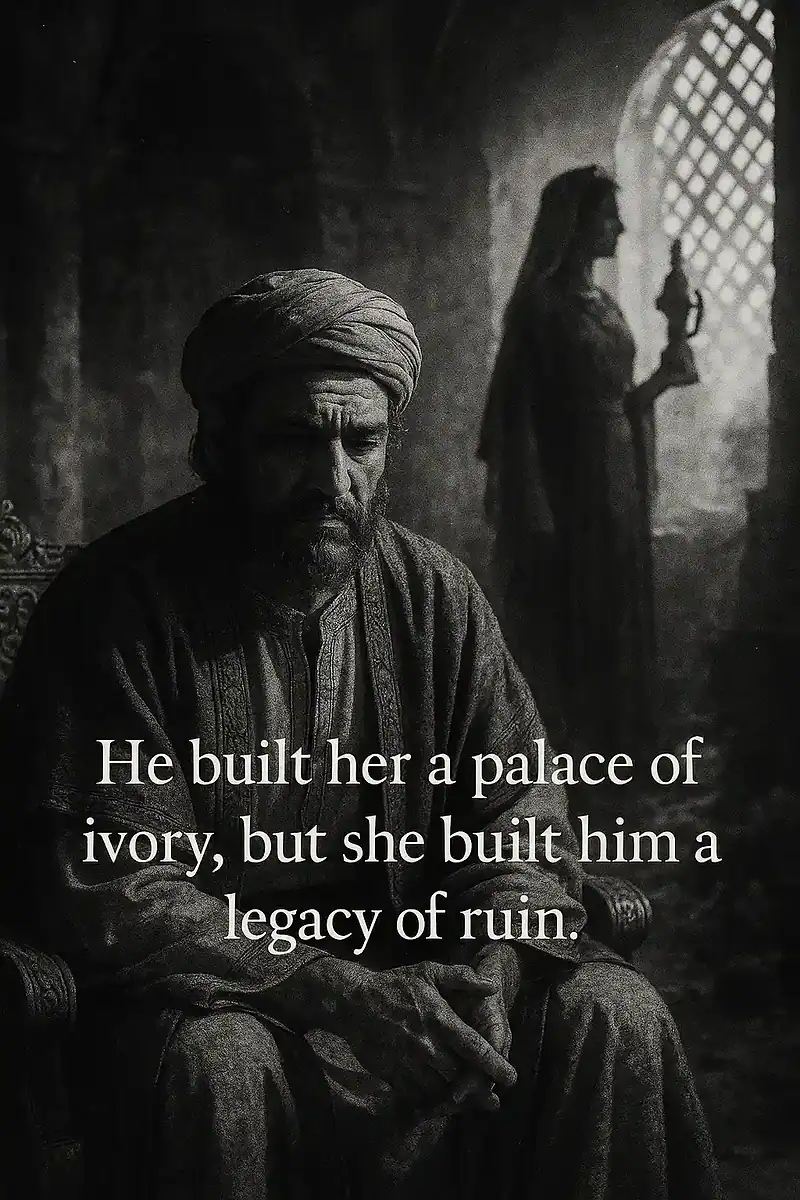
Samaria glittered under the sun, its palace terraces draped with imported tapestries and carved ivory. The smell of incense drifted from new altars built in the name of Baal. Ahab watched from his throne, the weight of his crown pressing against his brow. He had wealth, armies, and peace with neighboring nations—but not peace within himself. The whispers of prophets made him uneasy. Israel’s God still demanded loyalty, but Jezebel’s voice drowned out the call of heaven.
She was a storm in royal robes. Her Sidonian upbringing taught her to worship Baal, the god of rain and fertility. When she married Ahab, she brought her gods with her—and Ahab opened the door wide. The woman he loved did not only share his throne; she slowly took command of his heart, his decisions, and his worship.
The Slow Erosion of Conviction
At first, Ahab believed he could keep both worlds. He thought he could honor the Lord and still please Jezebel. But faith divided soon becomes faith destroyed. Under her influence, he built an altar to Baal and a grove for Asherah. He surrounded himself with prophets who would tell him what he wanted to hear.
The people followed their king. Shrines rose on the hills, sacrifices were made to false gods, and Israel—once a light among nations—began to flicker. God’s covenant was not forgotten because He was silent; it was forgotten because the people chose comfort over conviction.
And Jezebel? She was determined to erase the worship of the Lord from Israel entirely. Her cruelty was legendary. She hunted the prophets, silencing truth with blood and fear. Her name would one day become a symbol of spiritual seduction and rebellion against God.
The Prophet Who Wouldn’t Bow
Then came Elijah—the prophet who would not bend, the man whose prayers could summon drought or rain. He walked straight into the throne room and spoke with the boldness of heaven: “As the Lord God of Israel lives, there shall not be dew nor rain these years, but according to my word.”
The drought scorched the land, and Baal—supposedly the god of rain—was silent. The fields cracked, the wells dried, and yet Jezebel’s rage only grew. She fed her prophets well even as the people starved. She mocked Elijah’s God as weak, blind, and powerless.
But when Elijah stood on Mount Carmel and fire fell from heaven, the illusion shattered. Baal’s prophets screamed, cut themselves, and bled for nothing. The Lord answered with fire that consumed the altar, the stones, the dust, and even the water. The people fell to their knees crying, “The Lord, He is God!”
Still, Jezebel did not repent. Instead, she vowed to kill Elijah. Some hearts would rather cling to lies than surrender to truth.
The Vineyards of Naboth
Years later, Ahab’s palace looked over a small vineyard that belonged to a man named Naboth. It was just a patch of soil—but Ahab wanted it for himself. When Naboth refused to sell, Ahab sulked like a child. Jezebel mocked his weakness. “You’re the king,” she said. “Act like it.”
She forged letters, arranged false witnesses, and had Naboth stoned to death. Then she turned to Ahab and said, “Go, take your vineyard.” He obeyed her again—this time walking over the blood of an innocent man.
But heaven saw it all. Elijah met him there in that stolen field and declared judgment: “In the place where dogs licked the blood of Naboth shall dogs lick thy blood, even thine.” The words were not empty—they were prophecy.
The Battle of Hearts and Thrones
From that day, Ahab’s heart was never at rest. He dressed in robes of repentance, tore his clothes, and humbled himself for a season. The Lord noticed—mercy always watches for even the smallest turn toward repentance. But Jezebel never softened. She mocked weakness as if it were a sin.
When Ahab went to war again, he disguised himself, thinking he could outsmart fate. But no disguise can hide a man from God. A random arrow flew between the joints of his armor, and his blood ran into the chariot floor. As it was written, dogs licked it up in the same place Naboth had died.
And Jezebel? Years later, Jehu entered her palace. She painted her face, called down mockery from the window, and met her end beneath the hooves of horses. Dogs devoured her remains. The woman who thought herself untouchable became dust on the city wall.
The Warning Beneath the Crown
Ahab and Jezebel’s story is not just ancient tragedy—it’s a warning dressed in royal garments. Ahab’s sin was not simply idolatry; it was passivity. He let his love for Jezebel outweigh his loyalty to God. He traded reverence for approval and authority for indulgence.
Jezebel’s sin was defiance—a spirit that could not bow even before the fire of heaven. Together, they became an example of what happens when compromise becomes lifestyle. When leaders drift from the Word, the people follow them into ruin.
The Hinge of Heaven’s Mercy
Even then, God was patient. Through Elijah and Elisha, He gave warnings, miracles, and chances to repent. He sent prophets into the palace of rebellion. His mercy lingered, not because they deserved it, but because His nature never changes.
When Elijah fled into the wilderness, thinking Jezebel had won, the Lord whispered—not in fire or wind—but in a still small voice. It was a reminder that God’s kingdom doesn’t fall with kings. His truth doesn’t depend on popularity. Even when darkness seems to rule, heaven’s light still burns quietly, faithfully, waiting for hearts to return.
The Reflection: What We Worship, We Become
Today, Jezebel’s name echoes whenever faith gets traded for influence or when truth bends to culture. The spirit that moved her still tempts us—to silence conviction, to make peace with sin, to worship success instead of surrender.
Ahab teaches us that spiritual neglect is as dangerous as rebellion. Jezebel teaches us that rebellion dressed in glamour still ends in judgment. Both show us that who we worship shapes who we become.
The Closing Parallels: A Better Bridegroom
But there is another King—a better one. Jesus is the opposite of Ahab. Where Ahab gave in to darkness, Jesus overcame it. Where Jezebel manipulated for power, Christ humbled Himself for love.
At Calvary, He faced the full weight of sin that began in palaces like theirs. The blood that ran down from His cross didn’t cry for vengeance like Naboth’s—it cried for mercy. He came to make His bride pure again, not corrupted by the world’s idols but washed in His grace.
The Final Line
Every throne on earth will one day crumble, but the kingdom of Christ will never fall—for no other name has power to break the spell of Jezebel or restore the heart of a fallen king.