The Stirring in the Camp
It began as a whisper. Dissatisfaction doesn’t start with thunder – it starts in the heart. Korah, son of Izhar, cousin to Moses, had spent years watching his kin lead Israel. Every morning he saw Moses walk into the tent of meeting while he tended the duties of a Levite. At first, it was enough to serve. But slowly, the line between service and status began to blur. Why should Moses speak for God when all the congregation was holy? Why should Aaron alone burn incense before the Lord? The seed of comparison had taken root, and its fruit was rebellion.
The wilderness was quiet that night. Fires flickered in the distance, the smell of smoke and dust hung heavy, and in Korah’s tent, the air felt thick with ambition. He had gathered men who felt overlooked – Dathan, Abiram, and two hundred fifty princes of renown. Their arguments sounded noble, even spiritual. “All the people are holy,” they said. “The Lord is among them all.” But behind those words hid a dangerous lie: the belief that they could choose the terms of holiness without submission to God’s appointed order.
The Gathering of Rebels
At dawn, they moved through the camp like a rising tide.
The people murmured as Korah and his followers stood before Moses, faces hard, voices bold. “You take too much upon you,” Korah declared. “Seeing all the congregation are holy, why do you lift yourselves above the assembly of the Lord?”
Moses looked at them with grief, not anger. He had stood before Pharaoh, faced plagues and armies, and seen the Red Sea part – but this cut deeper. These were his own brethren. Pride had turned family into foes. He fell on his face before God. Then he stood, steady and trembling. “Tomorrow,” he said, “the Lord will show who belongs to Him, and who is holy.”
It was not a threat. It was a warning soaked in mercy.
The Test of Incense
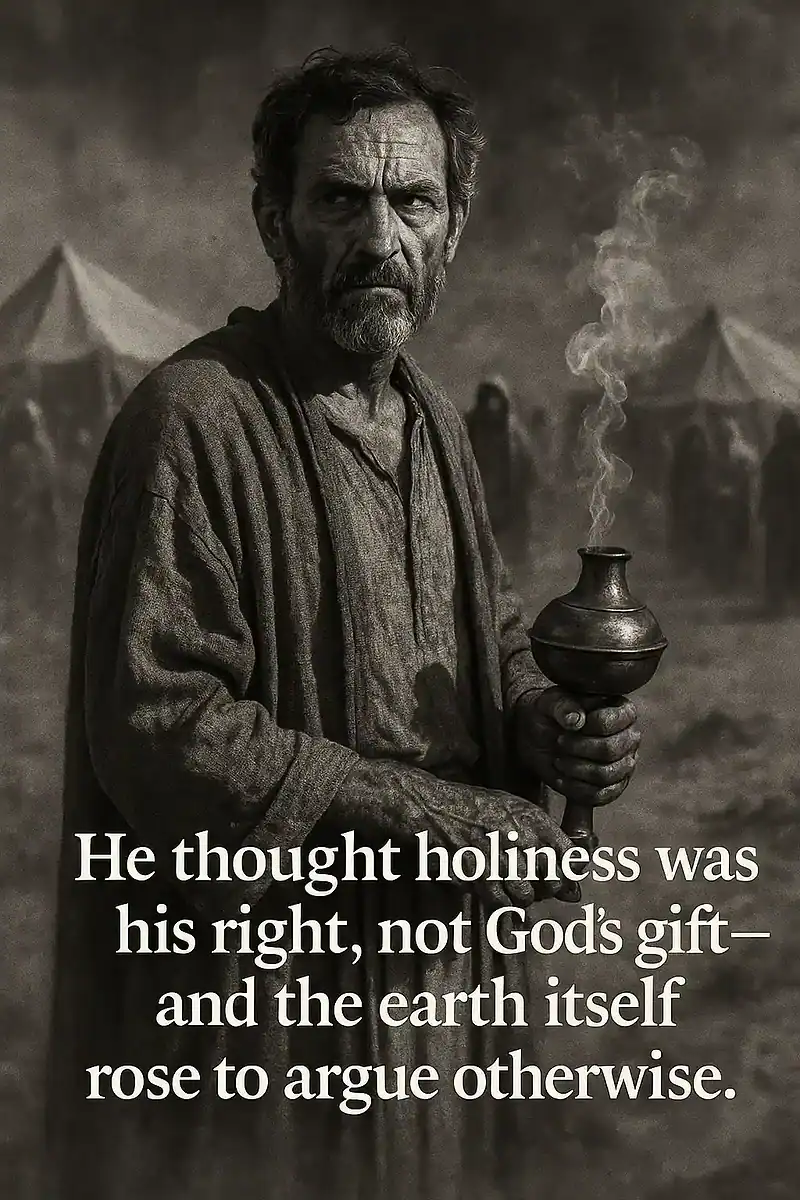
The next morning, the wilderness shimmered with tension. Each man held a censer of brass filled with burning coals and incense. The scent of smoke rose into the air – pleasant, but heavy with defiance.
Moses stood beside Aaron, watching. “Hereby ye shall know,” he said, “that the Lord hath sent me to do all these works.”
But rebellion doesn’t back down easily. Korah’s eyes burned with the conviction that he was right. The ground beneath them seemed steady, but heaven had already drawn a line. The Lord’s voice thundered, “Separate yourselves from among this congregation, that I may consume them in a moment.”
Moses and Aaron fell again on their faces. “O God, the God of the spirits of all flesh,” Moses pleaded, “shall one man sin, and wilt Thou be wroth with all the congregation?” Even in the face of rebellion, Moses interceded for the people. That’s the difference between the called and the proud – the called plead for mercy; the proud demand recognition.
The Earth Opens Its Mouth
Then came the sound no one had ever heard before – a deep, cracking roar that split the ground beneath their feet. The earth opened, swallowing Korah, Dathan, Abiram, their families, their tents, and all that belonged to them. The people screamed and fled as the ground closed again, leaving only silence and smoke.
The fire of the Lord consumed the two hundred fifty men who offered incense. Their censers – those symbols of ambition – were beaten into plates to cover the altar, a lasting reminder that no one takes God’s holiness lightly.
The dust settled. The murmuring stopped. What began as a challenge ended as a caution carved into the wilderness.
The Aftermath of Pride
The next day, the congregation murmured again, blaming Moses and Aaron for the deaths. Rebellion rarely learns easily. God’s glory appeared once more, and a plague swept through the camp until Aaron stood between the living and the dead, incense in hand – not as a challenger, but as a mediator. The same act that brought death in pride now brought life in humility.
The people watched as Aaron stood in the gap, smoke rising toward heaven. The lesson was clear: incense, order, leadership – none of these are evil in themselves. It’s the heart behind them that decides whether they serve life or destruction.
The Warning Echoes Through Time
Korah’s rebellion was not just an ancient uprising – it’s a mirror for every heart that resents God’s order. Pride still whispers, “Why not me?” It still questions authority, mocks structure, and dresses jealousy as justice. But rebellion always ends the same way – cut off from the life it seeks to control.
The earth may not open today, but pride still buries people alive. It swallows marriages, churches, friendships, and callings. It devours peace and leaves only ashes where gratitude used to grow. God’s judgment against Korah wasn’t cruel – it was necessary. Because unchecked rebellion spreads faster than wildfire in a dry land.
The Reflection of Submission
True holiness isn’t about claiming equality with others – it’s about surrender to God’s order. Korah wanted position without obedience, holiness without humility, incense without intercession. The tragedy is that he could have walked with Moses instead of against him. He could have shared in the glory of serving rather than the grief of falling.
Submission doesn’t mean inferiority; it means alignment. When God sets order, He sets blessing in motion. Every time Israel followed that pattern – Moses under God, Aaron at the altar, the Levites serving – they prospered. When they broke it, chaos followed.
The Shadow and the Savior
Centuries later, another Man faced accusation. They said He exalted Himself, that He blasphemed by claiming to be equal with God. But unlike Korah, this Man humbled Himself and became obedient unto death, even the death of the cross. Where Korah reached upward in pride and fell, Jesus bowed downward in obedience and was exalted above every name.
Korah’s censer turned to ash, but Christ’s intercession rises forever. He stands between the living and the dead, the same way Aaron did that day in the wilderness. He doesn’t just silence rebellion – He redeems rebels.
A Final Reflection
The story of Korah is a warning, but also a mercy note. God doesn’t crush pride to humiliate people – He does it to heal them. Every rebellion begins in the heart that forgets who set the order in the first place. The earth opened once to swallow the proud; the tomb opened once to raise the humble.
And in that single difference, eternity was rewritten.
“The ground closed over Korah’s name – but the grave opened for Christ’s.”
Call to Action: The Question That Demands an AnswerIn Acts 2:37 Peter and the Apostles were asked the question – What Shall We do? And in Acts 2:38 Peter answered, Repent, and be baptized every one of you in the name of Jesus Christ for the remission of sins, and ye shall receive the gift of the Holy Ghost. For the promise is unto you, and to your children, and to all that are afar off, even as many as the Lord our God shall call. Do you understand this? After hearing the gospel and believing, they asked what should would do. The answer hasn’t changed friend, Peter clearly gave the answer. The question for you today is, Have you receieved the Holy Spirit Since you believed? If you’re ready to take that step, or you want to learn more about what it means to be born again of water and Spirit, visit: Come, and let the Spirit make you new. |