You Know You’re Forgiven… So Why Do You Still Feel Guilty?
Let’s be honest.
You’ve prayed. You’ve asked God to forgive you. You believe He’s merciful.
But the guilt doesn’t leave.
It keeps showing up in your thoughts. In your memory. In that quiet moment when everything slows down.
And you start thinking, Why do I still feel condemned if God has already forgiven me?
Scripture answers that directly.
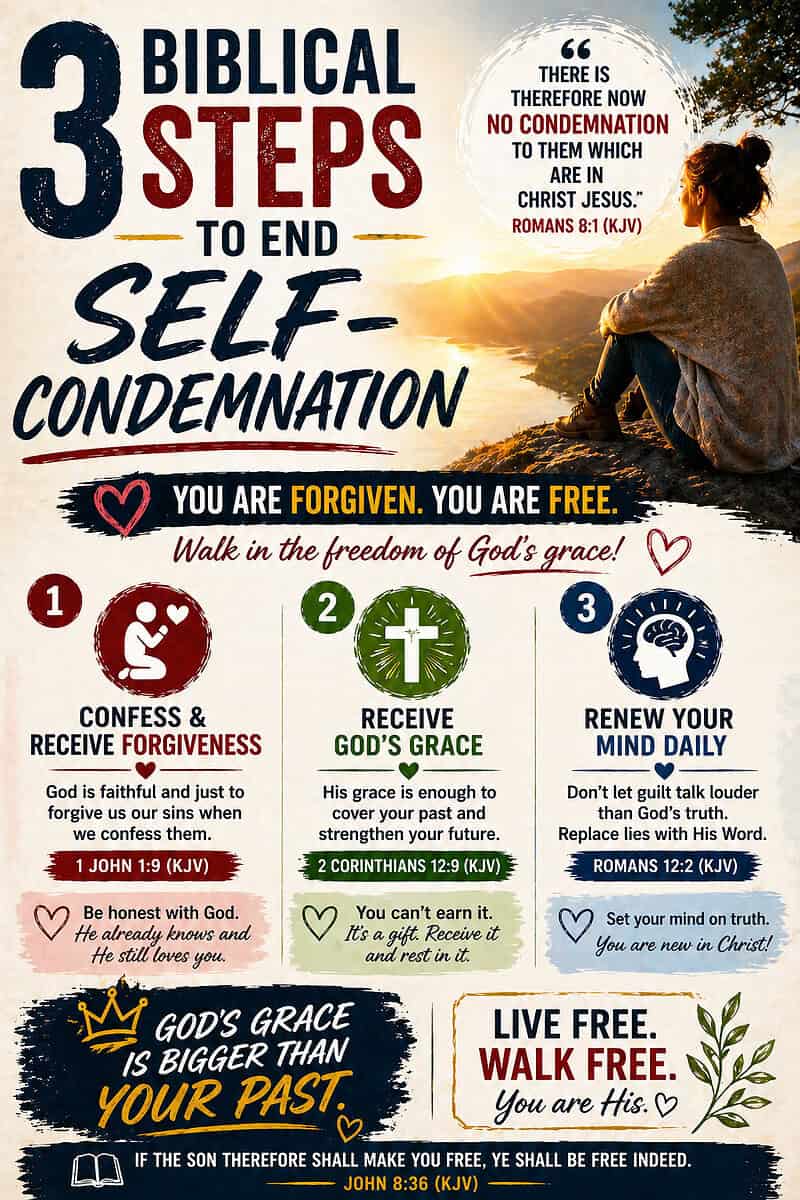
“There is therefore now no condemnation to them which are in Christ Jesus” (Romans 8:1, KJV).
So if there’s no condemnation… why does it still feel like there is?
Because feeling forgiven and living free are not always the same thing.
That’s where these steps matter.
Step 1: Real Repentance, Not Just Regret
A lot of people confuse regret with repentance.
Regret says, “I feel bad about what I did.”
Repentance says, “I’m turning away from it.”
“If we confess our sins, he is faithful and just to forgive us our sins, and to cleanse us from all unrighteousness” (1 John 1:9, KJV).
Confession isn’t just admitting you were wrong.
It’s agreeing with God about it.
It’s saying, “You’re right. This needs to change.”
And here’s the key.
When repentance is real, you don’t keep negotiating with the same sin.
You step away from it.
That doesn’t mean perfection overnight. But it does mean direction has changed.
Because unresolved sin keeps feeding condemnation.
Step 2: Accept What God Already Did
This is where most people get stuck.
They repent… but they don’t accept.
They keep replaying what happened. Re-evaluating themselves. Trying to feel forgiven before they move forward.
But forgiveness isn’t based on your feelings.
It’s based on what Jesus already did.
“As far as the east is from the west, so far hath he removed our transgressions from us” (Psalm 103:12, KJV).
That’s not partial.
That’s complete.
So when you keep holding onto what God has already removed, you’re carrying something you were never meant to carry.
And this is where you have to make a decision.
Will you trust what God said… or what you feel?
Because those two don’t always agree at first.
Step 3: Renew Your Mind Daily
Even after repentance and forgiveness, your mind doesn’t automatically reset.
It remembers.
It replays.
It brings things back up.
That’s why this step matters so much.
“Be not conformed to this world: but be ye transformed by the renewing of your mind” (Romans 12:2, KJV).
Renewing your mind isn’t a one-time event.
It’s daily.
It means replacing old thoughts with truth.
When your mind says, “You’re still that person,” you answer with Scripture.
“Old things are passed away; behold, all things are become new” (2 Corinthians 5:17, KJV).
When your mind says, “God is disappointed in you,” you answer with truth.
“There is therefore now no condemnation” (Romans 8:1, KJV).
This isn’t pretending.
It’s aligning your thinking with what God has already declared.
Why Condemnation Feels So Persistent
Here’s something people don’t always realize.
Condemnation thrives on memory without truth.
It keeps replaying the past… but leaves out what God did about it.
That’s why it feels heavy.
Because it’s incomplete.
Conviction, on the other hand, is different.
Conviction points out what’s wrong… and leads you back to God.
Condemnation points out what’s wrong… and pushes you away.
If what you’re feeling is driving you away from God, that’s not coming from Him.
Pentecost: From Guilt to Boldness
Think about the disciples for a second.
Peter denied Jesus.
Not once. Three times.
If anyone had reason to live in guilt, it was him.
But after the resurrection… and after Pentecost…
“And they were all filled with the Holy Ghost” (Acts 2:4, KJV).
Peter stood up and preached boldly.
No hesitation. No hiding.
What changed?
He didn’t ignore what happened.
He received forgiveness… and then was filled with the Spirit.
That’s the shift.
From guilt… to boldness.
From looking back… to moving forward.
What Freedom Actually Looks Like
Freedom doesn’t mean you forget everything.
It means the past no longer controls you.
You’re not defined by it.
You’re not constantly dragged back into it.
“Whom the Son therefore shall make free, he shall be free indeed” (John 8:36, KJV).
That’s real freedom.
Not partial.
Not temporary.
A Simple Way to Walk This Out Daily
If you’re struggling with condemnation, keep it simple.
When you mess up
Confess it immediately. Don’t let it sit.
When guilt comes back
Remind yourself of what God already said.
When your mind drifts
Bring it back to truth.
Over and over.
That’s how renewal happens.
Final Question
Are you holding onto something God has already forgiven?
Because if He’s already released it…
Why are you still carrying it?
You don’t have to stay stuck there.
There’s a way out.
And it starts with believing what God said… more than what you feel.