
Quick Overview of “Wilful Sin: No More Sacrifice For Sins”
Short on time? Here’s a concise slideshow of the key takeaways. The full study follows below…
The Warning of Hebrews 10:26 in the Context of Old Testament Sacrificial Law and Covenant Transition
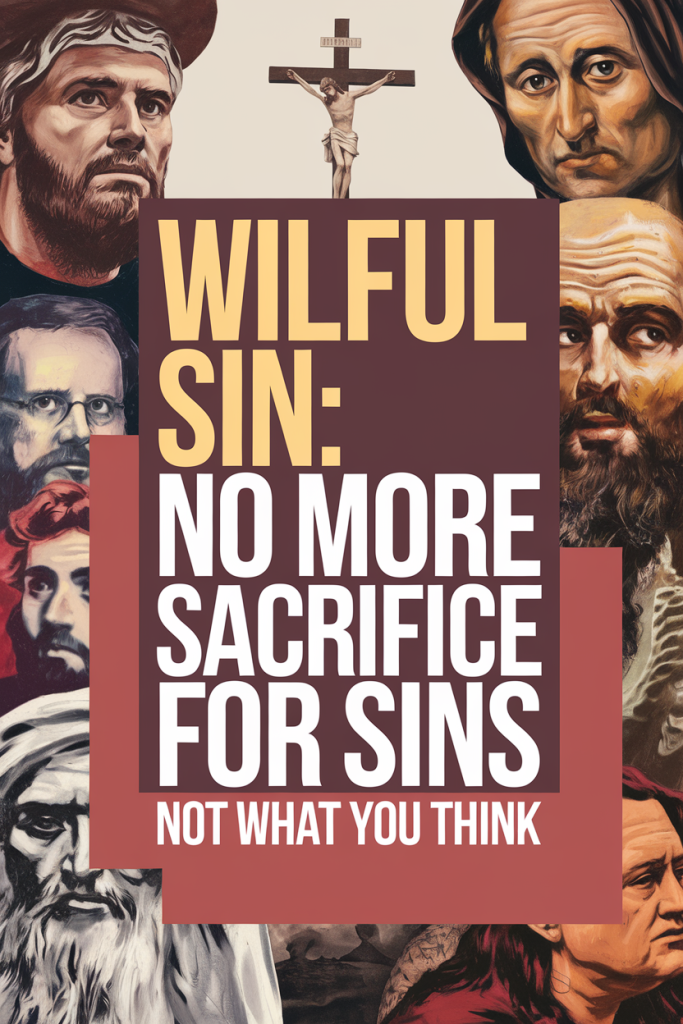
The Epistle to the Hebrews stands as a theological masterpiece, bridging the Old Covenant’s shadows with the New Covenant’s substance. Within this framework, Hebrews 10:26 emerges as a critical warning: “For if we sin wilfully after that we have received the knowledge of the truth, there remaineth no more sacrifice for sins.”
This verse has sparked extensive debate, particularly regarding its relationship to the Old Testament’s sacrificial system and its handling of intentional sin. By examining the historical, theological, and textual context of this passage, it becomes clear that the author is cautioning Jewish believers against abandoning Christ’s final sacrifice for the obsolete rituals of the Mosaic Law.
The Old Testament’s lack of atonement for defiant, high-handed sins—coupled with Christ’s once-for-all offering—forms the bedrock of this warning, emphasizing the irrevocable consequences of apostasy.
Historical and Cultural Context of Hebrews 10:26
The Audience: Jewish Believers and the Temptation to Apostatize
The Epistle to the Hebrews was written primarily to Jewish Christians grappling with persecution and the lure of reverting to Judaism13. The temple in Jerusalem still stood at the time of writing, and many Jewish converts faced societal pressure to abandon their faith in Christ and return to the familiar rituals of the Law15.
This context is critical for understanding the urgency of Hebrews 10:26.
The “wilful sin” in view is not a momentary lapse or moral failure but a deliberate, persistent rejection of Christ’s sacrifice in favor of the Levitical system14.
The author contrasts the “shadow” of the Law with the “very image” of Christ’s redemptive work (Hebrews 10:1)2. Animal sacrifices under the Old Covenant were inherently insufficient, serving only as a temporary reminder of sins rather than effecting true forgiveness (Hebrews 10:3–4)26.
By returning to temple sacrifices, Jewish believers would implicitly deny the sufficiency of Christ’s death, committing a form of apostasy that the author equates to “trampling the Son of God underfoot” (Hebrews 10:29)14.
Old Testament Sacrificial Law and the Distinction Between Intentional and Unintentional Sins
The Levitical System’s Limitations
The Mosaic Law meticulously distinguished between unintentional sins (shegagah) and intentional, “high-handed” sins (b’yad ramah)6. Leviticus 4–5 outlines sacrifices for sins committed in ignorance, negligence, or weakness, such as unintentional violations of purity laws or oaths.
These could be atoned for through grain offerings, sin offerings, or guilt offerings. However...
- Numbers 15:30–31 explicitly states that “the person who does anything presumptuously... blasphemes the Lord, and that person shall be cut off from among his people”6.
- Defiant sins—those committed with a raised fist (b’yad ramah)—carried no sacrificial remedy. Such acts constituted open rebellion against God’s covenant, meriting excommunication or death46.
In other words, there is no sacrifice for wilful sin in the Old Testament. Why would you want to go back to that? Why would you reject the sacrifice of Jesus Christ and living in grace, to return to a system of animal sacrifices and a law that will ultimately condemn you?
This distinction underscores a foundational theological principle: intentional rebellion cannot be remedied through ritual. The author of Hebrews leverages this framework to argue that rejecting Christ’s sacrifice constitutes a high-handed sin of unparalleled severity34.
Just as the Old Covenant offered no atonement for defiant apostasy, the New Covenant leaves no recourse for those who consciously spurn Christ’s blood17.
Hebrews 10:26 and the Finality of Christ’s Sacrifice
The Perfection of Christ’s Offering
Hebrews 10:1–18 systematically dismantles the Levitical system by contrasting its repetitive, ineffective sacrifices with Christ’s singular, perfect offering. The Law’s sacrifices were a “shadow” pointing forward to the Messiah, but they could never “make perfect those who draw near” (Hebrews 10:1–2)27.
Christ’s death, however, achieved what centuries of animal blood could not: eternal redemption (Hebrews 9:12)2. By “offering for all time a single sacrifice for sins,” Christ “perfected for all time those who are being sanctified” (Hebrews 10:14)24.
To “sin wilfully” after receiving the “knowledge of the truth” is to reject the only means of atonement God has provided37. Just as the Old Covenant apostate faced being “cut off,” the New Covenant apostate faces “a fearful expectation of judgment” (Hebrews 10:27)45.
The deliberate rejection of Christ’s sacrifice leaves no alternative—no temple to revisit, no animal to slaughter, no further sacrifice to plead16.
Theological Implications: Apostasy and the Irrevocable Nature of Rejection
The Gravity of Wilful Sin in the New Covenant
The warning of Hebrews 10:26 is not directed at believers struggling with habitual sin but at those who consciously repudiate Christ. The Greek term hekousiōs (“wilfully”) denotes voluntary, deliberate action, akin to the Old Testament’s “high-handed” sins47.
This is not a sin of passion or ignorance but a calculated rejection of the gospel. The author’s use of “we” (Hebrews 10:26) indicates that this warning applies to those within the covenant community—professing believers who later renounce their faith38.
Such apostasy mirrors the rebellion of Israel in the wilderness (Hebrews 3:12–19) and carries eternal consequences.
By returning to the Law’s shadows, the apostate declares Christ’s blood insufficient and “insults the Spirit of grace” (Hebrews 10:29)14.
The Old Testament’s severest penalty—being “cut off”—finds its New Testament counterpart in the impossibility of renewal to repentance (Hebrews 6:4–6)37.
Practical Applications for Modern Believers
The Call to Perseverance and Assurance
While Hebrews 10:26 serves as a sobering warning, it also reinforces the believer’s assurance in Christ. The author distinguishes between temporary moral failures and final apostasy37.
True believers, though prone to sin, are sustained by Christ’s intercession (Hebrews 7:25) and sealed by the Holy Spirit (Ephesians 1:13–14). The warning thus functions not to instill fear in genuine followers but to urge vigilance against complacency and unbelief.
For modern readers, this passage underscores the sufficiency of Christ’s sacrifice. Just as the Old Testament’s sacrificial system could not address defiant sin, no human effort—whether religious ritual or moral striving—can atone for the rejection of Christ. The gospel offers grace for the repentant but no refuge for the apostate.
Conclusion
Hebrews 10:26 stands as a theological linchpin, binding the Old Covenant’s limitations to the New Covenant’s finality. By invoking the Old Testament’s distinction between intentional and unintentional sin, the author underscores the peril of abandoning Christ’s sacrifice.
The warning is clear: to spurn the once-for-all offering of Jesus is to embrace a fate more severe than any Levitical penalty. In a world still tempted by legalism and self-atonement, this passage calls believers to cling to Christ alone, in whom every shadow finds its substance and every sin its remedy.
Call to Action: The Question That Demands an AnswerIn Acts 2:37 Peter and the Apostles were asked the question – What Shall We do? And in Acts 2:38 Peter answered, Repent, and be baptized every one of you in the name of Jesus Christ for the remission of sins, and ye shall receive the gift of the Holy Ghost. For the promise is unto you, and to your children, and to all that are afar off, even as many as the Lord our God shall call. Do you understand this? After hearing the gospel and believing, they asked what should would do. The answer hasn’t changed friend, Peter clearly gave the answer. The question for you today is, Have you receieved the Holy Spirit Since you believed? If you’re ready to take that step, or you want to learn more about what it means to be born again of water and Spirit, visit: Come, and let the Spirit make you new. |