Brethren, praise be to God who still raises voices like Asaph’s – voices that shake hearts, expose sin, and awaken worship. The world may forget the names of God’s servants, but heaven remembers every sound born of obedience.
Asaph’s life teaches us that worship isn’t a performance – it’s warfare. It’s truth wrapped in melody, conviction clothed in song. The man who sang before the Ark now sings through Scripture, still teaching us how to see God when the world goes dark.
Worship that doesn’t confront sin isn’t worship – it’s entertainment. True worship opens the heavens and brings us face to face with holiness.
WHO WAS ASAPH? A MAN CALLED TO SOUND HOLINESS
Praise the Lord! Asaph was not just a musician – he was a Levite, chosen from the tribe God sanctified for His own service (1 Chronicles 6:31–32, 39). David, the king after God’s own heart, handpicked Asaph to lead the music before the Ark of the Covenant (1 Chronicles 15:16–19). This wasn’t a casual assignment; this was a divine trust.
Friends, imagine standing before the very Ark – the symbol of God’s presence – and being told, “Sing!” That’s what Asaph did. He led not from a stage, but from a place of holy fear and revelation. Scripture even calls him a seer – a prophet who didn’t just strum strings, but discerned God’s heart (2 Chronicles 29:30).
Day after day, Asaph and his sons were appointed “to record, and to thank and praise the Lord God of Israel” (1 Chronicles 16:4). Praise wasn’t a side project – it was their full-time calling.
WHY GOD CHOSE ASAPH
Thank you, Lord, for hearts like Asaph’s! He didn’t worship for applause; he worshiped for truth. In a generation filled with idols, God found a man who would keep the sound of holiness alive.
In Psalm 73, Asaph admitted he almost stumbled when he saw the wicked prosper. Can we relate? Who among us hasn’t wondered why evil seems to win? But Asaph said, “Until I went into the sanctuary of God; then understood I their end.” Worship lifted his eyes from envy to eternity.
And in Psalm 50, God’s voice thundered through him: “Whoso offereth praise glorifieth me: and to him that ordereth his conversation aright will I shew the salvation of God.” Praise isn’t noise – it’s alignment with God’s will. Asaph’s worship was truth set to tune.
ASAPH’S WRITINGS STILL SING
Twelve psalms bear his name – Psalm 50 and Psalms 73–83 – each one pulsing with real emotion and raw faith.
In Psalm 77, Asaph cried out, “Will the Lord cast off for ever?” Yet he ended in remembrance – “Thy way, O God, is in the sanctuary.”
In Psalm 79, he mourned Jerusalem’s destruction, but still pleaded for mercy.
In Psalm 81, he recorded God’s open invitation: “Open thy mouth wide, and I will fill it.”
Do you see the pattern? Asaph teaches us that worship doesn’t deny pain – it transforms it. Real praise can rise even from brokenness.
THE TIME AND PLACE OF HIS MINISTRY
Asaph ministered under King David and King Solomon, during one of Israel’s holiest seasons. When the Ark was brought to Jerusalem, Asaph was there, sounding cymbals before the Lord (1 Chronicles 15:19). Later, when Solomon dedicated the temple, Asaph’s descendants were still there.
2 Chronicles 5:12–14 paints the moment: the singers and trumpeters lifted their voices “as one,” and the house was filled with a cloud – the glory of the Lord. Brethren, that’s what true worship does – it invites glory.
Can you picture it? Asaph’s songs echoing through the temple as God’s presence descends. The sound of obedience met the sound of heaven.
ASAPH’S LEGACY CONTINUED
Even after centuries and captivity, the spirit of Asaph’s worship didn’t die. His descendants are listed among those who returned from Babylon to rebuild Jerusalem’s praise (Ezra 2:41; Nehemiah 7:44).
Nehemiah 11:22 records that “Uzzi… of the sons of Asaph, the singers,” was still overseeing temple worship. Think about that: kingdoms fell, nations scattered, but the song never stopped.
Faithful worship doesn’t fade – it multiplies. The praise that began before the Ark found fulfillment in the Church age, where Christ declared that the Father seeks those who worship “in spirit and in truth” (John 4:23–24).
ASAPH’S MINISTRY POINTED TO CHRIST
Friends, Asaph’s work foreshadowed Jesus. Where Asaph stood before the Ark, Christ stands before the throne (Hebrews 7:25; 9:11–12).
Asaph’s psalms invited repentance – Christ brings redemption. Asaph sang of covenant – Christ became the covenant.
In Psalm 73:26, Asaph declared, “God is the strength of my heart, and my portion for ever.” And in Revelation 5:9–10, we see that truth perfected: “Thou wast slain… and hast redeemed us to God by thy blood.”
What Asaph glimpsed in shadows, Christ fulfilled in light.
WHAT WE LEARN FROM ASAPH
Brethren, hear this truth: worship is not a sound you make; it’s a life you live. Asaph reminds us that honest hearts make the purest music. When we’re confused, we must go to the sanctuary. When life breaks us, we must still sing. When the world mocks holiness, we must lift our hands anyway.
Hebrews 13:15 says, “By him therefore let us offer the sacrifice of praise to God continually.” That’s the legacy of Asaph – praise that survives pain, faith that sings through fire, and worship that waits on God’s glory.
Friends, may our songs today carry that same weight. May our worship echo across generations, until the final trumpet sounds and the saints of all ages sing together, “The Lord is my strength and my portion forever.”
KEY SCRIPTURES THAT TELL ASAPH’S STORY
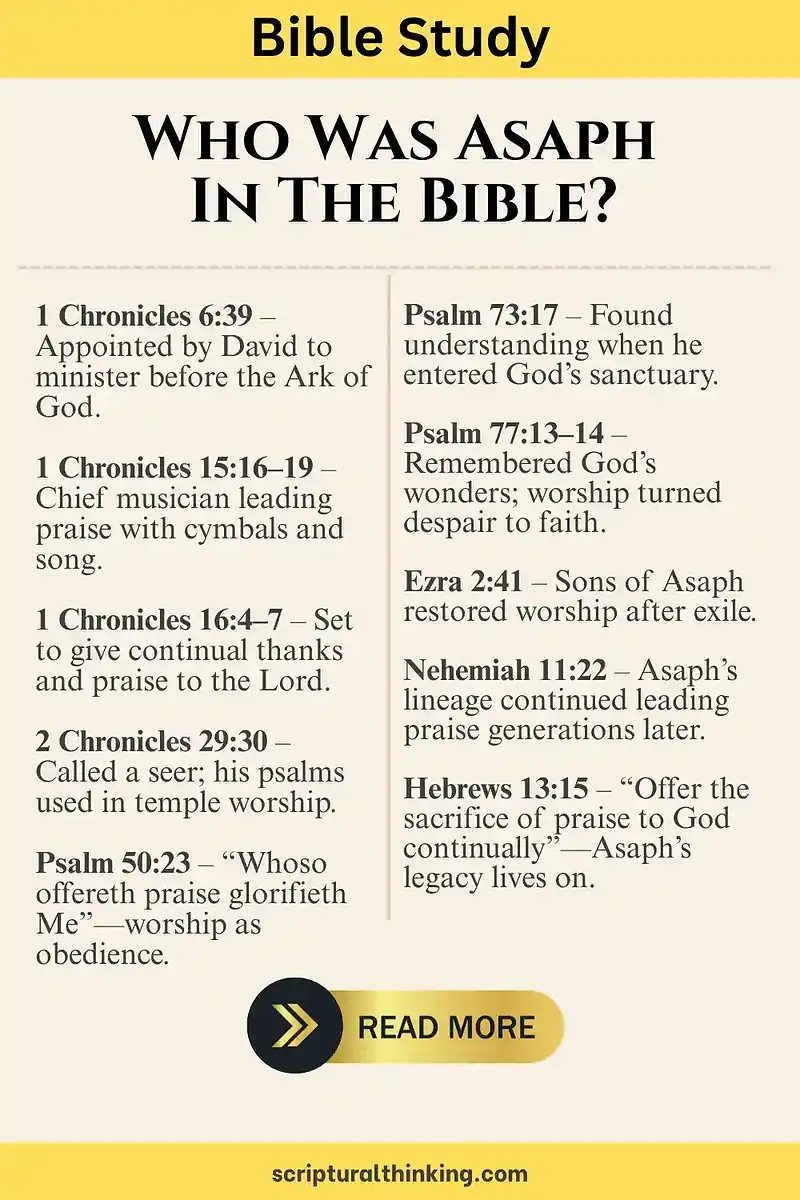
- 1 Chronicles 6:39 – Appointed to minister before the Ark.
- 1 Chronicles 15:16–19 – David makes Asaph chief musician.
- 1 Chronicles 16:4–7 – Leads thanksgiving before the Lord.
- 2 Chronicles 29:30 – Called a seer; psalms used in temple worship.
- Psalms 50, 73–83 – The psalms of Asaph.
- Ezra 2:41; Nehemiah 11:22 – His descendants continue temple praise.
- Psalm 73:25–26 – “Whom have I in heaven but thee?”
- John 4:23–24 – The call to true worship.
- Hebrews 13:15 – The call to continual praise.
Call to Action: The Question That Demands an AnswerIn Acts 2:37 Peter and the Apostles were asked the question – What Shall We do? And in Acts 2:38 Peter answered, Repent, and be baptized every one of you in the name of Jesus Christ for the remission of sins, and ye shall receive the gift of the Holy Ghost. For the promise is unto you, and to your children, and to all that are afar off, even as many as the Lord our God shall call. Do you understand this? After hearing the gospel and believing, they asked what should would do. The answer hasn’t changed friend, Peter clearly gave the answer. The question for you today is, Have you receieved the Holy Spirit Since you believed? If you’re ready to take that step, or you want to learn more about what it means to be born again of water and Spirit, visit: Come, and let the Spirit make you new. |