Quick Overview of This Bible Study…
Short on time? I have created a short slide show presentation of some key takeaways in our study. The complete, more comprehensive bible study is below…
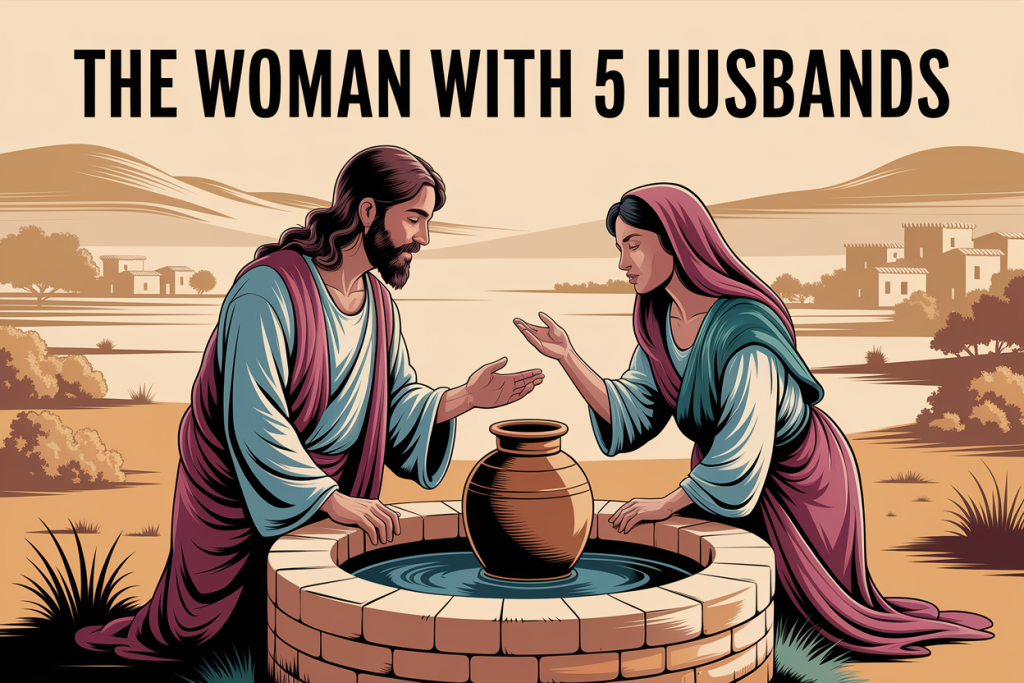
Jesus’ encounter with the Samaritan woman at the well is one of the most intriguing stories in the New Testament (John 4:5–42). On the surface, it’s a simple conversation about water and worship.
But when Jesus tells the woman, “For thou hast had five husbands; and he whom thou now hast is not thy husband” (John 4:18, KJV), he hints at a deeper meaning (JOHN 4:18 KJV "For thou hast had five husbands; and he whom thou now hast is not thy husband: in that saidst thou truly.").
Biblical scholars and theologians have long pondered this remark. Could Jesus be referring not just to the woman’s personal life, but also to the history of her people in Samaria?
To find out, we’ll explore how the Samaritan’s “five husbands” might connect to five foreign nations mentioned in the Old Testament, and what that reveals about God’s plan to restore Israel.
Five Husbands and Five Nations: A Surprising Connection
When Jesus brings up the woman’s five past husbands (John 4:16–18), it surprises her – and readers – because it seems so personal and specific.
However, some Bible interpreters believe Jesus is speaking on two levels: literal and symbolic (gospels - Woman at the well: What is the significance of Jesus asking her to call her Husband (John 4:16) - Biblical Hermeneutics Stack Exchange) (gospels - Woman at the well: What is the significance of Jesus asking her to call her Husband (John 4:16) - Biblical Hermeneutics Stack Exchange).
On the symbolic level, the Samaritan woman represents Samaria itself – the land of the northern tribes of Israel.
In the Old Testament, Samaria had a troubled history with false gods and foreign influences, almost like a wife unfaithful to her true husband.
Remarkably, the number five appears in Samaria’s history in the form of five nations that were brought into the land centuries earlier (A well, two mountains, and five husbands (John 4; Lent 3A) – An Informed Faith) (Commentary on John 4:5-42 - Working Preacher from Luther Seminary).
Who Were These Five Nations?

About 700 years before Christ, the northern kingdom of Israel (capital: Samaria) fell to the Assyrian Empire.
The Assyrians had a strategy of resettling conquered lands. According to 2 Kings 17:24 (KJV), “the king of Assyria brought men from Babylon, and from Cuthah, and from Ava, and from Hamath, and from Sepharvaim, and placed them in the cities of Samaria instead of the children of Israel” ( 2 KINGS CHAPTER 17 KJV).
These were five groups from five foreign regions. They moved into Samaria after many Israelites were exiled. Each group brought along its own gods and religious practices, which they mingled with the local worship of the Lord God.
In fact, the Bible describes how each of these settler nations made idols and altars in Samaria’s towns:
- Babylonians – worshiped an idol called Succoth-benoth ( 2 KINGS CHAPTER 17 KJV).
- Cuthaeans (from Cuthah) – worshiped Nergal, a foreign god ( 2 KINGS CHAPTER 17 KJV).
- Hamathites (from Hamath) – worshiped Ashima, another idol ( 2 KINGS CHAPTER 17 KJV).
- Avvites (from Avva) – worshiped Nibhaz and Tartak, pagan deities ( 2 KINGS CHAPTER 17 KJV).
- Sepharvites (from Sepharvaim) – worshiped Adrammelech and Anammelech, even practicing child sacrifice ( 2 KINGS CHAPTER 17 KJV).
These newcomers “feared the LORD, and served their own gods” ( 2 KINGS CHAPTER 17 KJV). In other words, they added Israel’s God to their pantheon but kept worshipping their idols too.
This mix-and-match religion influenced the region for generations. The people who descended from this mix eventually came to be known as Samaritans.
By Jesus’ time, Samaritans did worship the Lord alone, but their faith had been shaped by this history.
They accepted only the first five books of Moses (the Torah) as Scripture and had their own temple on Mount Gerizim, rather than Jerusalem (A Historical Summary of the Samaritans: Spirit and Truth and the God Beyond).
It’s easy to see a possible connection: five husbands, five nations. The Samaritan woman’s five former husbands might symbolically correspond to those five foreign peoples (and their gods) that Samaria had “married” itself to long ago (The Samaritan Woman And Her "Five Husbands" - White Feather Ministries).
Just as the woman had a series of relationships, Samaria had given its heart to a series of false gods brought in by foreign nations.
In fact, the Hebrew word ba‘alim used for pagan gods can mean “lords” or “husbands” (The Samaritan Woman And Her "Five Husbands" - White Feather Ministries).
From a theological perspective, Samaria was like a wife who had been with five different “husbands” – the false gods of those nations – and the current situation was still not right.
“For thou hast had five husbands; and he whom thou now hast is not thy husband.” – John 4:18 (KJV) (JOHN 4:18 KJV "For thou hast had five husbands; and he whom thou now hast is not thy husband: in that saidst thou truly.")
Spiritual Adultery in the Bible

Why would the Bible compare foreign gods to husbands? Throughout Scripture, the relationship between the Lord and His people is often described like a marriage.
God is the husband, and Israel is the wife. Worshiping idols is seen as being unfaithful – essentially spiritual adultery.
For example, the prophet Hosea was commanded to marry an unfaithful wife as a living illustration of how Israel had treated God (gospels - Woman at the well: What is the significance of Jesus asking her to call her Husband (John 4:16) - Biblical Hermeneutics Stack Exchange).
Hosea’s wife chased after other lovers, just as Israel chased other gods. In one place God says, “this land hath committed great whoredom, departing from the LORD” (Hosea 1:2, KJV), showing how idolatry is like marital unfaithfulness (gospels - Woman at the well: What is the significance of Jesus asking her to call her Husband (John 4:16) - Biblical Hermeneutics Stack Exchange).
Yet, even when Israel (including the northern kingdom often called Samaria or Ephraim) was unfaithful, God promised not to give up on her. Through Hosea, God spoke words of tender restoration and “remarriage.”
He vowed to woo Israel back and renew the relationship. Hosea 2:14–19 paints a beautiful picture of God courting His estranged wife Israel again: “I will allure her… and speak comfortably unto her” (HOSEA 2:16 KJV "And it shall be at that day, saith the LORD, that thou shalt call me Ishi; and shalt call me no more Baali.").
God says there will come a day when Israel will call Him “Ishi” (meaning ‘My Husband’) instead of “Baali” (‘My Master’) (HOSEA 2:16 KJV "And it shall be at that day, saith the LORD, that thou shalt call me Ishi; and shalt call me no more Baali.").
He declares, “I will betroth thee unto me for ever… in righteousness, and in judgment, and in lovingkindness, and in mercies” (Hosea 2:19, KJV) (HOSEA 2:16 KJV "And it shall be at that day, saith the LORD, that thou shalt call me Ishi; and shalt call me no more Baali.").
In short, God promises to reconcile and remarry His people after their unfaithfulness.
“And it shall be at that day, saith the LORD, that thou shalt call me Ishi; and shalt call me no more Baali… I will betroth thee unto me for ever… in righteousness, and in judgment, and in lovingkindness, and in mercies.” – Hosea 2:16, 19 (KJV) (HOSEA 2:16 KJV "And it shall be at that day, saith the LORD, that thou shalt call me Ishi; and shalt call me no more Baali.") (HOSEA 2:16 KJV "And it shall be at that day, saith the LORD, that thou shalt call me Ishi; and shalt call me no more Baali.")
This prophetic theme tells us that God intended to forgive Israel’s sins (her “adultery” with idols) and start fresh.
The northern tribes of Israel (whose capital was Samaria) had been cut off due to idolatry (gospels - Woman at the well: What is the significance of Jesus asking her to call her Husband (John 4:16) - Biblical Hermeneutics Stack Exchange), but prophecy hinted that they would not be lost forever.
The Lord would bring them back into a covenant relationship. In Jewish expectation, this restoration of Israel (including Samaria) would be part of the Messianic age.
Jesus – The Bridegroom Comes to Samaria

With that background, the scene at Jacob’s well in John 4 comes alive with symbolism.
In the Bible, a well is a classic place for meeting one’s spouse – think of Isaac meeting Rebekah, or Jacob meeting Rachel at a well (Genesis 24:11–15, 29:10–12).
By meeting a woman at a well, Jesus is acting out a familiar biblical motif of a bridegroom meeting his bride (gospels - Woman at the well: What is the significance of Jesus asking her to call her Husband (John 4:16) - Biblical Hermeneutics Stack Exchange).
Indeed, just one chapter earlier Jesus is metaphorically called a bridegroom (John 3:29). Now in Samaria, Jesus, the Son of God, meets a Samaritan woman by a well.
It’s not romantic, but it is deeply spiritual. Jesus is on a mission to bring Samaria back to the true God – almost as if God the Husband is seeking to win back His long-lost bride.
When Jesus asks the woman for water and then offers her “living water,” he is really inviting her (and her people) to renew their relationship with God.
He lovingly confronts her with the truth: her many marriages and current situation reflect a deeper thirst that only God can satisfy.
On the symbolic level, “thou hast had five husbands” points to Samaria’s five-fold idolatry, and “he whom thou now hast is not thy husband” suggests that the Samaritans’ current worship was incomplete or not fully correct (The Samaritan Woman And Her "Five Husbands" - White Feather Ministries).
(The Samaritans worshiped the Lord, but they were missing full understanding, and lacked unity with the Jews.)
Jesus, in essence, offers himself as the true husband she and her people have been waiting for (gospels - Woman at the well: What is the significance of Jesus asking her to call her Husband (John 4:16) - Biblical Hermeneutics Stack Exchange).
He is the Messiah, come to finally unite Samaria with the true God in spirit and truth.
Indeed, Jesus tells her outright that He is the Messiah she’s been expecting (John 4:25–26). The woman and then the other Samaritans believe in him, proclaiming Jesus “the Saviour of the world” (John 4:42, KJV).
This joyful acceptance can be seen as Samaria’s “remarriage” to God – a fulfillment of the prophetic promises.
What a beautiful turnaround: the people who were once estranged due to idol worship are now among the first to recognize and embrace Jesus as the Savior.
Early Christian writers noticed this powerful imagery. One commentary explains that by meeting the woman at the well, “Jesus... is essentially symbolically offering to redeem and remarry Samaria and restore her to her original place as his wife” (gospels - Woman at the well: What is the significance of Jesus asking her to call her Husband (John 4:16) - Biblical Hermeneutics Stack Exchange).
The centuries-old story of infidelity and exile finds its resolution in this New Testament moment. Jesus the Bridegroom has come to Samaria, and many Samaritans enter the renewed covenant with God.
In the Book of Acts, we see the Samaritan people receiving the Holy Spirit and fully joining the Church (Acts 8:5–17), confirming that God’s promise to reclaim His northern “bride” was coming to pass.
Jewish and Early Christian Interpretations
Jewish perspective: Jewish readers of Scripture wouldn’t connect John 4 (a New Testament text) with the Old Testament, but they do understand the themes at play.
In Jewish tradition, the restoration of Israel (including the northern tribes) is a hopeful theme. The prophets’ words, like those in Hosea, indicate that God would one day reconcile with the northern kingdom.
Many Jews expected that the Messiah or the end-times would bring back the “lost tribes” of Israel.
The hostility between Jews and Samaritans in Jesus’ day was strong, yet the Hebrew prophets (e.g. Hosea, Amos) had planted the seed that God still loved those in Samaria and would call them back.
So when Jesus engaged with Samaritans, it resonated with the idea of Israel’s restoration.
Even the Samaritan woman herself speaks of Messiah’s coming, showing that Samaritans held onto the hope of a savior who would “tell us all things” (John 4:25).
In essence, what Jesus did in Samaria aligns with Jewish prophecies of healing the breach between God and His estranged people.
Early Christian interpretation:
The early Christians, who knew both the Old Testament and the teachings of Jesus, readily saw the connection in this story.
Several early Christian interpreters taught that the Samaritan woman’s five husbands symbolized the five pagan nations (with their gods) described in 2 Kings 17 (A Historical Summary of the Samaritans: Spirit and Truth and the God Beyond).
Those five groups were viewed as five “husbands” that had dominated Samaria’s spiritual life. By this reading, Jesus was exposing Samaria’s history and offering salvation from it.
Another early Christian teacher, Origen (3rd century), noted a different symbolic five: he suggested the five husbands represented the five Books of Moses (Genesis through Deuteronomy), which were the only scriptures the Samaritans accepted (A Historical Summary of the Samaritans: Spirit and Truth and the God Beyond) (The Samaritan Woman | Holy Archangels Monastery).
Origen proposed that the woman had “married” the Torah, but without the rest of God’s revelation (the prophets and writings), and “he whom thou now hast is not thy husband” could imply that the Samaritan was not yet joined to Christ and his fuller teaching (The Samaritan Woman | Holy Archangels Monastery).
This shows that early Christians loved finding layered meanings in the text – either pointing to Israel’s history or to spiritual truths about incomplete faith.
Of course, not every commentator allegorized the story; some simply see Jesus demonstrating prophetic insight into the woman’s life to convict her of sin.
But the thematic links between John 4 and the Old Testament were hard to miss for many believers.
The idea that Jesus fulfills the Old Testament by restoring Israel was central to Christian thought. They saw Jesus as the divine husband coming for a broken people, just as God promised.
The Samaritan woman at the well became, for early Christians, a symbol of the Church: formerly adulterous (sinful and idolatrous), now forgiven and united with Christ, the true husband.
The prophetic Scriptures like Hosea 2:19 (“I will betroth thee unto me for ever…”) were seen as coming to fulfillment as Samaritans and other Israelites were brought into the New Covenant (HOSEA 2:16 KJV "And it shall be at that day, saith the LORD, that thou shalt call me Ishi; and shalt call me no more Baali.").
Key Takeaways
- Five Husbands = Five Foreign Nations: Many believe the “five husbands” of the Samaritan woman represent the five nations that Assyria imported into Samaria (Babylon, Cuthah, Avva, Hamath, Sepharvaim). These nations brought their gods and mixed them into Samaritan worship ( 2 KINGS CHAPTER 17 KJV) ( 2 KINGS CHAPTER 17 KJV), just as the woman had multiple partners.
- Syncretism in Samaria: The foreign settlers in Samaria each worshipped their own idols (such as Nergal and Ashima) alongside a form of Yahweh worship ( 2 KINGS CHAPTER 17 KJV). This religious mixing meant Samaria was not faithful to God alone – much like a wife with many husbands.
- Idolatry as Adultery: In the Bible, worshiping other gods is compared to a wife being unfaithful to her husband (gospels - Woman at the well: What is the significance of Jesus asking her to call her Husband (John 4:16) - Biblical Hermeneutics Stack Exchange). God was the “husband” of Israel, and idols were like lovers. Prophets like Hosea and Jeremiah used this marriage metaphor to condemn Israel’s idolatry and call for repentance.
- “Remarrying” the Unfaithful Wife: Despite Israel’s unfaithfulness, God promised to restore the relationship. Hosea prophesied that Israel (including Samaria) would once again call God “my Husband” (Hebrew: Ishi) instead of Baal (HOSEA 2:16 KJV "And it shall be at that day, saith the LORD, that thou shalt call me Ishi; and shalt call me no more Baali."). God said, “I will betroth thee unto me forever… in righteousness” (HOSEA 2:16 KJV "And it shall be at that day, saith the LORD, that thou shalt call me Ishi; and shalt call me no more Baali."), indicating His enduring love and a future new covenant.
- Jesus Fulfills the Prophecy: Jesus’ conversation with the Samaritan woman is seen as fulfilling these promises. By revealing her past and offering her “living water,” Jesus symbolically wed Samaria back to God – bringing Samaritans into true worship of the Father (John 4:23). He, the Messiah and bridegroom, initiated the healing of a centuries-old spiritual divide (gospels - Woman at the well: What is the significance of Jesus asking her to call her Husband (John 4:16) - Biblical Hermeneutics Stack Exchange). The Samaritan villagers accepting Jesus as Savior (John 4:42) is like the prodigal wife returning to her husband.
- Early Interpretations Acknowledge the Symbolism: Early Christian writers made the connection between John 4 and the Old Testament. They taught that the woman at the well symbolizes restored Israel. Some, like Origen, noted the Samaritans’ limited scriptures (five Books of Moses) as the “five husbands” (A Historical Summary of the Samaritans: Spirit and Truth and the God Beyond), while others pointed to the five pagan nations (A Historical Summary of the Samaritans: Spirit and Truth and the God Beyond). In both cases, the consensus was that John 4 echoes the prophetic theme of Israel’s restoration under the true Messiah.
Conclusion
The story of the Samaritan woman is far more than a personal redemption story. It is a microcosm of God’s plan for a broken nation.
Through one conversation at a well, Jesus unveiled Samaria’s painful past and also its hopeful future.
He showed that no matter how many “husbands” Israel had chased or how mixed-up its worship had become, God’s love was persistent. The Lord was ready to take His people back.
John 4 beautifully ties together history and hope: the five husbands remind us of Samaria’s history of infidelity (The Samaritan Woman And Her "Five Husbands" - White Feather Ministries), and Jesus’ loving engagement shows us God’s heart to forgive and “remarry” His people.
The result is a restored relationship – one in which Samaritans and all who believe can worship the Father in spirit and in truth, as part of the one bride of Christ.
This ancient well-side encounter still speaks to us today about God’s faithfulness, the dangers of spiritual adultery, and the joy of being invited back into communion with Him.
Call to Action: The Question That Demands an AnswerIn Acts 2:37 Peter and the Apostles were asked the question – What Shall We do? And in Acts 2:38 Peter answered, Repent, and be baptized every one of you in the name of Jesus Christ for the remission of sins, and ye shall receive the gift of the Holy Ghost. For the promise is unto you, and to your children, and to all that are afar off, even as many as the Lord our God shall call. Do you understand this? After hearing the gospel and believing, they asked what should would do. The answer hasn’t changed friend, Peter clearly gave the answer. The question for you today is, Have you receieved the Holy Spirit Since you believed? If you’re ready to take that step, or you want to learn more about what it means to be born again of water and Spirit, visit: Come, and let the Spirit make you new. |