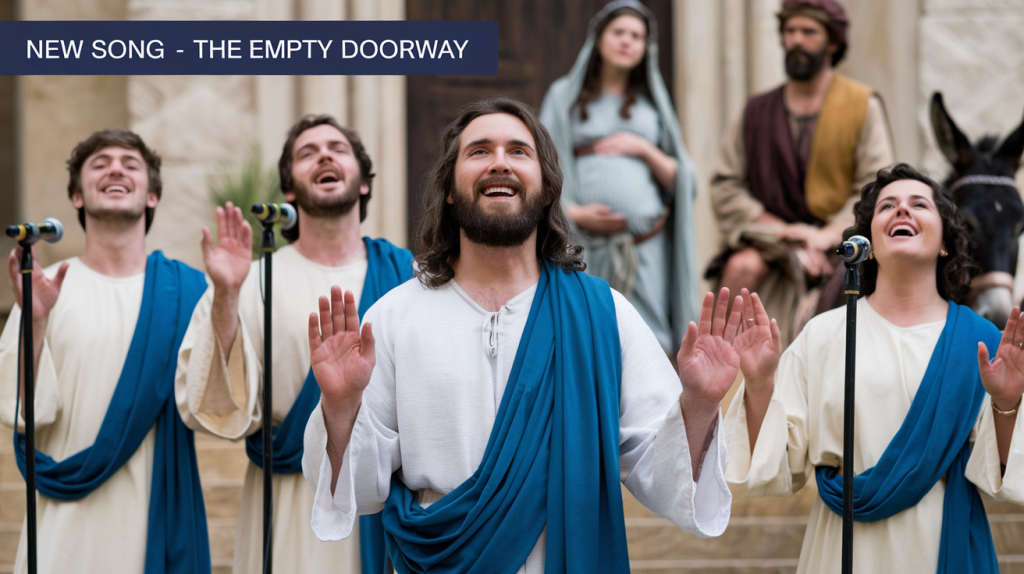
Experience the moving story of Christ’s humble birth with “The Empty Doorway,” a heartfelt worship song that reflects on the rejection and humility surrounding Jesus’ arrival in Bethlehem. This powerful piece brings Luke 2:7 and other biblical scriptures to life, capturing the profound truth of God’s love for humanity.
Through poetic storytelling and rich melodies, “The Empty Doorway” explores the contrast between the world’s rejection of Christ and the eternal hope found in His birth. Let the song inspire worship and deepen your faith as you reflect on the miracle of salvation that began in a lowly manger.
Make Sure You Watch My Video: I would love for you to subscribe to my YouTube channel as well…
How Does “The Crown in the Cradle” Compare to “The Empty Doorway” in Depicting the Christmas Story?
“The Crown in the Cradle” contrasts with “The Empty Doorway” by emphasizing the humble beginnings of Christ while reflecting on His divine destiny. Through its heartfelt lyrics, the crown in the cradle song beautifully intertwines the nativity with themes of kingship, offering a more introspective lens compared to the minimalist tone of “The Empty Doorway.
Song Lyrics
Verse 1:
In the still of the night, beneath Bethlehem’s glow,
A weary young couple with no place to go.
Knocking on doorways, they faced every “no,”
While Heaven looked down on the love they would show.
Verse 2:
The innkeeper shrugged, no room to extend,
No space for a stranger, no kindness to lend.
But the stable stood ready, a cradle of hay,
Where the King of all kings would be born that day.
Chorus:
The empty doorway, a world turned aside,
No room for the Savior, no place to abide.
Yet in the manger, God’s grace would begin,
Born in rejection, salvation within.
Verse 3:
Despised and rejected, foretold long ago,
A child of great sorrow, the world didn’t know.
From the line of King David, so humble, so small,
In the city of promise, He came for us all.
Verse 4:
The cries of a newborn filled the night air,
The hope of creation lay resting there.
Though the world made no room, Heaven’s glory would shine,
Through the humblest birth, God’s perfect design.
Chorus:
The empty doorway, a world turned aside,
No room for the Savior, no place to abide.
Yet in the manger, God’s grace would begin,
Born in rejection, salvation within.
Verse 5:
He was the Maker, yet homeless from birth,
No palace, no riches, no throne of the earth.
But love couldn’t be silenced; it broke through the night,
In the cry of the Savior, God’s radiant light.
Verse 6:
O Bethlehem town, you opened your door,
Not to the grand, but to the poor.
Through your humble stable, redemption took place,
For the world found its hope in the child’s gentle face.
Outro:
The empty doorway still speaks to this day,
Will we make room, or turn Him away?
For in every heart, He seeks to come in,
Born in rejection, yet saving from sin.
The Meaning of “The Empty Doorway”
Introduction: “The Empty Doorway” tells the story of Jesus’ birth in Bethlehem, a humble and profound moment that fulfills centuries of prophecy. It captures the heart of the Christmas story: how the King of kings entered the world in the humblest of circumstances, rejected yet bringing salvation to all. Each verse and chorus in this song unfolds layers of meaning, showing how Jesus’ birth aligns with God’s promises, fulfills Scripture, and foreshadows His ultimate mission.
Verse 1: “In the still of the night, beneath Bethlehem’s glow…”
The first verse sets the stage with Joseph and Mary searching for a place to stay. It draws from Luke 2:7, where Mary gives birth and lays Jesus in a manger because there was no room in the inn. This verse reflects the physical rejection they experienced, foreshadowing Jesus’ later rejection by many (as prophesied in Isaiah 53:3). Despite being the Creator of the world, He found no place to rest in His own creation (John 1:10-11). Yet, the quiet imagery of Bethlehem’s glow reminds us that God’s plan is unfolding, even in the midst of rejection.
Verse 2: “The innkeeper shrugged, no room to extend…”
This verse highlights the indifference and dismissiveness Jesus faced even at His birth. Micah 5:2 foretold Bethlehem’s significance, a small and unimportant town that would host the greatest event in history. The line “the stable stood ready” symbolizes how God uses the humblest settings for His glory, much like He later chose fishermen and tax collectors to carry the message of His kingdom. The manger, a lowly feeding trough, becomes a throne of grace.
Chorus: “The empty doorway, a world turned aside…”
The chorus captures the central theme: the rejection of Jesus at His birth mirrors the world’s tendency to turn away from Him. It echoes Matthew 8:20, where Jesus said He had no place to lay His head, emphasizing His humility and willingness to enter our brokenness. Yet, it also proclaims the triumph of grace—though the world may reject Him, salvation begins in that very moment. The excitement of the chorus reminds us that God’s plan cannot be stopped, even when humanity fails to make room.
Verse 3: “Despised and rejected, foretold long ago…”
Here, the song directly ties Jesus’ rejection at birth to the prophecy in Isaiah 53:3, where the Messiah is described as “despised and rejected of men.” This verse also connects to John 1:10-11, reminding us that the world, which He created, did not recognize Him. The mention of David’s lineage recalls God’s covenant in 2 Samuel 7:12-16, where He promised a ruler from David’s line whose kingdom would last forever—a promise fulfilled in Jesus.
Verse 4: “The cries of a newborn filled the night air…”
This verse reflects the paradox of the Christmas story: the cries of a helpless infant are the sound of the Savior entering the world. This ties to Philippians 2:7, where Paul describes Jesus “making Himself nothing” and taking on human form. The stable may seem insignificant, but it becomes the stage for Heaven’s glory to shine. Just as God’s presence dwelled in a lowly tabernacle in the Old Testament, He now dwells in human flesh, bringing His glory into our midst.
Verse 5: “He was the Maker, yet homeless from birth…”
This verse emphasizes the profound humility of Christ’s incarnation. John 1:3 declares that all things were made through Him, yet He entered the world with no earthly riches or comforts. This reflects Jesus’ later ministry, where He lived among the poor and outcast. His homelessness at birth foreshadows His sacrifice, showing that His mission was never about worldly power but about redeeming humanity.
Verse 6: “O Bethlehem town, you opened your door…”
The final verse circles back to Bethlehem, the city of David, tying together its prophetic and redemptive significance. In Micah 5:2, Bethlehem is described as “little among the thousands of Judah,” yet chosen by God as the birthplace of the Messiah. This verse reminds us that God often works through what seems insignificant. Bethlehem’s stable becomes the birthplace of eternal hope, just as Jesus transforms the lowly into the redeemed.
Outro: “The empty doorway still speaks to this day…”
The song closes by turning the story inward. The “empty doorway” symbolizes the choice each person faces: Will we make room for Jesus in our hearts, or will we turn Him away? Revelation 3:20 echoes this invitation, where Jesus says, “Behold, I stand at the door and knock.” His birth in a manger reflects His humility and willingness to enter our lives, no matter how unprepared we feel.
Foreshadowing and Parallels: The story of Jesus’ rejection at birth parallels many other moments in Scripture:
- Joseph and Mary’s journey to Bethlehem mirrors the exile of Israel and their longing for redemption.
- The rejection at the inn foreshadows Jesus’ rejection during His ministry and at the cross.
- The stable’s lowly setting reflects God’s pattern of using humble means to accomplish great purposes, seen in the lives of Moses, David, and the disciples.
FAQ: 10 Interesting Facts About the Story of Jesus’ Birth and “The Empty Doorway”
1. Why was Jesus born in Bethlehem?
Bethlehem was the prophesied birthplace of the Messiah, as foretold in Micah 5:2. It was also the hometown of King David, emphasizing Jesus’ lineage as the fulfillment of the Davidic covenant (2 Samuel 7:12-16). Joseph and Mary traveled to Bethlehem because of a Roman census, aligning perfectly with God’s plan.
2. What does “no room in the inn” symbolize?
The lack of room in the inn (Luke 2:7) symbolizes humanity’s rejection of Jesus. It foreshadows His later rejection during His ministry (John 1:10-11) and reminds us of the humility He embraced to fulfill His mission (Philippians 2:7). It also reflects a spiritual reality: the challenge of making room for Christ in our lives.
3. Why was Jesus placed in a manger?
A manger, a feeding trough for animals, highlights the humility of Jesus’ birth. This simple setting reflects God’s intentional choice to make salvation accessible to all, not just the wealthy or powerful. The manger also foreshadows Jesus as the “Bread of Life” (John 6:35), offered to sustain and nourish the world.
4. What role does Bethlehem play in biblical prophecy?
Bethlehem, though small and seemingly insignificant, was chosen by God as the birthplace of the Messiah (Micah 5:2). It is referred to as the “City of David,” symbolizing the fulfillment of God’s promise to establish a ruler from David’s line whose kingdom would last forever (Luke 2:4-5).
5. Why were Mary and Joseph in Bethlehem during Jesus’ birth?
Mary and Joseph traveled to Bethlehem to register for a Roman census decreed by Caesar Augustus (Luke 2:1-4). This journey not only fulfilled prophecy but also demonstrated God’s sovereignty in orchestrating events to align with His divine plan.
6. How does Jesus’ birth fulfill Old Testament prophecies?
Jesus’ birth fulfills several key prophecies, including:
- The Messiah would be born in Bethlehem (Micah 5:2).
- He would be born of a virgin (Isaiah 7:14).
- He would be despised and rejected (Isaiah 53:3).
These prophecies highlight the precision of God’s plan and the significance of Jesus as the promised Savior.
7. What does Jesus’ rejection at birth foreshadow?
The rejection at the inn foreshadows the rejection Jesus faced during His ministry and at the cross (John 1:10-11, Isaiah 53:3). From the very beginning, His life was marked by humility and opposition, yet His mission was one of redemption and love.
8. Why is the setting of a stable significant?
The stable symbolizes the humility of Jesus’ arrival and God’s choice to reveal His glory through the lowly. It contrasts with the grandeur expected for a king and demonstrates that God’s kingdom operates differently from human expectations (1 Corinthians 1:27-29).
9. What is the significance of the census?
The Roman census mentioned in Luke 2:1-3 highlights God’s control over historical events. Although the census was a political maneuver by Caesar Augustus, it served to fulfill God’s purpose by bringing Joseph and Mary to Bethlehem, ensuring Jesus’ birth aligned with prophecy.
10. How does this story relate to our lives today?
The story of Jesus’ birth reminds us to make room for Christ in our hearts. Just as there was no room in the inn, many today struggle to prioritize Jesus amidst life’s distractions. The invitation in Revelation 3:20, where Jesus says, “Behold, I stand at the door and knock,” calls us to open our hearts and let Him in.
These fascinating details emphasize the depth and beauty of the Christmas story, showcasing how Jesus’ birth was the fulfillment of God’s divine promises. Each element, from the manger to the prophecy, reveals the humility, sovereignty, and love of God.
Call to Action: The Question That Demands an AnswerIn Acts 2:37 Peter and the Apostles were asked the question – What Shall We do? And in Acts 2:38 Peter answered, Repent, and be baptized every one of you in the name of Jesus Christ for the remission of sins, and ye shall receive the gift of the Holy Ghost. For the promise is unto you, and to your children, and to all that are afar off, even as many as the Lord our God shall call. Do you understand this? After hearing the gospel and believing, they asked what should would do. The answer hasn’t changed friend, Peter clearly gave the answer. The question for you today is, Have you receieved the Holy Spirit Since you believed? If you’re ready to take that step, or you want to learn more about what it means to be born again of water and Spirit, visit: Come, and let the Spirit make you new. |