Quick Overview of This Bible Study…
Short on time? I have created a short slide show presentation of some key takeaways in our study. The complete, more comprehensive bible study is below…
Thirsty Souls and Heavy Stones
Have you ever felt spiritually dry, like your soul is a parched land craving rain? I know I have. Sometimes life piles “stones” of stress, doubt, or guilt over our hearts, and we feel blocked off from the refreshing presence of God.
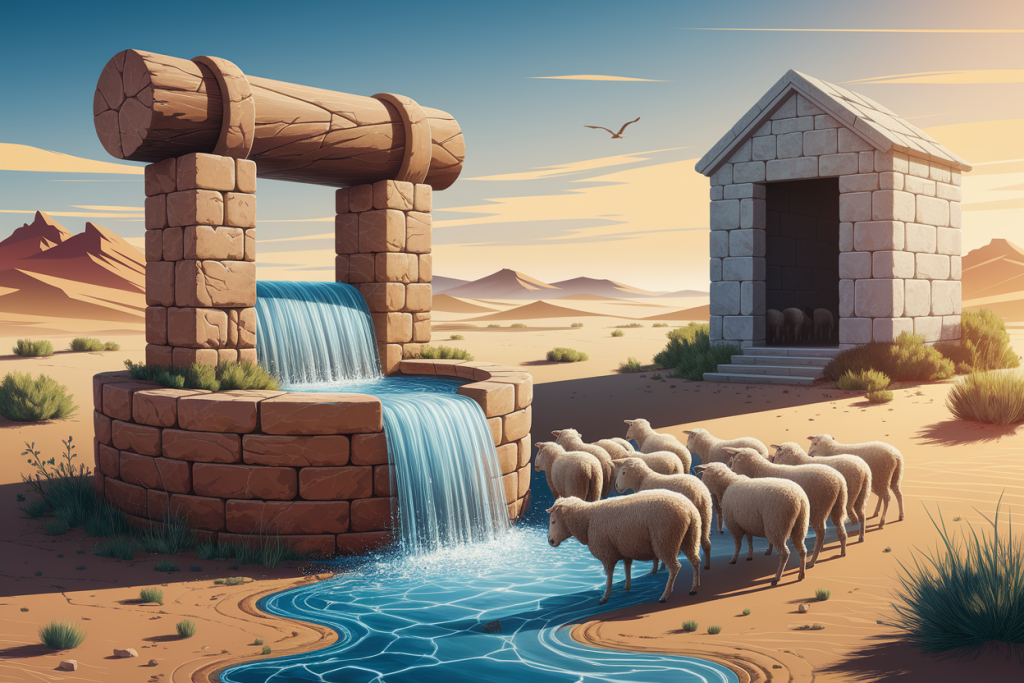
We’re like thirsty sheep standing around a sealed well, longing for water but unsure how to remove the barrier.
In those moments, we can take heart: the Bible is full of stories where God rolls away stones and provides life-giving water to His sheep (that’s us!).
In fact, one ancient scene at a well in Genesis beautifully foreshadows the greatest stone-removal of all time at Jesus’ resurrection. Let’s explore this rich biblical typology together – and find encouragement for our own dry seasons along the way.
Jacob at the Well: Thirsty Sheep and a Rolled Stone
Our journey begins in Genesis 29. Picture Jacob – tired from travel, probably in desperate need of a shower – arriving at a well in Haran. He finds local shepherds waiting to water their flocks.
But there’s a catch: “a great stone was upon the well’s mouth”, covering the water source. The custom was to gather all the flocks, then roll away the stone together.
- In fact, the locals said, “We cannot, until all the flocks be gathered…and till they roll the stone from the well’s mouth; then we water the sheep.”
In other words, this stone was so heavy it normally took a team effort to move it.
Enter Jacob. Upon seeing Rachel (his cousin-to-be and spoiler alert: future wife) arriving with her father Laban’s sheep, Jacob has a burst of inspiration (or maybe just pure adrenaline).
In an impressive feat – perhaps to show off for Rachel – “Jacob went near, and rolled the stone from the well’s mouth, and watered the flock of Laban”.
He does single-handedly what others couldn’t do together.
The guy rolls away the huge stone and generously draws water for all the thirsty sheep. Talk about first impressions!
Jacob’s chivalry at the well wasn’t just ancient Near Eastern flirtation; it was also an act of shepherd-like care. His first concern was, “let me water these sheep so they can drink.”
As a result, this scene overflows (pun intended) with meaning.
- Jacob removes the barrier and provides life-giving water to the flock.
- He also meets his beloved bride at this well.
In one sense, it’s a story of love and hospitality. But in a deeper sense, Christians through the ages have seen a sneak preview here of something God would do on a cosmic scale later on.
It’s as if Genesis 29 is whispering, “One day, another stone will be rolled away and a greater thirst will be quenched.”
The Empty Tomb: Stone Rolled Away, Living Water Unleashed
Fast-forward a few thousand years to a garden tomb outside Jerusalem. Early Sunday morning, a group of women walks toward Jesus’ burial place with heavy hearts and spices in hand.
- On the way they worry, “Who shall roll us away the stone from the door of the sepulchre?”.
- That stone was no small obstacle; the Gospel of Mark notes it was “very great”, similar to the massive well-stone Jacob faced.
These women felt powerless before a barrier too big to budge – and isn’t that relatable? How often do we stare at problems that seem like unmovable boulders, wondering who will help us.
But when the women arrive, surprise! “They saw that the stone was rolled away: for it was very great.” God had sent an angel to do the heavy lifting. That tomb was wide open.
And instead of a dead body, the women encountered an angel declaring Jesus had risen.
In that moment, death was defeated and eternal life burst forth.
- It’s as if the sealed tomb became a well of living water, now flung open for all of us.
- Jesus walked out of that grave victorious, and soon after He would pour out the Holy Spirit – living water – on His followers.
Remember Jacob’s well? When he rolled away the stone, water flowed to satisfy the sheep.
At Jesus’ resurrection, the stone rolled away from the tomb so that Living Water could flow to satisfy God’s sheep (us!).
Jesus often referred to the Holy Spirit and eternal life as “living water.” He promised, “whosoever drinketh of the water that I shall give him shall never thirst”.
And He spoke of believers having “rivers of living water” flowing from within – by this He meant the Spirit living in us.
None of that would be accessible if Jesus stayed sealed in a grave. But He didn’t! The tomb couldn’t hold Him any more than a well-stone could stop Jacob. In fact, Jesus is far greater than Jacob.
When I imagine that Easter morning, I see a beautiful parallel: once again God’s people were like thirsty sheep in need of water, and once again a stone is miraculously removed.
This time it wasn’t just a well of H₂O – it was the fountain of eternal life gushing forth from an empty tomb.
Jesus, our Good Shepherd, stepped out of the grave to lead us to spiritual waters.
Just as Jacob “watered the flock” after rolling the stone, Jesus now calls His sheep to “come and drink.”He provides the water of life. Hallelujah!
Jesus the Living Water and Good Shepherd
Okay, so Jesus is alive – but how do we connect Him explicitly to the “living water” imagery? Let’s look at what Jesus Himself said. In John 4, Jesus met a Samaritan woman at (get this) Jacob’s well!
(Yep, tradition holds it’s the same well Jacob gave to his son Joseph long ago.) There, Jesus told the woman that He could give her “living water” so that she’d never thirst again.
Naturally, she was intrigued (indoor plumbing was not a thing yet). Jesus wasn’t talking about physical H₂O; He meant the eternal life and Holy Spirit that He gives to those who believe.
Earlier He had explained, “Except a man be born of water and of the Spirit, he cannot enter the kingdom of God” (John 3:5, KJV).
And later at a feast He cried out, “If any man thirst, let him come unto me, and drink” – promising that whoever believes in Him, “out of his belly shall flow rivers of living water”. John’s Gospel even adds, “this spake he of the Spirit” (John 7:37-39). So it’s crystal clear: Jesus is the source of Living Water for our souls.
- Not only that, Jesus is also the shepherd of us, His sheep. He said, “I am the good shepherd, and know my sheep” (John 10:14).
- A good shepherd always leads his flock to water. King David rejoiced that “The LORD is my shepherd…he leadeth me beside the still waters.”
Our Lord knows we need sustenance and refreshment.
In fact, the resurrected Jesus immediately took care to commission His disciples as under-shepherds (John 21:15-17, “Feed my sheep”) and breathed on them the Holy Spirit (John 20:22). It’s like He rolled away the stone and said, “Alright flock, drink up!”
- In the book of Revelation, we get a glimpse of Jesus’ shepherding in heavenly glory. It says “the Lamb…shall feed them, and shall lead them unto living fountains of waters”.
Did you catch that? Jesus is called the Lamb (because of His sacrifice) but He’s doing the work of a shepherd, guiding us to fountains of living water.
And ultimately, in eternity, “God shall wipe away all tears” – no more thirst, no more sorrow. What a hope! Until that day, you and I can trust that Jesus right now wants to quench our spiritual thirst. He yearns for us to be filled with the Holy Spirit, experiencing His peace and power even in life’s dry valleys.
Other Well Encounters and Foreshadows in Scripture
The Bible is an interconnected tapestry, with many threads pointing to Jesus. It’s no coincidence that wells and water often show up at crucial moments. Here are a few other connections that tie together the themes of water, wells, stones, sheep, and God’s provision:
Rebekah at the Well (Genesis 24)
In a story strikingly similar to Jacob’s, Abraham’s servant meets Rebekah by a well when seeking a wife for Isaac. Rebekah generously draws water for the servant and all his camels (talk about a workout!).
Her hospitality at the well leads to her becoming the bride of the promised son, Isaac.
This echoes how Christ, the ultimate Promised Son, would one day seek out His bride (the Church).
It’s as if Rebekah’s well-side betrothal is a tiny preview of sinners meeting Jesus and becoming part of His family.
Moses at the Well of Midian (Exodus 2)
Fleeing from Pharaoh, Moses stops by a well in Midian. He finds Jethro’s daughters harassed by rude shepherds, so he drives the bullies away and waters the girls’ flock himself. (Moses basically said, “These ladies will drink and their sheep will too!”)
This act of deliverance at a well led to Moses marrying Zipporah. Once again, a rescuer provides water and finds a bride. Sound familiar?
Jesus, our ultimate Deliverer, came to a spiritually dry world and defended the weak and outcast, offering them living water and calling the Church His bride.
Water from the Rock (Exodus 17 & Numbers 20)
When God’s people wandered thirsty in the desert, God miraculously gave them water from a rock. Moses struck a stone, and streams flowed to satisfy everyone’s thirst (imagine Poland Spring on steroids).
The New Testament reveals the deeper meaning: “They drank of that spiritual Rock that followed them: and that Rock was Christ.” Wow!
The rock was a sneak preview of Jesus being struck (crucified) to give us living water.
It’s a powerful image of how Jesus, our Rock, was broken for our sins so that we could drink the waters of salvation. Every sip from that desert stream was basically shouting “Jesus is coming!”
Jesus and the Samaritan Woman (John 4)
We mentioned this earlier, but it deserves another look. This is the ultimate well encounter, where the greater Jacob (Jesus) sits by Jacob’s well and meets a woman in desperate need of grace.
He tells her about the “well of water springing up into everlasting life” available through Him. Not only does she get a personal revelation of Him as Messiah, but she runs to her town to invite others to come meet Jesus too.
Many have noted how Jesus, in a spiritual sense, “found a bride” among the Samaritans at that well – winning people’s hearts and betrothing them to Himself in faith.
It’s a beautiful fulfillment of all the well romances in the Old Testament. Jesus is the lover of our souls who meets us in our brokenness and offers true satisfaction.
From Genesis to John, God has been in the business of opening access to water and life where there was none. Again and again, stones are removed, whether literal or figurative, and God’s people drink deeply of His goodness.
These patterns aren’t just biblical trivia; they’re meant to boost our faith. They remind us that God sees our thirst and has been planning to quench it all along!
Living Water for Our Dry Days
Maybe you’re reading this and thinking, “That’s cool Bible insight and all, but I feel pretty spiritually dry right now.” Hey, I hear you.
Some days we feel like those sheep waiting around a well, or like the women fretting over the tomb stone, or like that Samaritan woman who had tried everything and was still thirsty in her soul.
Our modern “wells” (careers, relationships, hobbies, you name it) often leave us carrying an empty bucket. We might even put a stone over our heart, sealing off pain inside.
But here’s the good news: Jesus hasn’t changed. The same Lord who met those people at wells, who rolled away that gravestone, He is still at work today!
What “stone” do you need God to roll away?
Is it the weight of anxiety, the shame of past mistakes, or a stubborn situation you just can’t fix? We all have something. The shepherds in Haran said, “We cannot” move that stone – and often, neither can we in our own strength.
But Jesus CAN. In fact, He already did the heaviest lifting by conquering death for you. If He can bulldoze through sin and the grave, He can handle your depression, your debt, your family drama, your health crisis – whatever.
Sometimes I have to remind myself of that: “If God can roll away a 2-ton tombstone, He can surely roll away this burden off my heart.”
The key is, we need to come to the well.
Jesus cries out to us, “If you’re thirsty, come to Me and drink!” It’s an open invitation. No ticket required – just bring your honest, thirsty self.
When we spend time with Him – in prayer, in Scripture, in worship – it’s like taking a long, cool drink of living water. The circumstances outside might still be hot and dry, but something inside us changes.
I’ve experienced it on tough days: I drag myself to God in prayer, feeling empty, and slowly but surely He refreshes my soul.
It’s not a one-time sip either; we keep drawing from His well daily.
Isaiah beautifully foretold this: “Therefore with joy shall ye draw water out of the wells of salvation.”
Did you catch the tone? With joy! We can actually have joy even while pulling up buckets of water from life’s trials, because we know God’s well won’t run dry.
Conclusion: Come and Drink
The story of Jacob rolling away that stone to water sheep is more than a Bible history lesson – it’s a picture of Jesus and what He accomplishes for us. Our Good Shepherd saw us dying of thirst in sin and said, “I’m going to remove every barrier between them and my life-giving Spirit.”
At the cross, Jesus basically shouldered the full weight of that stone (our sin and death) and on resurrection morning He hurled it aside forever. Now the well of salvation is wide open. Jesus, the Living Water, says to each of us, “Drink freely.”
So, my friend, if you feel dry or blocked by something heavy today, take heart. God is still in the business of rolling stones.
Our God still opens wells in deserts and tombs in gardens. He loves to turn places of death into places of life.
The same power that raised Christ from the dead is at work in all who believe (Ephesians 1:19–20), and that means no stone can ultimately stay in your way – not when God’s on the move.
Let’s encourage each other to stay hydrated in the Word and Spirit. When you feel parched, remember Jacob’s well and Jesus’ empty tomb. Remember that Jesus knows your thirst and has already made a way for you to be filled.
You’re not alone at the well; the Lord is sitting there waiting for you, offering a drink. And you’re not standing outside a sealed tomb; that grave is open and full of light now.
In the end, every story – from Genesis to Revelation – invites us to know Jesus more deeply. The more we see Him in these pages, the more our faith and love grow.
I pray that these connections we explored spur you to trust Him with whatever you’re facing. Go ahead – roll your worries onto Jesus, and let His living water flow.
As we draw from the wells of salvation with joy, our once-dry hearts become like a lush garden, “well-watered” and alive. And the best part? There’s plenty of water for all of us. So come to the well, dear one, and drink deeply of His grace. You won’t leave thirsty.
Call to Action: The Question That Demands an AnswerIn Acts 2:37 Peter and the Apostles were asked the question – What Shall We do? And in Acts 2:38 Peter answered, Repent, and be baptized every one of you in the name of Jesus Christ for the remission of sins, and ye shall receive the gift of the Holy Ghost. For the promise is unto you, and to your children, and to all that are afar off, even as many as the Lord our God shall call. Do you understand this? After hearing the gospel and believing, they asked what should would do. The answer hasn’t changed friend, Peter clearly gave the answer. The question for you today is, Have you receieved the Holy Spirit Since you believed? If you’re ready to take that step, or you want to learn more about what it means to be born again of water and Spirit, visit: Come, and let the Spirit make you new. |