
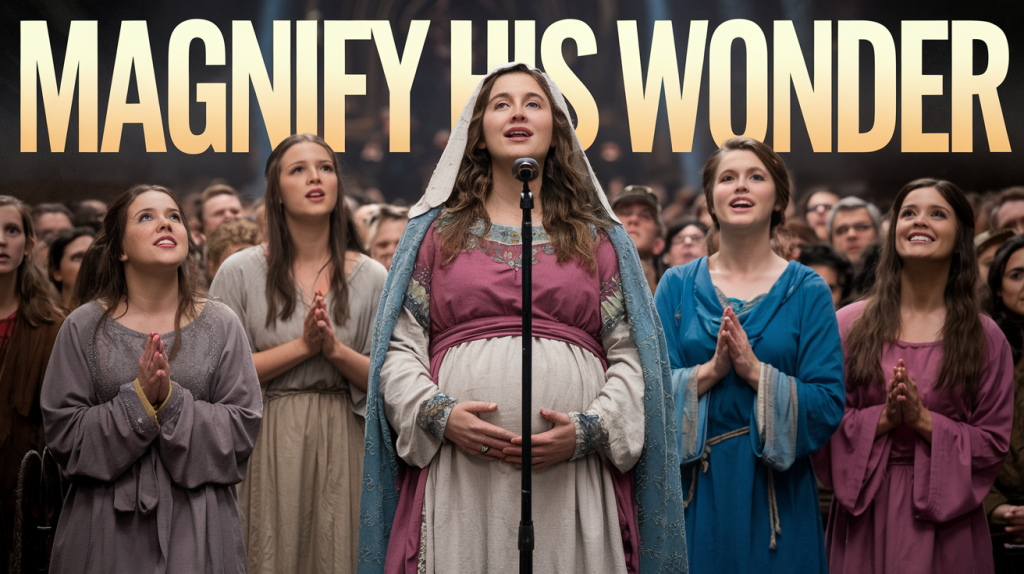
Experience the powerful storytelling of “Magnify His Wonder,” a song inspired by Mary’s faith-filled praise in Luke 1:46-55 and other scriptures that celebrate God’s mercy, power, and promises fulfilled. This worshipful anthem beautifully captures the themes of humility, salvation, and magnifying the Lord through heartfelt lyrics and stirring melodies.
In this video song, you’ll hear the story of Mary’s joy as she exalts God for His mighty works, reflecting on His enduring mercy from generation to generation.
The song weaves together biblical verses from Psalms, Isaiah, Micah, and more, highlighting the wonder of God’s promises and His faithfulness to His people. Let this song inspire you to magnify the Lord in your own life and rejoice in His love!
Make Sure You Watch My Video: I would love for you to subscribe to my YouTube channel as well…
Song Lyrics
Verse 1:
My soul lifts high, the Lord I adore,
His mercy flows forevermore.
He saw His servant, humble and small,
Yet in His grace, He blesses us all.
Verse 2:
The mighty are scattered, their thrones cast down,
The lowly are lifted, the humble crowned.
His mercy endures for those who fear,
Through every age, His love draws near.
Chorus:
Magnify His wonder, let the heavens proclaim,
The God of salvation, forever the same!
From generation to generation, His promise remains,
Magnify His wonder, exalt His holy name!
Verse 3:
The hungry are filled with blessings untold,
The rich sent away, their hands left cold.
His arm is strong, His covenant true,
He remembers His mercy for me and you.
Verse 4:
From Abraham’s seed to the end of the earth,
He fulfills His Word, giving new birth.
The mighty Creator, in Him we rejoice,
We sing of His goodness with one loud voice.
Chorus:
Magnify His wonder, let the heavens proclaim,
The God of salvation, forever the same!
From generation to generation, His promise remains,
Magnify His wonder, exalt His holy name!
Verse 5:
Like Hannah before, I lift my praise,
Rejoicing in God through all my days.
The Rock of salvation, my soul takes flight,
In Him I rejoice, my strength and my light.
Verse 6:
Clothed in salvation, crowned by His hand,
His mercy and love will forever stand.
Through every nation, His glory will shine,
The Savior, the King, forever divine.
Outro:
Magnify His wonder, let the praises ring,
Lift high the name of Jesus, our Savior and King.
Forever exalting, His mercy untold,
Magnify His wonder, His glory behold.
This song captures Mary’s joy, faith, and the fulfillment of God’s promises while incorporating a celebratory tone of worship. Let me know if you’d like further adjustments or expansion!
Exploring “Magnify His Wonder”
An Exciting Look at the Story Behind the Song Inspired by Mary’s Praise
Introduction
The song “Magnify His Wonder” is a powerful reflection of Mary’s response to the angel’s announcement that she would give birth to the Messiah. Based on Luke 1:46-55, this song captures the wonder, humility, and joy of a young woman chosen to be part of God’s plan to redeem the world. Each verse and chorus takes us on a journey through Mary’s song of praise—known as the Magnificat—and connects it to fulfilled prophecies, eternal promises, and the larger story of God’s work in the Bible.
Verse 1: “My soul lifts high, the Lord I adore…”
The opening verse mirrors Mary’s first words in Luke 1:46: “My soul magnifies the Lord, and my spirit rejoices in God my Savior.” This is an outpouring of awe and gratitude, not only for what God has done for Mary but for His faithfulness throughout history. Mary acknowledges her humble status, marveling that the Creator would regard her with favor.
This echoes Psalm 138:6, which states, “Though the Lord be high, yet hath he respect unto the lowly.” It reminds us that God often uses the humble and the overlooked to accomplish His mighty works—just as He did with David, Ruth, and Hannah.
Verse 2: “The mighty are scattered, their thrones cast down…”
In this verse, we see the revolutionary power of God’s work. Mary proclaims that God scatters the proud and lifts up the humble. This recalls Hannah’s prayer in 1 Samuel 2:7-8, where she says, “The Lord makes poor and makes rich; he brings low and lifts up. He raises the poor from the dust.”
Mary’s words also foreshadow Christ’s ministry, where He consistently elevated the meek, the poor in spirit, and those society cast aside. The verse celebrates how God’s Kingdom turns worldly expectations upside down, just as Jesus would later declare in the Beatitudes (Matthew 5).
Chorus: “Magnify His wonder, let the heavens proclaim…”
The chorus bursts with celebration, calling all creation to recognize God’s greatness. It highlights God’s eternal nature and the salvation He brings. This aligns with Isaiah 61:10: “I will greatly rejoice in the Lord; my soul shall be joyful in my God; for he hath clothed me with the garments of salvation.”
The call to magnify God’s wonder mirrors Psalm 34:3: “O magnify the Lord with me, and let us exalt his name together.” It invites every believer to join Mary’s praise, emphasizing that her joy in God’s promises is meant to be shared.
Verse 3: “The hungry are filled with blessings untold…”
This verse reminds us of God’s provision and His justice. Mary rejoices that God fills the hungry but sends the rich away empty, showing that His mercy is for those who depend on Him.
This connects to Psalm 146:7-9, which celebrates God as the one who “giveth food to the hungry” and “relieveth the fatherless and widow.” It also foreshadows Jesus feeding the multitudes (Matthew 14:13-21) and His declaration in John 6:35: “I am the bread of life.” God’s provision is both physical and spiritual.
Verse 4: “From Abraham’s seed to the end of the earth…”
Here, Mary reflects on the fulfillment of God’s covenant with Abraham, where He promised that all nations would be blessed through his seed (Genesis 22:18). The birth of Jesus is the ultimate fulfillment of this promise, as Paul confirms in Galatians 3:16: “Now to Abraham and his seed were the promises made…which is Christ.”
This verse also reminds us that God’s promises are not just for Israel but for all humanity. The song connects Mary’s personal joy to the global, eternal impact of Christ’s birth.
Chorus Revisited: “Magnify His wonder, let the heavens proclaim…”
Revisiting the chorus reinforces the call to worship and awe. It reminds us that the story of Jesus’ birth is not just Mary’s story—it’s the story of all creation rejoicing in God’s salvation plan.
Verse 5: “Like Hannah before, I lift my praise…”
This verse draws a parallel between Mary and Hannah, who both rejoiced in God’s miraculous intervention. In 1 Samuel 2, Hannah’s prayer celebrates the birth of her son Samuel, but it also looks forward to God’s greater redemptive plan. Similarly, Mary’s joy is deeply personal yet profoundly universal.
Both women recognize that God exalts the humble and brings hope to the hopeless. Mary’s connection to Hannah reminds us that God’s story is woven throughout history, pointing to Jesus as the ultimate fulfillment.
Verse 6: “Clothed in salvation, crowned by His hand…”
The final verse celebrates God’s eternal faithfulness. Mary recognizes that His mercy is not fleeting but enduring, from generation to generation (Luke 1:50). This ties to Psalm 103:17: “But the mercy of the Lord is from everlasting to everlasting upon them that fear him.”
The imagery of being “clothed in salvation” reflects Isaiah 61:10 and reminds us that Jesus’ birth is the beginning of a redemptive plan that will ultimately clothe believers in righteousness.
Outro: “Magnify His wonder, His glory behold…”
The outro brings the song to a reflective and triumphant close, inviting listeners to pause and consider the magnitude of what God has done. The glory of Christ’s birth is not just an ancient story—it is a living reality that continues to shape hearts and lives.
Conclusion
“Magnify His Wonder” celebrates Mary’s faith and God’s incredible work through Christ. It connects her words to the prophecies, promises, and themes found throughout Scripture, emphasizing that Jesus is the fulfillment of everything God has spoken. The song invites us to join Mary in magnifying the Lord, rejoicing in His mercy, and celebrating the salvation He offers to all. It’s a call to worship that echoes across time, as relevant today as it was on the night of Christ’s birth.
Let this song inspire you to see the wonder of God’s promises fulfilled and to lift your own voice in praise!
How Does “The Guiding Star” Relate to the Worship Message in Mary’s Song?
Mary’s Song reflects profound devotion and divine purpose, resonating deeply with “the guiding star” that led the wise men’s journey. Just as the star illuminated the path to Christ, Mary’s worship proclaims God’s guidance and faithfulness, uniting celestial direction with heartfelt praise in a tapestry of divine salvation and grace.
10 Interesting Facts About the Story Behind “Magnify His Wonder”
Based on Luke 1:46-55 and the biblical context surrounding Mary’s song of praise.
1. What is the Magnificat?
The Magnificat is the name traditionally given to Mary’s song in Luke 1:46-55. The name comes from the Latin word “Magnificat,” meaning “magnifies,” taken from the first line, “My soul magnifies the Lord.” It is one of the most famous hymns of praise in the Bible and is a profound declaration of God’s mercy, justice, and faithfulness.
2. Why is Mary’s song significant?
Mary’s song is significant because it highlights her deep faith and knowledge of Scripture. Despite being young and in a humble position, she praises God for fulfilling His promises to Israel and the world. Her song shows that she understands the enormity of what God is doing through her—bringing the Savior into the world.
3. How does Mary’s song connect to the Old Testament?
Mary’s song is filled with echoes of Old Testament scripture. It draws heavily from Hannah’s prayer in 1 Samuel 2:1-10, where Hannah praises God after the birth of Samuel. Both women rejoice in God’s mercy, justice, and power, celebrating how He lifts the humble and brings down the proud.
4. What prophecies are fulfilled in this story?
Mary’s song acknowledges the fulfillment of several prophecies:
- The promise to Abraham (Genesis 22:18) that his descendants would bless all nations is fulfilled in Jesus, Mary’s child.
- Micah 5:2 foretells the Messiah would come from humble beginnings in Bethlehem, reflecting God’s pattern of working through the lowly.
- Isaiah 7:14 predicts the virgin birth of Immanuel, fulfilled in Mary’s miraculous conception.
5. Why does Mary call herself “blessed”?
Mary says, “From henceforth all generations shall call me blessed” (Luke 1:48) because of the extraordinary role she plays in God’s plan. She is not boasting but humbly recognizing that God’s choice of her will make her a model of faith for generations to come. Her blessing is a result of God’s mercy and not her own merit.
6. How does Mary’s song emphasize God’s justice?
Mary praises God for scattering the proud, bringing down rulers, and lifting the humble (Luke 1:51-52). This theme reflects God’s heart for justice, showing that His Kingdom upends worldly systems of power and wealth. It foreshadows Jesus’ teachings, such as in the Beatitudes (Matthew 5:3-10), where He blesses the meek and the poor in spirit.
7. What does Mary mean by “the hungry are filled”?
When Mary says, “He hath filled the hungry with good things; and the rich he hath sent empty away” (Luke 1:53), she is celebrating God’s provision for those who rely on Him. This foreshadows Jesus’ ministry, where He feeds the hungry (e.g., the feeding of the 5,000 in Matthew 14:13-21) and teaches about spiritual hunger in John 6:35, “I am the bread of life.”
8. How does Mary’s song reflect God’s mercy?
Mary repeatedly emphasizes God’s mercy, saying it is for “them that fear him from generation to generation” (Luke 1:50). This reminds us of verses like Psalm 103:17, which declare that God’s mercy is everlasting. Mary’s words reassure us that God’s mercy is not limited to one time or people but extends to all who seek Him.
9. What is the role of humility in Mary’s song?
Humility is central to Mary’s song and her story. She calls herself God’s “handmaiden” (Luke 1:48), emphasizing her submission to His will. Mary’s humility reflects a larger biblical theme: God uses the humble to accomplish great things, as seen in the lives of David, Moses, and Ruth.
10. Why is Mary’s song a universal call to worship?
While Mary’s song is personal, it also reflects universal truths about God’s character—His mercy, justice, faithfulness, and provision. Her praise transcends her own story, inviting all believers to magnify the Lord for His great works. This makes the Magnificat not only a celebration of Christ’s birth but also a timeless anthem for all who trust in God’s promises.
These facts highlight the depth and richness of Mary’s song, showing how her words connect to the broader story of God’s redemptive work throughout Scripture. It’s an incredible example of how faith and understanding of God’s Word can lead to worship that echoes through generations.
Call to Action: The Question That Demands an AnswerIn Acts 2:37 Peter and the Apostles were asked the question – What Shall We do? And in Acts 2:38 Peter answered, Repent, and be baptized every one of you in the name of Jesus Christ for the remission of sins, and ye shall receive the gift of the Holy Ghost. For the promise is unto you, and to your children, and to all that are afar off, even as many as the Lord our God shall call. Do you understand this? After hearing the gospel and believing, they asked what should would do. The answer hasn’t changed friend, Peter clearly gave the answer. The question for you today is, Have you receieved the Holy Spirit Since you believed? If you’re ready to take that step, or you want to learn more about what it means to be born again of water and Spirit, visit: Come, and let the Spirit make you new. |