
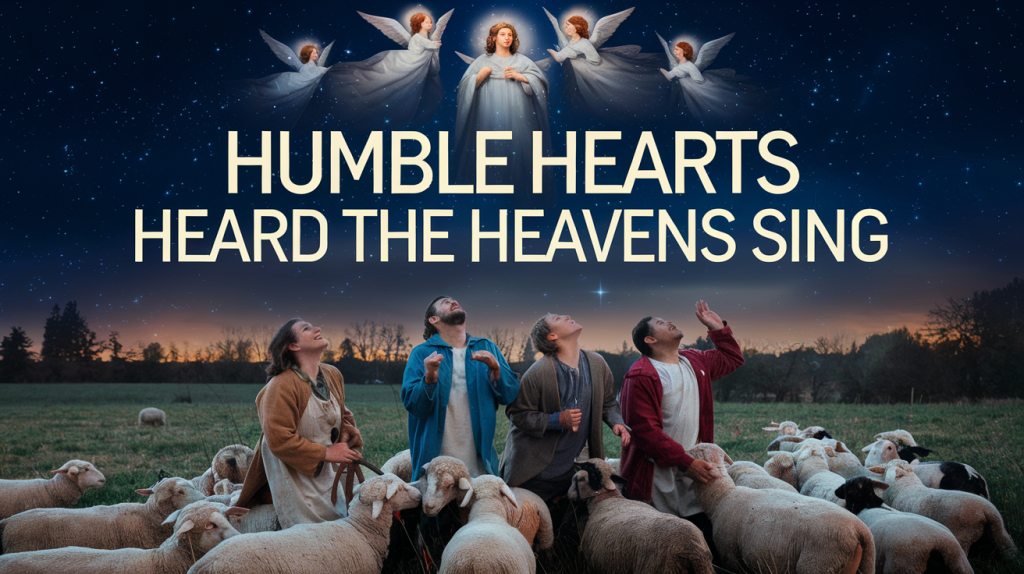
This song, “Humble Hearts Heard the Heavens Sing,” tells the beautiful and awe-inspiring story of the shepherds in the fields as described in Luke 2:8-20. It celebrates how these humble, overlooked individuals became the first witnesses of the greatest announcement in history: the birth of Jesus Christ.
Make Sure You Watch My Video: I would love for you to subscribe to my YouTube channel as well…
Song Lyrics
Verse 1:
In fields so still beneath the night,
Shepherds kept watch by the moon’s soft light.
Their hearts were humble, their eyes unaware,
That heaven would meet them in that open air.
Verse 2:
The skies burst forth, the angels proclaimed,
“Fear not, good tidings we now proclaim!
In David’s city, a Savior is born,
Christ the Lord, this holy morn!”
Chorus:
Humble hearts heard the heavens sing,
Glory to God! Let praises ring!
Peace on earth, goodwill to men,
A Savior has come to Bethlehem.
Verse 3:
The shepherds trembled, the glory so bright,
The fields were ablaze with heavenly light.
“Find the Babe in a manger laid,
Wrapped in love, where hope is displayed.”
Verse 4:
As the angels ascended, their song still near,
The shepherds rose with joy and cheer.
They left their flocks to seek the Lamb,
To kneel before the great I AM.
Chorus:
Humble hearts heard the heavens sing,
Glory to God! Let praises ring!
Peace on earth, goodwill to men,
A Savior has come to Bethlehem.
Verse 5:
In the stable, their eyes beheld,
The promise of ages, Emmanuel.
With worshipful hearts, they knelt in awe,
Before the child who fulfilled God’s law.
Verse 6:
With voices lifted, they spread the news,
The Messiah has come for Gentiles and Jews.
Through humble hearts, His glory shone,
For the world to know, they made Him known.
Chorus:
Humble hearts heard the heavens sing,
Glory to God! Let praises ring!
Peace on earth, goodwill to men,
A Savior has come to Bethlehem.
Outro:
From humble fields to hearts worldwide,
The news of salvation can’t be denied.
Humble hearts still hear heaven sing,
For Christ is our Lord, our Shepherd, and King.
How Does “The King of Creation in Mary’s Hands” Relate to the Themes in “Humble Hearts Heard the Heavens Sing”?
“The king of creation in Mary’s Hands” reflects surrender and divine trust, paralleling the themes of humility and grace in “Humble Hearts Heard the Heavens Sing.” Both works emphasize how surrendering earthly power to divine will creates harmony, showcasing an intertwined relationship between faith, humility, and celestial acknowledgment.
The Story Behind “Humble Hearts Heard the Heavens Sing”
Each verse and chorus are woven together to reflect the fulfillment of prophecy, the glory of Christ’s coming, and the joy it brings to the world.
Introduction: Setting the Stage
The story begins with shepherds, simple and unassuming, watching over their sheep under the stars. These shepherds represent humanity in its humility, yet they are chosen to receive the most glorious news of all time. In this way, the song reflects the biblical truth that God often chooses the lowly to display His glory (1 Corinthians 1:27). Their hearts are prepared—not by their greatness, but by their simplicity and faithfulness—to hear the heavens sing.
Verse 1: “In fields so still beneath the night…”
The first verse paints the peaceful yet unremarkable setting of the shepherds. They are tending their flocks as they always do, unaware of the divine encounter awaiting them. This verse mirrors how God often meets us in the ordinary moments of life, just as He called Moses from a burning bush while tending sheep (Exodus 3:1-4).
The phrase “heaven would meet them in that open air” foreshadows the extraordinary encounter with the angels. It reflects God’s pattern of bringing His presence to those least expecting it, a theme echoed throughout Scripture.
Verse 2: “The skies burst forth, the angels proclaimed…”
The second verse recounts the angelic announcement, echoing Luke 2:10-11:
“Fear not: for, behold, I bring you good tidings of great joy, which shall be to all people. For unto you is born this day in the city of David a Saviour, which is Christ the Lord.”
This moment fulfills the prophecy of Micah 5:2, which foretold that the Messiah would be born in Bethlehem. The angel’s proclamation is significant because it declares Jesus not just as a baby, but as Christ the Lord, the promised Savior and King. The excitement in this verse reflects the awe and magnitude of this momentous event.
Chorus: “Humble hearts heard the heavens sing…”
The chorus is a triumphant celebration of the shepherds’ experience. The angelic choir’s song—”Glory to God in the highest, and on earth peace, good will toward men” (Luke 2:14)—emphasizes the peace Jesus brings to a broken world.
The phrase “peace on earth, goodwill to men” recalls Isaiah 9:6-7, where the Messiah is described as the Prince of Peace, whose reign will bring justice and righteousness forever. This chorus is a joyful acknowledgment that Jesus has fulfilled this promise.
Verse 3: “The shepherds trembled, the glory so bright…”
This verse captures the shepherds’ fear and awe as the glory of the Lord shines around them. Their reaction is reminiscent of Moses’ encounter with God on Mount Sinai, where the glory of the Lord was overwhelming (Exodus 33:20-23). Yet, unlike Moses, these shepherds are not called to climb a mountain—they are invited to meet the Savior directly.
The angels’ instructions to find the baby wrapped in swaddling clothes and lying in a manger emphasize Jesus’ humility. The King of Kings is born not in a palace but in the simplest of places, foreshadowing His life of humility and service (Philippians 2:6-8).
Verse 4: “As the angels ascended, their song still near…”
This verse portrays the shepherds’ immediate response: they leave their flocks to seek the Savior. Their eagerness reflects the proper response to God’s call. The shepherds’ journey parallels the wise men’s later pilgrimage (Matthew 2:1-12), as both groups seek Jesus with joy and faith.
The verse also highlights how God chooses unexpected witnesses. Shepherds, considered lowly in society, are entrusted with proclaiming the Messiah’s arrival. This is a recurring theme in Scripture, where God exalts the humble (Luke 1:52).
Chorus (Repeated): “Humble hearts heard the heavens sing…”
Revisiting the chorus reinforces the awe and joy of the moment. It serves as a reminder that the message of peace and salvation is for all people, regardless of status or position.
Verse 5: “In the stable, their eyes beheld…”
This verse shifts the focus to the shepherds’ encounter with Jesus. The stable scene reflects the prophecy of Isaiah 7:14:
“Behold, a virgin shall conceive, and bear a son, and shall call his name Immanuel.”
The name “Immanuel” means “God with us,” underscoring the profound truth that God has come to dwell among His people.
This humble setting contrasts with the glory of the angels, highlighting the dual nature of Christ as both divine and approachable.
Verse 6: “With voices lifted, they spread the news…”
The shepherds’ response is to share the good news with everyone they meet (Luke 2:17-18). Their joy and urgency mirror the Great Commission in Matthew 28:19-20, where Jesus commands His followers to spread the gospel to all nations.
This verse also reflects the transformative power of encountering Christ. The shepherds, once fearful and ordinary, become bold messengers of God’s glory, much like the apostles after the resurrection (Acts 4:13).
Outro: “From humble fields to hearts worldwide…”
The outro brings the song to a reflective close, connecting the shepherds’ experience to our own lives. Just as the shepherds’ humble hearts heard the heavens sing, we too are invited to receive the message of Christ’s birth with awe and joy.
The phrase “Christ is our Lord, our Shepherd, and King” ties together the themes of Jesus as the Good Shepherd (John 10:11) and the eternal King (Micah 5:4, Isaiah 9:7). It reminds us that the message of Christmas is not just historical—it is alive and relevant for all who believe.
Conclusion: The Fulfillment of Joy and Prophecy
“Humble Hearts Heard the Heavens Sing” captures the excitement and wonder of the shepherds’ encounter with the angels and the newborn Savior. It celebrates the fulfillment of ancient prophecies, the joy of God’s redemptive plan, and the peace that Christ brings to the world.
The story of the shepherds reminds us that God meets us in our humility and invites us to partake in His glory. Their story becomes our story as we respond to Christ’s coming with worship, joy, and a desire to share the good news. The song beautifully ties together the scriptural themes of humility, divine glory, and salvation through Christ.

10 Interesting Facts About the Shepherds and the Angelic Announcement
Here’s a list of frequently asked questions (FAQ) with fascinating insights about the story of the shepherds and the angelic announcement of Christ’s birth, based on Luke 2:8-20 and related Scriptures.
1. Why did God choose shepherds to receive the announcement of Jesus’ birth?
Shepherds were considered humble, lowly, and often overlooked in society, yet God chose them to highlight His pattern of exalting the humble (Luke 1:52). Their role as caretakers of sheep also symbolized Jesus’ identity as the Good Shepherd (John 10:11) and the sacrificial Lamb of God (John 1:29). This choice emphasizes that the good news is for all people, not just the elite.
2. What does the angelic announcement signify in the larger biblical narrative?
The angel’s proclamation, “Good tidings of great joy, which shall be to all people” (Luke 2:10), reflects God’s promise to Abraham that all nations would be blessed through his lineage (Genesis 12:3). The announcement fulfills prophecies about the Messiah’s arrival bringing peace and salvation (Isaiah 9:6-7, Micah 5:2).
3. Why were the shepherds afraid when they saw the angels?
When the glory of the Lord shone around them (Luke 2:9), the shepherds were “sore afraid” because encountering God’s presence was often overwhelming in Scripture. This reaction mirrors others who encountered divine glory, such as Moses on Mount Sinai (Exodus 33:20) or Isaiah’s vision of the Lord (Isaiah 6:5). The angel reassures them with “Fear not,” reflecting God’s invitation to approach Him through Christ.
4. What is the significance of Bethlehem in this story?
Bethlehem, known as the “City of David,” fulfills the prophecy of Micah 5:2 that the Messiah would be born there. It is also where King David was anointed, symbolizing the Messiah’s lineage and eternal kingship. The humble setting of Bethlehem contrasts with the grandeur one might expect for a king’s birthplace.
5. Why did the angels appear to shepherds at night?
The nighttime setting emphasizes the contrast between darkness and light. The angelic announcement fulfilled Isaiah 9:2, which says, “The people that walked in darkness have seen a great light.” This theme of Jesus as the Light of the World (John 8:12) underscores His mission to bring spiritual illumination.
6. What is the meaning of “goodwill toward men” in Luke 2:14?
The angelic chorus declares peace and goodwill, highlighting the reconciliation between God and humanity through Christ. This peace is not merely the absence of conflict but a deep, spiritual peace promised in Isaiah 9:6-7. It signifies God’s favor toward those who accept His gift of salvation.
7. Why is it important that the shepherds found Jesus in a manger?
Finding Jesus in a manger fulfills the angel’s specific instructions (Luke 2:12) and underscores His humility. The manger, a feeding trough for animals, symbolizes Jesus as the Bread of Life (John 6:35), offering sustenance and life to all who come to Him.
8. How does this story connect to other shepherds in the Bible?
Shepherding is a recurring theme in Scripture. Moses, David, and even God Himself are depicted as shepherds (Exodus 3:1, 1 Samuel 16:11, Psalm 23:1). Jesus identifies as the Good Shepherd (John 10:11), tying this role to His care, protection, and sacrifice for His people.
9. Why did the shepherds immediately spread the news?
The shepherds’ reaction reflects the transformative power of encountering Christ. They couldn’t keep the good news to themselves (Luke 2:17). This foreshadows the Great Commission (Matthew 28:19-20), where Jesus commands His followers to spread the gospel.
10. How does this story fulfill Old Testament prophecies?
This story fulfills multiple prophecies:
- Micah 5:2: The Messiah would be born in Bethlehem.
- Isaiah 7:14: The Messiah would be born of a virgin and called Emmanuel.
- Isaiah 9:6-7: A child would be born to bring peace and establish God’s eternal kingdom.
- Psalm 23 and Isaiah 40:11: The shepherd imagery reflects God’s care and the Messiah’s role as both shepherd and lamb.
Call to Action: The Question That Demands an AnswerIn Acts 2:37 Peter and the Apostles were asked the question – What Shall We do? And in Acts 2:38 Peter answered, Repent, and be baptized every one of you in the name of Jesus Christ for the remission of sins, and ye shall receive the gift of the Holy Ghost. For the promise is unto you, and to your children, and to all that are afar off, even as many as the Lord our God shall call. Do you understand this? After hearing the gospel and believing, they asked what should would do. The answer hasn’t changed friend, Peter clearly gave the answer. The question for you today is, Have you receieved the Holy Spirit Since you believed? If you’re ready to take that step, or you want to learn more about what it means to be born again of water and Spirit, visit: Come, and let the Spirit make you new. |