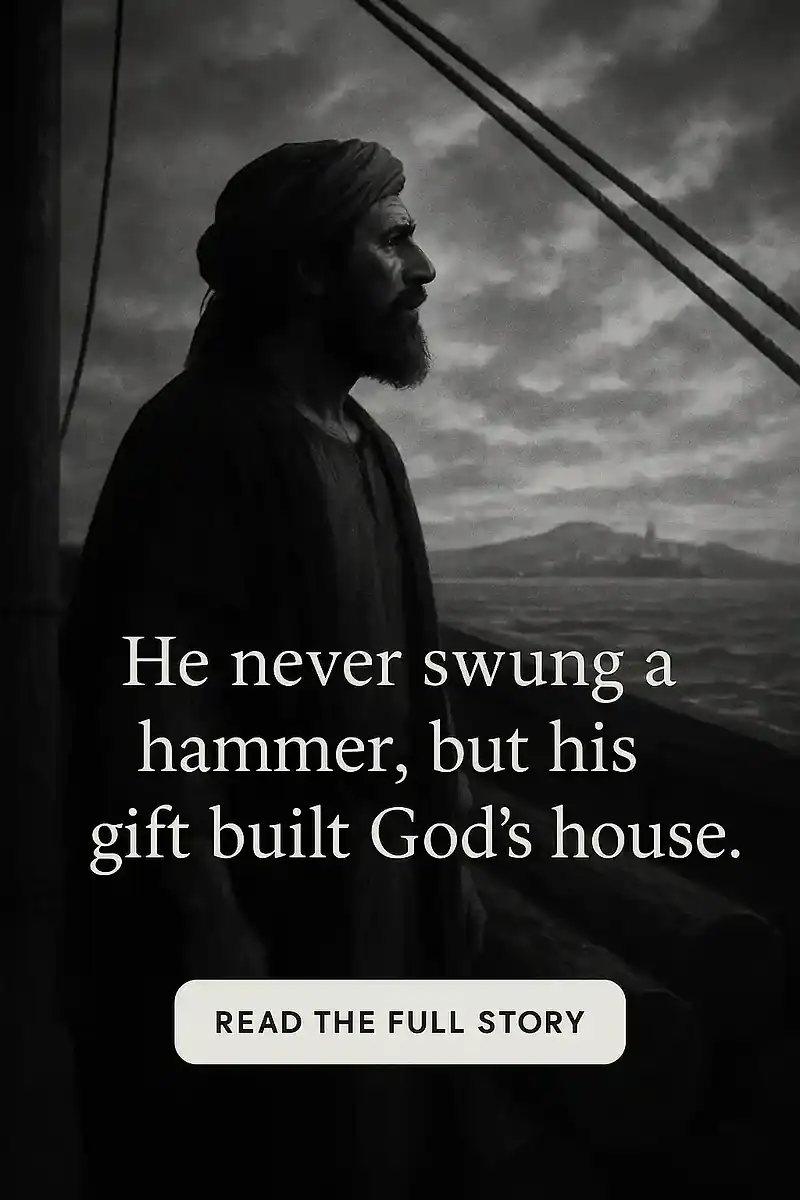
He Never Swung a Hammer – But His Gift Built God’s House
The Quiet King Beyond the Border
Before the first stone was laid, before Solomon ever raised his hand to bless the work, another man was already at work – miles away, across the sea. His name was Hiram, king of Tyre. A Gentile. A foreigner. A man with no covenant claim to Israel’s promises. Yet when the time came for God’s house to rise, it was Hiram’s forests that answered the call.
In his port city of Tyre, ships rocked in rhythm against the shore, heavy with cedar from Lebanon. Hiram’s people were craftsmen of the sea – traders, builders, men who knew how to take what was hidden in the heights and bring it down to the hands of men. But this time, it wasn’t just business. This was about friendship – and something far greater than he understood.
Hiram had known David. The Scripture says he “sent messengers to David, and cedar trees, and carpenters, and masons: and they built David an house.” David, the man after God’s own heart. That alliance had lasted years, born not out of politics but respect. And when David died, Hiram reached out to his son Solomon, saying, “I loved David your father.”
The echo of that love would soon build a house not for a king, but for the King of kings.
A Friendship Carved in Cedar
In Solomon, Hiram saw the same spirit he’d seen in David – humility mixed with greatness. The letter Solomon sent was both practical and holy: “You know that there is no one among us that can hew timber like the Sidonians.” He wasn’t flattering Hiram; he was acknowledging God’s wisdom beyond his own borders.
It’s easy to think of the Temple as purely Israel’s story – but this is where the world quietly joined in. Hiram’s kingdom supplied the trees, the labor, the ships. His men cut the cedar, floated it down to Joppa, and delivered it to Jerusalem. In return, Solomon provided wheat, oil, and wine – a covenant of provision for provision.
There’s beauty in that exchange. One gave what grew tall and strong in his land; the other gave what nourished life in his. Isn’t that still how the Kingdom works? One gives strength, the other sustenance, and both become part of something eternal.
The Timber That Touched Heaven
Every log cut from Lebanon carried more than the scent of cedar – it carried prophecy. For what they built wasn’t just stone and wood; it was a symbol of the dwelling place of God among men.
Picture those logs stacked and shipped, rolling in the waves, carried from Gentile soil to holy ground. The cedars of Lebanon, mentioned again and again in Scripture, were a picture of majesty and endurance. “The righteous shall flourish like the palm tree: he shall grow like a cedar in Lebanon.”
Those same cedars would stand as pillars in the Temple. The fragrance filled the courts. Worship rose from golden altars. The house of the Lord shone brighter than any kingdom on earth.
And Hiram’s wood held it all together.
He may never have seen it finished. He may never have walked its courts or heard the Levites sing. But every time a priest stepped into that holy place, his obedience whispered through the grain of every beam.
When Gentile Hands Built Holy Work
There’s something deeply humbling about that. The first Temple – the most sacred space on earth – was built with the help of a man outside the covenant line. And yet God allowed it. Welcomed it. Even wove it into His redemptive pattern.
Hiram didn’t have to be Jewish to play his part in God’s story. He just had to be willing.
That should make every believer pause. God’s plans are never limited to our borders. He uses strangers, skeptics, and distant allies to move His work forward. Some may never see the fruit of their contribution, but heaven keeps record.
Sometimes you’re Hiram – called to give what you have so someone else can build what God has planned.
The Exchange of Kings
When Hiram received Solomon’s request, Scripture says he “rejoiced greatly.” He wasn’t pressured; he was honored. His words back to Solomon were almost prophetic: “Blessed be the LORD this day, which hath given unto David a wise son over this great people.”
Think about that – this Gentile king praised the God of Israel. He saw the hand of the Lord and spoke blessing over it. That’s not politics; that’s revelation.
Their alliance became a model of what God would one day do through Christ – uniting Jew and Gentile in one house, one body, one Spirit. Long before the cross, God was already building bridges through timber and trust.
Every Board Was an Offering
The Temple wasn’t built overnight. Years of work, thousands of men, countless resources – but every detail mattered. The cedar beams were cut, shaped, and fitted to divine measurements given to Solomon by God Himself.
The sound of hammers echoed across Jerusalem. The smell of sawdust and oil filled the air. Each board carried fingerprints – human effort woven with holy purpose.
And when the last board was placed, the Ark of the Covenant entered, and the glory of the Lord filled the house so powerfully that the priests couldn’t even stand to minister.
That’s what obedience builds – glory beyond human effort.
Lessons from a Foreign King
When you think of Hiram, think of faith expressed through generosity. He didn’t preach sermons or prophesy over kings, but he did what he could with what he had. That’s the kind of worship God still honors.
We tend to think the spotlight is where faith lives – but sometimes it’s in the quiet shipments, the hidden labor, the unseen contributions that make the miracle possible.
Hiram’s gift reminds us that partnership in God’s plan looks like stewardship of what’s already in your hands. You may not be Solomon, but your obedience can still hold up the work of God in your generation.
The House and the Heart
Solomon’s Temple was eventually destroyed. The gold stripped, the stones broken, the cedar burned. But what it pointed to could never be lost.
Centuries later, another Son of David came – not to build with cedar, but with people. Jesus said, “Destroy this temple, and in three days I will raise it up.” He was speaking of His body – the true dwelling of God among men.
And just as Hiram’s hands helped raise a house for the Lord, our faith now becomes part of His living temple. The Apostle Peter wrote, “You also, as lively stones, are built up a spiritual house.”
We’re not just spectators; we’re structure.
When Christ Became the True Cornerstone
The alliance between Solomon and Hiram foreshadowed the greater reconciliation Christ would bring. The Gentile king’s timber helped build a holy dwelling; Christ’s cross – also made of wood – became the bridge between heaven and earth.
The cedar upheld the Temple; the cross upheld salvation.
The scent of that old wood in Solomon’s day hinted at something more – the sweet savor of obedience, the fragrance of sacrifice that pleased the Lord. Every beam pointed to the greater Builder who would one day lay down His life to make His Father’s house accessible to all.
The Final Reflection
The story of Hiram of Tyre isn’t about cedar alone – it’s about connection. A foreign king heard a divine invitation and answered it with generosity. He sent what he had, and heaven turned it into worship.
Maybe that’s your story, too. You may never stand on a platform or lead a crowd, but your obedience might hold up someone else’s calling. Your gift, your faith, your small act of yes – those are the unseen timbers in God’s greater house.
Because every offering, every sacrifice, every partnership that exalts the Lord becomes a fragrant cedar beam in His eternal story.
And long after the buildings crumble, the fragrance remains.
MANIFESTO: The Faith of the One Who Built Without Entering
You don’t have to stand in the spotlight to be part of God’s story. Sometimes, faith looks like building from a distance, giving what’s in your hands when you’ll never see how it’s used. That was Hiram of Tyre’s kind of faith – a faith that gave, trusted, and obeyed without needing to be seen.
He didn’t walk the courts of the Temple. He didn’t hear the priests sing or see the glory cloud fill the house. But he sent what he had – cedar from his mountains, labor from his people, skill from his craftsmen – and God turned it into worship. That’s the quiet kind of obedience that shakes heaven.
We live in a world that worships visibility. Everyone wants credit, applause, results they can post. But the Kingdom doesn’t run on credit; it runs on faith. The hidden givers, the unseen servants, the ones who keep building while no one’s watching – these are the ones who move the story forward. Hiram’s name may not headline the Scriptures, but his timber held up the holiest place on earth.
Your offering matters like that. Your obedience may not be glamorous, but when you give what God’s placed in your hands – your time, your voice, your craft, your kindness – it becomes something eternal. Maybe you’re not Solomon with the vision, but maybe you’re Hiram with the provision. Both are vital.
God’s Kingdom is built on partnership. It’s the carpenter and the king, the prophet and the builder, the one who prays and the one who pays, all woven together by obedience. The moment you say “yes” to what God asks of you, you step into that holy chain.
So give like Hiram. Build like someone who believes the unseen matters. Trust that your obedience today becomes the structure someone else will stand on tomorrow.
Because one day, when the final house is complete – the living Temple made of every believer through Christ – you’ll see that every board, every sacrifice, every act of love you offered in faith was part of something greater than you ever imagined.
You may never step inside the Temple you helped build, but heaven already counts you among its builders.
Call to Action: The Question That Demands an AnswerIn Acts 2:37 Peter and the Apostles were asked the question – What Shall We do? And in Acts 2:38 Peter answered, Repent, and be baptized every one of you in the name of Jesus Christ for the remission of sins, and ye shall receive the gift of the Holy Ghost. For the promise is unto you, and to your children, and to all that are afar off, even as many as the Lord our God shall call. Do you understand this? After hearing the gospel and believing, they asked what should would do. The answer hasn’t changed friend, Peter clearly gave the answer. The question for you today is, Have you receieved the Holy Spirit Since you believed? If you’re ready to take that step, or you want to learn more about what it means to be born again of water and Spirit, visit: Come, and let the Spirit make you new. |