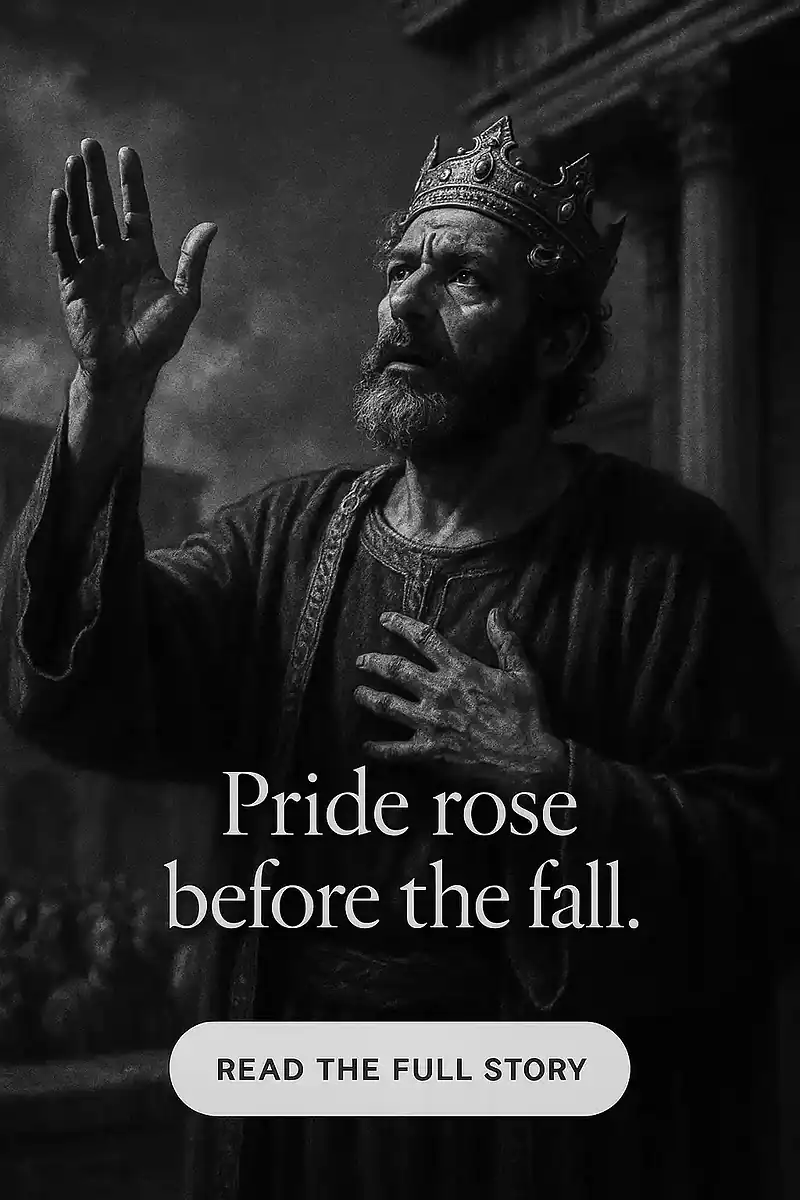
The Crown That Cost Too Much
He thought the applause could make him immortal. The crowd was roaring, the robe was gleaming like the sun, and every word that fell from their lips was like honey to his heart: “It is the voice of a god, and not of a man!”
But pride has a strange appetite. It devours the one who feeds it.
Herod Agrippa I was not the first to wear a crown and forget Who gave it. Yet his story stands out because God let his downfall unfold in front of everyone – as if heaven itself wanted to show what happens when man steals glory meant for God.
A Dangerous Popularity
Agrippa had been born into privilege and politics. Grandson of Herod the Great, the same ruler who tried to kill baby Jesus, Agrippa grew up in the shadow of fear and ambition. He learned early that survival came from pleasing powerful people. He befriended emperors, flattered nobles, and climbed the slippery ladder of Roman politics until the empire rewarded him with the throne over Judea.
The Jews admired him because he tried to act like one of them. He followed their customs, spoke their language, and visited their festivals. But Agrippa’s devotion wasn’t to God – it was to approval. The moment he saw how much praise he could earn by persecuting Christians, he traded mercy for momentum.
He noticed the people were pleased when he arrested followers of Jesus, so he went further. James, the brother of John – one of the sons of thunder – was dragged out and executed by the sword. It was a political move, but heaven took note.
The Chain That Couldn’t Hold Peter
Herod saw how killing James boosted his popularity, so he decided to double it by seizing Peter. It was Passover week, the same season when another innocent man had once been condemned. Peter was chained between soldiers in a guarded prison – sixteen men to watch one preacher.
Herod was sure this would make the crowd love him. But while Herod plotted, the church prayed. They didn’t protest, they didn’t panic – they prayed without ceasing to God.
And in the quiet hours of the night, when no one expected it, heaven moved. A light filled the cell, an angel appeared, and Peter’s chains fell to the ground. He walked past guards who didn’t even stir. Iron gates opened by themselves. The same God Herod ignored was setting His servant free right under Herod’s nose.
The next morning, chaos broke loose. The guards were baffled, Peter was gone, and Herod was furious. He interrogated his men, then executed them. But Herod’s real problem wasn’t Peter’s escape – it was his own pride.
The Praise That Poisoned
Sometime later, Herod traveled to Caesarea to deal with a dispute between his kingdom and the cities of Tyre and Sidon. The people needed food from his territory, so they gathered to flatter him. They came dressed in their best, hoping to win his favor.
Herod saw the opportunity. He put on his royal robe – historians say it shimmered with silver threads that caught the morning sun. He stepped onto the stage, the light danced across his garment, and the crowd gasped. Then they shouted, “It is the voice of a god, and not of a man!”
He could have stopped them. He could have pointed upward and said, “Give glory to God.” But instead, he smiled. He soaked in the praise like it was worship he deserved.
At that very moment, the Bible says, “The angel of the Lord smote him, because he gave not God the glory: and he was eaten of worms, and gave up the ghost” (Acts 12:23).
It didn’t happen later, not quietly in his bed. It happened right there, before the people whose cheers had fed his ego. The one who loved the sound of his own praise died with none left to offer it.
The Throne That Turned to Dust
The same crowd that once adored him watched in horror as the man they had called a god was struck down. The robe that had shimmered like the sun became a shroud of shame. Pride had devoured him – literally and spiritually.
But the story doesn’t end in despair. Because while Herod fell, the Word of God rose. Acts tells us, “But the word of God grew and multiplied.” The persecutor died; the gospel lived. Kings come and go, but the Kingdom stands.
The Warning Hidden in the Applause
There’s something about human praise that feels addictive. Maybe that’s why Agrippa’s story hits so close to home. We might not sit on a throne, but pride still whispers the same lie – “You deserve the glory.”
We feel it when someone compliments our work, our success, or our faith. There’s that subtle temptation to keep the spotlight just a little longer instead of pointing it back to God. Pride doesn’t always wear a crown; sometimes it hides behind a smile.
Agrippa’s story is a warning to every believer that no achievement, no applause, no position is worth losing the favor of God. The moment we crave glory more than obedience, we step onto dangerous ground.
The Church That Outlasted Kings
While Herod lay dying, Peter was alive and preaching. The church he tried to crush was stronger than ever. The prayers that rose from frightened believers had become the very sound that shook prisons and toppled pride.
It’s almost poetic: Herod wanted to silence God’s people, but his own voice was the one that was silenced. The man who wore the silver robe fell before the One who clothes Himself in light.
And all through history, that pattern repeats – the proud fall, the humble stand.
The Lesson for Our Time
Pride still kills. It may not strike instantly like it did with Agrippa, but it eats from the inside out – our peace, our gratitude, our dependence on God. The moment we start believing our own praise, the worms of self-glory start their quiet work.
Humility, on the other hand, makes room for God to dwell. When we choose to give Him glory instead of grabbing it, heaven leans closer. God resists the proud but gives grace to the humble.
Agrippa’s story isn’t just about judgment – it’s about warning wrapped in mercy. It tells us, “Don’t wait to give God glory later.” Every breath, every victory, every moment of applause is borrowed air. It belongs to Him.
The King and the True King
Herod Agrippa wore a robe of silver; Jesus wore a robe stained with blood. Herod took life to please men; Jesus gave His life to save them. Herod sought glory and found decay; Jesus humbled Himself and was exalted forever.
That’s the contrast heaven wants us to see. Pride always dies trying to live like a god. Humility lives forever because it bows to the real One.
When we look at Agrippa’s end, we see more than judgment – we see a mirror. And when we turn from that mirror to Christ, we see hope.
For one king was eaten by worms.
But the King of kings walked out of a tomb.
And His glory will never fade.
MANIFESTO: THE GLORY BELONGS TO GOD ALONE
We live in a world obsessed with applause. It’s everywhere – on stages, on screens, in the secret corners of our hearts. We crave it, chase it, and sometimes, without even noticing, start to believe we deserve it. But Herod Agrippa’s story reminds us that applause can be poison when swallowed instead of redirected. Pride doesn’t just ruin kings – it ruins anyone who starts believing the light belongs to them instead of the Lord.
Herod wore silver to shine before men. Jesus bore scars to shine before God. One sought honor and fell; the other chose humility and rose. The contrast couldn’t be clearer. Heaven doesn’t cheer for the proud. Heaven crowns the humble.
So this is our declaration – our stand in a culture that worships self and forgets the Source. Every victory, every gift, every breath is borrowed. Every good thing in our hands comes from the hands that were pierced for us. We will not trade God’s glory for human approval. We will not chase the crowd’s praise when the whisper of His “Well done” is worth infinitely more.
Let this be the anthem of our lives:
The glory belongs to God alone.
When success comes, we’ll point upward. When people praise, we’ll deflect it to the One who deserves it. When pride whispers, we’ll remember the king who was eaten alive by his own vanity – and the Savior who was lifted up by His humility.
The robe of pride rots. The robe of righteousness endures.
Let our lives shimmer not with silver but with surrender.
Let every word, every work, every witness say the same thing –
To God be the glory, forever and ever.
Call to Action: The Question That Demands an AnswerIn Acts 2:37 Peter and the Apostles were asked the question – What Shall We do? And in Acts 2:38 Peter answered, Repent, and be baptized every one of you in the name of Jesus Christ for the remission of sins, and ye shall receive the gift of the Holy Ghost. For the promise is unto you, and to your children, and to all that are afar off, even as many as the Lord our God shall call. Do you understand this? After hearing the gospel and believing, they asked what should would do. The answer hasn’t changed friend, Peter clearly gave the answer. The question for you today is, Have you receieved the Holy Spirit Since you believed? If you’re ready to take that step, or you want to learn more about what it means to be born again of water and Spirit, visit: Come, and let the Spirit make you new. |