
Quick Overview of This Bible Study…
Short on time? I have created a short slide show presentation of some key takeaways in our study. The complete, more comprehensive bible study is below…
If you’ve ever felt confused or even a bit intimidated by the topic of the Holy Spirit, you’re not alone. Many of us wonder who the Holy Spirit really is and how He works in our everyday lives.
In our day-to-day spiritual struggles – feeling weak, seeking guidance, craving comfort – the Bible shows that the Holy Spirit is God’s personal presence and help for us.
The King James Version (KJV) of Scripture, with its classic wording (“Holy Ghost” and “Holy Spirit”), paints a rich picture of the Spirit’s role.
Let’s walk through the Bible together in a friendly, conversational way, and discover what God’s Word says about the Holy Spirit.
Along the journey, we’ll look at the names of the Holy Spirit, how we’re instructed to live in the Spirit, biblical examples of His work (from Genesis to Revelation), the blessings He brings, powerful symbols that describe Him, and how the Old Testament promises and patterns point to New Testament fulfillment through the Spirit.
Names and Titles of the Holy Spirit in Scripture
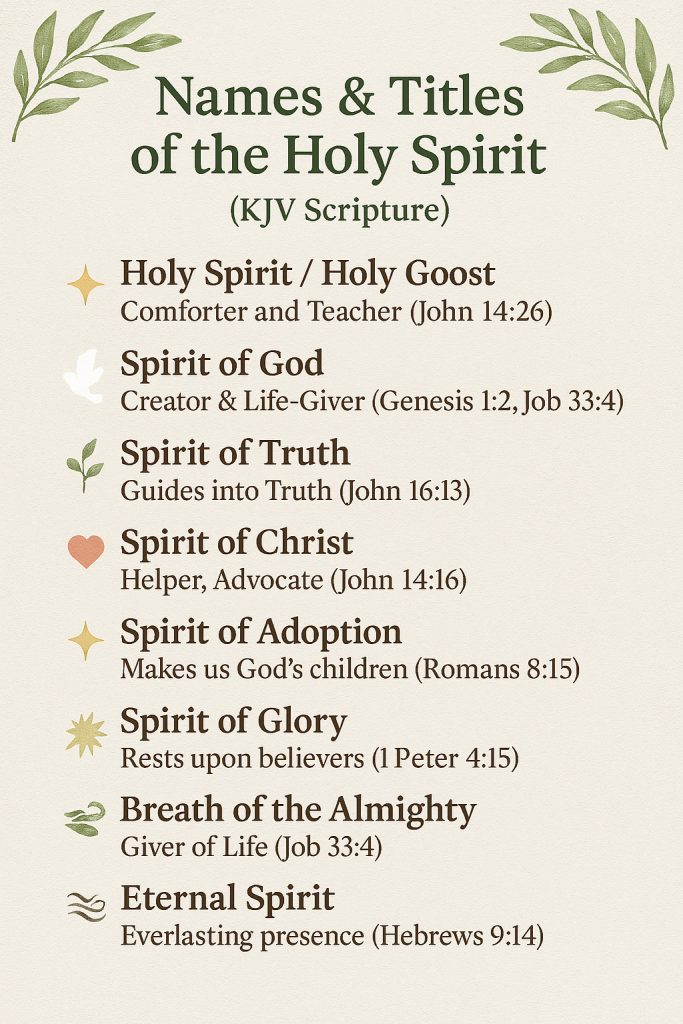
One of the best ways to get to know someone is by learning their names or titles – and the Holy Spirit has quite a few in the Bible! Each name reveals something about His character or work. Here are some of the main ways the Holy Spirit is referred to in Scripture (with KJV verses):
Holy Spirit / Holy Ghost:
In the KJV, the third Person of the Trinity is often called the Holy Ghost (especially in the New Testament) or the Holy Spirit. These mean the same divine Spirit of God.
For example, Jesus promises, “the Comforter, which is the Holy Ghost, whom the Father will send in my name, he shall teach you all things” (John 14:26, KJV).
David in the Old Testament prayed, “take not thy holy spirit from me” (Psalm 51:11, KJV), showing even then the Spirit’s presence was precious. Whether we say Holy Spirit or Holy Ghost, we’re talking about God’s holy presence moving and active.
Spirit of God / Spirit of the LORD:
The Bible often emphasizes the Holy Spirit as God’s Spirit. In the very second verse of the Bible, we meet Him: “the Spirit of God moved upon the face of the waters” at creation (Genesis 1:2).
He is also called the Spirit of the LORD, especially in the Old Testament when God’s Spirit empowered someone.
For instance, when David was anointed king, “the Spirit of the LORD came upon David from that day forward” (1 Samuel 16:13). Calling Him Spirit of God or Spirit of the Lord reminds us that He is fully divine, one with the Father and Son.
Comforter (Helper, Advocate):

On the night of the Last Supper, Jesus comforted His anxious disciples by telling them He would send “another Comforter” (John 14:16).
Comforter is a translation of the Greek word Paraklete, meaning one called alongside to help. Jesus said this Comforter is the Holy Ghost who will abide with us forever, teaching and reminding us of Jesus’ words.
The Holy Spirit is literally our divine Helper. When you feel alone or weak, remember Jesus promised “I will not leave you comfortless” because the Spirit, the Comforter, is with us (John 14:18).
Spirit of Truth:

Jesus also called the Holy Spirit “the Spirit of truth”. “When He, the Spirit of truth, is come, He will guide you into all truth” (John 16:13, KJV).
The Holy Spirit embodies truth and leads us to truth – especially truth about Jesus (who is “the way, the truth, and the life”). In a world of confusion and lies, God’s Spirit speaks to our hearts what is true, aligning us with God’s Word.
Spirit of Christ:
Interestingly, the New Testament sometimes calls the Holy Spirit the Spirit of Christ. Romans 8:9 says, “Now if any man have not the Spirit of Christ, he is none of His.”
This title shows the unity of Jesus and the Spirit – having the Holy Spirit is how Jesus Himself lives in us. In fact, the Spirit’s mission is to glorify Christ and make Him known to us (John 16:14).
The apostle Peter even writes that the Old Testament prophets had the “Spirit of Christ” in them, pointing to the sufferings of Jesus long before He came. So, the Spirit of God is also the Spirit of the Son; when you have the Holy Spirit, you have Jesus’ presence with you.
Other Titles:
Scripture gives many other beautiful names for the Holy Spirit, each highlighting a different facet of His work.
- He’s called the “Spirit of adoption” because by Him we become God’s children, crying “Abba, Father” (Romans 8:15).
- He is the “Spirit of holiness” (Romans 1:4)
- the “Spirit of grace” (Hebrews 10:29)
- the “Spirit of glory” who rests on suffering believers (1 Peter 4:14).
- He is the “Eternal Spirit” (Hebrews 9:14), reminding us that He is uncreated and divine.
- He’s even poetically called the “breath of the Almighty” (Job 33:4), since the word for Spirit in Hebrew ( ruach ) and Greek ( pneuma ) can mean breath or wind.
All these names and images help us understand that the Holy Spirit is God Himself, working in power, holiness, truth, comfort, and life.
Think of it this way: God the Father is for us, God the Son (Jesus) is God with us, and God the Holy Spirit is God in us. He’s not an “it” or a vague force; He is a personal divine He – the Bible consistently describes the Spirit with personal terms (teaching, guiding, feeling grief, etc.).
The Holy Spirit is as much God as the Father and Son are, and yet He’s intimately involved in our daily Christian life. As Charles Spurgeon once remarked, “Without the Spirit of God, we can do nothing. We are as ships without wind. We are useless.” quotefancy.com.
That’s how crucial the Holy Spirit is! Now that we know who the Holy Spirit is by name, how do we relate to Him in daily life? That’s what we’ll explore next.
Living by the Spirit: Key Biblical Instructions for Believers
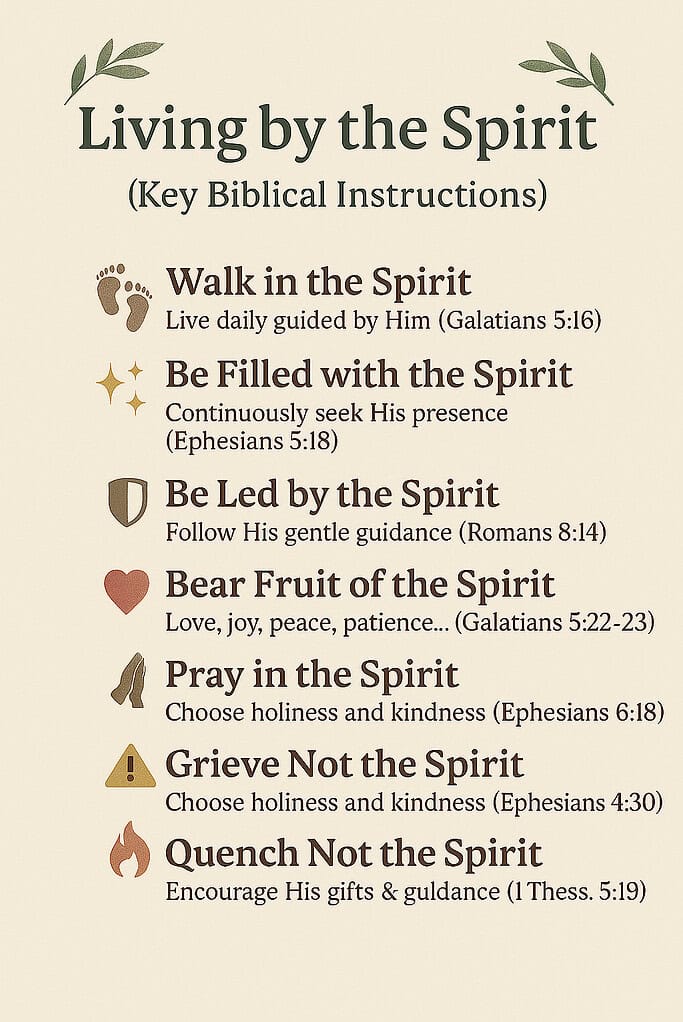
Once we trust in Christ, the Bible says we receive the Holy Spirit (see Ephesians 1:13, believers are “sealed with that Holy Spirit of promise”).
But having the Holy Spirit is not meant to be a one-time event or a passive possession – it’s the beginning of a new way of life.
The New Testament is full of practical instructions for Christians about how to live in the Spirit. If you’re longing to grow in your walk with God, paying attention to these Spirit-related commands is vital. Let’s look at a few:
“Walk in the Spirit”

– Galatians 5:16 says, “This I say then, Walk in the Spirit, and ye shall not fulfil the lust of the flesh.” To walk in the Spirit means to live each day step by step under the Holy Spirit’s guidance and influence.
Picture walking down the road with God’s Spirit as your guide – you set your direction and pace to match Him. We all feel the tug-of-war inside between doing wrong (the “lusts of the flesh”) and doing right.

If we follow the Holy Spirit’s prompting, we “shall not fulfill” those wrong desires. It’s not about trying harder in our own strength, but rather keeping in step with the Spirit (Gal. 5:25) who gives us strength.
Practically, this might look like praying throughout your day, listening for that quiet conviction or encouragement He gives through Scripture, and obeying promptly when He nudges your heart.
“Be led by the Spirit”

– Similar to walking with Him is being led by Him. “For as many as are led by the Spirit of God, they are the sons of God” (Romans 8:14).
God’s children have the privilege of being led by God’s own Spirit, like a shepherd leading sheep. This means in our decisions and paths, we pray and yield to the Holy Spirit’s direction.
He might lead through a verse that speaks to your situation, through an inner conviction, or through wise counsel that aligns with Scripture. When you’re unsure what to do, ask the Holy Spirit for guidance – He delights in guiding God’s children.
“Be filled with the Spirit”

– The Apostle Paul gives this clear command: “And be not drunk with wine, wherein is excess; but be filled with the Spirit” (Ephesians 5:18). To be filled means to be under the Spirit’s influence and full of His presence.
Paul contrasts it with being drunk on wine – when someone is drunk, the alcohol controls their speech and actions; likewise, we should let the Holy Spirit so fill us that He directs our words, thoughts, and actions.
Being filled with the Spirit isn’t a one-time thing; the verb implies an ongoing process – “keep on being filled.”
We leak and get distracted, so we need continuous refilling by surrendering to Him daily. (It’s okay to admit to God, “Lord, I feel empty – please fill me afresh with Your Spirit today.” He will!)
“Do not grieve the Holy Spirit”

– Ephesians 4:30 warns believers, “And grieve not the holy Spirit of God, whereby ye are sealed unto the day of redemption.”
This shows the Holy Spirit isn’t an impersonal force; He can feel sorrow or grief. When we, as Christians, live in sin, bitterness, or disunity, we hurt the Holy Spirit’s heart.
Think of a loving friend who is pained when they see you making harmful choices – the Spirit is that friend, because He loves us. Conversely, when we obey God and love others, we please the Spirit.
So, if you’ve ever felt a conviction inside after speaking harshly or doing something dishonest, that’s likely the Spirit letting you know, “That made Me sad; it’s not fitting for who you are.” We respond by confessing and turning back to behaviors that honor God.
“Quench not the Spirit”
– In 1 Thessalonians 5:19 we’re instructed, “Quench not the Spirit.” This imagery is of putting out a fire.
The Holy Spirit’s presence in us is often compared to a flame (He set hearts “on fire” with love and zeal). To quench Him would be to stifle or suppress His work.
For example, if the Spirit prompts you to pray, to praise, or to speak a word of encouragement or prophecy, and you repeatedly ignore or suppress that impulse, it’s like pouring water on the flame.
Instead, God invites us to keep fanning into flame the Spirit’s work – welcome His guidance and stir up the gifts He’s given. Don’t suppress those holy urges to worship, serve, or speak truth.
“Bear the Fruit of the Spirit”
– When we live closely with the Spirit, our lives will naturally begin to display what Paul calls “the fruit of the Spirit”.
These are Christ-like character qualities that the Holy Ghost produces in us, like a tree bearing fruit. Galatians 5:22–23 lists them: “But the fruit of the Spirit is love, joy, peace, longsuffering, gentleness, goodness, faith, meekness, temperance: against such there is no law.”.
Who wouldn’t want more of those in their life, right? It’s interesting that it’s fruit (singular), not “fruits” – meaning all these qualities grow together as we grow in the Spirit.
It’s not by our effort alone; an apple tree doesn’t strain to pop out apples – it bears fruit by staying rooted and nourished. Likewise, as we abide in Christ and stay yielded to the Spirit, He changes us from the inside.
Over time, you might look back and realize, “Wow, I’m more patient than I used to be,” or others will notice “there’s such peace and kindness about her” – that’s the Holy Spirit’s fruit, not our flesh.
“Pray in the Spirit”
– Prayer is one of the primary ways we cooperate with the Holy Spirit. The Bible encourages us to “pray in the Holy Ghost” (Jude 1:20) and “pray at all times in the Spirit” (Ephesians 6:18). This means allowing the Spirit to guide your prayers and even empower them.
Romans 8:26 gives us a comforting insight: “the Spirit also helpeth our infirmities: for we know not what we should pray for as we ought: but the Spirit itself maketh intercession for us with groanings which cannot be uttered.”.
Have you ever been so burdened or confused you didn’t know how to pray? In those moments, the Holy Spirit steps in to help, translating our tears or sighs into effective prayer before the Father.
Praying in the Spirit could include praying Scripture that He brings to mind, yielding to His agenda in prayer rather than a wish list, or even praying in tongues (a gift He gives some for prayer and praise – see 1 Corinthians 14:15).
The core idea is: don’t pray by yourself – pray with the Holy Spirit’s help and leading.
These are just some of the ways Scripture teaches us to live by the Spirit. It’s a lifelong adventure of learning to listen to His voice through the Word, obey His gentle promptings, and depend on His power rather than our own. It’s not always easy – we all stumble.
But remember, the Spirit is called the Helper for a reason! He is patient and will keep working in us. The more we yield and trust, the more we’ll find the truth of A.W. Tozer’s words: “The Spirit-filled life is not a special, deluxe edition of Christianity. It is part and parcel of the total plan of God for His people.” gracequotes.org.
In other words, a “Spirit-filled Christian” shouldn’t be the rare exception; it’s meant to be the normal Christian life. And it can be normal for you and me as we invite Him to fill us each day.
Now, let’s deepen our study by seeing the Holy Spirit in action throughout the Bible. We’ll look at some powerful examples of His work in both the Old and New Testaments, and see how amazingly consistent God’s Spirit is from Genesis to Revelation.
The Holy Spirit in the Old Testament: Power, Prophecy, and Presence
When we think of the Holy Spirit, many of us jump straight to the New Testament – Pentecost, the early Church, etc. But did you know the Holy Spirit was actively working from the very beginning?
The Old Testament (OT) is full of references to God’s Spirit. While the experience of the Holy Spirit was somewhat different before Jesus (e.g. the Spirit wasn’t yet given to all believers in an indwelling way kingjamesbibleonline.org), He was certainly present and powerful.
Here are some key examples and themes of the Spirit’s work in the Old Testament:
Creation Life-Giver:
The Holy Spirit was present at Creation. In Genesis 1:2 we read, “And the Spirit of God moved upon the face of the waters.”
Picture a dark, formless earth and the Spirit of God hovering like a nurturing bird, ready to bring order and life.
Job 33:4 echoes, “The Spirit of God hath made me, and the breath of the Almighty hath given me life.”.
So, from the start, the Spirit is the Giver of life – physical life in creation, and later we learn He’s the giver of spiritual life (being “born of the Spirit,” John 3:6).
If you’ve ever watched a sunrise or felt a baby’s tiny heartbeat and sensed God’s presence, that’s the Creator Spirit at work.
Empowering Leaders and Heroes:
Throughout the OT, the Spirit of the Lord would “come upon” certain people to empower them for a task or office. For example, the judges who saved Israel showed supernatural strength or boldness when God’s Spirit came on them.
“The Spirit of the LORD came upon Gideon” before he led a tiny army to victory (Judges 6:34). “And the Spirit of the LORD came mightily upon Samson” giving him strength to defeat Israel’s enemies (Judges 14:6).
When God chose kings or prophets, He often anointed them with oil as a sign of the Spirit coming upon them. David is a prime example: when Samuel anointed young David with oil, “the Spirit of the LORD came upon David from that day forward” (1 Samuel 16:13).
But when King Saul turned his back on God, “the Spirit of the LORD departed from Saul” (1 Samuel 16:14).
In the OT, the Spirit’s presence with someone was a sign of God’s favor and empowerment. David even begged God, after his sin, “take not Thy Holy Spirit from me” (Psalm 51:11).
Unlike in the New Covenant, where Jesus promises the Spirit will abide with us forever (John 14:16), in those days the Spirit’s anointing could be withdrawn if the person rejected God.
This is why David was so desperate in that prayer. The takeaway for us: Any ability to truly serve God or overcome enemies (even our spiritual enemies like sin) comes from the Holy Spirit’s power, not our own.
Zechariah 4:6 says, “Not by might, nor by power, but by my Spirit, saith the LORD of hosts.” We see that truth lived out in the stories of the OT heroes.
Prophets and Scripture:
The Holy Spirit was the source of prophecy and Scripture in the OT. The prophets often prefaced their messages with phrases like “The Spirit of the LORD spoke through me” or “came upon me.”
For instance, Ezekiel says, “the Spirit entered into me when He spake unto me” (Ezek. 2:2), and he was lifted in visions by the Spirit. Isaiah wrote, “The Lord GOD and His Spirit hath sent me” (Isa. 48:16).
Perhaps one of the clearest is King David’s last words: “The Spirit of the LORD spake by me, and His word was in my tongue” (2 Samuel 23:2).
So when you read those powerful prophecies in Isaiah or Jeremiah, recognize it was the Holy Ghost giving the message through human vessels.
In fact, the New Testament later confirms, “holy men of God spake as they were moved by the Holy Ghost” (2 Peter 1:21, speaking of the OT Scriptures).
That means the author of Scripture is the Holy Spirit Himself! This gives us great confidence – the same Spirit who lives in us is the one who inspired the Bible we read. He can interpret and apply it to our hearts, since He wrote it.
God’s Presence with Israel:
The Holy Spirit sometimes appears in the OT as the very presence of God among His people. When Israel was in the wilderness, God led them with a pillar of cloud by day and fire by night – not explicitly called the Spirit, but it was a manifest presence of God.
Later on, Isaiah reflecting on that time said, “They vexed His Holy Spirit: therefore He was turned to be their enemy... Where is He... that put His Holy Spirit within [Moses]?” (Isaiah 63:10-11).
This is a fascinating passage indicating that God’s Spirit was with Moses and Israel, and their rebellion grieved or vexed the Spirit (sounds like Ephesians 4:30, doesn’t it?).
Another example: when Moses was overwhelmed with leadership, God took “of the spirit that was upon [Moses], and gave it unto the seventy elders” so they all prophesied (Numbers 11:25).
This sharing of the Spirit was a temporary help, but it foreshadowed a future day when God’s Spirit would be shared among all God’s people (we’ll see that prophecy next).
Also, craftsmen like Bezalel were said to be “filled with the Spirit of God” to have wisdom and skill in building the Tabernacle (Exodus 31:3). How cool is that?
The Spirit’s not only for preaching and fighting battles – He also empowers artistic and practical skills for God’s glory.
Promise of Something More:
Through all these snapshots, the Old Testament also creates a sense of anticipation – that a fuller outpouring of the Spirit is coming.
Prophets like Joel declared God’s word: “And it shall come to pass afterward, that I will pour out my spirit upon all flesh; and your sons and your daughters shall prophesy, your old men shall dream dreams, your young men shall see visions” (Joel 2:28).
This was radical because, as we saw, under the Old Covenant typically only certain individuals (prophet, priest, king, etc.) experienced the Spirit’s anointing. But Joel foresaw a time when all God’s people, young or old, male or female, would receive the Spirit.
Similarly, Ezekiel prophesied of God’s New Covenant promise: “A new heart also will I give you... and I will put My Spirit within you, and cause you to walk in My statutes” (Ezek. 36:26-27).
God was saying: a day is coming when My very own Spirit will live inside My people, empowering them to live righteously from the inside out, not by external law alone.
The stage was set. By the end of the Old Testament, faithful Israelites were waiting for the Messiah (Anointed One) and the outpouring of the Holy Spirit that would transform their relationship with God.
Before we move on, maybe you’re thinking: That’s great history, but does the Spirit work differently now? There are some differences after Christ (we’ll cover in a moment), but one thing is the same: our need for the Holy Spirit’s work.
Whether it was David needing strength to slay Goliath, or you needing strength to face today’s “giants” (temptations, fears, trials), it’s the same Spirit who provides the power.
When you read the Psalms and hear the heart-cries for God’s presence, that hunger is met for us by the indwelling Holy Spirit.
The God of the Old Testament is the same God today – and His Spirit still “giveth life” and victory. Keep that in mind as we now turn to the New Testament, where the Holy Spirit takes center stage in a new and exciting way.
The Holy Spirit in the New Testament: From Jesus to the Early Church
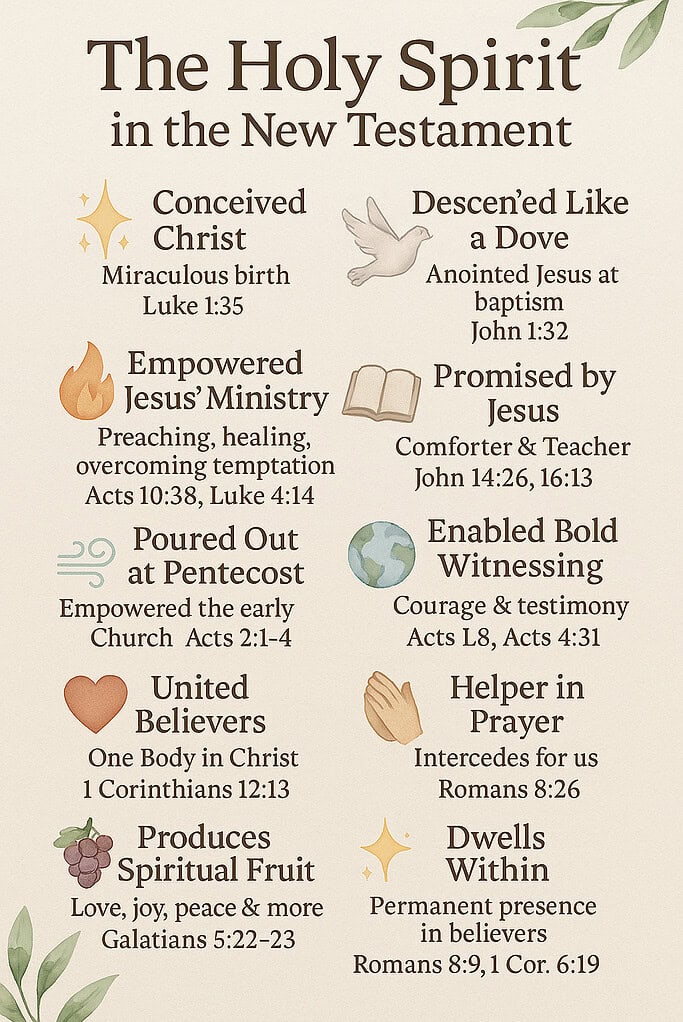
The New Testament (NT) is sometimes called the “Age of the Spirit,” and for good reason. With the coming of Jesus the Messiah and His completed work of salvation, the Holy Spirit is given more fully to God’s people.
Nearly every page of the NT testifies to the Spirit’s presence – from Jesus’s own life and ministry, to the birth of the Church at Pentecost, to the instructions for Christian living. Let’s highlight some key aspects of the Holy Spirit’s work in the NT:
Jesus Conceived and Anointed by the Spirit:
- The very entrance of Jesus Christ into the world was by the Holy Spirit. The angel told Mary that the Holy Ghost would “come upon” her so that she, a virgin, would miraculously conceive the Son of God (Luke 1:35).
- So Jesus’s birth was a Spirit-empowered miracle. Fast forward 30 years: at Jesus’s baptism in the Jordan, the Holy Spirit visibly came upon Him “like a dove”, and the Father’s voice from heaven affirmed Jesus as His Son.
- John the Baptist knew Jesus was the One because he saw “the Spirit descending from heaven like a dove, and it abode upon Him” (John 1:32). The dove is a beautiful symbol of the Spirit (gentle, pure, bringing peace – more on symbols later).
- Right after His baptism, “Jesus being full of the Holy Ghost” was “led by the Spirit” into the wilderness (Luke 4:1) where He overcame Satan’s temptations.
- Then Jesus returned “in the power of the Spirit” to begin preaching (Luke 4:14). In His very first sermon, Jesus read the prophecy, “The Spirit of the Lord is upon Me, because He hath anointed Me…” (Isaiah 61:1, quoted in Luke 4:18bible-topics.com).
- Peter later summarized Jesus’s ministry by saying, “God anointed Jesus of Nazareth with the Holy Ghost and with power: who went about doing good, and healing… for God was with Him” (Acts 10:38).
What does this tell us?
If Jesus himself, the Son of God, carried out His ministry in the power of the Holy Spirit, how much more do we need the Spirit’s power! The perfect, sinless Jesus relied on the Spirit moment by moment as an example for us of Spirit-filled living.
Teaching about the Spirit:
Jesus taught His disciples extensively about the Holy Spirit, particularly in the Gospel of John chapters 14–16, because He knew He would return to the Father and they (and we) would need the Spirit as our ongoing helper.
He said the Spirit “dwelleth with you, and shall be in you” (John 14:17) – indicating a coming change.
He also said it was actually better for Him to go away, because then the Comforter would come (John 16:7). Imagine that – the disciples were sorrowful at the idea of Jesus leaving, but He basically said, “Trust Me, you want this Gift I’m sending.”
The Holy Ghost would do many things:
- teach us, remind us of Jesus’s words (John 14:26)
- testify of Jesus (John 15:26)
- guide us into all truth and even show us things to come (John 16:13)
- and convict the world of sin, righteousness, and judgment (John 16:8-11).
Importantly, the Spirit would not draw attention to Himself, but glorify Jesus (John 16:14).
It’s like the Spirit shines a big spotlight on Jesus so we can know and love our Savior more. So, while some Christians today fear or misunderstand the Holy Spirit, we should remember Jesus Himself enthusiastically promised and endorsed the Spirit’s work.
The Spirit is not an “extra” – He’s the very presence of Jesus with us. Jesus even breathed on the disciples after His resurrection and said, “Receive ye the Holy Ghost” (John 20:22), a foretaste of what would fully happen at Pentecost.
Pentecost: The Holy Spirit Poured Out on the Church:
This is the game-changing moment in history. In Acts chapter 2, after Jesus ascended to heaven, He fulfilled the promise of the Father by pouring out the Holy Spirit on His followers.
The day was the Jewish festival of Pentecost (50 days after Passover). The disciples were all praying together, “and suddenly there came a sound from heaven as of a rushing mighty wind, and it filled all the house where they were sitting”.
Then “there appeared unto them cloven tongues like as of fire, and it sat upon each of them”. Wind and fire – two powerful symbols of the Spirit’s presence – accompanied this moment. “And they were all filled with the Holy Ghost” (Acts 2:4).
Immediately, those believers experienced a dramatic sign: they spoke in other languages (“tongues”) they hadn’t learned, as the Spirit enabled them, declaring God’s works.
A crowd of Jews from various nations heard them speak in their native languages and were astonished. Peter then stood up, full of the Spirit’s boldness, and preached about Jesus’s death and resurrection.
He explained to the crowd, “this is that which was spoken by the prophet Joel” – pointing them back to Joel’s prophecy that God would pour out His Spirit on all flesh.
Indeed, it was being fulfilled!
Thousands believed in Christ that day and were baptized, and “they received the gift of the Holy Ghost” as well (Acts 2:38).
Pentecost marks the birth of the Church, and the star of Acts is arguably the Holy Spirit, empowering believers to be the Body of Christ in the world.
The Early Church and Beyond:
From Acts onward, we see the Holy Spirit orchestrating everything. He’s not a mere background force; He is personally guiding:
- He speaks (Acts 8:29 the Spirit told Philip to approach the Ethiopian’s chariot
- Acts 13:2 the Spirit said “Separate Barnabas and Saul for the work...”)
- He comforts (Acts 9:31, the churches walked “in the comfort of the Holy Ghost”)
- He fills and emboldens (Acts 4:31, believers were filled and spoke God’s word boldly
- Acts 7:55, Stephen “being full of the Holy Ghost” saw a vision of Jesus even as he was martyred)
- and He even can be lied to (Acts 5:3-4 Ananias lied about the offering and Peter said he lied to the Holy Ghost, equating the Spirit with God).
- The Spirit broke down barriers – He fell upon the Gentiles in Cornelius’s house just as on the Jews (Acts 10:44-47), showing God’s salvation and Spirit are for all peoples.
- He guided missionary journeys (preventing Paul from going to certain places, but giving him a vision to go to Macedonia, see Acts 16:6-10).
- The gifts of the Spirit, like healing, prophecy, discernment, tongues, etc., were in operation to build up the church (1 Corinthians 12).
- The Spirit also inspired the writing of the New Testament letters through the apostles and prophets, just as He did with the Old Testament.
- Importantly, the Epistles (letters) clarify the theology of the Holy Spirit for us. They teach that every true believer has the Holy Spirit (Romans 8:9 – if you don’t, you’re not His; but if you are His, the Spirit lives in you).
- The Spirit baptizes us into the one Body of Christ (1 Cor. 12:13 – this is a spiritual joining of each believer to Christ and to each other).
- The Spirit seals us as God’s own, a guarantee of our final redemption (Eph. 1:13-14 calls the Spirit the “earnest” or down payment of our inheritance).
- He helps us pray (Rom. 8:26) and even prays for us. He produces His fruit in us (Gal. 5).
- He gives various gifts for ministry (read 1 Cor. 12 and Romans 12).
- He teaches us, opening our eyes to understand what God has freely given (1 Cor. 2:12).
- He is our constant companion. One of my favorite NT descriptions is that the Spirit in our hearts cries out “Abba, Father,” bearing witness that we are God’s children (Rom. 8:15-16, Gal. 4:6).
That means any genuine sense you have of knowing that God loves you and you are His is the Holy Spirit whispering it to your heart. How wonderful!
To sum up the NT revelation: The Holy Spirit is God’s empowering presence in and among His people.
- He exalts Jesus
- he convicts and converts hearts
- He incorporates us into Christ’s Body
- and He grows us into Christ’s likeness.
The difference from the Old Testament era is that now every believer (not just prophets or kings) can know the Spirit intimately.
Acts 2:39 says the promise of the Holy Ghost is “unto you, and to your children, and to all that are afar off, even as many as the Lord our God shall call.”
That includes us today. If you’re a Christian, you don’t have to strive to “get” the Holy Spirit – you received Him when you trusted Christ. Now it’s a matter of recognizing Him, yielding to Him, and being filled continually.
Before moving on, let me speak to those real-life struggles again: maybe you’re battling sin, and you feel weak.

Romans 8:13 says it’s through the Spirit that we can put to death the deeds of the body.
You’re not meant to wage war on sin alone; the Spirit gives you power to say no and overcome.
Or maybe you’re facing a tough decision – remember, the early Christians sought the Spirit’s guidance (sometimes even saying “it seemed good to the Holy Spirit and to us” in Acts 15:28).
You can pause and pray, “Holy Spirit, lead me. I’m listening.” He may guide through Scripture or a peace in your heart or godly counsel, but He will guide.

Or if you’re discouraged and dry, recall how the disciples were filled with joy and with the Holy Ghost (Acts 13:52) even amid hardships.
The Spirit can replenish your joy and comfort when you ask. He is called the Comforter, after all. The New Testament shows a vibrant, dynamic life with the Spirit – and that same life is available to us.
Now, having seen what the Holy Spirit does, let’s reflect on why this is such good news – what are the blessings and benefits the Bible connects to having the Holy Spirit? This will encourage you that “having the Holy Ghost” isn’t just a doctrine; it’s an amazing gift for your everyday life.
The Blessings of Having the Holy Spirit
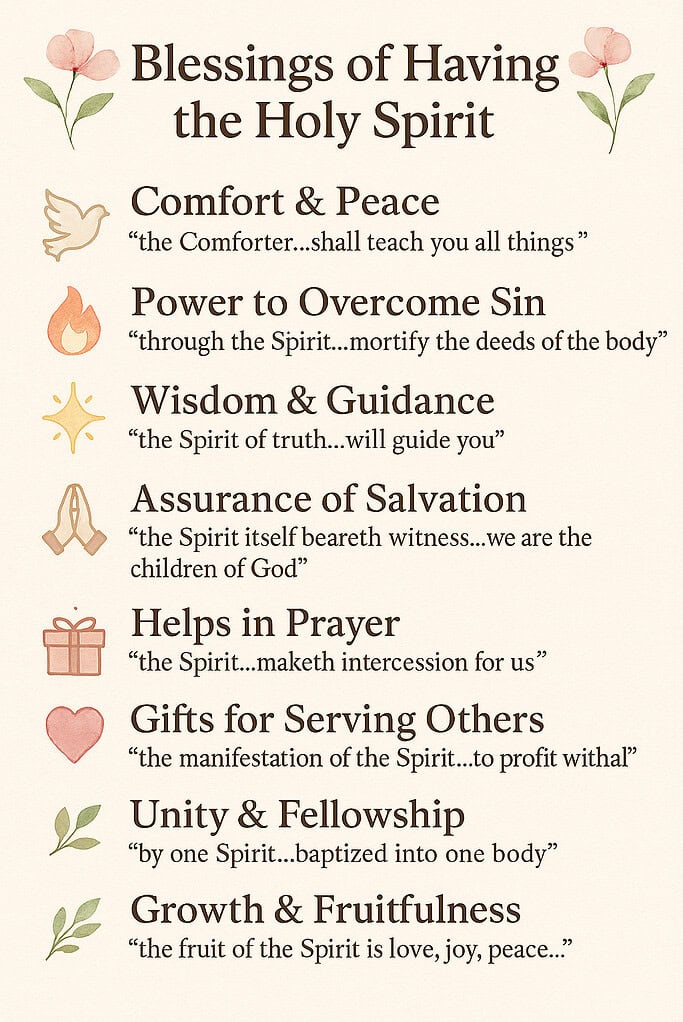
Why does it matter if we have the Holy Spirit? Oh, let me count the ways! The Bible overflows with descriptions of the blessings, benefits, and downright necessities of the Holy Spirit in the believer’s life.
Here are some of the wonderful things the Holy Spirit does for us – let these truths encourage you, especially if you’re weary or needing hope:
Assurance of God’s Love & Salvation:
One precious work of the Spirit is to give us an inner assurance that we truly belong to God. “The Spirit itself beareth witness with our spirit, that we are the children of God” (Romans 8:16).

When you doubt if God loves you or if you’re really saved, the Holy Spirit is there to whisper scripture to your heart, to let you feel the Father’s embrace.
Romans 5:5 says “the love of God is shed abroad in our hearts by the Holy Ghost which is given unto us.”
Have you ever experienced an overwhelming sense of God’s love during prayer or worship? That’s the Holy Spirit pouring God’s love into your heart.

We’re also told the Spirit seals us for the day of redemption (Eph. 4:30) – like a royal stamp that says “Property of Jesus Christ – hands off!”
Knowing the Spirit has sealed you gives a deep security: God isn’t going to lose you or abandon you. You’re His, and the presence of the Spirit in you is the proof.
Guidance and Wisdom:
The Holy Spirit is our divine guide and teacher. Jesus said the Spirit will “teach you all things, and bring all things to your remembrance, whatsoever I have said” (John 14:26).
Have you ever had a scripture verse come to mind right when you needed it? That’s the Holy Spirit doing exactly what Jesus promised. He also guides us in making decisions aligned with God’s will.

Isaiah 30:21 hinted at this guiding voice: “and thine ears shall hear a word behind thee, saying, ‘This is the way, walk ye in it’.”
Many times I’ve prayed for wisdom and later realized an idea or solution I got was from the Lord’s Spirit. The key is to ask – James 1:5 says God gives wisdom generously when we ask in faith.
The Spirit is also called “the Spirit of wisdom and revelation” (Eph. 1:17).
He can give insight beyond our natural reasoning, whether it’s understanding a Scripture passage or knowing how to respond to a difficult person with Christ-like grace.
Comfort and Peace:
Life is hard. Jesus didn’t sugarcoat that – “in this world you will have tribulation,” He said. But He also said, “I will pray the Father, and He shall give you another Comforter” (John 14:16).
The Greek word Parakletos (Comforter) means one who comes alongside to help, encourage, defend.
The Holy Spirit is like God’s arm around your shoulder and His voice in your ear saying, “I’m here with you. We’ll get through this.”
In Acts 9:31, the early Christians “were edified; and walking in the fear of the Lord, and in the comfort of the Holy Ghost.”
If you are mourning or in pain, ask the Holy Spirit to minister Christ’s comfort to you – He can do it in a deeply personal way. Along with comfort, He gives peace.

Romans 14:17 says life in the Spirit is characterized by “righteousness, peace, and joy in the Holy Ghost.”
And Galatians 5 lists peace as fruit of the Spirit. This isn’t circumstantial peace; it’s the kind that “passeth all understanding” (Phil. 4:7), meaning it’s there even when logic says you should be panicking.
Many believers can testify to an unexplainable peace in the midst of chaos – that’s the Holy Spirit at work in the heart.
Strength to Overcome Sin:
Earlier we talked about “walking in the Spirit” to not fulfill the lusts of the flesh (Gal. 5:16). The daily battle with sin is one we cannot win alone.
But Romans 8:13 tells us, “If ye through the Spirit do mortify (put to death) the deeds of the body, ye shall live.”
It’s through the Spirit that we can say no to those old habits and sinful urges. He gives us new desires that crowd out the old ones.
Have you noticed that after you became a Christian, your attitude toward certain sins changed? Things that never bothered your conscience before now make you uncomfortable.
That’s the Holy Spirit actively sanctifying you – setting you apart for holiness. 2 Thessalonians 2:13 speaks of “sanctification of the Spirit.”
He’s like a personal trainer, helping us exercise godliness and let go of sinful weights. We do have to cooperate and obey, but the power source is Him.
This is such good news for anyone feeling enslaved by a sin – there is hope and power in the Holy Spirit to break those chains over time.
Power to Serve and Witness:
Jesus told the disciples, “ye shall receive power, after that the Holy Ghost is come upon you: and ye shall be witnesses unto Me…” (Acts 1:8).
Indeed, when the Spirit came, these once fearful disciples became bold preachers of Jesus. The same power is available to us.
The Holy Spirit equips us with spiritual gifts – special abilities or enablements – to serve others and point them to Christ.
Do you find joy in encouraging others, or a knack for teaching the Bible, or a heart of compassion to serve the needy? Those could be Spirit-given gifts (see 1 Corinthians 12 and Romans 12 for various gifts).
Some gifts are supernatural like healing, prophecy, or tongues; others are more everyday like hospitality, administration, or mercy. Big or small, they all come from the Spirit for the common good.
Additionally, the Spirit gives us boldness and words to share the gospel. If you’ve ever feared telling someone about Jesus, you’re in good company – even Paul asked for prayer for boldness.
Rely on the Holy Spirit; even in moments where you suddenly recall exactly the right scripture or testimony to share, that’s Him helping you witness of Christ.
The early Christians prayed and “were all filled with the Holy Ghost, and spake the word of God with boldness.” (Acts 4:31).
I often pray, “Lord, fill me with Your Spirit so I can serve You effectively,” because I know my efforts alone accomplish nothing eternal unless His power flows through.
Prayer Help and Intercession:
We touched on this earlier, but it bears repeating as a huge benefit: the Spirit helps us pray and even prays for us. Sometimes you might feel an unexplained burden to pray for someone – follow that leading; it could be the Holy Spirit inviting you to intercede in His strength.
Other times, you’re the one in crisis and can barely groan out a prayer – take heart that “the Spirit Himself maketh intercession for us with groanings which cannot be uttered” (Rom. 8:26).
That means in your weakest prayer moment, the Holy Spirit is in your corner translating that heartache perfectly to the Father. We truly never pray alone.
Unity and Fellowship:

The Holy Spirit is the source of true Christian unity. He has a way of knitting believers’ hearts together in love. 1 Corinthians 12:13 says, “For by one Spirit are we all baptized into one body...”
The Spirit breaks down walls between Jew and Gentile, male and female, rich and poor – making us one in Christ (Gal. 3:28).
If you’ve ever met a Christian from a totally different background and yet felt an instant kinship because of Christ, that’s the fellowship of the Holy Spirit at work.
Ephesians 4:3 urges us to keep “the unity of the Spirit in the bond of peace.”
This unity is fragile if we grieve the Spirit with pride or division, but strong when we all submit to Him in humility and love. The Spirit can guide churches through conflicts into peace when people listen to Him.
Also, on a personal level, the term “fellowship of the Holy Ghost” (2 Cor. 13:14) implies we actually fellowship with God through the Spirit – we commune with God’s presence, enjoying a relationship, not just checking religious boxes.
He makes God’s fatherhood real to us, crying “Abba, Father” in our hearts (Rom. 8:15bible-topics.com). That relational closeness is something only the Spirit can produce.
Honestly, this list could go on and on:
- the Spirit gives joy (Luke 10:21 says Jesus rejoiced in the Spirit; and we’re told to rejoice always in the Lord – the Spirit enables that)
- He gives hope (Romans 15:13 – we abound in hope “through the power of the Holy Ghost”)
- He is the agent of our spiritual growth (we are changed “from glory to glory” by the Spirit, 2 Cor. 3:18)
- and He even will give life to our mortal bodies one day (Romans 8:11 promises the Spirit who raised Jesus will also resurrect us).
In short, every aspect of the Christian life from beginning to end is touched by the Holy Spirit’s blessing.
If you’re feeling spiritually dry or powerless, the answer is not to try harder by yourself – it’s to sink deeper into the Spirit. Ask God to fill you anew.
Open your heart in worship (sometimes singing hymns or spiritual songs can invite the Spirit’s refreshing – Ephesians 5:18-19 links being filled with the Spirit to singing).
Meditate on Scriptures about the Spirit’s work and believe they are true for you. And simply talk to the Holy Spirit.
He’s a person; you can say, “Good morning Holy Spirit, thank You for being with me. Help me to sense Your guidance today.” This isn’t a formula but a relationship. The more we acknowledge Him, the more we recognize His gentle hand in our lives.
Now, as we continue, let's have a bit of a creative break. The Bible often uses symbolism and metaphors to teach us about spiritual realities.
The Holy Spirit, being invisible, is described with tangible images so we can grasp His nature. Let’s explore some of those beautiful symbols of the Holy Spirit and what they mean.
Symbols of the Holy Spirit in Scripture
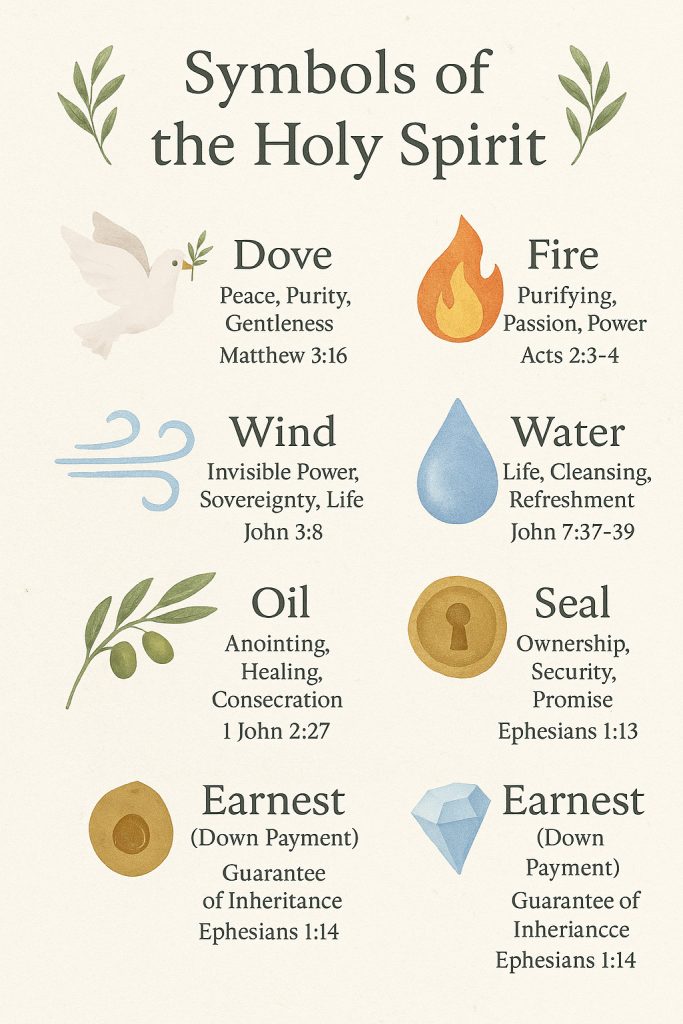
The Holy Spirit is invisible to our physical eyes, but the Bible uses various symbols and metaphors to help us understand who He is and what He does.
These word pictures are like windows into the Spirit’s character – each one highlighting a certain attribute or mode of His operation. Here are some of the most prominent symbols of the Holy Spirit in the Bible:
A Dove:
When Jesus was baptized, the Spirit of God descended upon Him “like a dove”. All four Gospels mention this.
The dove is a symbol of peace, purity, and gentleness. In the story of Noah’s ark, a dove brought back an olive leaf indicating new life after the flood.
Similarly, the Holy Spirit brings the new life of peace with God (Romans 5:1-5, peace and love via the Spirit). Doves are also gentle creatures – the Spirit is loving and tender with us.
If you’ve sensed a sweet peace in worship or prayer, that’s the “dove” aspect of the Spirit’s presence. Yet, note that the Spirit only appeared like a dove; He’s not literally a bird.
The point is the manner in which He came on Jesus – softly, gracefully, bringing approval and anointing. Sometimes in our noisy lives, the Holy Spirit comes in a quiet, gentle way. We need to slow down to experience the dove’s soft whisper.
Wind:
In both Hebrew (ruach) and Greek (pneuma), the word for Spirit also means wind or breath.
Jesus drew on this in John 3:8: “The wind bloweth where it listeth (wants), and thou hearest the sound thereof, but canst not tell whence it cometh, and whither it goeth: so is every one that is born of the Spirit.”
In other words, the Holy Spirit is like the wind – invisible, sovereign, yet powerful and life-giving. You can’t see wind directly, but you see its effects (the rustling leaves, the feel on your skin).
Likewise, we don’t see the Spirit, but we see changed lives as His effect. Wind also implies power – think of a strong breeze or even a hurricane.
On Pentecost, the Spirit announced His arrival with “a sound... as of a rushing mighty wind” (Acts 2:2). That wasn’t random; God was saying the Holy Spirit is a mighty force straight from heaven, sweeping through to empower His people.
Wind can also be refreshing – on a hot day, a cool breeze revives you. The Holy Spirit refreshes our weary souls like a divine breeze.
And just as we can’t control which way the wind blows, the Spirit moves as He wills – we yield to Him. It’s a humbling reminder that He is God. Our role is to set our sails to catch the wind of the Spirit, not try to boss Him around.
Fire:
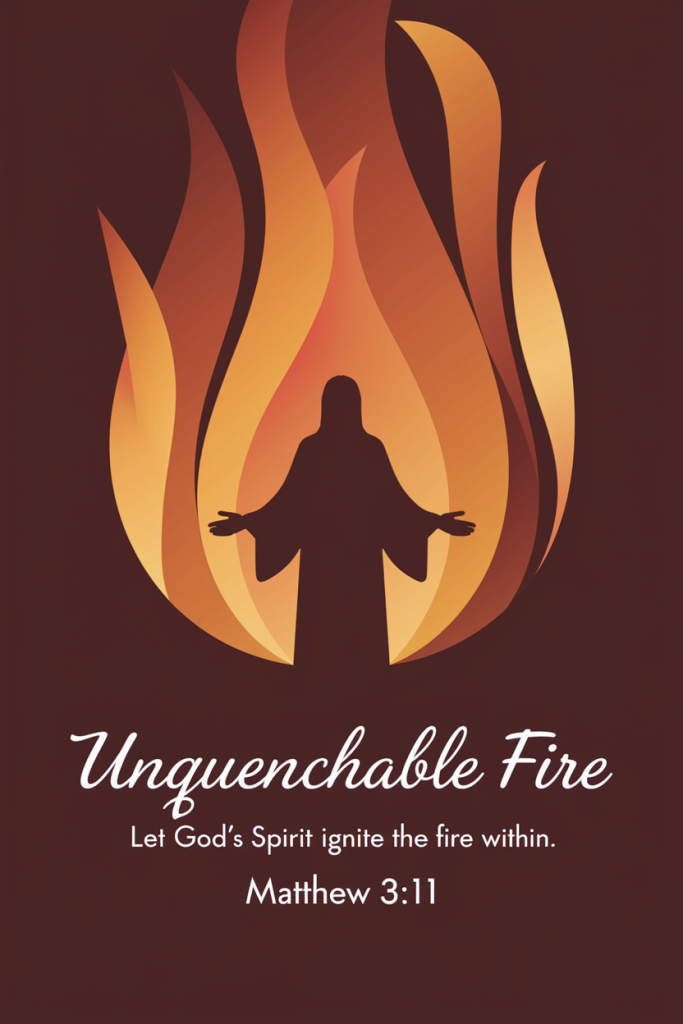
Fire is a frequent symbol of God’s presence and the Spirit’s work. John the Baptist said of Jesus, “He shall baptize you with the Holy Ghost, and with fire” (Matthew 3:11).
On Pentecost, the disciples saw what looked like little flames (tongues of fire) resting on each person. Fire symbolizes purifying and power. It brings heat and light.
The Holy Spirit is like a refining fire, burning away the impurities in our hearts (like how a refiner’s fire purifies gold).
If you’ve ever felt conviction of sin so strongly – almost a burning in your heart to repent – that’s the Spirit’s holy fire at work.
Fire also ignites passion: the Spirit sets our hearts ablaze with love for God and zeal to serve.
Think of the two disciples on the road to Emmaus who said, “Did not our heart burn within us... while He opened to us the scriptures?” (Luke 24:32).
That “holy heartburn” was the Spirit illuminating the Word and stirring faith. Additionally, fire gives light in darkness – the Spirit enlightens our minds to truth and gives guidance in dark times.
And fire spreads if it’s not contained. Likewise, the Spirit’s work in one person can ignite others. A revival is often described as a fire spreading among people, started by the Spirit.
When we sing “O Holy Spirit, burn like a fire,” we’re asking Him to purify us and inflame us with love and boldness.
Water:
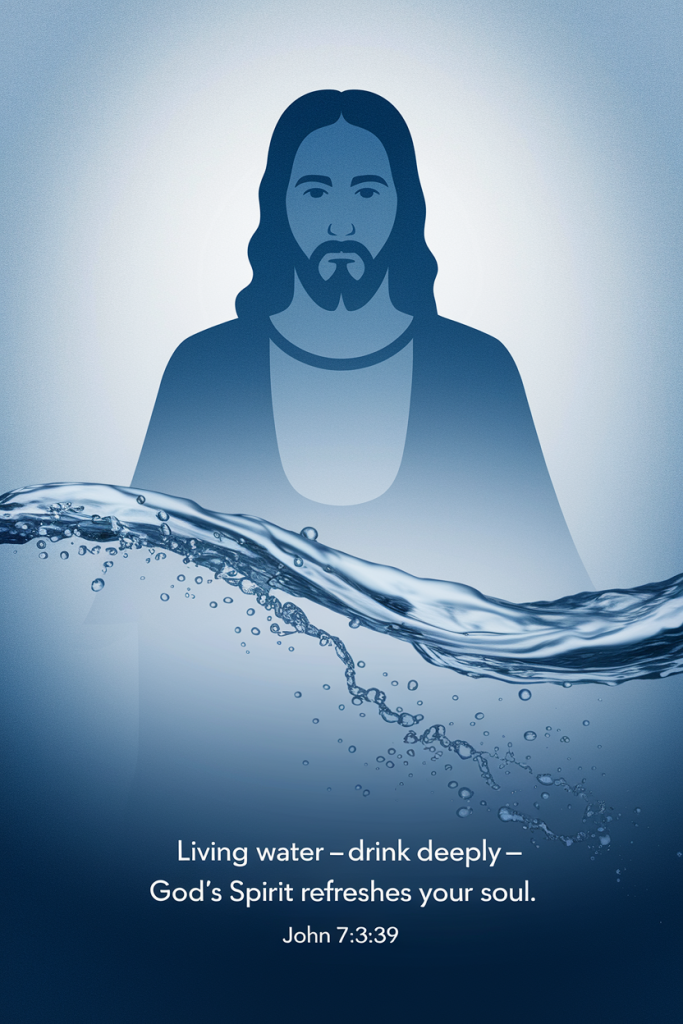
Water is a symbol of the Holy Spirit that signifies life, cleansing, and refreshment.
Jesus stood in the Temple and cried, “If any man thirst, let him come unto Me, and drink... out of his belly shall flow rivers of living water.” John then explains, “(But this spake He of the Spirit, which they that believe on Him should receive…)” (John 7:37-39).
The Holy Spirit is like a river of living water flowing from within believers, bringing life wherever it goes. In the Middle East, water is precious – it means survival. Similarly, the Spirit sustains our spiritual life.
Without Him, we dry up. Water cleanses too – we wash with water. The Spirit applies the cleansing work of Jesus to our souls, sanctifying us.
Titus 3:5 speaks of “the washing of regeneration and renewing of the Holy Ghost.”
When you feel spiritually parched, the Spirit invites you to drink deeply of His presence. Sometimes in worship or prayer, I imagine myself under a waterfall of the Spirit, letting Him wash off the grime of the week and refresh me.
This is biblical imagery; Isaiah 44:3 has God saying, “For I will pour water upon him that is thirsty... I will pour My Spirit upon thy seed.”
Water can be still and peaceful (like Psalm 23’s still waters) or powerful like a rushing river – the Spirit is both gentle and powerful, meeting our need.
Oil:
In the Bible, oil (especially olive oil) was used for anointing – pouring on someone’s head to signify being set apart for God’s service (prophets, priests, and kings were anointed with oil).
This oil is a symbol of the Holy Spirit’s anointing. The very word “Messiah” (Hebrew) or “Christ” (Greek) means “Anointed One,” pointing to Jesus being anointed with the Holy Spirit.
- We saw in 1 Samuel 16:13 that when Samuel anointed David with oil, the Spirit came upon him.
- Isaiah 61:1 (which Jesus read) links the Spirit and anointing: “The Spirit of the Lord GOD is upon me; because the LORD hath anointed me...”.
Oil in the lampstand of the Tabernacle kept the light burning – symbolizing how the Spirit fuels our light. Oil also was used to heal wounds (the Good Samaritan poured oil and wine on the injured man).
The Spirit brings healing to our broken hearts and bodies according to God’s will.
Moreover, oil was used to consecrate something as holy – the Spirit makes us holy and marks us as belonging to God.
In the New Testament, “anointing” is used metaphorically of the Holy Spirit’s presence: “ye have an unction (anointing) from the Holy One, and ye know all things” (1 John 2:20).
This likely refers to the Holy Spirit enabling believers to discern truth. The wonderful truth is that every believer is “anointed” by the Holy Spirit, not just a special few.
If you are in Christ, you have the Spirit’s anointing on your life to empower the calling God gives you. Just as oil can’t be compressed or contained easily (it will flow), the Spirit will flow in any area of your life you surrender to God.
A Seal/Down Payment:
The Bible also uses more literal metaphors like a seal or earnest (down payment) to describe the Spirit. While not as poetic as doves or fire, these are encouraging images of security and promise.
Ephesians 1:13-14 says after believing in Christ, we “were sealed with that Holy Spirit of promise, which is the earnest of our inheritance”.
In ancient times, a king would seal a letter with wax and imprint of his ring – meaning it’s official and under his authority. God “seals” us with the Spirit, meaning we carry God’s mark of ownership and authenticity.
It’s as if God says, “This person is mine, and I put My Spirit in them as proof.” An earnest is a first installment that guarantees full payment later (like earnest money in real estate).
The Spirit in us now is a foretaste of the full inheritance – which is eternal life in God’s perfect presence. Every time you experience the joy or love or power of the Holy Spirit now, it’s like a little preview of heaven.
God is saying, “See, I haven’t forgotten you – more is coming!” This fills us with hope and reassurance that God finishes what He starts.
There are other symbols too
- cloud and light (the Spirit often manifested as the bright cloud of God’s glory)
- or wine (Paul’s contrast in Eph. 5:18 hints at the Spirit being like positive intoxication, making us joyful and bold in God).
- Even clothing is used: Jesus said, “tarry… until ye be endued (clothed) with power from on high” (Luke 24:49), implying the Spirit is like a garment of power we “put on.” But the ones we covered are the major ones.
Why do these symbols matter?
They help us appreciate the multifaceted work of the Spirit. He is gentle and strong (dove and wind). He is comforting and refining (oil and fire). He gives life and growth (water) and light (fire).
He is both intimate (like breath) and awesome (like a raging flame). When you pray for the Holy Spirit’s work, you can use these images: “Spirit, blow upon me with Your wind, ignite Your fire in me, flow like water to refresh me, anoint me with Your oil for service.”
These aren’t magic words, but biblical ways of understanding and welcoming Him. They can make our prayer life more vivid and our expectation of the Spirit more concrete.
Now, let’s turn to a fascinating aspect of Bible study: seeing how the Old Testament symbols and prophecies we mentioned find fulfillment in the New Testament through the Holy Spirit.
We touched on Joel’s prophecy earlier; that’s one clear connection. But there are many patterns and foreshadowings (“types”) in the OT that point to the Holy Spirit’s work under the New Covenant.
Recognizing these can deepen our awe at God’s master plan unfolding through Scripture.
Promises and Patterns: The Holy Spirit Foretold and Fulfilled
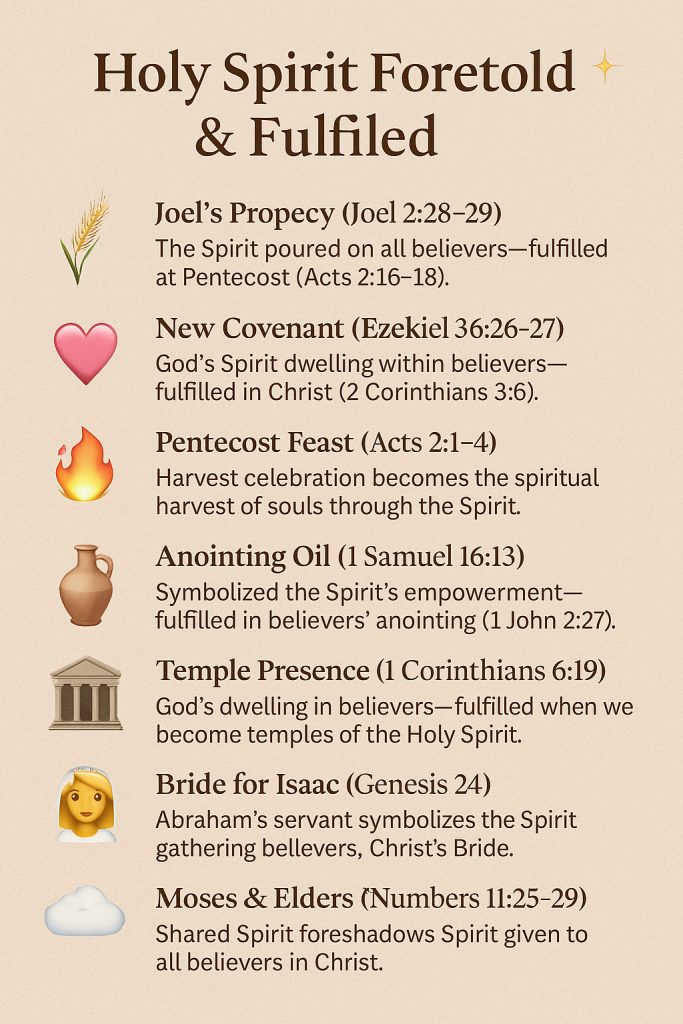
One of the joys of studying the Bible is seeing how the Old Testament lays the groundwork and the New Testament brings the fulfillment. God’s plans are consistent across the ages, and the Holy Spirit is a key figure in those plans.
Let’s look at some connections between Old Testament prophecies or patterns and their New Testament fulfillment in relation to the Holy Spirit:
The Prophecy of a Widespread Outpouring:
We’ve already discussed Joel 2:28-29 where God promised, “I will pour out My Spirit upon all flesh; and your sons and daughters shall prophesy…”.
For centuries, faithful Jews read that and wondered when it would happen. Then on the day of Pentecost, Peter stood up and declared “This is that” – Joel’s word was coming to pass.
No longer would the Spirit be for a select few; now young and old, men and women, even servants – all could receive Him.
This democratization of the Spirit is a hallmark of the Church age. And it’s still in effect – every believer, not just pastors or prophets, has the Spirit and can experience His gifts.
That means you, reading this, if you belong to Jesus, have access to the fullness of the Spirit. Peter also said the promise is for those “afar off” – which likely included future Gentile believers and generations to come (like us!).
How amazing that we live in the era Joel could only look forward to. When you feel spiritually dry or discouraged, remember: you’re living in the time of the promised outpouring.
Sometimes I pray, “Lord, You promised to pour out Your Spirit – pour Him out on me, on my church, on this generation. We need You!”
The New Covenant of the Spirit:
The prophets Jeremiah and Ezekiel spoke of a coming new covenant. Instead of laws chiseled on stone, God said, “I will put My law in their inward parts, and write it in their hearts” (Jer. 31:33).
How would He do that?
Ezekiel gives the answer: “I will put My Spirit within you, and cause you to walk in My statutes” (Ezek. 36:27).
This is exactly what happens in the New Testament believer – the Holy Spirit inside us empowers us to obey God from the heart.
Paul explicitly says in 2 Corinthians 3:6 that God “hath made us able ministers of the new testament (covenant); not of the letter, but of the Spirit: for the letter killeth, but the Spirit giveth life.”
The old written code could point out right from wrong, but it couldn’t change a stubborn heart. The Spirit can.
Have you ever experienced a change in your desires such that you want to do God’s will, not just feel you have to?
That’s the new covenant work of the Spirit writing God’s ways on your heart. We aren’t under the Old Covenant of law-keeping to earn righteousness; we’re under grace, empowered by the Spirit to live righteously as a response to the love we’ve received.
This was foretold in the OT and fulfilled in Christ sending the Spirit. The book of Hebrews makes a big deal of this too, quoting those OT passages and calling the Holy Spirit the witness to that covenant (Heb. 10:15-17).
Feast of Pentecost – From Harvest to Holy Spirit:
In the OT, the Feast of Pentecost (also called Feast of Weeks or Shavuot) was a celebration of the wheat harvest and also later associated with the giving of the Law at Sinai (according to Jewish tradition).
It’s striking that God chose that day to send the Spirit (Acts 2).
One symbolic connection: at Sinai, the Law written on tablets was given; at Pentecost, the Spirit who writes the law on hearts was given.
The letter vs. the Spirit as Paul contrasted is beautifully illustrated by those two events happening on the same calendar day, centuries apart.
Also, Pentecost as a harvest festival becomes the day of the first great harvest of souls into Christ’s kingdom – 3,000 people came to Christ that day (Acts 2:41).
It’s as if God is saying, “Here begins the great harvest of humanity, empowered by My Spirit.”
Jesus had told the disciples the fields were ripe for harvest (souls ready to believe) and that workers (witnesses) were needed – the Spirit made them those effective workers.
We too join in that harvest by the Spirit’s power, and the full harvest will be completed by the end of the age.
Anointing Oil – Foreshadowing the Spirit’s Anointing:
The use of holy anointing oil in the OT (for priests, kings, and the tabernacle articles) was a symbolic foreshadow of the Holy Spirit. When Aaron was anointed as high priest, oil was poured on his head, running down his beard (Psalm 133:2).
This oil symbolized God’s Spirit coming upon him for the task. In the NT, believers are called a “royal priesthood” (1 Peter 2:9) and are all anointed with the Holy Spirit.
The OT phrase “the anointing came upon” is basically equivalent to the NT concept of being filled with the Spirit.
In fact, the title “Christ” (Anointed One) indicates Jesus is the ultimate Anointed One (with the Spirit without measure), and we, as Christians, are “anointed ones” in a lesser sense because we share in His Spirit (1 John 2:27 says “the anointing which ye have received of Him abideth in you” – meaning the Spirit abides in us).
So whenever you see oil used in OT ceremonies, think: this is pointing to the Holy Spirit’s role in consecrating and empowering people for God’s service.
The Temple and the Spirit:

In the OT, God’s presence dwelt in the Tabernacle and later the Temple in a special way (the Shekinah glory cloud).
That was a shadow of what was to come. In the NT, we are the temple of God’s Spirit. “Know ye not that ye are the temple of God, and that the Spirit of God dwelleth in you?” Paul writes.
- Individually, your body is a temple of the Holy Spirit (1 Cor. 6:19), and corporately, the church is a temple being built (Eph. 2:21-22).
- This is a fulfillment of God’s desire to dwell not just among His people, but in His people.
- The veil in the Jerusalem temple tore when Jesus died, signifying open access – and indeed, at Pentecost God moved His residence into human hearts.
- In a sense, every gathering of believers is more sacred than the stone temple of old, because the Holy Spirit is in our midst.
This was foreshadowed many ways – for example, the OT Feast of Tabernacles (dwelling in booths) celebrated God “dwelling” with Israel; now by the Spirit, God permanently dwells in and with us.
Foreshadowing in OT Stories (Types):
Beyond direct prophecies, many Bible teachers have seen the Holy Spirit’s work foreshadowed in various narratives. One classic example: Abraham sending his servant to find a bride for Isaac in Genesis 24.
In that story, Abraham (who can represent God the Father) sends his unnamed chief servant (who many see as a type of the Holy Spirit) to fetch a bride for his son Isaac (who represents Christ, the Son).
The servant guides Rebekah to Isaac, giving gifts along the way. This beautifully parallels how the Father sends the Holy Spirit to call and prepare a bride for Christ (the Church).
The servant in Genesis 24 isn’t named (though we know from earlier his name was likely Eleazar, which significantly means “God’s helper”!), perhaps highlighting that the Holy Spirit doesn’t draw attention to Himself – He’s behind the scenes, testifying of the Son.
Genesis 24:67 ends with Rebekah meeting Isaac and becoming his wife – just as the Spirit will bring us, the Church, to Christ at the great “marriage supper of the Lamb” one day.
Chuck Smith commented on this analogy: “We have seen Abraham as a type of the Father... Isaac as the type of the Son, Jesus Christ. And Eleazar would become the type of the Holy Spirit... Eleazar means ‘God, my help’, and... the Holy Spirit [is] called the Comforter, which means one to come alongside to help.”.
This isn’t explicitly stated in Scripture, but it’s a cherished illustration passed down by preachers to show God’s plan in type and shadow.
It reminds us that the Holy Spirit is actively at work gathering people to Christ even now, wooing hearts to come to Jesus just as that servant spoke winsomely of Isaac to Rebekah.
Another “type” example: Moses and the 70 elders in Numbers 11. Moses was overwhelmed leading Israel, so God took of the Spirit on Moses and distributed it to 70 elders who then prophesied.
This is a picture of shared ministry empowered by the Spirit – Jesus sent out 70 discipeles and when Jesus the ultimate Prophet/Leader shares His Spirit with the 120 in the upper room and beyond, so that leadership and ministry is broadened.
Moses even said, “Would God that all the LORD'S people were prophets, and that the LORD would put His Spirit upon them!” (Num. 11:29).
That wish is basically fulfilled in the New Covenant – all God’s people have the Spirit and can speak forth God’s Word (not that everyone holds the office of prophet, but we can all prophesy in the sense of speaking edification as the Spirit enables, see 1 Cor. 14:31).
We could also see symbolism in things like the pillar of fire and cloud guiding Israel = the Spirit’s guidance.
Or the furnishing of the Tabernacle: for instance, the golden lampstand had oil for light – oil representing the Spirit providing light, akin to how the church needs the Spirit to be a light in the world (Revelation even refers to the seven Spirits of God symbolically as lamps of fire, Rev. 4:5, tying to Zechariah 4’s vision of lamps and olive oil which signified God’s Spirit).
The prophet Elijah’s life too had a passing of the Spirit: Elijah was taken up, and his successor Elisha received a “double portion” of his spirit – analogous to Jesus ascending and sending the Spirit in greater measure to His followers (indeed, Jesus said those who believe in Him would do the works He did and even “greater” works, John 14:12, which came true as the gospel went global through Spirit-empowered apostles).
The point of all this is: God always had the Holy Spirit in view as part of His redemptive plan.
The OT was preparing for the grand gift of the Spirit that the NT unveils. It’s like when you plant seeds in fall and wait – by spring, you see the bloom. The OT planted seeds of promise; the NT blooms with the Spirit’s outpouring.
This should bolster your confidence in Scripture’s unity and God’s sovereignty. It wasn’t an accident or afterthought that you and I live in this age of the Spirit – God chose us to experience what prophets and kings longed for (Luke 10:24).
So when you read the Old Testament, watch for hints of the Holy Spirit. It will thrill you to see how God was pointing to our current blessings all along.
And when you live your daily life, realize: you are walking in the fulfilled promises that required centuries of preparation. Don’t take the Holy Spirit for granted! Reverence Him, thank God for Him, and live in the good of these amazing truths.
Conclusion: Embracing the Holy Spirit in Our Daily Walk
We’ve journeyed through a deep study of the Holy Spirit – from His names and character, to His instructions for our lives, to His works in history, the blessings He brings, the symbols that describe Him, and the grand story of promise and fulfillment that we are now a part of.
It’s a lot to take in, but at the heart of it is a simple and beautiful reality: The Holy Spirit is God’s personal presence with you, every day, to help you live the life He’s called you to.
Dear friend, maybe you started reading this with a sense of spiritual dryness, or confusion, or longing for more of God. That in itself may be the Holy Spirit drawing you! Jesus said our Heavenly Father is eager to give the Holy Spirit to those who ask (Luke 11:13).
So ask. Each morning, you can pray, “Father, fill me with Your Holy Spirit today. Holy Spirit, lead me and teach me. Let me walk in step with You.” That’s a prayer God loves to answer because it honors the gift He’s given.
Be encouraged that the Holy Spirit understands your real-life struggles. He is called the Helper for a reason – to help you in those struggles. If you battle anxiety, remember He is the Comforter who can calm your heart.
If you feel weak facing temptation, remember He is the Spirit of power who can strengthen your will to choose what’s right. If you don’t know how to pray or what decision to make, He is the Spirit of wisdom ready to guide when you listen.
If you feel lonely or misunderstood, He is the Spirit of adoption whispering that you are God’s beloved child, never abandoned.
Truly, He is “another of the same kind” as Jesus – meaning having the Holy Spirit with us is like having Jesus by our side at all times, except even closer, for He lives within. Jesus hasn’t left us alone; “I will not leave you comfortless: I will come to you,” He promised, referring to the Spirit’s coming.
Perhaps you worry you’ve messed up too much for the Holy Spirit to work with you. Maybe you’ve been a Christian a long time but drifted, or you feel you quenched the Spirit’s voice in your life. It’s not too late.
The very fact you care is evidence the Spirit is still at work in you, gently pulling you to repentance and surrender. Don’t run from Him; run to Him. Ephesians 5:18’s command to “be filled with the Spirit” is in the present continuous tense – keep being filled.
It suggests that even if we leaked out or resisted Him yesterday, today is a new opportunity. God’s mercies are new every morning, and I believe asking afresh for the Spirit’s filling is part of that mercy. He desires to fill you more than you desire to be filled.
In a practical sense, how do we stay filled and in tune with the Holy Spirit? There’s no formula, but here are some final encouragements:
- Stay in Scripture: The Holy Spirit speaks primarily through God’s Word. The more you read, meditate, and memorize Scripture, the more material the Spirit can bring to your mind right when you need it. It’s like giving Him a vocabulary to speak to you. And as you read, ask the Spirit to illuminate and apply the Word to your heart – that’s His specialty.
- Cultivate Prayer and Worship: Spend regular time in God’s presence. Talk to the Holy Spirit as you pray; invite Him into every concern. In worship, whether in church or alone, open your heart fully – the Spirit often manifests His nearness when we focus on glorifying Jesus in praise. Some of my most profound experiences of the Spirit have been during heartfelt worship, where I sensed His joy and even felt Him prompting me to new surrender or giving me a word of encouragement for someone.
- Obey Promptings Quickly: When you sense the Holy Spirit nudging you – maybe to apologize to someone, to lend a helping hand, to share a word with someone, or to refrain from something – obey. The more we obey, the more sensitive we become to His voice. It’s like tuning an ear. Conversely, if we constantly ignore or rationalize away His promptings, our hearts get dull. None of us obeys perfectly, but aim to keep in step. If you realize you ignored Him, just repent and tune in again. He is patient.
- Pursue Community: Since the Spirit dwells in other believers too, fellowship can sharpen our spiritual sensitivity. Sometimes the Holy Spirit will speak to you through a brother or sister in Christ – a word of wisdom, or just their example of Spirit-filled living. We are the Body of Christ together; the ear needs the eye, etc. (1 Cor. 12). Also, praying together invites a multiplied manifestation of the Spirit’s presence (“For where two or three are gathered in My name, there am I in the midst of them,” Matt. 18:20, and we saw often in Acts they were filled as they prayed in one accord).
- Keep Short Accounts with Sin: When you stumble into sin, don’t delay confession. Sin will grieve the Spirit and dampen your joy, but the solution is provided: the blood of Jesus. Confess, receive forgiveness (1 John 1:9), and ask the Holy Spirit to help you overcome. The Spirit’s work is to make us holy (note His name Holy Spirit), so He’s eager to restore us to right fellowship when we turn back. A clear conscience through the Spirit’s conviction and Christ’s cleansing makes for a joyful, free life in the Spirit.
Finally, remember that the Holy Spirit’s aim is to glorify Jesus in your life. If you want more of the Spirit, focus on Jesus – love Jesus, exalt Jesus, study Jesus – and the Spirit will come alongside that and say “Yes!
Let me help you with that!” He loves when we center on Christ, because that’s when He can really work. A Spirit-filled person ultimately looks a lot like Jesus in character. That’s our goal.
What a gift we’ve been given in the Holy Ghost. The same Spirit who moved at creation, who empowered Moses, David, Elijah, who raised Christ from the dead – He lives in us.
Let that sink in. You are not alone; you are a walking sanctuary of God’s presence. Wherever you go, He goes. Whatever you face, He faces with you. So take heart. Lean into this relationship.
As Paul encouraged Timothy, “stir up the gift of God” (the context implies the Spirit’s gifting). Fan that flame. God has not given us a spirit of fear, but His Spirit of power, love, and a sound mind (2 Tim. 1:6-7).
May you daily experience more of the Holy Spirit’s friendship, guidance, and power. May you echo the early believers in praying, “Lord… grant unto thy servants… that signs and wonders may be done by the name of thy holy child Jesus” and be filled with the Holy Ghost and boldness.
And may your life overflow with “the fruit of the Spirit” – evidence of His holy presence within you – shining as a witness to those around you.
Call to Action: The Question That Demands an AnswerIn Acts 2:37 Peter and the Apostles were asked the question – What Shall We do? And in Acts 2:38 Peter answered, Repent, and be baptized every one of you in the name of Jesus Christ for the remission of sins, and ye shall receive the gift of the Holy Ghost. For the promise is unto you, and to your children, and to all that are afar off, even as many as the Lord our God shall call. Do you understand this? After hearing the gospel and believing, they asked what should would do. The answer hasn’t changed friend, Peter clearly gave the answer. The question for you today is, Have you receieved the Holy Spirit Since you believed? If you’re ready to take that step, or you want to learn more about what it means to be born again of water and Spirit, visit: Come, and let the Spirit make you new. |