Quick Overview of This Bible Study…
Short on time? I have created a short slide show presentation of some key takeaways in our study. The complete, more comprehensive bible study is below…
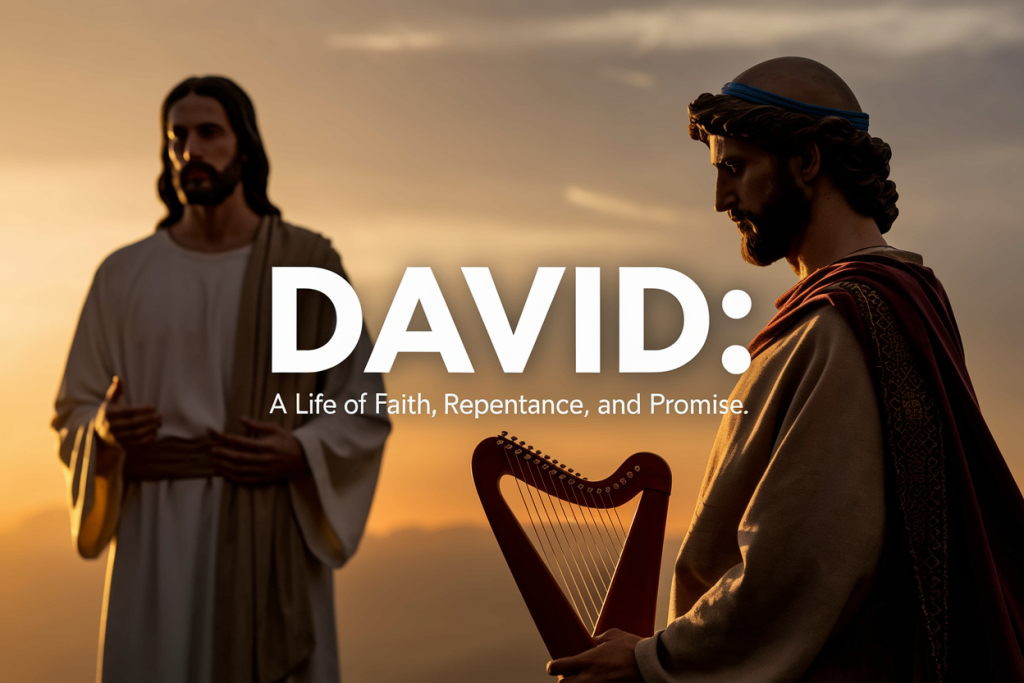
David is one of the most remarkable figures in the Bible. Shepherd boy, giant-slayer, king of Israel, poet, warrior – his life had it all. Yet what truly defines David is his heart for God.
The Lord Himself called David “a man after mine own heart”.
How could this be, when David also fell into grievous sin? What makes his spiritual legacy so enduring?
In this Bible study, we’ll journey through David’s life and explore three key themes:
- David as a type of Christ
- David and repentance
- and David and covenant promises.
Along the way, we’ll also touch on his life story and legacy, his authorship of many Psalms, and how the New Testament remembers him.
Prepare to be encouraged and challenged – David’s story has a way of shining light on our own struggles and God’s grace in the midst of them. Are you ready to learn from the life of David?

David’s Life and Legacy: From Shepherd to King
David’s early life was humble.
- The youngest son of Jesse, he grew up tending sheep in the Judean hills around Bethlehem.
- It was there that the prophet Samuel found him and anointed him to be Israel’s next king (even while King Saul still reigned).
- Not long after, David stepped into the national spotlight through his famous encounter with Goliath.
When a Philistine giant terrorized Israel’s army, young David – armed only with a sling and faith – volunteered to fight. “David hit the giant in the forehead with a stone and killed him”, winning a stunning victory for God’s people.
Can you imagine the scene?
The entire army was paralyzed by fear, but David’s confidence in the Lord propelled him forward. How often do we shy away from our “giants” when God is able to give us victory?
- David’s triumph over Goliath made him a national hero, but it also aroused King Saul’s jealousy.
- Saul attempted to kill David multiple times, forcing David to live on the run. During those fugitive years, David gathered a band of loyal followers and often cried out to God in psalms.
- Many of the “Maschil” psalms (teachings) reflect David’s prayers from caves and wilderness hideouts, showing us that even in fear and uncertainty, he sought the Lord.
- Eventually, Saul died in battle, and God’s promise to David was fulfilled: David was made king.
- At age thirty, he assumed the throne of Judah, and a few years later all Israel crowned him their king.
- He “reigned forty years” in total – seven and a half in Hebron (over Judah) and thirty-three in Jerusalem over the united kingdom.
- Under David’s leadership, Israel experienced military success and spiritual renewal.
- He established Jerusalem as his capital (often called the “City of David”) and brought the Ark of the Covenant there, making worship central to national life.
- David’s reign was far from trouble-free, but “the Lord God of hosts was with him”, and Israel prospered.
Yet David’s legacy is not one of unbroken triumph. The Bible doesn’t sugarcoat his failures – and that’s actually encouraging for us.
David had some disastrous lapses in judgment and morality, the most infamous being his sin with Bathsheba.
- At the height of his power, David committed adultery with Bathsheba (the wife of one of his loyal soldiers, Uriah), and then orchestrated Uriah’s death to cover it up.
- For a time David tried to hide this sin, and it ate away at him. But God loved David too much to let him remain in darkness.
- He sent the prophet Nathan to confront the king with a parable that pierced David’s conscience. When Nathan exclaimed “Thou art the man!”, David’s heart shattered in conviction.
- The king broke down and confessed. In that moment of raw honesty, we see why David is called a man after God’s heart – not because he was perfect, but because he was tender-hearted enough to repent deeply when he failed.
David’s life had great victories and great failures, but through it all he kept turning back to God.
In the end, he passed on a rich spiritual legacy: he prepared for the building of the temple, left a treasury of psalms, and, most importantly, carried the line of promise through which the Messiah would come.
His epitaph could well read as it does in Acts: David “served his own generation by the will of God,” and then fell asleep (Acts 13:36). What a way to be remembered – as someone who served God’s purpose in his time.
Before we dive into the key themes, think about David’s journey. From shepherd’s field to royal throne, from fervent worship to moral collapse and back to restoration – doesn’t it sound a bit like the rollercoaster of real life?
We have seasons of bold faith and seasons of painful failure. We have hidden years of preparation and moments of public testing. David’s story assures us that God’s grace is sufficient for every season.
When we trust Him like David did facing Goliath, God can bring victory. And even when we stumble horribly as David did, God’s mercy can redeem and restore.
David’s life invites us to an authentic walk with God – one that is honest about struggles, quick to repent, and steadfast in hope.
David the Psalmist: Worship and Song from the Heart
One cannot talk about David’s spiritual significance without mentioning the Book of Psalms. David’s nickname was “the sweet psalmist of Israel”, and for good reason – he was a prolific songwriter and musician.
In fact, about half of the 150 psalms are attributed to David as their author! Seventy-three psalms explicitly bear his name in their headings, and the New Testament credits him with two more (Psalm 2 and Psalm 95).
These ancient songs give us a window into David’s soul. When you read the Psalms, you’re reading the journal of a man’s intimate walk with God through every high and low.
Consider what David’s psalms teach us.
In them, he pours out raw emotions – joy, fear, gratitude, anger, repentance, hope.
- There are Psalms of exuberant praise, like “I will bless the Lord at all times: his praise shall continually be in my mouth” (Psalm 34:1).
- There are songs of trust from desperate situations, like “The Lord is my light and my salvation; whom shall I fear?” (Psalm 27:1).
- David’s most famous song, Psalm 23, paints God as a caring shepherd guiding him through green pastures and dark valleys alike.
- And of course, there are David’s penitential psalms, which we’ll discuss more in the repentance section.
- Through every verse, one thing shines clearly: David loved the Lord and loved His Word.
- He wrote, “O how love I thy law! it is my meditation all the day” (Psalm 119:97)
- and “Thy word have I hid in mine heart, that I might not sin against thee” (Psalm 119:11).
David didn’t just compose worship; he lived it. He even organized musicians and introduced new instruments for worship in Israel.
Picture King David dancing with all his might as the Ark of God entered Jerusalem, overflowing with joy in God’s presence (2 Samuel 6:14)! His wife thought it undignified, but God delighted in David’s wholehearted worship.
David’s psalms continue to resonate with us today because they are so deeply human and deeply God-centered.
- When you’ve been betrayed by a friend, Psalm 55 (which David wrote after Ahithophel’s betrayal) gives words to your pain.
- When you can’t sleep due to anxiety, Psalm 4 or 63 can be your midnight prayer.
- When you’re overwhelmed by guilt, Psalm 51 (David’s confession) guides you back to mercy.
- And when your heart is bursting with gratitude, Psalms like 103 help you “bless the Lord” with all that is within you.
Isn’t it amazing that words penned 3,000 years ago still speak to our hearts and to our God today?
David’s songs transcend time. By saturating himself in God’s truth and baring his soul in song, David left a legacy of worship that still teaches us how to connect with God authentically.
Have you ever considered writing out your own prayers or songs to God like David did?
You don’t have to be a poet or musician. Simply pour out your heart. David shows us that God isn’t looking for polish or perfection in our prayers – He’s looking for honesty and faith.
Whether we come dancing or weeping, rejoicing or repenting, God welcomes us into His presence. The Psalms assure us of that.
David in the New Testament: Ancestor, Example, and Type
David’s influence didn’t end with his death; in many ways it increased through the centuries, especially as the New Testament era began. By the time of Jesus, “Son of David” had become a well-known title for the expected Messiah.
The very first verse of the New Testament introduces Jesus Christ as “the son of David, the son of Abraham”, immediately linking Jesus to David’s lineage and covenant.
Let’s look at a few ways David is referenced in the New Testament and why it matters:
Ancestor of Jesus – Promise Fulfilled:
Both Matthew and Luke trace Jesus’ genealogy through David’s line, fulfilling the Old Testament prophecies that Messiah would come from David’s family. God kept the promise He made to David about an everlasting dynasty.
As the angel told Mary, “the Lord God shall give unto [Jesus] the throne of his father David: and he shall reign over the house of Jacob for ever”.
Every time Jesus is called “Son of David,” it’s a reminder that God’s covenant with David came true in Christ.
Messianic Title – Son of David:
During Jesus’ ministry, people who recognized His identity often cried out to Him as “Son of David.”
For example,
- Blind Bartimaeus shouted, “Jesus, thou Son of David, have mercy on me” (Mark 10:47), and Jesus responded by healing him.
- The crowds at Jerusalem hailed Jesus as “Hosanna to the Son of David!” (Matthew 21:9) when He rode in on a donkey.
They were acknowledging Jesus as the promised King from David’s line. In one intriguing exchange, Jesus Himself brings up this title: He asks the Pharisees whose son the Christ is.
- When they answer “The son of David,” Jesus quotes David’s Psalm 110, where David calls the Messiah “Lord.”
- Jesus then points out the Messiah must be more than just David’s descendant – He is David’s Lord (Matthew 22:41-45).
This silenced the critics and revealed a profound truth: the Messiah (Jesus) is both David’s offspring and David’s divine Lord. It’s a beautiful fulfillment of the Scriptures and typology we’ll explore soon.
David as a Prophet – Foreshadowing Jesus:
The New Testament writers saw David not only as an ancestor of Christ but also as a prophet who foreshadowed Christ. Peter, in his sermon at Pentecost, noted that David spoke of the resurrection of the Messiah.
- Peter quotes Psalm 16 (a psalm of David) – “Thou wilt not leave my soul in hell, neither wilt thou suffer thine Holy One to see corruption.”
Then Peter explains that David, “being a prophet,” foresaw that God would raise the Christ from the dead to sit on David’s throne.
In other words, David’s psalms contained messianic prophecies.
- Psalm 22 is another example: David’s anguished cry “My God, my God, why hast thou forsaken me?” and the vivid description of suffering in that psalm align so exactly with Jesus’ crucifixion that it’s clear David (by the Holy Spirit) was pointing to Jesus’ ordeal on the cross.
The New Testament authors quote the Psalms more than any other Old Testament book, often from David’s writings, to explain who Jesus is.
David’s experiences became prophetic patterns that Jesus perfectly fulfilled (more on that in the next section!).
Example of Faith and Forgiveness:
David is also given as an example for believers.
- Hebrews 11:32 lists David among the heroes of faith – a reminder of his trust in God to slay giants and lead a nation.
- And in Romans 4, Paul uses David’s words to illustrate the blessing of forgiveness by faith.
- Paul quotes David’s Psalm: “Blessed are they whose iniquities are forgiven, and whose sins are covered. Blessed is the man to whom the Lord will not impute sin.”.
Through David’s testimony, Paul shows that even under the Old Covenant David understood righteousness comes by God’s grace, not our works. David rejoiced in being forgiven, and Christians too can rejoice that through Jesus, our sins are covered.
- In Acts 13:34, Paul even mentions “the sure mercies of David,” implying that the same steadfast love God showed David is now shown to us through Christ’s resurrection life.
These are just a few highlights. Overall, the New Testament presents David as a crucial link in God’s redemptive plan – the ancestor of Jesus, the prototype (or “type”) of the Messiah, and an example of both human frailty and sincere faith.
David’s name is on the very last page of the Bible, where Jesus declares, “I am the root and the offspring of David, and the bright and morning star” (Revelation 22:16).
What a remarkable legacy! From Genesis to Revelation, David’s fingerprint is seen in Scripture. And each time, it ultimately directs our attention to Jesus Christ, the Greater David.
If we remember this as we study David’s life, we’ll gain so much more than just a history lesson – we’ll see reflections of our Savior and lessons for our own walk with God.
David as a Type of Christ: The King Who Foreshadows The King
One of the deepest themes in David’s story is that he serves as a “type” of Jesus Christ. In biblical terms, a type is like a prophetic pattern or foreshadowing.
It’s a real person or thing in the Old Testament that prefigures a greater fulfillment in the New Testament. David’s life, in many ways, prefigured Jesus’ life.
While David was an imperfect preview and Jesus is the perfect fulfillment, the parallels are awe-inspiring. Jesus is often called “the Son of David,” not only because of lineage, but because He steps into the role of the ultimate Davidic King.
Let’s break down how David foreshadows Christ and what that means for us:
Divinely Chosen and Anointed:
- David was chosen by God and anointed with oil by Samuel to be king of Israel (1 Samuel 16:12-13). This anointing marked him as God’s chosen servant.
- In a far greater way, Jesus is the Anointed One (in fact, “Messiah” and “Christ” mean Anointed One). He was anointed by the Holy Spirit at His baptism and declared to be God’s beloved Son.
Both David and Jesus were kings by divine ordination – God Himself appointed them. No one could take that calling away. David’s anointing anticipated the coming of the King of Kings, Jesus, who was “elected from eternity” to reign.
Shepherds and Kings:
David started out as a humble shepherd of his father’s flock, and later he became the shepherd-king of God’s people.
- In fact, God said to David, “Thou shalt feed my people Israel” – giving him a shepherd’s role over the nation.
- This beautifully foreshadows Jesus, the Good Shepherd (John 10:11) who leads and feeds His people spiritually.
- Jesus even called Himself “the son of David” and the shepherd in the same breath when He said, “I am the good shepherd; the good shepherd giveth his life for the sheep.”
- David risked his life defending his sheep from lions and bears; Jesus gave His life to save us from the “roaring lion” (Satan) and the curse of sin.
Just as David cared for his flock and later for Israel, Jesus cares for each of us personally. He knows His sheep by name. What comfort we can take that our King is also our caring Shepherd!
Facing and Conquering the Enemy:
David’s dramatic confrontation with Goliath paints a picture of Christ’s victory over our great enemy. Goliath, with his massive strength, mocking God and enslaving Israel in fear, is a lot like the powers of sin and death that no human could overcome.
- David steps onto the battlefield as Israel’s representative – seemingly weak, but armed with faith – and strikes down the giant.
- In the same way, Jesus stepped into our world to face the giant of sin on our behalf. On the cross, it looked like weakness and foolishness to the world, but it was God’s chosen weapon to fell the enemy.
- By His death and resurrection, Jesus defeated sin, Satan, and death for us, just as David’s victory was credited to the whole nation.
There’s an old saying: “When David won, Israel won.” Likewise, when Jesus won, humanity won – all who trust in Him share in His victory over evil.
This is a pattern we see throughout Scripture: God raises up a deliverer to rescue His people, culminating in Christ, our ultimate Deliverer.
Rejected Before Reigning:
Did you know both David and Jesus experienced a period of rejection and hardship before their kingship was fully realized?
David was anointed as a young man, but he spent years fleeing from Saul in the wilderness before he actually sat on the throne. He gathered a band of misfits and outcasts during that time (see 1 Samuel 22:1-2). Only after much suffering did David receive the kingdom.
In the same way, Jesus came as the promised King but was largely rejected by the rulers of His day. He gathered a band of humble disciples, many of them common folk and sinners.
He said His kingdom was “not of this world” (John 18:36), and indeed He went to the cross with a mocking sign over His head that read “King of the Jews.” But like David, Jesus emerged from the period of suffering victorious.
David ascended to the throne of Israel; Jesus “sat down at the right hand of the Majesty on high” (Hebrews 1:3) – the throne of the universe!
This pattern – suffering first, then glory – is a hallmark of the Messiah. As one article succinctly put it, “David’s kingship was a shadow; Jesus’ kingship is the reality”.
David waited for God’s timing to be exalted, and Jesus, “who for the joy set before Him endured the cross,” waited for the Father to exalt Him at the proper time.
In our lives too, we often walk through trials before entering into God’s promised blessings. We can take heart that our King understands this path – He walked it Himself.
Prophet, Priest, and King:
In the Old Testament, these three offices were usually distinct. But David had a unique role that at times touched on all three:
- he was God’s anointed king
- he offered sacrifices
- and organized worship like a priest (for example, wearing a linen ephod and sacrificing when bringing the Ark in 2 Samuel 6)
- and he uttered prophetic psalms about the Messiah.
This convergence in David’s life was a hint of someone greater.
Jesus fulfills all three offices perfectly.
- He is our anointed King, the King of Kings who rules forever.
- He is our great High Priest, offering Himself as the perfect sacrifice for sin (Hebrews 10:12).
- And He is the Prophet, the very Word of God made flesh, revealing God to us (John 1:1, 14).
David could only be a dim reflection of this ultimate Anointed One. Where David stumbled or sinned, Jesus succeeded in righteousness.
As a scholar noted, “What King David was as a deeply flawed pattern, Jesus was in perfection”.
In Jesus, the title “Son of David” reaches its highest meaning: not just a son in the royal line, but the culmination of all that the ideal king should be – righteous, merciful, courageous, and godly.
We could list many more parallels:
- Both David and Jesus were born in Bethlehem.
- Both were betrayed by someone close (Ahithophel for David, Judas for Jesus).
- Both showed unimaginable mercy to their enemies – David spared Saul’s life even when he had the chance to kill him, and Jesus prayed forgiveness for those who crucified Him.
- In fact, David’s mercy to Saul is sometimes cited as reflecting the heart of Christ: David refused to harm “the Lord’s anointed” and instead left vengeance to God.
- Jesus, in His mercy, offers reconciliation to us while we were yet His enemies (Romans 5:10).
The more you examine David’s story, the more you see shadows of Jesus emerging. This isn’t by accident; it’s by God’s design.
Why does this matter for our faith?
Seeing David as a type of Christ strengthens our confidence that Jesus truly is the Messiah.
God was painting the picture long beforehand. It also expands our understanding of Jesus’ work: He is the conquering King who slays our giant (sin), the compassionate Shepherd who guides us, the Exalted One who was once rejected.
When you read the books of Samuel or the Psalms with Jesus in mind, they explode with new meaning. As Jesus Himself taught, “all the Scriptures” ultimately point to Him (Luke 24:27). David is one of the clearest signposts.
Lastly, this theme challenges us personally: David’s Christlike qualities – his faith, his zeal for God’s honor, his mercy, his heart of worship – are ones we are called to emulate as followers of the Son of David.
And David’s failures that Christ corrected – things like pride, lust, abuse of power – serve as sober warnings for us. In every way, David’s life can drive us to cling more tightly to Jesus, the “true and better David.”
We can sing with confidence, “Great David’s greater Son” (a line from an old hymn), rejoicing that we belong to the King who fulfills all the hope that David stirred in Israel.
David and Repentance: A Model of Brokenness and Restoration
One of the most soul-stirring aspects of David’s story is his repentance. David sinned greatly, but he repented greatly as well.
In a world that often either excuses sin or despairs in it, David shows us a third way: honest repentance leading to forgiveness and renewal.
Let’s revisit the incident with Bathsheba and see what true repentance meant for David – and what it means for us.
After David’s adultery and the arranged death of Uriah, he spent perhaps a year in silent spiritual misery.
- Psalm 32 (which David wrote later) reflects on that time, saying, “When I kept silence, my bones waxed old through my roaring all the day long… my vitality was turned into the drought of summer” (Psalm 32:3-4).
Unconfessed sin was crushing him from the inside out.
- But when the confrontation came through Nathan and David finally said, “I have sinned against the LORD” (2 Samuel 12:13), the floodgates opened.
David penned Psalm 51, the most famous prayer of repentance in the Bible.
In its heading it says, “A Psalm of David, when Nathan the prophet went to him, after he had gone in to Bathsheba.” What does a contrite heart sound like? Psalm 51 gives us David’s cry in his own words:
“Have mercy upon me, O God, according to thy lovingkindness: according unto the multitude of thy tender mercies blot out my transgressions. Wash me thoroughly from mine iniquity, and cleanse me from my sin” (Psalm 51:1-2, KJV).
David doesn’t sugarcoat anything – he uses three words for what he’s done: transgression, iniquity, sin. He accepts full responsibility and appeals only to God’s mercy and steadfast love.
- He even acknowledges that his sin, while it hurt others, is foremost an offense against God: “Against thee, thee only, have I sinned, and done this evil in thy sight” (51:4).
Repentance, in its essence, is agreeing with God about how bad our sin is – not hiding or minimizing it – and sincerely turning our heart back toward God for cleansing. David exemplifies this.
- In the middle of Psalm 51 comes the famous request: “Create in me a clean heart, O God; and renew a right spirit within me”.
David knew he didn’t just need his record cleared; he needed his heart changed.
Only God could create (the Hebrew word is bara, the same verb from Genesis 1:1) purity where there was perversion.
David is asking for a miracle of grace – and isn’t that what all of us need when we’ve sinned?
- He goes on to pray, “Cast me not away from thy presence; and take not thy holy spirit from me. Restore unto me the joy of thy salvation” (51:11-12).
He had tasted the bitterness of life out of fellowship with God, and nothing mattered more now than living in God’s presence again.
- He even promises to teach others if God forgives him, so that “sinners shall be converted unto Thee” (51:13).
Indeed, David’s fall and restoration have been teaching sinners about God’s mercy for generations!
Psalm 51 climaxes in verses 16-17 with a profound insight: “For Thou desirest not sacrifice; else would I give it… The sacrifices of God are a broken spirit: a broken and a contrite heart, O God, Thou wilt not despise.”
David realizes that what God wanted was not an abundance of burnt offerings to cover up the sin – God wanted David’s heart to break in godly sorrow. And it had. David came to God humbly, with nothing to offer except a plea for mercy. And God did not despise it.
- The prophet Nathan assured David, “The LORD also hath put away thy sin; thou shalt not die” (2 Samuel 12:13).
Despite the dreadful consequences that would follow in David’s family (and they did – the baby died, and later David’s household saw turmoil and rebellion), God in His grace forgave David and continued to fulfill His purposes through him.
David and Bathsheba even had another son, Solomon, whom God loved and chose to succeed David as king. What an illustration that “where sin abounded, grace did much more abound” (Romans 5:20)!
Now, how does David’s repentance speak to us?
First, it teaches us that no one is too great to fall, and no one who falls is too far gone to be forgiven. Maybe you wonder, “After what I’ve done, can God ever forgive me or use me again?”
David’s story answers with a resounding yes – if you come with a broken and contrite heart. “Psalm 51 is a renowned expression of repentance” because it shows the way back to God.
True repentance involves: acknowledging our sin honestly, taking responsibility, recognizing that all sin is ultimately against God, desiring inner transformation, and relying on God’s mercy alone.
We see all of this in David. There’s no self-justification, no blame-shifting, no quid pro quo bargaining with God. He simply falls on grace. And that is exactly what the New Testament calls us to do as well.
- “If we confess our sins, He is faithful and just to forgive us our sins, and to cleanse us from all unrighteousness,” the Bible promises (1 John 1:9).
God is faithful to His character (He’s just – Jesus has paid for those sins) and faithful to His covenant (He promised forgiveness through the blood of Christ).
David experienced a shadow of that truth, but we have the fullness in Jesus. Because Jesus died and rose again, the mercy David begged for is freely offered to us.
David also shows us the joy and freedom that comes from repentance.
- In Psalm 32 (likely written after he received forgiveness), David writes, “Blessed is he whose transgression is forgiven, whose sin is covered”.
He goes from groaning under conviction to rejoicing in being forgiven.
- He says, “Thou art my hiding place; Thou shalt preserve me from trouble; Thou shalt compass me about with songs of deliverance” (Psalm 32:7).
Isn’t that beautiful? The man who once tried to hide his sin now finds God to be his hiding place. Instead of songs of sorrow, he is surrounded with songs of deliverance.
This is the blessing of repentance: it restores intimacy with God and the joy of salvation. Yes, there may still be earthly consequences to face (David bore many). But the relational breach with God is healed.
For us as Christians, repentance is not a one-time event; it’s a lifestyle. Martin Luther said the whole life of believers should be repentance – not in a morbid, self-loathing way, but in a continual turning to God for cleansing and renewal. It keeps our fellowship with God sweet.
One more lesson: David’s repentance had ripple effects. He pledged to teach others God’s ways so they would turn to Him (Psalm 51:13). Indeed, countless people have been led to repent by David’s words in Psalm 51.
When we humbly share our own stories of failure and God’s restoration, we can help others find their way back to God too.
Have you ever considered that your worst moment, once redeemed by God’s grace, might become your greatest ministry to someone else?
Don’t waste your failures! Let God use them as He used David’s – to showcase the greatness of His mercy and call other prodigals home.
In summary, David and repentance are practically synonymous in Scripture. His name is forever linked to the heartfelt contrition of Psalm 51. And through that, God is teaching every generation of His people what He desires: not rituals, not pretense, but a broken heart that He can heal by His grace.
If David, with the enormity of his sin, found forgiveness, then none of us need despair. “A broken and contrite heart, O God, Thou wilt not despise.” That is as true today as when David first wrote it.
Are you carrying guilt or running from God over something? Stop running. Take it to God like David did. You will find that the arms of God’s mercy are open wide.
As Jesus illustrated in the parable of the prodigal son – the Father is waiting on the porch, ready to run toward you and celebrate your return. David’s life shouts to us that there is hope after failure. And on the other side of honest repentance, there is fresh joy and usefulness for God’s kingdom.
David and Covenant Promises: The House God Built for David
The last major theme we’ll explore is David and the covenant promises God made to him. This is often called the Davidic Covenant, and it’s a pivotal piece of the Bible’s big picture.
Through David, God revealed a promise that would ultimately be fulfilled in Jesus Christ – a promise of an everlasting kingdom. Understanding this covenant will not only make sense of much of the Old Testament (and why the Jews longed for a “Son of David”), but it will also encourage us about the faithfulness of God to keep His word.
The story is found in 2 Samuel 7. By this point, David was established in Jerusalem, living in a nice cedar palace. He felt uneasy that he lived in a house of cedar while the Ark of God was still in a tent.
So David expressed to Nathan the prophet his desire to build a temple for the Lord. Initially, Nathan said, “Go ahead,” but that night God gave Nathan a different message.
God essentially said, “Tell David: Did I ever ask for a house of cedar? I took you from the sheepfold to be ruler, I have been with you, and I have cut off your enemies. And now the Lord will make you a house” (2 Samuel 7:5-11 paraphrased).
In a stunning role reversal, God said He would build David a “house.” By “house,” God meant a dynasty – a line of kings from David that would last.
God promised David that one of his offspring would reign after him (that was Solomon, initially) and that this son would build the temple David wanted to build.
- That part came to pass: Solomon built the temple. But then God went further, promising: “Thine house and thy kingdom shall be established for ever before thee: thy throne shall be established for ever.” (2 Samuel 7:16).
This was an unconditional promise of an everlasting kingdom through David’s lineage.
- God even confirmed it with an oath, as the Psalms later recount: “I have made a covenant with my chosen, I have sworn unto David my servant, Thy seed will I establish for ever, and build up thy throne to all generations” (Psalm 89:3-4).
This covenant is huge.
It’s God’s answer to the problems hinted at since Genesis – ever since humanity fell...
- God promised a Redeemer (the seed of the woman in Genesis 3:15).
- That promise was narrowed to Abraham’s seed, then to Jacob’s, then specifically to Judah’s tribe.
- Now God narrows it to David’s family.
- The future Messiah, the eternal King, will come from this line.
- That’s why, as we saw, the title “Son of David” became synonymous with “Messiah.”
- The prophets picked up this promise repeatedly. Isaiah foretold a child who would sit “upon the throne of David... to establish it with judgment and with justice from henceforth even for ever” (Isaiah 9:7).
- Jeremiah spoke of “a righteous Branch” from David’s line who would be called “The LORD our righteousness” (Jer. 23:5-6).
- Ezekiel, writing during the exile, prophesied that God would one day “set up one shepherd over [His people], even my servant David” – referring to a future ruler from David’s line (Ezek. 34:23).
- Even after David was long dead, the prophets often referred to the coming Messiah as “David” because of this covenant promise (e.g., Ezekiel 37:24, Hosea 3:5).
For centuries, Israel clung to the Davidic Covenant as a beacon of hope, especially when the kingdom collapsed and the line of David seemed lost in obscurity. They knew God’s promise could not fail.
- Indeed, God reaffirmed to David’s son Solomon that, despite any chastisement for sin, “My mercy shall not depart away from him, as I took it from Saul… And thy house shall be established for ever” (2 Samuel 7:15-16).
- It’s called “the sure mercies of David” (Isaiah 55:3) – an unbreakable loving promise.
When we turn to the New Testament, we see this gloriously fulfilled in Jesus.
The angel Gabriel’s announcement to Mary about Jesus deliberately echoes the language of the Davidic covenant: “He shall be great, and shall be called the Son of the Highest: and the Lord God shall give unto Him the throne of His father David: and He shall reign over the house of Jacob for ever; and of His kingdom there shall be no end.”.
There is no ambiguity – Jesus is the promised Son of David who will have the everlasting kingdom. During Jesus’ earthly ministry, though He inaugurated the kingdom of God, He did not yet overthrow Rome or take an earthly throne.
This led some to be confused or even to reject Him. But after His resurrection, the apostles understood that He indeed fulfilled God’s promise to David in a greater way.
- Peter preached that God swore an oath to David “that of the fruit of his loins… He would raise up Christ to sit on his throne”.
Jesus’ resurrection and ascension mean He is now seated on the throne – not in earthly Jerusalem at the moment, but at the Father’s right hand, ruling a kingdom that transcends all earthly realms.
And one day, when He returns, that heavenly reign will extend fully to Earth as well, in the Messianic Kingdom where He physically reigns as King of Kings from the New Jerusalem.
- The book of Revelation shows Jesus coming as “the Lion of the tribe of Judah, the Root of David,” to judge and rule (Rev. 5:5, 19:15).
- It concludes with Jesus identifying Himself as “the root and the offspring of David” – root, because He is David’s Lord; offspring, because He is David’s descendant.
What an awesome fulfillment: the covenant promise to David is eternally kept in the Person of Jesus Christ.
Now, why is this important for us as believers in a practical sense? For one, it reassures us that God keeps His promises, no matter how long it may take or how unlikely it may seem.
David died without seeing the eternal throne – his son Solomon had a glorious reign, yes, but after Solomon the kingdom split and eventually fell apart. It was over 900 years from David to Jesus. That’s a long time to wait!
- But God was faithful. “Though it tarry, wait for it,” the Scripture says (Hab. 2:3).
The Davidic covenant is a case study in God’s faithfulness and sovereign control over history.
When you read those genealogies in Matthew or Luke, rather than zoning out at the list of names, realize: it’s a record of God preserving a lineage through generations, against all odds, to deliver on His Word.
It included kings and also ordinary people, heroes and even some with shady pasts – but grace carried the promise through.
In your own life, you may have promises from God’s Word that you’re holding onto. It might seem like nothing’s happening or even that circumstances are moving the opposite direction.
Remember David’s “house.”
If God could bring a Messiah out of a lineage that at one point was down to a single baby (Joash, in 2 Kings 11, nearly wiped out by an enemy queen) and later seemingly extinct in exile, He can bring about His promises for you. He is utterly faithful.
Another takeaway is the concept of covenant itself.
God’s covenant with David was part of a chain of covenants leading to the New Covenant in Christ.
- God made a covenant with Abraham (land, nation, blessing to all nations)
- then with Israel at Sinai (the law)
- then with David (kingdom)
- and through Jeremiah God promised a “new covenant” of heart transformation and forgiveness.
Jesus declared at the Last Supper, “This cup is the new testament (covenant) in my blood” – His death and resurrection inaugurated that New Covenant.
It built upon the promise to Abraham and David: through Jesus, the son of Abraham and son of David, all nations are blessed and His kingdom reigns forever.
And we, as believers in Christ, become partakers of those covenant blessings. We become, in a spiritual sense, part of the “house of David” – not that we become Jews, but we come under the rule and blessing of David’s greater Son.
The “sure mercies of David” are given to us: we receive the steadfast love God vowed to give through the Messiah.
This means our salvation and hope are absolutely secure, grounded in God’s unbreakable promise.
We often talk about trusting God, but isn’t it amazing to consider that God has bound Himself by covenant to be faithful to us who are in Christ? The covenant with David ultimately points to the covenant of grace in Jesus, where God says, “I will be your God and you will be My people, forever.”
One lovely symbol in the Davidic covenant narrative is the idea of “house.” David wanted to build God a house (temple); God said, “No, I’ll build you a house (dynasty).”
- Then, in the fullness of time, God Himself entered the “house” of David – Jesus was born into David’s family.
- And Jesus said, “I will build my church” – a spiritual house, a living temple made of people.
- We, the church, are referred to as the “household of God” (Ephesians 2:19) and a spiritual house (1 Peter 2:5).
- So in a way, David did get to build God a house, but not the stone temple he envisioned.
- His lineage produced Jesus, who built the true temple of God’s people, filled with the Holy Spirit.
- In Acts 15:16, James quotes an Old Testament prophecy about God restoring “the tabernacle (house) of David” and interprets it as God raising up the church, including Gentiles, under Jesus’ reign.
- The “house of David” has become a worldwide family of believers in Jesus, united under the eternal King. How cool is that?
God’s promises often exceed our expectations. David wanted to build a physical building; God said, “I’m going to do something far greater through you.”
In summary, David and the covenant promises teach us about God’s faithfulness, the messianic hope centered on Jesus, and our secure future under Christ’s kingship.
- David responded to God’s promise in 2 Samuel 7 with a beautiful prayer of humble gratitude (2 Samuel 7:18-29).
He was overwhelmed that God took him from the pasture to the palace and then vowed to establish his throne forever.
- David exclaimed, “Who am I, O Lord GOD? and what is my house, that Thou hast brought me hitherto?”
- and “Thou hast spoken also of Thy servant’s house for a great while to come” (7:18-19).
He worshiped the Lord for His greatness and grace. We should have the same awe. Who are we that God has brought us into His own family, into an everlasting kingdom with Christ?
Yet He has, by sheer grace. The promise to David is ultimately the promise to all of us who trust in David’s Son: a kingdom that will never end, resurrection life, and a King who will never fail us.
So when you think of David, remember that his true legacy is Jesus. Every king has his glory days and then fades, but David’s greatest legacy was that from his line came the Savior of the world.
God’s covenant with David still stands, and Christ is alive, reigning, and coming again to fulfill every last word of it. In that we rejoice and place our hope.
Conclusion: Living in the Light of David’s Greater Son
As we conclude this study of David’s life and spiritual significance, it’s fitting to ask: What does this mean for me today? David’s story is not just ancient history; it’s a mirror and a window.
It’s a mirror that reflects the struggles of our own hearts – our faith battles, our temptations, our failures, our worship. And it’s a window that gives us a clearer view of Jesus and the gospel.
From David’s life and legacy, we learn that God can take an unlikely person from a sheep pen and use him to change the world. God saw David’s heart when no one else did. Likewise, God sees you.
You may feel insignificant, but if your heart is seeking Him, God can do great things in and through your life.
David also teaches us that leadership is servanthood – as king he was to shepherd and serve his people, not lord over them. In our families, churches, and communities, we’re called to that same spirit of humble leadership and care.
From David’s psalms, we’re invited into a life of honest worship and prayer. Perhaps you struggle to express yourself to God. Let the Psalms be your guide and inspiration.
They show that we can bring all our emotions to God. Have you ever read a psalm out loud as your prayer? Give it a try. It can be powerfully cathartic and faith-building.
David’s example encourages us to make worship a lifestyle – not just an event once a week, but a constant conversation with God.
Sing in the car, journal a prayer, memorize a verse – cultivate a heart like David’s that pants after God like a deer for water (Psalm 42:1). There is nothing more satisfying to the soul than communion with God.
From David as a type of Christ, we ultimately get a deeper love for Jesus. It’s like tracing the outlines of a drawing and then seeing the full picture colored in. Jesus is the fulfillment of all the best that David represented.
Where David was a great king, Jesus is the perfect King. Where David showed courage, Jesus exemplified it far more. Where David extended mercy, Jesus extends it to the whole world.
And unlike David, Jesus never fails, never sins, never lets us down. Aren’t you grateful for that? Sometimes human leaders inspire us only to disappoint us later.
David did that for Israel – he inspired and he also stumbled. But Jesus Christ will never disappoint. He is the Hero behind every hero of Scripture.
Studying David should make us worship Jesus with even greater awe, as we say, “Thank You, Lord, for being everything that even a man after God’s heart could not be. You are my King and my Shepherd.”
From David’s repentance, we learn not to hide our sin but to run to God with it. It’s been well said that Saul (the king before David) and David both sinned, but the difference was in how they responded.
Saul made excuses and hardened his heart; David humbled himself and was forgiven. Each of us has a choice when we fall: hide or repent. David would tell you (and Paul would echo), “Blessed are those whose iniquities are forgiven” – there is no greater relief.
If something is weighing on your conscience, don’t carry it one more day. Take it to Jesus, our greater Nathan and greater High Priest. He already paid for it on the cross, and He says, “Come unto me... and I will give you rest” (Matthew 11:28).
Rest from guilt, restoration of joy – it’s what God longs to give, as a Father longing to see broken relationships healed. David’s life shows that God can redeem the worst situation.
He can bring beauty from ashes (Isaiah 61:3). Perhaps you’ve made a mess of something in your life – marriage, career, ministry, personal integrity.
It may not be exactly like David’s situation, but the remedy is the same: repent and receive God’s grace. He can still use you and write a good ending to your story, just as He did with David.
From David’s experience of God’s promises, we gain confidence in God’s plan. David had moments when things looked bleak – on the run from Saul, or later during Absalom’s rebellion. But he clung to God’s promise.
In Psalm 31, during a time of distress, David wrote, “But I trusted in Thee, O LORD: I said, Thou art my God. My times are in Thy hand” (Psalm 31:14-15). He knew God had anointed him for a purpose, and until that purpose was fulfilled, his life was in God’s hands, not the enemy’s. We too can say, “My times are in Your hand.”
The covenant-keeping God who kept David’s dynasty intact to bring forth Jesus is keeping you! You’re in covenant with God through the blood of Christ – sealed by the Holy Spirit. Nothing can separate you from His love or thwart His plan.
Even when you can’t see how His promises will come true, you can trust His character. He is a promise-maker and a promise-keeper. David died singing of the “everlasting covenant” God had made with him, “ordered in all things, and sure” (2 Samuel 23:5).
We too can face the future with hope, knowing we stand on a new and everlasting covenant through Jesus, ordered and sure, with “better promises” (Hebrews 8:6).
In closing, the life of David points us upward to Christ and inward to the state of our own hearts. It’s fitting that Jesus, the son of David, is also called the “Root of David”, meaning the source of David’s life and greatness.
Without Jesus, David would just be a forgotten king of a long-lost dynasty. But with Jesus, David’s line and legacy become a conduit of salvation to the world.
Likewise, without Jesus, our lives ultimately won’t amount to much of eternal value. But with Jesus at the root of our lives, our story becomes entwined with His story, and that’s a story that never ends.
So, be encouraged: The same God who guided David’s slingshot, who forgave David’s sin, and who fulfilled David’s dreams in ways beyond what he could imagine, is your God too.
You may find yourself in the shepherd’s field of obscurity, or on the battlefield facing giants, or in the king’s court of success, or in the dark cave of failure and regret. Wherever you are, the Lord is with you as He was with David.
He is writing a greater story through your life as you yield to Him. Stay faithful in the little tasks as David did with his sheep – God may be preparing you for bigger battles.
Be courageous against the “Goliaths” you encounter – the battle is the Lord’s. When you stumble, repent quickly and deeply – you’ll find God’s mercy ready to meet you. And hold tight to God’s promises – He who promised is faithful.
Let’s allow David’s life to inspire us to live with that authentic faith, passionate worship, sincere repentance, and unwavering hope in God’s promises.
In doing so, we too will be people “after God’s own heart,” pointing the world to David’s greater Son, Jesus Christ. And one day, we will reign with our King Jesus in the very kingdom God swore to establish – the kingdom that has no end. What a day that will be!
Until then, like David, let’s keep singing, “I will praise Thee, O Lord, among the nations: I will sing unto Thy name” (Psalm 18:49) and keep trusting, “for Thou, LORD, hast not forsaken them that seek Thee” (Psalm 9:10).
The life of David assures us that seeking God is always worth it. May his journey of faith fuel yours, and may the Spirit of God work in us the same love and devotion that made David a man after God’s heart. Amen.
Citations
- biblehub.com Hall, N. D.D. – “King David a Type of Christ.” Sermon on 2 Samuel 5:1-12 (BibleHub). David as king foreshadowed Jesus’ kingship; Jesus was recognized as “Son of David” and His kingdom is everlasting.
- alexkocman.com Kocman, Alex. – “4 Ways David Points to Christ.” JesusPlusNothing.com (2017). David sparing his enemy (Saul) prefigures Christ sparing and saving those who were once His enemiesalexkocman.com (cf. Romans 5:10).
- learn.ligonier.orglearn.ligonier.org Hamilton, Ian. – “Jesus Is the New David.” Ligonier Ministries Article (Dec 26, 2024). Explains biblical typology: David, the flawed “anointed one,” prefigures Jesus, the perfect Anointed One who fulfills the offices of prophet, priest, and king in perfectionlearn.ligonier.org. Jesus is portrayed in the New Testament as the “new and better David,” fulfilling all righteousness where David failedlearn.ligonier.org.
- learn.ligonier.org Hamilton, Ian. – “Jesus Is the New David.” Ligonier. Notes that “Son of David” is used 17 times in the New Testament as a messianic title for Jesus, emphasizing more than physical descent – it points to Him as the promised Messiah whom even David called “Lord”learn.ligonier.org.
- biblegateway.com Bible (KJV), Acts 13:22-23. God’s testimony about David: “a man after mine own heart.” Paul connects the promise to David with its fulfillment in Christ: “Of this man’s seed hath God according to His promise raised unto Israel a Saviour, Jesus.”biblegateway.com
- biblegateway.com Bible (KJV), Acts 2:30. Peter explains that God swore an oath to David to set one of his descendants on his throne, which pointed to the resurrection and reign of Christbiblegateway.com.
- britannica.com Encyclopaedia Britannica – “David”. Summary of David’s sin with Bathsheba and Nathan’s confrontation. David ensured Uriah’s death, took Bathsheba as wife, and Nathan’s parable provoked David’s anger at injustice before Nathan revealed “Thou art the man,” leading David to repentbritannica.com.
- britannica.com Encyclopaedia Britannica – “David”. Description of David slaying Goliath. No one dared face Goliath until David, armed with only a sling and stones, volunteered and killed the giant, sparking Saul’s jealousybritannica.com.
- biblegateway.combiblegateway.com Bible (KJV), 2 Samuel 5:4-10. Records that David reigned 40 years (7½ in Hebron over Judah, 33 in Jerusalem over all Israel)biblegateway.com. It also notes, “David went on, and grew great, and the LORD God of hosts was with him”biblegateway.com, highlighting God’s favor on his reign.
- biblehub.com *BibleHub – Treasury of Scripture (2 Samuel 23:1). * David is called “the sweet psalmist of Israel” in his last wordsbiblehub.com, acknowledging his role as a composer of psalms central to Israel’s worship.
- gotquestions.org GotQuestions.org – “How many psalms did David write?”. Confirms David is named as author of 73 Psalms in their titles and is credited with two additional Psalms in the New Testament (Psalms 2 and 95), for a total of 75gotquestions.org. Shows David wrote about half the Psalter.
- gotquestions.org GotQuestions.org – “Man after God’s own heart”. References Acts 13:22 and points out that David was called a man after God’s heart because he would do God’s willgotquestions.org. Discusses how David’s repentance and devotion set him apart despite his sins.
- bibleref.com BibleRef.com – “What does Psalm 51 mean?”. Describes Psalm 51 as “a renowned expression of repentance.” Notes that David, Israel’s greatest king, fell into grievous sin and pleaded with God for forgiveness, writing this confession after adultery and murderbibleref.com.
- biblehub.com BibleHub – Commentary on Romans 4:6-8. Quotes Paul’s citation of David: “Blessed are they whose iniquities are forgiven, and whose sins are covered. Blessed is the man to whom the Lord will not impute sin.”biblehub.com David’s words in Psalm 32:1-2 are used in the New Testament to illustrate the blessing of forgiven sin apart from works.
- biblegateway.com Bible (KJV), Luke 1:32-33. Angel Gabriel’s promise to Mary about Jesus: “the Lord God shall give unto Him the throne of His father David… and of His kingdom there shall be no end.”biblegateway.com This directly ties Jesus to the Davidic covenant promise of an everlasting throne.
Call to Action: The Question That Demands an AnswerIn Acts 2:37 Peter and the Apostles were asked the question – What Shall We do? And in Acts 2:38 Peter answered, Repent, and be baptized every one of you in the name of Jesus Christ for the remission of sins, and ye shall receive the gift of the Holy Ghost. For the promise is unto you, and to your children, and to all that are afar off, even as many as the Lord our God shall call. Do you understand this? After hearing the gospel and believing, they asked what should would do. The answer hasn’t changed friend, Peter clearly gave the answer. The question for you today is, Have you receieved the Holy Spirit Since you believed? If you’re ready to take that step, or you want to learn more about what it means to be born again of water and Spirit, visit: Come, and let the Spirit make you new. |