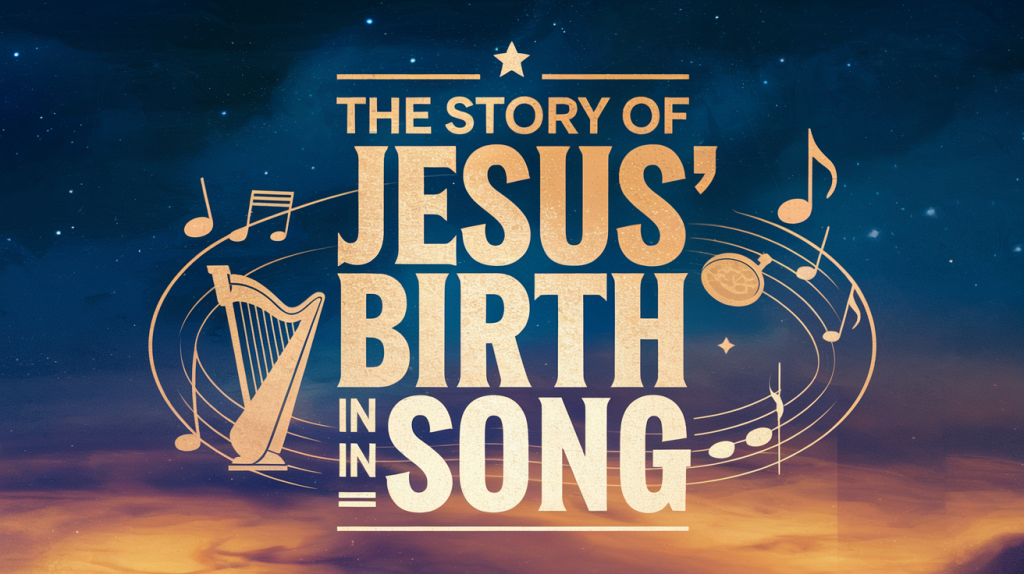
This song, “Born in Bethlehem As Prophets Foretold,” tells the Christmas story through the lens of biblical prophecy. It highlights key figures like Micah, Mary, Joseph, shepherds, and wise men, emphasizing the fulfillment of Old Testament predictions regarding the Messiah’s birth in Bethlehem.
The lyrics recount the events surrounding Jesus’ birth, including the angelic announcement, the visit of the Magi, and Herod’s attempt to kill the infant King. Ultimately, the song celebrates the arrival of the Savior and God’s love for humanity.
Make Sure You Watch My Video: I would love for you to subscribe to my YouTube channel as well…
Song Lyrics
Verse 1:
In the beginning, the promise was made,
Through prophets and kings, the foundation was laid.
From David’s own line, a ruler would rise,
A star in the heavens, a sign in the skies.
Verse 2:
Micah proclaimed it, the truth loud and clear,
In tiny Bethlehem, salvation draws near.
Not mighty in stature, but chosen of old,
The birthplace of glory, a story foretold.
Chorus:
Born in Bethlehem, the King has come!
The heavens rejoice, salvation’s begun!
A child in a manger, God’s love on display,
Born in Bethlehem, on this holy day.
Verse 3:
Mary, so humble, with Joseph by her side,
Traveled to Bethlehem, where prophecies abide.
No room in the inn, yet the Savior found rest,
In a stable so simple, the world would be blessed.
Verse 4:
Shepherds were watching their flocks through the night,
When angels appeared in radiant light.
“Glory to God! Good news we bring!
In Bethlehem lies your Savior and King!”
Chorus:
Born in Bethlehem, the King has come!
The heavens rejoice, salvation’s begun!
A child in a manger, God’s love on display,
Born in Bethlehem, on this holy day.
Verse 5:
Wise men from the East, they followed the star,
Traveling in wonder, from lands afar.
With treasures of gold, frankincense, and myrrh,
They bowed before Him, hearts in worship stirred.
Verse 6:
Herod in fury, his power undone,
Tried to destroy the Holy One.
But God’s hand protected, His plan would prevail,
In Bethlehem’s story, His love never fails.
Outro:
Born in Bethlehem, the promise fulfilled,
Through the humble and lowly, His purpose revealed.
The Savior has come, the world to redeem,
Born in Bethlehem, God’s glorious dream.
The Story Behind The Song
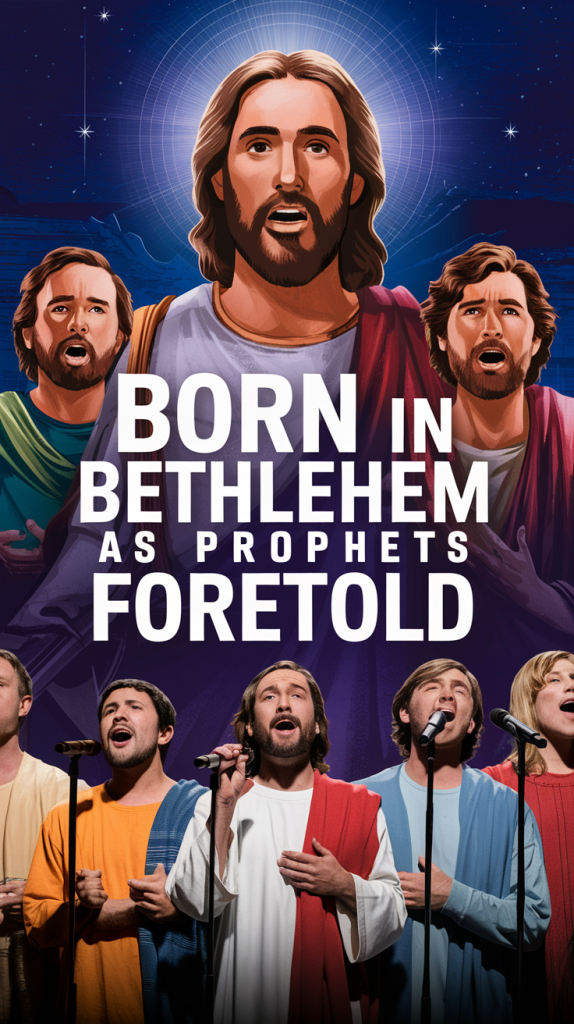
Introduction to the Song
“Born In Bethlehem As Prophets Foretold” is a vibrant storytelling song that captures the wonder and fulfillment of God’s promises through the birth of Jesus.
Each verse, rich with biblical allusions and prophecies, takes us on a journey from the foundations of the Messiah’s coming to His humble birth and triumphant fulfillment of salvation.
The chorus echoes the joyful announcement of heaven and earth: the King has come! This song invites us to celebrate Christ’s birth as the turning point of history, where God’s love is displayed for all humanity.
Verse 1: The Promise Made
The song begins by grounding us in the promises of God, “In the beginning, the promise was made.” This opening line reflects the covenantal nature of Scripture, reminding us of God’s words to Abraham, Isaac, Jacob, and David.
The promise of a ruler from David’s lineage (2 Samuel 7:12-16) laid the foundation for the Messiah. The imagery of a “star in the heavens” recalls the star that guided the wise men, prophesied in Numbers 24:17: “A star shall come out of Jacob, and a scepter shall rise out of Israel.” This verse sets the stage for the fulfillment of a plan orchestrated through generations.
Verse 2: Micah’s Prophecy Fulfilled
Here, the focus shifts to the prophecy of Micah 5:2, where it was foretold that Bethlehem, though small, would be the birthplace of the Savior: “But you, Bethlehem Ephrathah, though you are small among the clans of Judah, out of you will come for me one who will be ruler over Israel.”
This verse celebrates the profound truth that God often works through the humble and unexpected. Bethlehem, the town where David was anointed, becomes the place where the ultimate King is born.
The phrase “chosen of old” reflects Christ’s eternal nature, emphasizing that His mission was planned before the foundation of the world (Ephesians 1:4).
Chorus: The King Has Come!
The chorus is a jubilant declaration of heaven’s joy: “Born in Bethlehem, the King has come!” It highlights the cosmic significance of Jesus’ birth. The line, “God’s love on display,” echoes John 3:16: “For God so loved the world, that He gave His only Son.”
This moment marks the beginning of salvation’s story, where heaven and earth converge in celebration of God’s redemptive plan.
Verse 3: The Humble Arrival
Verse 3 introduces Mary and Joseph’s journey to Bethlehem, fulfilling the prophecy of Luke 2:4-7. Despite being part of David’s royal lineage, they find no room in the inn, emphasizing the humility of Jesus’ arrival.
Born in a stable and laid in a manger, this humble setting foreshadows Christ’s ministry of serving the lowly and marginalized. This verse reflects Philippians 2:7, where Jesus “made Himself nothing, taking the form of a servant.”
Verse 4: Shepherds Witness the Glory
The shepherds, often considered outcasts, are the first to hear the angelic proclamation (Luke 2:8-14): “Glory to God in the highest, and on earth peace, good will toward men.”
This verse celebrates how God reveals His greatest gift to ordinary people, showing that salvation is for all. The shepherds’ awe parallels Moses’ encounter with God in the burning bush—divine glory breaking into the everyday.
Chorus: Heaven Rejoices Again
The repeated chorus reinforces the overwhelming joy of heaven and earth. The King has come, salvation has begun, and God’s love is evident in the simple yet profound act of the incarnation. This moment reminds believers that Christ’s birth is not just an event in history but a reason for continual celebration.
Verse 5: The Wise Men’s Journey
Verse 5 shifts to the Magi’s journey, recalling Matthew 2:1-12. The wise men, following the star, bring gifts of gold (symbolizing royalty), frankincense (representing divinity), and myrrh (foretelling His sacrificial death).
Their worship reflects the prophecy in Psalm 72:10-11: “May the kings of Tarshish and of distant shores bring tribute to Him.” This act of worship foreshadows the global recognition of Jesus as King.
Verse 6: God’s Plan Prevails
The final verse recounts Herod’s attempt to destroy the Messiah (Matthew 2:13-18). Despite Herod’s fury, God’s hand protects Jesus, mirroring how He often shields His people from evil.
The words “God’s plan would prevail” affirm that no earthly power can thwart His purposes. This verse reminds us of Jeremiah 29:11: “For I know the plans I have for you,” declares the Lord.
Outro: The Promise Fulfilled
The outro ties everything together with a reflective tone: “Born in Bethlehem, the promise fulfilled.” It emphasizes the overarching theme of the song: God’s faithfulness in bringing His plan to completion.
The phrase, “Through the humble and lowly, His purpose revealed,” echoes Mary’s song in Luke 1:52, where she proclaims: “He has brought down the mighty from their thrones and exalted those of humble estate.”
The Savior’s birth redeems the world, fulfilling not just prophecy but the deepest longing of humanity for reconciliation with God.
Foreshadowing and Similarities in Scripture
- The star guiding the wise men recalls the pillar of fire that led Israel in the wilderness (Exodus 13:21).
- The shepherds echo David, the shepherd-king, who foreshadowed Christ as the Good Shepherd (John 10:11).
- Herod’s slaughter of innocents parallels Pharaoh’s decree in Exodus, highlighting Jesus as the ultimate deliverer.
In Summary
“Born In Bethlehem As Prophets Foretold” beautifully recounts the biblical story of Jesus’ birth, weaving together prophecy, humility, and triumph. It invites us to celebrate the fulfillment of God’s promises with joy and awe.
The song reflects the heart of the gospel: that God’s love entered our world to bring salvation, reminding us that the Light of the world was born to redeem all who believe. What an incredible story of hope and victory!
10 Interesting Facts About Bethlehem
- Bethlehem Means “House of Bread”
- The name Bethlehem comes from the Hebrew words “Beth” (house) and “Lehem” (bread), which is fitting as Jesus, the “Bread of Life” (John 6:35), was born there. This symbolism highlights God’s provision and sustenance through Christ.
- Prophecy of Bethlehem as Jesus’ Birthplace
- Micah 5:2 prophesied that the Messiah would come from Bethlehem, despite it being a small and seemingly insignificant town. This prophecy was fulfilled in Jesus’ birth, showing that God works through humble beginnings.
- Bethlehem Is the City of David
- Bethlehem is known as the city where King David was born and anointed as king (1 Samuel 16:1-13). This connects Jesus, a descendant of David, to the royal lineage and fulfills God’s promise of an eternal king from David’s line (2 Samuel 7:12-16).
- A Place of Refuge in Ruth’s Story
- Bethlehem is where Naomi and Ruth returned after the famine, and where Ruth met Boaz, her redeemer (Ruth 1–4). This story foreshadows Jesus, the ultimate Redeemer, who was also born in Bethlehem.
- Location of Rachel’s Tomb
- Near Bethlehem is the tomb of Rachel, Jacob’s wife, who died giving birth to Benjamin (Genesis 35:19-20). The mourning of Rachel in this area is echoed in Matthew 2:18, referring to Herod’s massacre of infants after Jesus’ birth.
- Bethlehem Is in Judah
- Bethlehem is located in the region of Judah, which is significant as Judah was the tribe from which the Messiah was prophesied to come (Genesis 49:10).
- Known for the Shepherds’ Fields
- Tradition holds that the shepherds who received the angelic announcement of Jesus’ birth were watching their flocks near Bethlehem (Luke 2:8-15). These fields are now a pilgrimage site.
- Bethlehem Was Under Roman Rule at Jesus’ Birth
- At the time of Jesus’ birth, Bethlehem was part of the Roman Empire. Mary and Joseph traveled there for the census decreed by Caesar Augustus (Luke 2:1-5), which directly led to the fulfillment of Micah’s prophecy.
- The Church of the Nativity
- The Church of the Nativity in Bethlehem is one of the oldest continuously operating churches in the world. Built over the site traditionally believed to be Jesus’ birthplace, it attracts millions of visitors yearly.
- Bethlehem’s Role in the Christmas Story
- Bethlehem is central to the Christmas story, not only as Jesus’ birthplace but also as a symbol of God’s faithfulness. Despite its small size and humble reputation, it became the stage for the most important event in human history: the incarnation of God.
Bethlehem is much more than a geographical location; it is a symbol of God’s providence, humility, and the fulfillment of His promises. Each detail about Bethlehem adds depth and richness to the story of Jesus’ birth.
How Does “The Empty Doorway” Compare to “Born in Bethlehem” in Reflecting the Christmas Story?
“The Empty Doorway” and “Born in Bethlehem” both capture the essence of the Christmas story in contrasting ways. While one focuses on solitude and reflection, the other embraces nativity’s warmth. A new christmas song no room could perfectly embody the struggle of finding space for hope, echoing the timeless tale of Christ’s humble birth.
FAQs about the Birth of Jesus
1. What is the significance of Bethlehem in the Christmas story?
Bethlehem holds a central role in the Christmas narrative as the prophesied birthplace of Jesus Christ. The Old Testament prophet Micah specifically foretold that the Messiah would be born in Bethlehem, making it a place of great anticipation and religious importance for the Jewish people.
2. How was the birth of Jesus foretold?
The birth of Jesus was foretold through various prophets and signs throughout the Old Testament. Prophets like Isaiah, Micah, and Jeremiah spoke of a coming Messiah who would redeem and save his people. The lineage of Jesus, tracing back to King David, was also a significant element of the prophecies, as it established his rightful claim to the throne of David.
3. What role did angels play in the Christmas story?
Angels played a crucial role in announcing the birth of Jesus. They appeared to the shepherds in the fields, proclaiming the good news of the Savior’s arrival and directing them to the manger where he lay. The angelic proclamation, “Glory to God in the highest, and on earth peace, good will toward men,” is a central message of Christmas, signifying the divine peace and goodwill that Jesus brought into the world.
4. Who were the wise men and what gifts did they bring?
The wise men, also known as Magi, were scholars and astrologers from the East who were guided by a star to the birthplace of Jesus. They brought gifts of gold, frankincense, and myrrh, each symbolizing an aspect of Jesus’s identity: gold for his kingship, frankincense for his divinity, and myrrh for his suffering and death.
5. Why did Mary and Joseph travel to Bethlehem?
Mary and Joseph traveled to Bethlehem because they were descendants of King David and were required to register for a census decreed by the Roman emperor. This decree, seemingly coincidental, fulfilled the prophecy that the Messiah would be born in Bethlehem, the city of David.
6. Where was Jesus born?
Due to the lack of available lodging in Bethlehem, Jesus was born in a humble stable, a place typically used for housing animals. This setting highlights the humility of Jesus’s birth and the accessibility of his message to all, regardless of social status.
7. What was King Herod’s reaction to the news of Jesus’ birth?
King Herod, the Roman-appointed ruler of Judea, was threatened by the news of Jesus’ birth, perceiving him as a potential rival to his throne. In an attempt to eliminate this threat, he ordered the massacre of all male infants in Bethlehem, an event known as the Massacre of the Innocents.
8. What is the main message of the Christmas story?
The Christmas story is a message of hope, love, and redemption. It tells of the birth of Jesus Christ, the Son of God, who came into the world to save humanity from sin and offer eternal life. His humble birth, the angelic proclamation of peace, and the wise men’s journey from afar all point to the universality of God’s love and the significance of Jesus’s arrival for all people.
Call to Action: The Question That Demands an AnswerIn Acts 2:37 Peter and the Apostles were asked the question – What Shall We do? And in Acts 2:38 Peter answered, Repent, and be baptized every one of you in the name of Jesus Christ for the remission of sins, and ye shall receive the gift of the Holy Ghost. For the promise is unto you, and to your children, and to all that are afar off, even as many as the Lord our God shall call. Do you understand this? After hearing the gospel and believing, they asked what should would do. The answer hasn’t changed friend, Peter clearly gave the answer. The question for you today is, Have you receieved the Holy Spirit Since you believed? If you’re ready to take that step, or you want to learn more about what it means to be born again of water and Spirit, visit: Come, and let the Spirit make you new. |