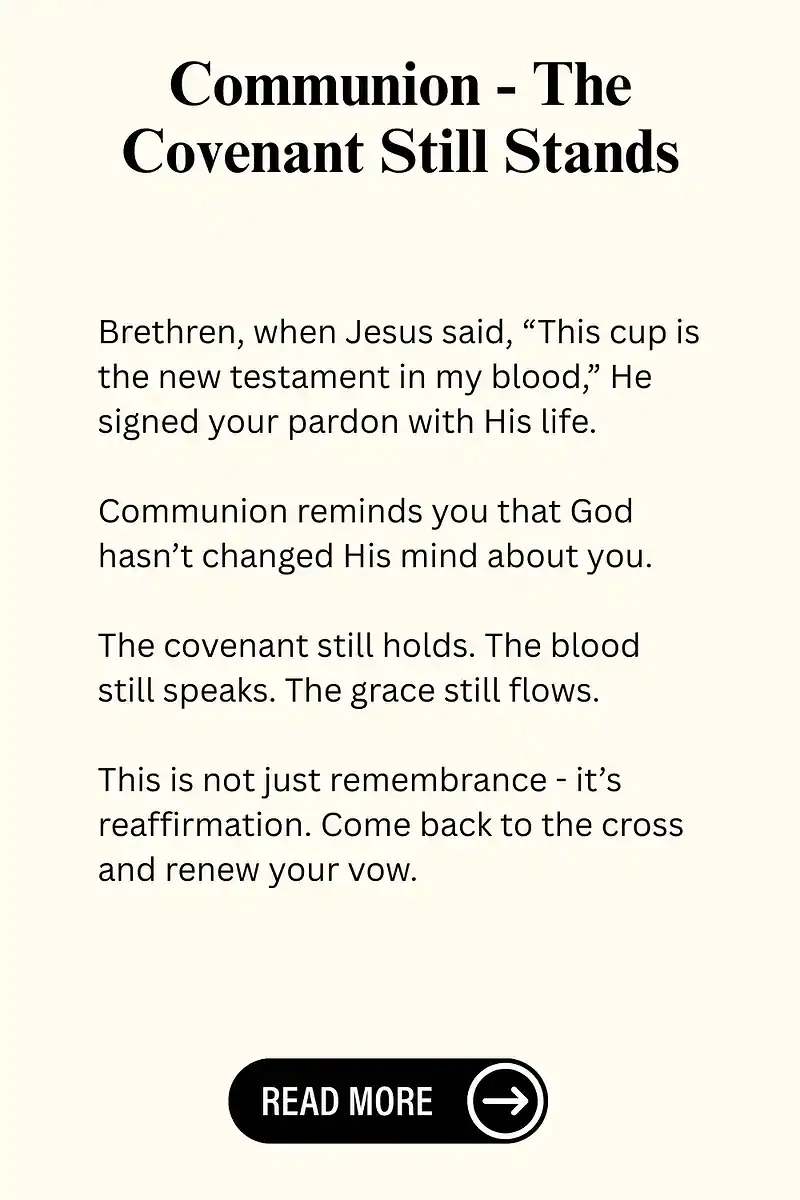
Brethren, hear this with a ready heart. Holy Communion is not a side dish in the Christian life. It is memorial, proclamation, participation, unity, and hope in one sacred act.
- We remember the cross because Jesus said, “This do in remembrance of me” (Luke 22:19, KJV).
- We proclaim the Gospel because “as often as ye eat this bread, and drink this cup, ye do shew the Lord’s death till he come” (1 Corinthians 11:26).
- We partake because “the cup of blessing… is it not the communion of the blood of Christ? … the bread… the communion of the body of Christ?” (1 Corinthians 10:16).
- We gather as one body, for “we being many are one bread, and one body” (1 Corinthians 10:17).
- We look forward because the Lord promised, “I will not drink henceforth… until… I drink it new with you in my Father’s kingdom” (Matthew 26:29).
Friends, this table calls us to examine, to reconcile, to rejoice, to wait, and to witness. It is the New Covenant in His blood, sealed for the forgiveness of sins. It is a foretaste of the Marriage Supper of the Lamb (Revelation 19:9).
Praise be to God. Let us keep the feast “with the unleavened bread of sincerity and truth” (1 Corinthians 5:8). Hallelujah, what a Savior.
What Holy Communion Is
Holy Communion is the Lord’s own ordinance, given on the night He was betrayed. He took bread, gave thanks, brake it, and said, “This is my body which is given for you: this do in remembrance of me.”
He took the cup, saying, “This cup is the new testament in my blood… this do ye… in remembrance of me.” (Luke 22:19; 1 Corinthians 11:23–25; Matthew 26:27–28).
It is called the Lord’s Supper (1 Corinthians 11:20), the communion (1 Corinthians 10:16), the breaking of bread that marked the early believers’ worship (Acts 2:42; Acts 2:46; Acts 20:7).
Praise the Lord, He invites us not to an empty ritual, but to fellowship with the risen Christ who promised, “Lo, I am with you alway” (Matthew 28:20) and who stands among those who gather in His Name, “where two or three are gathered… there am I in the midst” (Matthew 18:20).
Question: When you come to the table, do you come as a spectator, or as a soul hungry for the Bread of Heaven?
The Passover Connection: Christ Our Sacrifice
Holy Communion is rooted in Passover. God commanded Israel to slay a spotless lamb, mark the door with blood, and keep the feast as a memorial throughout generations (Exodus 12; especially 12:14, 12:15).
Unleavened bread pictured purity, because leaven spreads and puffs up (Exodus 12:15). Paul ties the threads together: “Christ our passover is sacrificed for us… therefore let us keep the feast… with the unleavened bread of sincerity and truth.” (1 Corinthians 5:7–8).
Friends, every lamb slain was a signpost pointing to the Lamb of God. John pointed at Jesus and cried, “Behold the Lamb of God, which taketh away the sin of the world.” (John 1:29). Thank you, Lord. His blood is our shelter from judgment just as surely as the blood on Israel’s doors.
We even glimpse Communion’s shape in the priest-king Melchizedek who brought bread and wine and blessed Abraham (Genesis 14:18), in the covenant meal where Moses and the elders saw God, and did eat and drink (Exodus 24:9–11; cf. 24:8, “Behold the blood of the covenant”), and in manna from heaven, which Jesus fulfilled as the true Bread who gives life to the world (John 6:31–35).
He went further: “I am the living bread… if any man eat of this bread, he shall live for ever” and “He that eateth my flesh, and drinketh my blood, dwelleth in me, and I in him.” (John 6:51, 56).
Question: Will you trust the Lamb whose blood still speaks better things than all our efforts?
The Night He Gave Us This Feast
In the upper room, during Passover, Jesus took bread and the cup and gave them new meaning for all time (Matthew 26:26–29; Luke 22:19; 1 Corinthians 11:23–25). He said His blood is “shed for many for the remission of sins” (Matthew 26:28).
He anchored the church’s memory with a simple, sacred rhythm: take, bless, break, give; take and drink with thanksgiving. Praise the Lord, He tied our present remembrance to His promised future: He will drink it new with us in the Kingdom (Matthew 26:29).
Question: Do you taste in this cup not only pardon for the past, but promise for the future?
How The First Church Lived It
From Pentecost on, believers continued stedfastly in the apostles’ doctrine, fellowship, breaking of bread, and prayers (Acts 2:42). They broke bread from house to house with gladness and singleness of heart (Acts 2:46).
In Troas they gathered on the first day of the week… to break bread and hear the Word (Acts 20:7). Friends, Communion was not occasional or optional. It was family life centered on Christ.
Question: Is your table at church a weekly duty, or a weekly delight with the Lord and His people?
Paul’s Clear Teaching: Meaning, Order, Reverence
Paul explains that the cup and the bread are our “communion” in Christ’s blood and body, and that we are one because we all partake of that one bread (1 Corinthians 10:16–17).
He then confronts Corinth’s abuses and resets the pattern by repeating the words he received of the Lord about the bread and cup in remembrance of Christ (1 Corinthians 11:23–25).
He sums it up: “As often as ye eat this bread, and drink this cup, ye do shew the Lord’s death till he come.” (1 Corinthians 11:26). Then the warning: “Whosoever shall eat… and drink… unworthily, shall be guilty of the body and blood of the Lord.”
Therefore, “let a man examine himself” and discern the Lord’s body (1 Corinthians 11:27–29). Some in Corinth felt God’s discipline, “many are weak and sickly… and many sleep.”
Yet the call is not to stay away, but to judge ourselves and come rightly so we may not be judged (1 Corinthians 11:30–32). He urges order and love: wait for one another (1 Corinthians 11:33–34).
Brethren, reverence is not fear that pushes you back. Reverence is humility that brings you near.
Question: Will you examine your heart, reconcile with your brother, and come?
What The Symbols Preach Every Time
Bread speaks of the body of Christ given for us, our true sustenance. Jesus said, “I am the living bread… if any man eat of this bread, he shall live for ever.” (John 6:51). Cup speaks of blood.
Scripture is clear: “Without shedding of blood is no remission.” (Hebrews 9:22). “The life of the flesh is in the blood.” (Leviticus 17:11). Thank you, Lord, Your poured-out life cleanses us: “the blood of Jesus Christ his Son cleanseth us from all sin.” (1 John 1:7).
Eating and drinking are acts of reception and fellowship. At this table, status disappears and grace defines us. We do it mindful that Christ is present among His people (Matthew 18:20; Matthew 28:20), and like the Emmaus travelers, in the breaking of bread our eyes are opened to know Him afresh (Luke 24:31).
Question: When you take the bread and cup, are you merely remembering, or are you receiving with faith?
Blessings That Flow From The Table
- Nourishment and Nearness: Communion strengthens assurance that He dwelleth in me, and I in Him (John 6:56). Praise the Lord, many have found their hearts warmed and steadied at the table.
- Unity and Reconciliation: First be reconciled before you offer your gift, Jesus said (Matthew 5:23–24). The table softens hard hearts.
- Obedience and Joy: “If ye know these things, happy are ye if ye do them.” (John 13:17). Obedience opens the door to blessing.
- Witness and Hope: We shew the Lord’s death till he come (1 Corinthians 11:26) and keep watch for His appearing. Our prayer remains, “Even so, come, Lord Jesus.” (Revelation 22:20).
- Everyday Worship: Whether you eat or drink, do all to the glory of God (1 Corinthians 10:31). Communion trains the soul to live thankfully.
- Strength for the Journey: In weakness we learn to say, “I can do all things through Christ which strengtheneth me.” (Philippians 4:13).
Question: Will you approach the table expecting grace, or assuming routine?
How To Come And How To Live After
- Examine and Confess. “If we confess our sins, he is faithful and just to forgive us our sins.” (1 John 1:9). Clear the conscience.
- Reconcile and Forgive. Keep the unity of the Spirit in the bond of peace (Ephesians 4:3).
- Remember and Rejoice. Give thanks like Jesus gave thanks. Turn Communion into Eucharist in your heart.
- Go and Live Cross-shaped. “If any man will come after me, let him deny himself, and take up his cross daily, and follow me.” (Luke 9:23).
- Stay Expectant. Christ will drink it new with us in the Kingdom (Matthew 26:29). Keep your eyes lifted.
Friends, the rhythm of Communion shapes the rhythm of discipleship: conviction, confession, cleansing, communion, commission.
Question: Will you let the table tune your whole week to the key of grace?
A Pastoral Call At The Table
Praise the Lord, this is not our table. It is the Lord’s. He invites the humble, the repentant, the hungry. He calls us to remember, to proclaim, to partake, to unite, to wait.
If bitterness clings, forgive as you were forgiven. If pride puffs, remember the unleavened bread. If fear trembles, behold the blood of the covenant that speaks peace (Exodus 24:8; Hebrews 9:22; 1 John 1:7).
If weariness weighs, come and be strengthened. If hope flickers, lift the cup and whisper with the church through the ages, “Even so, come, Lord Jesus.” (Revelation 22:20).
Brethren, shall we draw near with gratitude? Shall we wait for one another with love? Shall we keep the feast with sincerity and truth? (1 Corinthians 5:8; 11:33). Praise be to God, Christ our Passover was sacrificed for us, and He lives forevermore.
Conclusion: Keep The Feast
- Remember: “This do in remembrance of me.” (Luke 22:19; 1 Corinthians 11:24–25).
- Proclaim: “Ye do shew the Lord’s death till he come.” (1 Corinthians 11:26).
- Partake: “Communion of the blood… communion of the body.” (1 Corinthians 10:16).
- Unite: “We… are one bread, and one body.” (1 Corinthians 10:17).
- Await: “I will… drink it new with you.” (Matthew 26:29; Revelation 19:9).
Friends, prepare your heart. Bring your thanks. Offer your faith. Receive your King. Then rise from the table to live a life that says in every meal, every choice, every step, “To the glory of God.” (1 Corinthians 10:31).
Praise the Lord. Thank you, Lord. Praise be to God.
Call to Action: The Question That Demands an AnswerIn Acts 2:37 Peter and the Apostles were asked the question – What Shall We do? And in Acts 2:38 Peter answered, Repent, and be baptized every one of you in the name of Jesus Christ for the remission of sins, and ye shall receive the gift of the Holy Ghost. For the promise is unto you, and to your children, and to all that are afar off, even as many as the Lord our God shall call. Do you understand this? After hearing the gospel and believing, they asked what should would do. The answer hasn’t changed friend, Peter clearly gave the answer. The question for you today is, Have you receieved the Holy Spirit Since you believed? If you’re ready to take that step, or you want to learn more about what it means to be born again of water and Spirit, visit: Come, and let the Spirit make you new. |