
Quick Overview of This Bible Study…
Short on time? I have created a short slide show presentation of some key takeaways in our study. The complete, more comprehensive bible study is below…
Have you ever felt like God was MIA – missing in action – in your life? Ever wondered if He’s working behind the scenes when everything seems to be going wrong?
If so, the Book of Esther is exactly what you need. It’s the one book in the Bible that never mentions God by name – not even once! Yet, ironically, Esther’s story ends up shouting God’s presence from the rooftops (or shall we say, the gallows?).
As a believer, I love the story of Esther. It’s got all the drama of a royal court, a courageous heroine, a scheming villain (boo, Haman!), and some of the most vivid examples of God’s providence – all wrapped up in 10 short chapters.
In this Bible study,we’ll look at the context and themes of the book of Esther, dig into where else “Esther” pops up in Scripture (spoiler: not much), discover related biblical ideas (deliverance! courage! divine timing!), unpack symbolism and metaphors (ever feel God is hidden?), and tie it all together with how Esther points forward to Jesus Christ and the Church.
All in a friendly, relatable way, from one fellow traveler of faith to another. Ready? Let’s do this – for such a time as this!
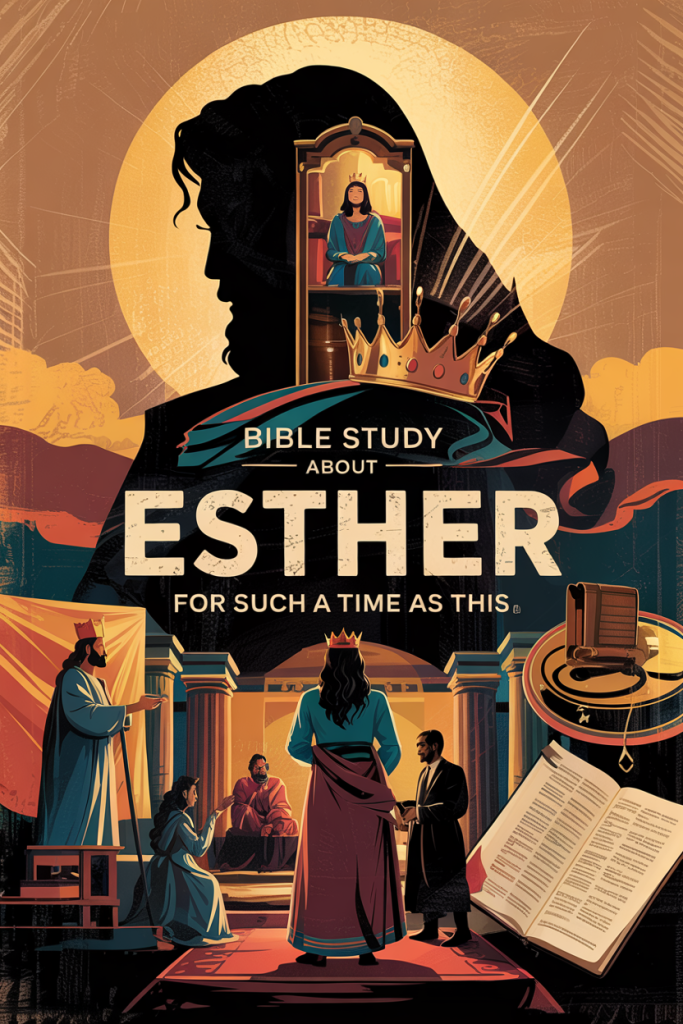
Esther in Context: A Hidden God and a Bold Queen
The Book of Esther is set about 480 BC in the Persian Empire. Think ancient Iran, sumptuous palaces, and a king who throws six-month-long parties (yes, really – see Esther 1:4).
The Persian king in the story is Ahasuerus (widely identified as Xerxes I). Esther herself is a young Jewish woman living in the Persian capital of Susa.
She’s an orphan raised by her cousin Mordecai, and through an unlikely twist, this Jewish girl becomes the queen of Persia. Talk about from rags to riches!
Here’s the quick rundown:
- King Ahasuerus gets rid of his first queen (Vashti) for insubordination.
- He then holds a beauty pageant to find a new queen.
- Esther, unknown to him as Jewish, wins his favor and the crown.
- Meanwhile, the king’s adviser Haman – a classic bad guy – hatches a genocidal plot to annihilate all the Jews in the empire (yep, a precursor to some very dark chapters of history). Unbeknownst to Haman, Queen Esther is Jewish.
- Mordecai famously challenges Esther to use her position to save her people, telling her “who knoweth whether thou art come to the kingdom for such a time as this?” (Esther 4:14, KJV).
- In other words: this is your moment, Esther! Don’t waste it.
- Esther gathers her courage ("If I perish, I perish," she says bravely in 4:16) and approaches the king uninvited – a capital offense.
- Long story short: Esther reveals Haman’s evil scheme, the king has Haman executed on the very gallows Haman built for Mordecai (talk about poetic justice!), and the Jewish people are saved.
- They inaugurate a festival, Purim, to celebrate the great deliverance.
Now, the wild thing about Esther’s story is what I mentioned up top: God’s name is never explicitly mentioned. There are no overt miracles, no prophetic speeches, no direct mention of prayer (though fasting is there).
It’s almost like God chose to stay anonymous in this one. Why? I like to think God wanted to show us something powerful: that He is at work even when we can’t see Him.
The fancy word here is providence – God’s invisible hand guiding events. The entire narrative of Esther is an illustration of God’s providence as “the unseen power” controlling everything for His purpose.
As one commentator put it, “there are no miracles in Esther, but the preservation of Israel through providential control of every event and person reveals the omniscience and omnipotence of Jehovah” blueletterbible.org.
In plain terms: God is the main character of Esther, even if He’s hiding just offstage.
And boy, is He obviously present once you know where to look.
Consider the “coincidences” in Esther:
- Esther happens to be beautiful and chosen as queen
- Mordecai happens to overhear an assassination plot, saving the king’s life
- the king happens to have insomnia one night and has the history books read to him
- which just happen to remind him that Mordecai saved his life
- and this occurs the very night before Haman comes to request Mordecai’s execution!
(You can almost hear God chuckling in the background.) The timing is so perfect it’s comical.
Esther is laced with irony and dramatic reversals – it reads almost like a satire of anyone who tries to outsmart God.
Every move Haman makes to destroy God’s people ends up advancing their salvation.
It’s as if God and Satan were playing chess with real people: Satan moved Haman into place and said “Check.” Then God positioned Esther and Mordecai and said “Checkmate!”
Traditional Judaism noticed this, teaching that the very absence of God’s name is deliberate – a lesson that God can work through secular events and imperfect people.
The Hebrew scholars even pointed out that Esther’s name sounds like the Hebrew word for “hide” (hester), and connect it to God’s statement in Deuteronomy, “I will surely hide my face” (haster astir) en.wikipedia.org.
In other words, Esther’s story fulfills that idea of God “hiding” His face – seemingly absent, yet very much present behind the scenes.
In fact, some ancient manuscripts and the Greek additions to Esther include prayers and even acrostic puzzles to “hide” God’s name (YHWH) in the text en.wikipedia.org, en.wikipedia.org. How cool is that?
For us today, Esther’s context offers a huge encouragement: Even when God feels absent, He is at work providentially.
It’s a reminder that faith isn’t just for when we see miracles; it’s for the ordinary, confusing Tuesday afternoons of life when we’re not sure what God is doing.
Like Esther and Mordecai, we often have to act in faith without a direct whisper from heaven. But we can trust that God is silently ordering events in the background for His glory and our good.
- As the Apostle Paul would much later reassure, “all things work together for good to them that love God” (Romans 8:28) – and “all things” means all, even the messy and scary things.
Before we move on, one more bit of context. The Book of Esther is one of only two books in the Bible named after a woman (the other is Ruth).
And interestingly, Esther is never directly mentioned elsewhere in Scripture.
The New Testament doesn’t quote Esther or even allude to it. (Esther stands in good company there along with Song of Solomon, Obadiah, Nahum – small books not referenced in the NT.)
So, Esther’s story is pretty much self-contained. However, its impact reverberates through history – Jewish people to this day celebrate Purim because of Esther. And spiritually, the principles in Esther absolutely echo throughout the Bible, as we’re about to see.
But if you flip through your Bible looking for “Esther” outside of that book, you won’t find much.
- However, you will find her Hebrew name “Hadassah” in Esther 2:7 (had to mention this fun fact!). Hadassah means “myrtle,” a fragrant evergreen shrub.
- The prophet Isaiah later uses the myrtle as a symbol of God’s blessing and restoration (Isaiah 55:13).
- It’s a fitting name for Esther – like a myrtle, she would bring blessing to her people and her legacy would be evergreen.
- Meanwhile, “Esther” likely comes from a Persian word meaning “star,” or possibly from the name of the Babylonian goddess Ishtar. She certainly became a star of hope for her people.
- And as noted earlier, Jewish tradition also connects “Esther” to “hidden.” In a poetic twist, “the Jewish meaning of the name Esther is ‘to hide.’ She was hidden… and kept her identity hidden” until the right time.
- It’s almost prophetic: God’s hidden star, shining when needed “for such a time as this.”
Alright, now that we know the background, let’s explore the big themes and see how Esther’s ancient story speaks to us as New Testament believers today.
Themes of Providence, Courage, and Divine Timing
Esther’s story might be set in a royal palace in ancient Persia, but the themes hit home in our modern lives. Let’s unpack a few major themes and lessons, and I’ll bet you’ll find yourself nodding along, thinking, “Yup, been there, needed that.”
Providence: God’s Got This (Even When You Can’t See Him).
As we’ve said, providence is the theme of Esther. The book asks us to trust that God is working “whether we see him or not”. Have you ever experienced a “coincidence” that later made you go, “Hmm, that had to be God!”? That’s providence.
In Esther, everything from Queen Vashti’s ouster to Esther’s crowning, from the timing of Haman’s plot to the king’s insomnia, screams that “God is ruling sovereignly, accomplishing his purposes” behind the scenes.
It’s like a divine tapestry where the backside looks like a mess of threads, but the front reveals a beautiful design. Believers often live on the “messy backside” of the tapestry – we can’t see what God is weaving. Esther reminds us to hang in there.
When life feels random or unfair, remember how God brilliantly orchestrated deliverance in this book. He “is clearly the main character in the drama” of Esther, hidden but present. And He’s the main character in our story too, even on days we feel forgotten.
In fact, Mordecai tells Esther that if she stayed silent, deliverance would arise from another place (Esther 4:14) – showing his confidence that God’s promise to preserve the Jewish people would not fail.
He was right! God had sworn to protect Israel, and Haman’s plot was ultimately doomed by God’s covenant faithfulness. This gives us a firm hope: God’s promises to us (through Christ) won’t fail either, no matter how dire things look.
Nothing – not an empire, not a villain, not even our own mistakes – can derail God’s plan. Providence is God’s loving control in action.
Courage and Obedience: Stepping Up “For Such a Time as This.”
Esther’s personal bravery is another huge theme. She didn’t set out to be a hero. Honestly, she was pretty reluctant at first. Can’t blame her – approaching the king uninvited could get you killed.
(Her predecessor Queen Vashti was ousted just for disobeying a summons; barging in on the king was a whole other level of risky.) Esther initially told Mordecai “um, I could die if I do that!”
- But Mordecai’s response was essentially: Esther, this is bigger than you. If you stay silent, deliverance will come from elsewhere, but you and your family will miss out – and who knows, maybe you were placed as queen for this very moment (Esther 4:13-14).
Talk about a wake-up call.
Those words – “for such a time as this” – have echoed through history as a call to purpose and courage. They certainly lit a fire under Esther.
- She decided to risk it all: “I will go to the king … and if I perish, I perish” (4:16).
That is holy boldness. It reminds me of other biblical heroes:
- Daniel’s friends saying “our God can save us from the fiery furnace, but even if not, we won’t bow” (Daniel 3:17-18)
- or the apostles in Acts saying “We must obey God rather than men” even if it leads to death (Acts 5:29).
Esther’s courage wasn’t reckless; it was a resolute willingness to do right and trust God with the outcome.
What about us? Most of us won’t have to face a literal king on a throne, but we might have to confront a boss, a government, a friend, or a situation where speaking up could cost us.
We might risk our reputation, job, or comfort. Esther’s example encourages us to do the right thing, even when it’s scary.
- And let’s not forget: Esther didn’t go it alone. She called for a three-day fast among all the Jews in Susa (4:16).
They were surely praying even though the text says “fast.” There’s a principle here: when facing a huge challenge, don’t go solo – gather your community to pray and seek God together.
- Jesus said “where two or three are gathered in my name…” (Matt 18:20); there’s power and encouragement in collective prayer.
So, when you’re up against it, invite others to “fast and pray” with you. Also, notice that Esther exercised wisdom and courage.
She didn’t rush impulsively; she fasted for three days (seeking God’s guidance), and then approached the king with a plan (she didn’t blurt out her request immediately, but tactfully invited the king and Haman to a banquet – actually two banquets – before exposing Haman).
There’s something to be said for patience and timing. Sometimes we need courage and God’s timing. Esther sensed when to speak up. Her story encourages us to pray for both boldness and discernment about timing.
Identity and Concealment: When to Blend In, When to Stand Out.
An interesting sub-theme is Esther’s identity as a Jew – which she hid for a long time.
- Mordecai had instructed her not to reveal her heritage (Esther 2:10), so she basically “passed” as Persian until the crisis forced her to come out of the closet, so to speak.
This raises a tricky question: Was it right for Esther to hide her faith/ethnicity? The Bible doesn’t explicitly praise or condemn it here, but we do know that by the end, Esther identifies openly with her people (“I am a Jew and these people are my people,” she tells the king in essence).
This makes me think of us as Christians. Sometimes we might hide our faith in certain settings out of fear – maybe at work or among non-believing friends, we keep our “Jesus identity” on the down-low.
Esther’s journey shows a couple of things:
(1) There may be seasons or situations where God’s people live “undercover” (think of Christians in persecuted countries who must be discreet). Mordecai likely thought it wasn’t yet time for Esther to reveal herself.
Jesus even instructed people not to reveal his identity on occasion, until the right time (Luke 8:56, etc.).
But (2) when a defining moment comes, we must be ready to stand up and be counted. There comes a time we cannot remain silent or hidden. For Esther, that time came and she rose to the occasion.
For us, it might be when core truth is on the line or someone’s life is at stake spiritually or physically. We can’t shy away from saying, “Yes, I follow Christ,” and doing what’s right.
- Esther’s eventual bold confession to the king saved lives; our bold confession of Christ can save souls (Romans 1:16).
It’s also a reminder of God’s grace: Esther and Mordecai weren’t perfectly devout saints from the start – they were a bit compromised (hiding their faith, not returning to Jerusalem when they could have).
Yet God still lovingly uses them. That gives hope to those of us who haven’t always been bold or faithful – it’s never too late to start doing the right thing. God in His providence can redeem our story, just as He did with Esther.
Divine Timing: “Such a Time as This”.
We can’t talk themes without circling back to the famous line: for such a time as this. This speaks to the sovereignty of God in positioning people. Mordecai was convinced that Esther’s rise to the throne wasn’t just a stroke of luck.
It had purpose. Similarly, have you ever paused to consider that your talents, position, job, neighborhood, even the era you live in, might be intentionally chosen by God?
- Ephesians 2:10 says we are created for good works “which God prepared beforehand” for us to do.
- Acts 17:26 says God determined our appointed times and the boundaries of our habitation.
In short, you are where you are and when you are for a reason. It’s a thrilling and sobering thought. Esther’s theme of divine timing encourages us to look around and ask, “What opportunities has God given me, here and now, to make a difference?”
It might be as dramatic as preventing a “genocide” (probably not) or as quiet as influencing one person’s life. No one else has your exact sphere of influence.
You might be the only Christian in your workplace – hey, maybe you are there “for such a time as this” to show Christ’s love to those coworkers. Maybe you’re the only believer in your family – God can use you like an Esther in your household.
This theme challenges me personally not to coast or assume someone else will step up. If God’s nudging your heart about a situation, take Esther’s cue and step up to the plate. Who knows? You might be part of a plan much bigger than you imagined.
Justice and Reversal: Pride Goes Down, Humility Rises Up.
One of the most satisfying themes in Esther is the great reversal. Haman, who strutted around as the king’s favorite, ends up disgraced and executed.
Mordecai, who humbly did his duty and even wore sackcloth in sorrow for his people, ends up wearing the king’s royal robes and signet ring, second in command of the empire. Talk about role reversal!
- This reflects a common biblical principle: God opposes the proud but gives grace to the humble (James 4:6).
- Or as Jesus said, “Whoever exalts himself will be humbled, and he who humbles himself will be exalted” (Luke 14:11).
Haman is basically a case study in that principle. There’s a dark humor in how Haman’s day went from bragging to begging. Remember that scene in chapter 6?
Haman enters the court to ask the king’s permission to hang Mordecai, but before he can speak, the king asks Haman, “What should be done for a man the king delights to honor?”
Haman, in his massive ego, thinks, “Who would the king want to honor more than me?” So he suggests a ridiculously grand honor – wearing the king’s robe and riding the king’s horse with a royal proclamation of glory.
The king loves the idea and says, “Great! Go do that for Mordecai the Jew.” Cue Haman’s jaw dropping. He has to lead his arch-enemy Mordecai around on horseback, declaring, “This is what is done for the man the king delights to honor!” I mean, you couldn’t script a better irony.
The Bible has a word for this kind of scenario: poetic justice.
- Psalm 7:15-16 says the wicked man digs a pit and falls into the hole he made; his trouble comes back on his own head.
That’s Haman’s fate to a tee – literally hung on the gallows he built for someone else. For us as readers, this theme is a mix of warning and comfort.
Warning: Don’t be a Haman. Pride and hatred will eventually destroy the one who harbors them. It might not always be as dramatic as a 75-foot gallows in your backyard, but eventually “you reap what you sow” (Galatians 6:7).
If we plot harm or nurture bitterness, it will boomerang on us.
Comfort: If you’ve ever been on the receiving end of injustice or malice (and who hasn’t, at some point?), Esther assures us that God sees and God will set things right.
There may be a waiting period (Mordecai wasn’t vindicated immediately; in fact, things got worse before they got better), but ultimately, evil doesn’t win.
The story is a mini-foreshadow of the final justice God will bring. As believers, we’re told to “leave room for God’s wrath” (Romans 12:19) and not take revenge, because God will repay.
In Esther, He repaid Haman thoroughly. So we can release our battles to the Lord, knowing He is just. In the meantime, keep walking in humility and integrity like Mordecai, and trust God to lift you up in due time (1 Peter 5:6).
Deliverance and Rest: Sorrow Turned to Joy.
The Book of Esther starts with an edict of death and ends with feasting and gladness. Once Haman is out of the picture, Mordecai and Esther issue a counter-decree that allows the Jews to defend themselves on the appointed day of attack.
The result is a massive deliverance. The Jews get relief from their enemies. The days that were supposed to be their doom become days of victory.
- In fact, Esther 9:22 says the Jews celebrated their deliverance, “a day of gladness and feasting, and a good day, and of sending portions one to another.”
They instituted Purim as a yearly festival so that “the memory of what had happened wouldn’t fade from among their descendants”.
(Side note: “Purim” comes from “pur” meaning lot – referring to the lots Haman cast to choose the date of destruction. God flipped those “lottery results” on their head. It’s like naming a holiday “Dice Day” because some dice fell in our favor thanks to God.)
The theme here is God’s ability to turn mourning into joy.
- “Weeping may endure for a night, but joy cometh in the morning” (Psalm 30:5) could practically be Esther’s motto.
One day they’re in sackcloth and ashes; a short time later they’re feasting and sending gifts. This resonates with the broader biblical theme of redemption – God saving His people and giving them rest.
For Christians, every deliverance story in the Old Testament, including Esther, ultimately echoes the Great deliverance Jesus accomplished.
We’ll talk more about Esther’s connection to Jesus soon, but here let’s appreciate the pattern: threat → prayerful dependence → bold action → divine deliverance → celebration and rest.
Many of our toughest faith experiences follow that arc. We face a threat or trial, we cry out to God (often in fasting or fervent prayer), we step out in faith, God comes through (often in ways we didn’t expect), and later we look back with joy and gratitude.
Esther encourages us that deliverance will come. It may not always come on our preferred schedule, but God will not abandon those who trust in Him.
- Mordecai and Esther’s people got relief “from their enemies” (Esther 9:22).
In Christ, we have the promise of ultimate relief from our enemies – sin, death, and Satan – and eternal rest in the Kingdom. In the meantime, God often grants timely rescues in this life too.
How many of us can share a testimony of how God “turned it around” at the last moment? Esther is the poster child of that turnaround.
Whew, those are some rich themes!
And there are even more we could extract (loyalty, wisdom, the role of feasting/festivals, etc.), but these are the biggies: providence, courage, identity, timing, justice, and deliverance.
Now, let’s zoom out and see if Esther’s story connects with other biblical stories or instructions, especially for us as New Testament believers.
Biblical Parallels and Related Concepts
Esther may be a unique book, but it’s not an island. Its themes link arms with many other Scriptures. Here are a few notable parallels and related ideas:
Joseph and Moses – Deliverers in Foreign Courts:
Esther’s story parallels those of Joseph in Genesis and Moses in Exodus in some interesting ways.
- Joseph, like Esther, rose to prominence in a foreign nation (Egypt) and ended up saving his family (and many others) from death (Genesis 50:20).
- Both stories involve a foiled genocide – in Joseph’s case it was a famine that could’ve wiped out Israel; in Esther’s, an execution order.
- In both, God’s providence is highlighted: Joseph famously said to his brothers, “You meant evil against me, but God meant it for good” – which could equally be said of Haman’s evil plot versus God’s good plan.
- Moses likewise was God’s instrument to prevent genocide – Pharaoh had ordered all baby boys of Israel drowned, but God spared Moses and eventually used him to deliver Israel from Egypt.
- Both Moses and Esther risked their lives to confront royalty (Moses before Pharaoh: “Let my people go”; Esther before Ahasuerus: “Spare my people”).
Both succeeded by God’s power. These stories reinforce a pattern: God raises up unlikely people (a Hebrew slave boy, a Jewish orphan girl) to save His people in dire times.
It’s a giant arrow pointing to the ultimate unlikely Savior – a carpenter from Nazareth who saved the world. (More on Jesus in a bit!)
Daniel and His Friends – Faith in Exile:
Esther takes place in the same general era as the Book of Daniel (Jews in exile under foreign kings).
- Daniel and Esther actually visited the same palace of Susa (Daniel 8:2 mentions Susa).
- But an interesting contrast: Daniel’s approach was very overt (praying at his window, getting thrown to lions for not hiding his faith), whereas Esther’s approach was covert until crisis hit. Yet both were faithful in their way and God honored both.
- Daniel’s friends refused to bow to an idol; Mordecai refused to bow to Haman (Esther 3:2-4). In both cases, that civil disobedience sparked a persecution against God’s people. And in both, God vindicated the faithful.
- A key difference is Daniel’s story highlights miraculous intervention (angels in a furnace, shutting lions’ mouths) whereas Esther highlights providential intervention (no overt miracles, just perfectly timed events).
But the outcome is the same: the faithful are saved, enemies are defeated, and God’s people prosper. This tells me that whether God chooses to act visibly or invisibly, our job is to be faithful and trust Him with the results.
Sometimes you’ll see a clear miracle; other times you’ll only realize later that God was working it out quietly. Both modes are God’s work.
Pride goes before destruction (Proverbs 16:18):
Haman’s downfall is practically a case study for the wisdom literature. The Proverbs repeatedly warn that arrogance and wicked schemes boomerang on the wicked.
- For instance, “Whoever digs a pit will fall into it, and a stone will come back on him who starts it rolling” (Proverbs 26:27).
We see this literally with Haman. The lesson is plain: pride and malice carry the seeds of self-destruction.
- This theme appears in the New Testament too: “God resists the proud” (James 4:6, 1 Peter 5:5).
- Herod Agrippa in Acts 12 found that out the hard way when he accepted worship and was struck down.
So, related to Esther, Christians are taught to humble ourselves and leave vengeance to God.
- Romans 12:19-21 echoes the Esther principle: don’t take revenge, overcome evil with good, and God will handle the evil in His timing (Haman got handled, alright). It’s a call to trust God’s justice.
Fasting and Prayer:
Esther is a textbook case of the power of fasting in crisis.
- She called a 3-day fast, which strongly implies intense prayer and repentance (Esther 4:16).
- This aligns with many biblical examples where God’s people fast and pray for deliverance – e.g., King Jehoshaphat in 2 Chronicles 20 proclaimed a fast when threatened by a vast army, and God gave victory.
- In the New Testament, Jesus teaches “this kind [of demon] does not go out except by prayer and fasting” (Matthew 17:21).
While we must be careful not to treat fasting as a magic button, Esther’s story shows that humbling ourselves through fasting can prepare us to receive God’s help and wisdom.
It was after the fast that Esther approached the king with a God-given plan. For Christians, when we face dire straits, consider fasting. It’s a way to earnestly seek God’s intervention.
And after the breakthrough, remember to switch to feasting and thanksgiving, like the Jews did at Purim. (Weeping to fasting to feasting – the full cycle of faith living!)
Such a time as this – New Testament flavor:
- Mordecai’s phrase resonates with the New Testament teaching that we are all given gifts and placed in the Body “as He pleases” (1 Corinthians 12:18).
- Paul tells Timothy to “fan into flame the gift of God” and not be timid (2 Timothy 1:6-7), which is basically a first-century way of saying, “Step up for such a time as this – God gave you what you need!”
- Also, Ephesians 5:16 urges us to “make the most of the time” (because the days are evil).
Esther literally made the most of her critical moment in history; as the Church, we’re to seize our opportunities to do God’s will in our generation.
We’re not in Persia, but we might be the generation in a certain nation or community that has to rise to a challenge – be it defending truth, helping the persecuted, or simply sharing the gospel in a hostile culture. The principle is the same.
Old Feud, New Victory:
- There’s a fascinating historical footnote in Esther: Haman is called an Agagite (Esther 3:1), likely a descendant of King Agag of the Amalekites, and Mordecai is from the tribe of Benjamin, a descendant of King Saul’s family.
Why does that matter?
- Because about 500 years earlier, King Saul (a Benjaminite) failed to obey God’s command to wipe out the Amalekites and King Agag (1 Samuel 15).
Saul’s disobedience let Agag’s line survive – and now, centuries later, here comes Haman the Agagite trying to wipe out Saul’s people! Coincidence? I think not.
The Bible is subtly showing that unresolved obedience issues can boomerang.
But wonderfully, Mordecai (from Saul’s line) succeeds where Saul failed – he engineers the destruction of Haman (the Agagite) and his followers, finishing the job. It’s like God gave a second chance to make right what had gone wrong generations before.
The broader idea: God’s justice may span generations, but He will right wrongs. And the obedience of a faithful person (Mordecai/Esther) can redeem the failures of ancestors.
For Christians, this speaks of breaking generational strongholds and obeying God in our time to bring blessing to future generations. It also reminds us that our battles are not just about us – they can have ripple effects far beyond.
There are many more connections I could draw, but these illustrate that Esther’s story is part of the larger tapestry of God’s salvation history.
Speaking of salvation history – it’s time to talk about Jesus. After all, as a Christian reading any Old Testament story, one question always on my mind is: Where’s Jesus in this? Or how does this point to the gospel? Let’s explore that next.
Christ Foreshadowed in Esther: Types and Shadows
On the surface, the Book of Esther doesn’t mention the Messiah at all (just as it doesn’t mention God explicitly).
But once you know that “all Scripture… testifies of Christ” (Luke 24:27, John 5:39), you can start to see glimmers of Jesus in Esther’s story – like hidden stars peeking out in the night sky.
One way to see Christ in Esther is through types (foreshadowing figures).
Christian scholars over the centuries have seen Mordecai and Esther themselves as types (pictures) of Christ in different ways.
Now, to be clear, Jesus is infinitely greater than any type, but types help illuminate aspects of who He is and what He does, using Old Testament “prototypes.”
Esther as a Type of Christ – Mediator and Savior:
Think about it – Esther was in a unique position as both a royal bride and one of the people under threat. She had one foot in the throne room and one foot in the community of the condemned.
This made her the perfect mediator.
- She interceded with the king on behalf of her people, effectively saying, “Let their punishment fall on me, I will identify myself with them.” She was willing to perish to save them.
- This is a striking parallel to Jesus Christ, who has one foot in heaven (the throne of God as the Son, the King’s beloved) and yet became one of us, identifying with us who were under the sentence of death.
- Jesus is often called our Mediator – the go-between who intercedes for us with God (1 Timothy 2:5, Hebrews 9:24).
- Just as Esther “stood in the gap to save a nation,” Jesus ultimately stood in the gap to save all nations.
- Mordecai’s words to Esther – “if you keep silent, deliverance will arise elsewhere” – remind us that only a mediator could save the people; if not Esther, God would send someone.
- In the fullness of time, God sent His own Son as the only truly capable Mediator.
- Esther’s famous line “if I perish, I perish” is heroic, but Jesus went further – He actually did perish (laying down His life) to accomplish our deliverance.
- Esther said, in effect, “I’m willing to die for my people,” which is very much a Christ-like attitude (echoing Jesus in Gethsemane, “Not my will, but Thine…”, and ultimately going to the cross).
- Through Esther’s risk, the king’s favor was won and the death decree was averted.
- Through Jesus’s sacrifice, the King of Kings’ favor is extended to us and the decree of death (the law of sin and death) is nullified for those in Christ (Romans 8:1-2).
- In Esther, the king held out a golden scepter to spare her life (Esther 5:2) – a symbol of grace.
- In Christ, God extends the scepter of His grace to us, saying we may approach His throne boldly (Hebrews 4:16) because of our mediator Jesus.
So, Esther gives a little sneak preview of the mediation and self-sacrifice of Christ. It’s no wonder one author said “Esther coordinates with the rest of the Old Testament to foreshadow Jesus as deliverer and mediator for God’s people”.
Mordecai as a Type of Christ – Exaltation and Victory:
Mordecai is another figure who has some Christ-like contours. He is righteous, he refuses to bow to the enemy (reminds us of Jesus refusing to bow to Satan’s temptations).
- Mordecai, like Christ, was hated by the enemy (Haman just seethed at Mordecai’s existence) and a target of a death plot.
- For a moment, Mordecai’s situation seemed hopeless – just as Jesus truly died and it seemed (to the disciples at least) all hope was lost.
- But then comes the reversal: Mordecai is saved from death and honored by the king.
- In fact, Mordecai goes from wearing sackcloth to being dressed in royal robes and a crown, riding the king’s horse.
- I can’t help but see a glimmer of the resurrection and exaltation of Christ here.
- Jesus went to the cross in humility and shame, but then He was raised and exalted, clothed in glory and honor (Revelation pictorially describes Jesus in royal, glorious attire).
- Mordecai ultimately is promoted to prime minister under Ahasuerus (Esther 10:3).
- Likewise, Christ, after His resurrection, is given “all authority in heaven and earth” (Matthew 28:18) – the right-hand position under God the Father, so to speak.
- Mordecai used his position to issue decrees that saved and protected God’s people; Christ uses His position to continually save, protect, and lead God’s people (us!).
- Mordecai also wrote words of peace and truth to all the Jews (Esther 9:30).
- Similarly, Christ’s gospel is a message of peace and truth sent out to all the world.
Some readers even note how Mordecai’s genealogy (Esther 2:5) links him to the family of Kish (father of Saul). Saul, as we mentioned, failed to defeat Agag; Mordecai finishes the task by defeating Haman (the Agagite).
This completion of a mission reminds us of how Jesus, the Son of David, succeeded where previous “saviors” fell short.
All human deliverers (like Saul, or even Esther/Mordecai) had imperfections and partial victories; Jesus comes as the perfect deliverer who completely crushes the enemy (Satan) – fulfilling the age-old prophecy that the seed of the woman will crush the serpent’s head (Genesis 3:15).
In fact, one could see Haman as a figure of Satan or the Antichrist – an enemy bent on destroying God’s people, full of pride, using deceit and manipulation.
Haman’s downfall anticipates the ultimate downfall of Satan. Just as Haman was humiliated and destroyed, the New Testament assures us that Satan was disarmed at the cross (Colossians 2:15) and will be utterly destroyed in the end (Revelation 20:10).
It’s almost poetic: Haman builds a gallows for Mordecai; Satan in a way “built the cross” for Jesus (stirring people up to crucify Him), but that cross became Satan’s undoing – the instrument of our salvation. The enemy’s own weapon backfired, much like Haman’s gallows.
The Unseen King and the Greater King:
King Ahasuerus in this story is a bit of a mixed figure. He’s not exactly a role model (he impulsively signed off on genocide without checking details, not great!).
But in the grand scheme, some have likened the king to a figure of God’s sovereignty.
- He had ultimate power in the empire – similarly God is the ultimate King of the universe.
- Ahasuerus extending his scepter to Esther shows mercy; God extends mercy to us.
- Ahasuerus issues an irrevocable law of death (through Haman) but then issues a counter-law of life (through Esther/Mordecai).
- This is analogous to how the law of sin and death was against us, but God introduced the law of the Spirit of life in Christ (Romans 8:2) to save us.
The difference is, God is perfect and Ahasuerus was not.
In any case, the dynamic of Esther’s mediation with the king can be seen as a shadow of Christ’s intercession with the Father on our behalf. Hebrews 7:25 says Jesus “always lives to intercede” for us.
Esther didn’t have that luxury of always interceding (one wrong move and she was dead), but she risked it at a crucial moment.
Jesus, by contrast, has constant access to the Father’s throne and unceasingly intercedes for us. He’s like a never-tiring Esther at God’s right hand – what a comforting thought!
Three Days of Fasting – Three Days in the Tomb:
Here’s a smaller but sweet parallel:
- Esther and the Jews fasted for three days (Esther 4:16), after which Esther went to seek the king’s favor.
- In the New Testament, Jesus was in the tomb for three days before rising, after which He ascended to the King (Father) to secure our favor.
- Those three days in both cases were a period of seeking God and battling fear.
- On the third day, there’s action: Esther puts on her royal robes on the third day and goes to the king; Jesus on the third day put on immortality and rose from the dead.
- Both result in victory over death for God’s people.
It’s an analogy that preachers love to make: “It may be Friday (or the first day of fasting), but Sunday (third day) is coming!”
The point is, deliverance often comes “on the third day” in Scripture, and Esther fits that pattern, hinting at the ultimate third-day deliverance in the resurrection.
Scholars who study biblical typology have noted many of these parallels. One thesis even presented “evidence of a typology of Christ in the book of Esther,” aiming to bring Esther back into focus as a Christ-foreshadowing story.
And indeed, reading Esther with gospel eyes, we see that it’s not just a moral tale of “be brave” – it’s a piece of the larger redemption puzzle that anticipates Jesus.
It ultimately shows the need for dependence on a mediator and God’s covenant faithfulness despite human unfaithfulness.
In the end, God gets the glory in Esther, just as God gets the glory in salvation by Christ.
As one article beautifully stated, Esther is not simply about a few faithful Jews in exile, but “more fundamentally and splendidly, it is the story of God’s desire to glorify himself and make His Son beautiful in the lives of alienated, weak exiles – like us.”.
Wow – that’ll preach! We, like those Jews in Persia, were once alienated and weak, but God orchestrated our salvation through Jesus, our greater Esther.
Esther and the Church: A Picture of the Bride
Another rich vein of symbolism in Esther is how she can be seen as a picture of the Church – the Bride of Christ. This is a more allegorical approach, but many Christian thinkers have gone there, and it’s quite edifying if you don’t press every detail too literally.
Think of Esther’s journey:
- She was an orphan who by the king’s grace was elevated to be his bride – the queen.
- She underwent a period of preparation and beautification (12 months of spa treatments, perfumes, etc., Esther 2:12) before meeting the king.
- When she did meet him, she found favor in his eyes beyond all others (2:17).
- He chose her and put the royal crown on her head.
- She then dwelt in the royal house and later used her position to intercede for her people.
This is an amazing analogy to our story as the Church.
- The New Testament calls the Church the “Bride of Christ” (Ephesians 5:25-27, Revelation 19:7).
- We too were spiritual orphans, in a sense – estranged from God.
- But by grace, King Jesus chose us.
- Like Esther, we did not earn our position; it was God’s favor.
- Esther “obtained grace and favor in [the king’s] sight” (2:17).
Likewise, we have found grace in God’s sight through Christ.
One sermon notes, “Esther was chosen by the grace of the king. She didn’t work to become queen. We don’t work to become the bride of Christ. We are saved by His grace through faith.”. Amen to that!
It’s the Ephesians 2:8-9 principle lived out in a story form.
- Esther’s year of beautification can symbolize the sanctification process of believers.
- When we come to Christ, that’s like when Esther was first brought into the palace – she belonged to the king, but there was a time of preparation before the full union.
- The Holy Spirit works in us to beautify us with holiness, cleansing us with the “washing of water by the word” so that Christ can present us to Himself radiant and without blemish (Eph 5:26-27).
- One imaginative parallel drawn by a pastor: Esther had six months with oil of myrrh and six with perfumes – perhaps a hint at the inward and outward work of the Spirit, or the twofold work of removing the old (myrrh for purification) and adding the new (perfumes for fragrance).
That might be a stretch, but the idea is the Church is in a beautification process now, awaiting that grand presentation to our King at the marriage supper of the Lamb (Rev 19:7-8).
Another aspect: Esther remained obedient to Mordecai’s guidance even after becoming queen (Esther 2:20).
In allegory, if Mordecai is a type of Christ, then this shows that the Church, even in a position of honor as the Bride, must remain submitted to Christ’s lordship and instruction.
The Church doesn’t operate independently; we follow our Mordecai (Jesus) in everything. Esther’s humility to listen to Mordecai is commendable – likewise, our closeness to Jesus as His bride should make us more eager to do His will, not less.
There’s also a missional parallel: Esther’s role was to intercede for her people’s salvation. The Church’s role is to intercede for the world – pleading with the King for the lives of others, and also being the vehicle through which salvation is proclaimed.
We stand in the gap through prayer and evangelism, much like Esther did through her advocacy. We have access to the throne of grace now (Heb 4:16), a privilege to be used for others, not just for ourselves.
One preacher made a fascinating comparison between Esther and Ruth – the two Bible heroines. “Ruth was the ancestress of the Deliverer – Jesus Christ. Esther saved the people that the Deliverer may come.”
Ruth married a Jewish man (Boaz) as a Gentile woman and became part of Christ’s lineage; Esther married a Gentile man (the king) as a Jewish woman and preserved the lineage.
In a sense, Ruth is like a picture of individual redemption (she was redeemed by Boaz, her kinsman-redeemer), whereas Esther is a picture of corporate preservation (saving the entire Jewish nation from which the Redeemer would come).
Together, they “join hands” in God’s plan: Ruth shows how Christ takes a Gentile bride (the Church) by redemption, and Esther shows how Christ preserves His people from destruction. Both were used in the genealogy/story of Jesus – Ruth literally, Esther providentially.
Speaking of kinsman-redeemers, another neat parallel: Ruth had Boaz as her kinsman-redeemer; Esther had Mordecai as a sort of kinsman-redeemer.
Mordecai wasn’t a redeemer in the same way Boaz was, but he did “adopt” Esther (2:7) and took responsibility for her, and ultimately for saving their kin (all the Jews).
Jesus is our true kinsman-redeemer – He became our “kinsman” by taking on humanity, and redeemed us. So Boaz, Mordecai, and ultimately Christ form a chain of increasing fulfillment of that role.
Let’s list a few principles we see in Esther that apply to the Church (and cite where relevant):
- Chosen by Grace: As noted, Esther didn’t win the king’s favor by sheer effort; in fact, it says “she obtained favor in the sight of all who saw her” (2:15). God gave her favor. Similarly, the Church is the elect Bride of Christ by grace. “Esther was the accepted queen or bride… chosen by the grace of the king… We don’t work to become the bride of Christ; we are saved by His grace.”. This is foundational – it keeps us humble and grateful.
- Clothed in Royal Garments: When Esther goes to see the king in chapter 5, she “put on her royal apparel.” This reminds me that the Church is clothed in Christ’s righteousness (Isaiah 61:10 speaks of being clothed with garments of salvation, like a bride adorns herself). We can only approach God clothed in the righteousness Jesus provides. Interestingly, after the victory, Mordecai was clothed in blue and white, with a crown (8:15). Blue and white were royal colors – the Church is described as a royal priesthood (1 Peter 2:9). We’ve traded our sackcloth (sins, mourning) for royal robes in Christ.
- Obedience and Submission: “Our righteous beauty and works did not please the king; obedience was demanded,” one commentary on Vashti warns. Vashti, the first queen, was deposed because she refused the king’s command. Some see Vashti as a symbol of those who are “called” but disobey (perhaps the unfaithful who are set aside). Esther, by contrast, was obedient to Mordecai and willing to submit even her life. The Church’s calling is to obey Jesus, our King. Outward beauty (good works) are good, but without a heart of obedience and respect for the King, it’s empty. Jesus said, “If you love me, keep my commandments” (John 14:15). Esther’s respectful attitude vs. Vashti’s refusal can serve as an allegory: let’s not be like Vashti, who lost her position through pride or disobedience; instead, like Esther, honor the King’s authority. (That said, poor Vashti might have had her reasons in context – but allegorically, the point stands.)
- Prepared for the King: “Esther was given one year to learn how to beautify and prepare herself for her husband, the King. The believer’s duty is to prepare and beautify themselves (in holiness) until Christ returns.” (Paraphrasing a sermonic point.) In other words, sanctification is like our beauty treatments. We adorn ourselves with Christlike character – compassion, humility, love – which are like sweet perfumes to God. Titus 2:10 talks about us “adorning the doctrine of God our Savior” by our good lives. The more the Church becomes like Jesus, the more we are “made ready” as a bride. Revelation 19:7 says the Bride has made herself ready, clothed in fine linen (the righteous acts of the saints). It’s fascinating that God both gives us the clothes (righteousness of Christ) and calls us to weave that linen by our righteous deeds empowered by Him. It’s a partnership of grace and response.
- Advocacy and Intercession: Esther didn’t become queen just to live in luxury; when the time came, she used her access to plead for others. The Church exists not for itself, but to be salt and light, to plead for the lost, to be ambassadors for Christ (2 Cor 5:20). We “approach the throne” in prayer, not just for ourselves but “to obtain mercy” for others, to stand in prayer for our communities and nations. James 5:16 says the fervent prayer of the righteous is powerful – think of all the fasting and praying behind Esther. That’s a call for us to be a praying Church, standing in the gap like Esther.
- Destined for Victory: Esther’s story ends in victory and honor, and a big feast (Purim). The Church’s story will end in ultimate victory (the gates of hell will not prevail against it, Matthew 16:18) and the Marriage Supper of the Lamb – an eternal feast of celebration. In Esther, after deliverance, the Jews had light, gladness, joy, and honor (Esth 8:16). For the Church, our future is nothing but light, gladness, joy, and honor in God’s presence. We’re more than conquerors through Him who loved us (Romans 8:37). So as bleak as times can get (and for Esther’s people it was almost Holocaust-level bleak), the end of the story for God’s people is joy.
Before concluding, I want to acknowledge that not every detail in Esther is meant to map onto spiritual symbolism.
We should be careful not to overly allegorize every element (for example, I’ve seen some go wild with the names of Haman’s ten sons symbolizing ten types of sin to be hanged – interesting, but speculative).
The key is to draw out genuine parallels that edify us in Christ. And I believe the ones we’ve discussed do just that.
Lessons and Blessings from Esther’s Story
Let’s distill some practical lessons and blessings we can take away from this amazing book. Consider this a quick-reference list of why Esther’s story matters to you today:
- God is always working, even when He seems absent. Feeling like God is silent? Remember Esther – God’s name was absent, but His hand was not. He was working through “coincidences” to fulfill His promises. Trust His providence. He might be working a miracle in slow-motion for you.
- You have a purpose “for such a time as this.” There are people only you can reach and good works only you can do. Don’t underestimate your position, your job, your relationships – they could be part of God’s grand plan. Like Esther, step up when the moment comes. Even if it’s scary, God put you there for a reason. Who knows what impact your obedience might have?
- Courage & faith can turn the tide. Esther’s bravery saved a nation. Your bravery in standing up for what’s right can change your family, workplace, or community. It could be confronting injustice, sharing your faith, or simply refusing to compromise your integrity. Courage is contagious – Esther’s act rallied the Jews to defend themselves. Your faith can inspire faith in others.
- Seek support through prayer (and fasting). Don’t try to be a lone ranger. When Esther faced danger, she gathered prayer support. We are the Body of Christ – lean on your brothers and sisters. When facing big decisions or crises, invite others to pray (or even fast) with you. There’s power in agreement and shared burden.
- Pride and hatred will destroy you; humility and love will save you. Haman’s ego was his undoing. Check your heart for any “Haman tendencies” – bitterness, pride, prejudice. Nip them in the bud through repentance and asking God for a humble heart. And if you’re on the receiving end of a “Haman” in life, don’t let hate infect you in return. Keep a Mordecai spirit – stand firm in righteousness, but don’t stoop to the enemy’s level. In due time, God will lift the humble and bring down the proud.
- God remembers even when people forget. The king forgot to reward Mordecai for foiling the assassination plot – for a while. But at the right time, it was brought to light and Mordecai was honored (and how!). Maybe you feel unappreciated or that your good deeds have been forgotten. Take heart: God is not unjust to forget your work and labor of love (Hebrews 6:10). Your reward may come later, but it will come – if not in this life, then at the resurrection of the righteous. Keep doing good even if no one thanks you right now.
- Fast when mourning, feast when delivered. There’s a time for fasting and a time for feasting. The Jews rightly lamented and fasted in the dark days. But when deliverance came, they just as rightly celebrated with all their might. In our spiritual rhythm, we have times of sorrow and repentance – but we shouldn’t forget to celebrate and be joyful for God’s victories. Gratitude parties (even small ones) are totally biblical! Maybe you’ve had a personal “Purim” – an answered prayer, a healing, a breakthrough. Have you properly celebrated it? Give thanks, share the testimony, maybe even throw a little party with friends to praise God. It honors Him to rejoice in our salvation.
- Women of faith can change the world. I have to highlight this: Esther is a young woman in a male-dominated empire, yet she was God’s chosen instrument. The Bible is sometimes criticized for lacking female heroes, but here we have a stellar example that God can and does use women to lead, to save, to teach (Esther actually taught the whole empire a lesson!). If you’re a woman reading this, be encouraged by Esther – your voice and courage matter in God’s kingdom. And if you’re a man, value and listen to the godly women around you; their perspective might be the key to a kingdom breakthrough. Mordecai had a crucial role, but in the end he had to step back and trust Esther to act. He said, “Who knows, Esther, maybe you are here for this.” Wise men encourage the Esthers in their life to step into God’s calling.
- Remember past deliverances to fuel future faith. The Feast of Purim was set up so that every generation would remember the Esther story. Likewise, it’s good for us to remember and retell our “Esther moments.” What are the times God delivered you or your family? Keep those testimonies alive – they will build faith for you and others in the next trial. It’s one reason we go to church and hear testimonies, or why we take Communion – to remember the great deliverance by Christ. A remembered victory is a weapon against future doubt.
Conclusion: Living in Light of Esther
The Book of Esther may be an ancient story of a Jewish queen, but its message hits us right where we live.
In times when God feels hidden, Esther whispers, “He’s still here, keep trusting.” In moments when we feel powerless, Esther shouts, “Use the position you have – God put you there on purpose!”
When evil seems to triumph, Esther laughs, “Don’t worry, God loves a good plot twist.” And when we wonder if our faith really matters, Esther encourages us, “Your courage and integrity could save lives (or souls) – so stand firm.”
As a Christian, I ultimately see in Esther a shadow of Jesus – our true Advocate at the throne, who rescues us from a decree of death – and I see a challenge to be like Esther as part of His Church – to intercede for others and boldly live out my calling.
The same God who orchestrated the divine timing in Esther’s day is orchestrating things in your life and mine. We may not always understand His moves (Esther sure didn’t at first, as she trembled before the king), but we can trust His heart.
So, whether you’re facing a personal “Haman” or standing at a crossroads where you need to do the right thing, take a deep breath and remember Queen Esther. Remember that you are here “for such a time as this.”
Your King will hold out the scepter of grace to you as you step forward in faith. And who knows – perhaps through you, God will bring relief and deliverance to someone who desperately needs it.
In the end, the hidden God of Esther was not absent at all. He was working all things together for good. And that same God has promised, “I will never leave thee, nor forsake thee” (Hebrews 13:5).
Even when He’s hiding, He’s still guiding. Even when you’re trembling, He’s still triumphing. Esther’s God is our God, and He’s as faithful as ever.
So go out there and live your role in God’s story with courage, wisdom, and faith. And don’t be surprised when, like in Esther, the story ends with joy and victory – because with God as author, that’s how all the best stories end. Amen!
Sources:
- Elyse Fitzpatrick, “The Gospel in Esther,” Crossway (2019) – pointing out Esther’s foreshadowing of Christ as deliverercrossway.orgcrossway.org.
- John MacArthur, Esther Introduction, in MacArthur Study Bible – notes on God’s providence and the historical Saul/Haman feudblueletterbible.orgblueletterbible.orgblueletterbible.org.
- Keith Fordham, Sermon Notes on Esther (2015) – typology parallels of Esther as the Church and Ruth/Esther comparisonharpscrossing.comharpscrossing.com.
- Bible (KJV) – Book of Esther (esp. chapters 4-9) for direct quotes and context; related passages as noted (Genesis 50:20, Daniel 3, etc.).
Call to Action: The Question That Demands an AnswerIn Acts 2:37 Peter and the Apostles were asked the question – What Shall We do? And in Acts 2:38 Peter answered, Repent, and be baptized every one of you in the name of Jesus Christ for the remission of sins, and ye shall receive the gift of the Holy Ghost. For the promise is unto you, and to your children, and to all that are afar off, even as many as the Lord our God shall call. Do you understand this? After hearing the gospel and believing, they asked what should would do. The answer hasn’t changed friend, Peter clearly gave the answer. The question for you today is, Have you receieved the Holy Spirit Since you believed? If you’re ready to take that step, or you want to learn more about what it means to be born again of water and Spirit, visit: Come, and let the Spirit make you new. |