
Quick Overview of This Bible Study…
Short on time? I have created a short slide show presentation of some key takeaways in our study. The complete, more comprehensive Bible study is below…
Decisions, decisions—we make thousands of choices every day. Some are minor (coffee or tea?), and some keep us up at night (job changes, relationships, finances).
As a Christian, have you ever wished God would just send you a quick text with the right answer? I know I have! Facing major life decisions can be overwhelming and even a little scary.
The good news is that God hasn’t left us alone in the dark. The Bible is full of wisdom, examples, and encouragement for people like us who truly want to make godly choices.
In this friendly Bible study, we’ll dig into what Scripture says about making decisions. We’ll explore what “decision making” means in a biblical context, how the idea shows up throughout the Bible, and related concepts like wisdom, counsel, and seeking God’s will.
We’ll look at some real-life Bible examples—some shining successes and some epic fails—to see what we can learn from them.
Along the way, we’ll discover the blessings that come from godly decision making, notice a few powerful metaphors and patterns God uses to teach us about choices, and connect the dots between the Old and New Testaments (yes, the whole Bible has one continuous message about our choices!).
We’ll even touch on how all this points to Jesus and what it means for prophecy or fulfillment, if anything.
Finally, because we’re living in the real world, we’ll talk about how to apply these truths when making personal decisions about marriage, career, money—you name it.
We’ll also gently tackle some common struggles and cultural misconceptions Christians often have about finding God’s will and making decisions.
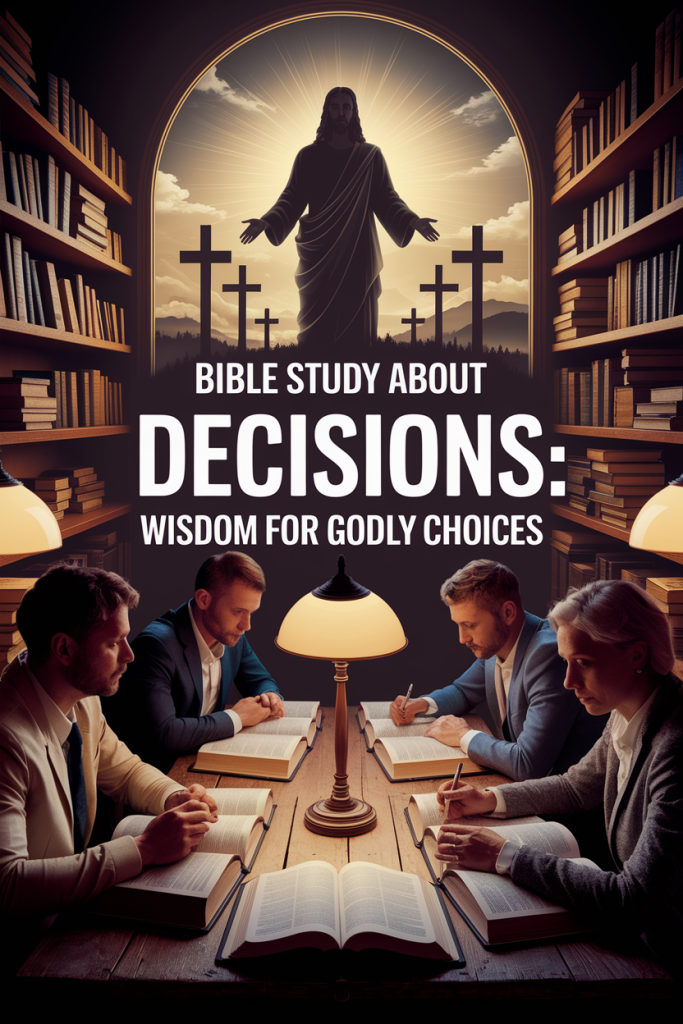
What Does “Decision Making” Mean in the Bible?
When we talk about “decision making” in a biblical sense, we’re not usually referring to choosing between chocolate or vanilla ice cream. In Scripture, decisions often involve a choice between following God’s way or going our own way.
The Bible may not use the modern phrase “decision-making” a lot (the word “decision” itself appears only a few times in the KJV, such as the “valley of decision” in Joel 3:14), but the concept is woven throughout.
In the Bible, making a decision is usually a moral and spiritual choice.
It’s about choosing obedience or disobedience, wisdom or folly, faith or doubt.
- For example, Moses set a choice before Israel: “I have set before you life and death, blessing and cursing: therefore choose life” (Deuteronomy 30:19, KJV).
- Likewise, Joshua challenged the people, “choose you this day whom ye will serve... as for me and my house, we will serve the LORD” (Joshua 24:15, KJV).
Clearly, deciding for God or against God is a central theme in Scripture.
Beyond these big spiritual crossroads, the Bible also recognizes the day-to-day decisions we make. The book of Proverbs, for instance, is a treasure trove of practical wisdom for making sound choices in everything from friendships to finances.
- Proverbs 1:5 says, “a wise man will hear, and will increase learning; and a man of understanding shall attain unto wise counsels,” implying that wise people make a decision to keep learning and seek good advice.
- In fact, Proverbs often contrasts the outcomes of good vs. bad decision-making: “The way of a fool is right in his own eyes: but he that hearkeneth unto counsel is wise” (Proverbs 12:15, KJV).
So, in biblical context, “decision making” means choosing a path.
Will I go God’s way or not? Will I operate by faith and wisdom, or by impulse and folly? Even when the Bible narrates a seemingly ordinary decision, there’s usually a deeper lesson or principle at play.
When Abraham decides to leave his homeland in obedience to God’s call, it’s not just a travel itinerary—it’s an act of faithful decision making that changes history.
When someone like King Saul decides to do things his own way instead of waiting on God, it’s not just a leadership style—it’s a disobedience that carries spiritual weight.
It’s also worth noting that the “valley of decision” mentioned in Joel 3:14 is often misunderstood. That prophetic phrase is not about people deciding; it actually refers to God’s decision of judgment on the nations.
In other words, it’s describing a future courtroom of God’s verdict, rather than an altar call moment.
I mention this because it highlights that in the Bible, sometimes God is the one making the big decisions (and His decisions are always final!). But generally, for our purposes, we’re focusing on human decision making—our choices—and how God guides us in those.
In summary, the Bible frames decision making as a serious thing: our choices reflect our values and our trust in God. Every choice, big or small, can be seen as an opportunity to glorify God or to stray from His path. That might sound heavy, but don’t worry—the Bible also gives us plenty of help to choose wisely!
Wisdom, Counsel, and God’s Will: Our Decision-Making Toolkit
When Christians talk about making decisions, certain words come up a lot: wisdom, counsel, and the will of God. These concepts are like the toolkit God gives us for navigating choices. Let’s break those down:
Wisdom:
In the Bible, wisdom isn’t just head knowledge; it’s knowing how to apply God’s truth to real life. It’s a godly common sense. We’re told to actively seek wisdom for our decisions.
- James 1:5 famously says, “If any of you lack wisdom, let him ask of God, that giveth to all men liberally... and it shall be given him” (KJV).
Think about that: God is inviting us to ask for insight! In the Old Testament, Solomon is a great example here—when he became king, his big request from God was for wisdom to make good judgments.
- Because Solomon valued wise decision-making over riches or long life, God was pleased and blessed him with all of the above (you can read this story in 1 Kings 3:5-14).
The book of Proverbs (much of which Solomon wrote) portrays wisdom as something calling out to us, saying essentially, “Listen to me, and your choices will lead to life and peace.”
Making decisions by wisdom means using our God-given brains and hearts informed by Scripture. It means we don’t just wing it; we thoughtfully consider what God’s Word says and what course is sensible and righteous.
Counsel:
Ever felt like you needed to “phone a friend” when faced with a tough choice? The Bible says that’s actually a great idea.
- Godly counsel is one of the main ways He guides us. Proverbs 15:22 teaches, “Without counsel purposes are disappointed: but in the multitude of counsellors they are established” (KJV).
In plain language, our plans can fall apart if we refuse to get advice, but with many advisors, our plans have a better chance. We see this principle play out dramatically in the Bible.
Remember King Rehoboam? He was Solomon’s son who had to decide how to rule the people. He rejected the wise counsel of older advisors and listened only to his young buddies who told him what he wanted to hear. Big mistake!
His harsh decision led to a major rebellion and the kingdom of Israel splitting in two (2 Chronicles 10).
The Bible bluntly notes that “choosing poor counselors can have disastrous consequences”.
On the flip side, seeking advice from faithful, mature believers can save us from blind spots. Sometimes others can see pitfalls or possibilities that we can’t. Ultimately, no one should feel they have to make life’s big decisions all by themselves.
God often speaks through the wise words of a friend, a pastor, a mentor, or even a spouse.
Of course, the quality of the counsel matters—Proverbs 12:5 says, “the counsels of the wicked are deceitful,” so we want advice from those who share a biblical perspective. But the bottom line is, humility in decision-making means being willing to ask for help and listen to advice.
The Will of God:
Ah yes, the big question: “What is God’s will for my life?” When facing a tough decision—like whom to marry or which job to take—Christians often agonize over trying to discern God’s specific will in that situation.
It’s good to desire God’s will! The Bible talks about God’s will in a few ways.
- First, there’s God’s revealed will, sometimes called His moral will or His commandments. These are the clear instructions in Scripture that apply to everyone (for example, it’s God’s will that we live a holy life, avoid sin, love others, etc.).
- Then there’s what some call God’s specific will for an individual’s life (like who to marry, where to live, which ministry to serve in). The key thing to know is that God’s specific guidance to us will never contradict His Word.
We shouldn’t expect God to reveal some personalized plan (“move to X city now”) if we’re ignoring what He’s already revealed in the Bible (“be honest, forgive others, etc.”).
In fact, James warns that if we are double-minded—trying to ask God for guidance while simultaneously refusing to obey Him in other areas—we can’t expect to receive clear direction. Ouch, right? That convicts me to make sure I’m surrendered to God’s moral will first.
So how do we “find” God’s will in a decision where multiple options seem viable and not sinful?
This is where wisdom and counsel (as mentioned above) come in, along with prayer and the inner leading of the Holy Spirit.
- Romans 12:2 gives a beautiful principle: if we avoid being conformed to the world and instead renew our mind (through God’s Word), we will be able to “prove what is that good, and acceptable, and perfect will of God.”
In other words, a mind steeped in scripture can discern God’s direction better. Also, as we pray, God can shape our desires and give us peace about one choice over another.
- Philippians 4:6-7 tells us to pray about everything with thanksgiving, and God’s peace will guard our hearts and minds.
That “peace of God” can be a gentle indicator that you’re on the right track—but be careful: feelings of peace should follow seeking God’s Word and wise counsel, not replace them.
One more important thing: God’s will is not some cruel riddle. He wants us to make choices that honor Him, but He also grants us freedom.
If you have two job offers and neither violates biblical principles, it may simply be that God trusts you to use wisdom and choose what seems best.
As long as we are not sinning, we can trust God is still with us (and He can bless either path). Sometimes we get so worried about “missing God’s will” that we freeze up and make no decision at all.
But trust that if you’re truly seeking Him, God can steer you even as you move forward. Think of it like steering a car—easier to guide when it’s moving than when it’s parked.
- Proverbs 16:9 says, “A man’s heart deviseth his way: but the LORD directeth his steps.” So make your plans prayerfully, start moving, and let God do the fine-tuning.
In summary, the Bible’s guidance system for our decisions involves using wisdom (applying biblical truth), seeking counsel from godly others, and aiming to align with God’s will as revealed in Scripture.
When we do these things, we can prayerfully trust that God will direct our paths (Proverbs 3:5-6). Speaking of paths, let’s check out some people in the Bible who came to a fork in the road and see what they did.
Biblical Examples of Decision Making (Good and Bad)
The Scriptures don’t read like a dry textbook on decision theory—they’re more like a rich storybook of real people making real choices, with real consequences.
Let’s look at a few snapshots from the Bible that illustrate good and bad decision-making. As we do, imagine yourself in their sandals and think about what you might have done!
Good Decisions and Their Blessings
Abraham (Genesis 12)
When God called Abram (later named Abraham) to leave his country and go to an unknown land, Abram went in faith. This decision to trust God launched the nation of Israel and brought blessing to the whole world (eventually leading to Jesus!).
It couldn’t have been easy for Abram to pack up his household and say goodbye to everything familiar, but his obedience shows us that faith often means making a hard decision now for a greater blessing later.
God promised Abram, “I will make of thee a great nation, and I will bless thee...” – and God sure kept that promise. Abraham’s story encourages us that stepping out in faith at God’s direction is always a wise choice.
Moses (Hebrews 11:24-26)
Moses grew up as an Egyptian prince with luxury at his fingertips, but he made a pivotal decision: to identify with God’s people instead of enjoying sinful pleasures in Pharaoh’s palace.
Hebrews tells us Moses chose to suffer with the people of God rather than be called the son of Pharaoh’s daughter, because he looked ahead to the reward. Moses’ decision cost him comfort in the short term, but it aligned with God’s plan to deliver Israel.
The result? Moses became the great leader of the Exodus. His choice teaches us about values – he valued God’s will over worldly gain.
Joshua (Joshua 24:15)
As mentioned earlier, Joshua, near the end of his life, drew a line in the sand for Israel: “choose whom ye will serve... but as for me and my house, we will serve the LORD.”
This wasn’t just a one-time choice; Joshua had a track record of courageous decisions (like spying out Canaan, leading battles, and instituting worship). His leadership in decisively choosing God set an example that influenced his whole generation.
The Bible notes that Israel served the Lord throughout Joshua’s lifetime. Sometimes, one person’s firm decision can inspire many others.
Daniel (Daniel 1:8)
Dragged into captivity in Babylon as a young man, Daniel “purposed in his heart” that he would not defile himself with the king’s unkosher food.
Basically, he made a personal conviction decision to honor God’s dietary laws even though he was in a foreign land. This could have gone badly for him, but Daniel gently sought an alternative (a veggie diet test!).
God honored Daniel’s integrity; Daniel and his friends ended up healthier than everyone else. This seemingly small decision was foundational to Daniel’s character—later on, he would make even more significant stands (like refusing to stop praying to God, which landed him in the lions’ den).
The outcome of Daniel’s consistent choices was God’s favor and protection, and high positions of influence under multiple kings. Daniel shows that little decisions to obey God build up strength for big decisions later.
Mary of Bethany (Luke 10:38-42)
In the New Testament, Mary (the sister of Martha) made a subtle but important decision: she chose to sit at Jesus’ feet and listen to His teaching, rather than scramble around the kitchen for a perfect dinner party.
Martha, though well-intentioned, was stressed and upset that Mary wasn’t helping. But Jesus defended Mary’s choice, saying she “hath chosen that good part, which shall not be taken away from her.”
Sometimes the “good” vs “better” decisions are the tricky ones. Mary decided that closeness with Jesus was the top priority at that moment. That’s a lesson for us in our busy, multitasking lives: choose what is spiritually needful even if other pressures are yelling for attention.
Each of these good decisions had positive outcomes or at least the promise of God’s approval. They often required faith, courage, or going against the crowd.
The common thread is that these people honored God in their choices, and God honored them. As 1 Samuel 2:30 says, “them that honor Me I will honor.”
Bad Decisions and Their Consequences
Adam and Eve (Genesis 3)
Let’s start at the very beginning. God gave Adam and Eve a garden paradise with one simple rule, but they decided to eat from the one forbidden tree.
That moment of listening to the serpent and following their appetite instead of God’s word was the ultimate bad decision that introduced sin and death into the world.
Talk about consequences! It’s a sobering reminder that decisions made out of distrust of God can have far-reaching effects. (Thankfully, God had a redemption plan in motion even then—but we’ll get to that later.)
Lot’s Wife (Genesis 19:26)
When fleeing the judgment on Sodom and Gomorrah, Lot’s wife notoriously looked back, longing for the life she was leaving. She literally got “stuck” in her decision—turning into a pillar of salt!
Jesus even later said, “Remember Lot’s wife,” as a warning not to cling to the past when God calls you forward.
Her hesitation between the sinful city and God’s escape route shows how indecision (or half-hearted decision) can be deadly. It’s a dramatic example that when God says “Go and don’t look back,” we’d better follow through.
King Saul (1 Samuel 13 & 15)
Saul, the first king of Israel, is practically a case study in bad decision-making. On one occasion, Saul grew impatient waiting for the prophet Samuel to come and offer a sacrifice, so Saul rashly decided to do it himself—violating God’s command.
Samuel arrived and told Saul, “Thou hast done foolishly” and that this disobedience would cost him the kingdom. On another occasion, Saul was told to destroy all the plunder from a battle, but he decided to keep the best livestock (and then tried to justify it with a religious excuse).
That act of partial obedience (which is disobedience) caused God to reject Saul as king. What was Saul’s problem? In the moment of decision, he consistently caved to fear and pride.
He didn’t inquire of the Lord or wait on God’s timing. In contrast, his successor David usually asked God first (notice in 1 Samuel and 2 Samuel how often David “inquired of the Lord” before battle or big moves).
Saul’s bad calls led to personal downfall and national turmoil. It’s a cautionary tale: impatience and self-reliance can lead to foolish decisions with lasting fallout.
Rehoboam (1 Kings 12)
We touched on Rehoboam in the counsel section, but here’s the full picture: People asked King Rehoboam to lighten the heavy workload his father Solomon had imposed.
The elder advisors said, “Speak kindly and serve the people today, and they’ll be your loyal servants forever.”
Rehoboam didn’t like that answer, so he asked his young peers, who basically said, “Nah, make it even harder for them!” Rehoboam chose the latter—and promptly sparked a rebellion where ten tribes broke away and crowned their own king.
Rehoboam’s kingdom was split and weakened permanently. This is such a classic bad decision scenario: ego and immaturity rejecting wise counsel. The consequence was a nation divided (literally).
For us, while our decisions might not split a kingdom, failing to listen to wise input can certainly divide families, friendships, or churches. It’s a high price to pay for pride.
The Rich Young Ruler (Mark 10:17-22)
Here’s a New Testament example of a tragic choice. A successful young man came to Jesus asking how to inherit eternal life. Jesus, knowing the man’s heart, told him to go sell all he had, give to the poor, and then follow Him.
Essentially, Jesus put His finger on the one thing holding this man back—his love of money—and offered him a choice. Sadly, the young ruler decided to walk away from Jesus rather than give up his great possessions.
He made a bad decision in that moment, preferring earthly wealth over heavenly treasure. We’re not told what happened to him later, but at least in that scene, he left “sorrowful.”
How many people make a similar mistake, holding on to something (money, a relationship, a habit) that keeps them from fully following God? The immediate payoff of not changing seems easier, but the long-term loss is huge.
Jesus said, “For what shall it profit a man, if he shall gain the whole world, and lose his own soul?” (Mark 8:36). The rich young ruler’s choice was a loss disguised as a win.
These negative examples serve as warning signs for us. In each case, the person either ignored God’s clear command, let selfish motives rule, or failed to trust God. As a result, they faced regret or even disaster.
The Bible doesn’t sugarcoat the outcomes: sin and foolishness have consequences.
However, even in these stories, we catch glimpses of God’s mercy (for example, God gave Adam and Eve a covering and a promise of a Savior; He sent prophets to give people chances to repent after many bad kings’ decisions). But it’s definitely far better to learn from these mistakes rather than repeat them!
Now that we’ve seen both sides—good and bad choices—let’s zoom out to see what blessings come when we strive to make godly decisions.
The Blessings of Godly Decision Making
If making right choices is so challenging, why do it? Is it worth the effort to seek God’s way consistently? The Bible’s answer is a resounding yes! There are tremendous blessings tied to godly decision making. Here are a few perks that Scripture highlights:
Guidance and Direction from God
Perhaps the most comforting blessing is knowing that when we trust God, He guides us.
- Proverbs 3:5-6 is a beloved promise: “Trust in the LORD with all thine heart; and lean not unto thine own understanding. In all thy ways acknowledge him, and he shall direct thy paths.”
In other words, if you involve God in your decisions (acknowledge Him) and rely on His wisdom, He takes on the job of steering you the right way.
That doesn’t mean you’ll hear a voice from heaven at every fork in the road, but it means as you pray and proceed, God providentially opens and closes doors to get you where you need to go.
It’s a huge relief to know it’s not all on us to figure out life – God actively directs a person who seeks Him.
Success and Prosperity (on God’s terms)
While Christianity isn’t a get-rich scheme or success formula, the Bible does teach that obeying God’s principles leads to long-term well-being.
- When Joshua took over leadership of Israel, God told him that if he would meditate on the law and obey it, “then thou shalt make thy way prosperous, and then thou shalt have good success” (Joshua 1:8, KJV).
This wasn’t a promise of a trouble-free life, but a general truth: following God’s Word brings success in the things that truly matter.
- The book of Psalms opens with a similar promise: the person who delights in God’s law is “like a tree planted by rivers of water” – fruitful, sturdy, alive – and “whatsoever he doeth shall prosper” (Psalm 1:3).
That prospering is tied to spiritual health and God’s blessing, not just material gain. Many of the Bible’s heroes (Joseph, Daniel, etc.) experienced tangible success and promotion, and the text often notes it was because God’s favor was on them for their faithfulness.
So one blessing of making godly decisions is that, over time, your life tends to flourish under God’s hand. It might be spiritual richness, strong relationships, or other kinds of prosperity as God sees fit.
Peace of Mind and Heart
Making a decision in line with God’s ways often brings an inner peace. Even if the decision is tough (say, choosing to forgive someone who hurt you, or turning down a shady business deal), there’s a deep reassurance when you know you did what’s right.
- Isaiah 32:17 says, “the work of righteousness shall be peace; and the effect of righteousness quietness and assurance for ever.”
Ever made a questionable choice and then been consumed with guilt or anxiety?
- Contrast that with times you obeyed God’s prompting and felt that “peace that passes understanding” (Philippians 4:7) guarding your heart.
One of the sweetest blessings of heeding Godly wisdom is being able to sleep at night with a clear conscience, trusting God with the results of your choice.
God’s Provision and Care
- Jesus taught that if we “seek first the kingdom of God and His righteousness,” then our material needs (food, clothing, etc.) will be provided (Matthew 6:33).
In context, He was telling people not to worry. Essentially, if you make the decision to put God first, He’s got your back on the other stuff.
Many believers can testify that when they made a sacrificial decision for God—whether it was giving generously, changing careers for ministry, or staying home to raise kids—the Lord came through and met their needs in unexpected ways.
Not that it’s always easy or immediate, but over a lifetime, you see that you just can’t outgive God. He honors those who honor Him.
- Another example: Proverbs 3:9-10 says honoring God with our finances (firstfruits) leads to having “thy barns filled with plenty.”
It’s proverbial literature (general principle, not a get-rich guarantee), but plenty of Christians have found that wise, God-honoring financial decisions lead to greater stability and even the ability to bless others more—truly a blessed outcome.
A Positive Legacy
Our decisions don’t just affect us; they ripple out to those around us and even future generations.
- Deuteronomy 30:19 (mentioned earlier) urged Israel to choose life “that both thou and thy seed may live.”
When you make godly choices, your children, friends, and community benefit. For instance, a parent who decides to raise their kids in the faith is giving those kids a priceless foundation.
Or someone who chooses integrity in their business may inspire employees to do likewise, creating a culture of trust.
- Proverbs 20:7 observes, “The just man walketh in his integrity: his children are blessed after him.”
Sometimes we think of blessings only as direct from heaven, but another blessing of right decisions is the indirect blessings that flow down to others.
Think of King David—he wasn’t perfect, but his heart for God brought blessing on Israel and even on his descendants (God made a covenant for a lasting dynasty).
On a smaller scale, any time you make a righteous decision, you’re shining a light (Matthew 5:16) that can encourage others and set good things in motion.
In short, making godly decisions tends to lead to guidance, success (as God defines it), inner peace, divine provision, and a lasting positive impact. It doesn’t mean life will be trouble-free (ask Job or Paul—the most obedient still had trials), but it means you’ll have God’s smile and support through whatever comes. That is a blessing that money can’t buy.
Now, to balance things, living wisely doesn’t mean immediate gratification. Sometimes doing the right thing can be costly in the short term (e.g. a decision to be honest might cost you a job, or a decision to stand for your faith might strain a relationship).
- But even then, the Bible says you are “blessed” when persecuted for righteousness’ sake, because you have a great reward in heaven (Matthew 5:10-12).
Ultimately, no one ever gets to heaven and regrets obeying God. The rewards will far outweigh the costs.
Having covered blessings, let’s turn to some of the Bible’s imagery and patterns about decision making—because God often teaches us through vivid pictures and recurring themes.
Symbolism and Metaphors of Decision Making in Scripture
The Bible is rich in imagery, and these images often help us understand abstract concepts like making choices. Here are a few key symbols and patterns related to decision making:
Two Paths (or Two Ways):
One of the most common biblical metaphors for decisions is the picture of two paths.
- In the Old Testament, wisdom literature frequently presents a “way of life” versus a “way of death.”
- For example, Psalm 1 contrasts the way of the righteous with the way of the wicked. Proverbs 4:26 says, “Ponder the path of thy feet.”
- We see this clearly in Moses’ and Joshua’s exhortations to choose the path of serving God (life) over the path of rebellion (death).
In the New Testament, Jesus continues this imagery:
- “Enter ye in at the strait gate... because strait is the gate, and narrow is the way which leadeth unto life... and broad is the way that leadeth to destruction” (Matthew 7:13-14, KJV).
It’s the classic fork in the road image. One road is godly wisdom, the other is worldly folly. Life is like a series of these forks, and the Bible urges us over and over: take the path of obedience, faith, and righteousness, even if it’s narrow or less traveled.
The outcome of that road is life and blessing. This two-paths motif also reminds us that indecision is not really neutral—hovering in the middle is itself a choice.
- Elijah used another metaphor when Israel was wavering between worshipping God or Baal: “How long halt ye between two opinions?” (1 Kings 18:21, KJV).
He pictures them as literally limping back and forth between two different paths/opinions. Eventually, you have to commit one way or the other.
Light vs. Darkness:
Another biblical theme tied to decision-making is light and darkness.
- Jesus said, “I am the light of the world: he that followeth me shall not walk in darkness” (John 8:12).
The idea is that following God (walking in His light) illuminates our path so we don’t stumble.
- Psalm 119:105 famously says, “Thy word is a lamp unto my feet, and a light unto my path.”
Think of walking on a dark trail at night with a flashlight—that’s God’s Word helping you see the next step or two ahead. We might not see miles down the road, but we usually get enough light for the next decision.
In practical terms, when you’re faced with a decision, turn on the light of Scripture. Search the Bible for principles or similar situations. Often, a particular verse will “light up” as especially relevant.
- For instance, if deciding whether to pursue a certain relationship, verses about being equally yoked (2 Corinthians 6:14) or about the kind of person to marry (like Proverbs 31 for character) can shed light on the choice.
Walking in darkness (i.e., without regard for God’s truth) can lead to painful stumbles. So light vs. darkness is a potent picture: decisions made in the light of God’s guidance versus decisions made blindly.
Doors, Paths, and Openings:
The Bible sometimes speaks of God opening doors or shutting doors as a way to indicate His guidance.
- In the book of Acts, Paul the Apostle experienced something interesting on his missionary journey: he tried to enter certain regions but was “forbidden by the Holy Ghost” and then he had a vision calling him to Macedonia (Acts 16:6-10).
He took that as God closing one door and opening another.
- Colossians 4:3 also mentions praying for God to open a door. And Jesus describes Himself as the one “that openeth, and no man shutteth; and shutteth, and no man openeth” (Revelation 3:7, KJV).
Many Christians use this door language to describe decision points: if an opportunity is from God, He’ll open the door; if not, He’ll close it.
It’s not a guarantee that every open door is God’s will (sometimes we can push doors open that we ought not), but it’s a useful metaphor when combined with prayer.
We often pray, “Lord, if this job (or move, or relationship) isn’t Your will, please close the door.” And He can! Conversely, He can open doors we thought were impossible.
So the symbolism of doors and paths ties in with trusting God’s sovereignty. If you’re yielded to Him, you can trust that a door remaining firmly closed is likely His protective hand, and an unexpected open door might be His providence.
The “Fleece” and Signs:
In Judges 6, we find Gideon, who is called by God to lead Israel against Midian. Gideon was unsure, so he famously laid out a fleece of wool and asked God for a sign: make the fleece wet with dew but the ground dry, and then the reverse.
God in His patience did the miracles Gideon asked for (twice!) to confirm the decision. Because of this story, Christians sometimes talk about “putting out a fleece” when they’re looking for a sign to confirm a decision.
This is more descriptive than prescriptive; Gideon’s method isn’t necessarily held up as a model of faith (in fact, it was due to lack of faith).
- Jesus said, “An evil and adulterous generation seeketh after a sign” (Matthew 12:39) – strong words cautioning us not to always demand miraculous signs when God’s Word and Spirit should be enough.
That said, God may occasionally graciously provide a confirmatory sign in our lives, but we should be careful about relying on this method. The metaphor of Gideon’s fleece stands as a symbol of seeking extra confirmation.
The pattern taught in Scripture leans more toward seeking wisdom and counsel rather than magical signs. Remember, even Satan tried to tempt Jesus to “force” God’s hand into a sign (jump off the temple and see if angels catch you), and Jesus refused.
So while many of us half-joke, “Lord, just send me a sign – maybe an email from heaven?”, in reality the sign God gave to guide us is the cross and the resurrection (the gospel) and the completed Scriptures.
Still, the fleece story is a memorable symbol – it reminds us of God’s mercy with our doubts, but also nudges us to grow past needing fleeces by developing a mature faith.
Metaphors of Guidance:
The Bible also uses the image of God as a shepherd and us as sheep.
- “He leadeth me beside the still waters... He leadeth me in the paths of righteousness for His name’s sake” (Psalm 23:2-3).
Sheep don’t always know where to go; they need a shepherd to guide them to good pasture and away from danger. This is a comforting pattern: God isn’t just a coach shouting directions from afar; He is a shepherd with us, guiding gently.
- Jesus calls Himself the Good Shepherd who calls His sheep by name and says “my sheep hear my voice” (John 10:3-4, 27).
This metaphor suggests an intimate, ongoing guidance. How do we “hear His voice” today? Through Scripture (the recorded voice of God) and through the Holy Spirit’s promptings which will always align with Scripture.
Sometimes in making a decision, you might experience a nudge or conviction in your spirit—that could be the Shepherd’s still small voice. It won’t contradict the Bible, and it often works in tandem with the wisdom and counsel we discussed.
For example, you might have a plan that looks good on paper, but every time you pray you feel an unease or check in your spirit about it. That could be the Shepherd warning you of a hidden wolf on that path.
On the contrary, you might have a sense of peace and confirmation (the proverbial “green light” inside) when you consider one option. These subjective feelings aren’t foolproof, but they are part of how God shepherds us internally.
- Colossians 3:15 says “let the peace of God rule in your hearts,” and the word “rule” literally means “act as an umpire.”
It’s like God’s peace can help call some shots (“safe” or “out”) regarding choices, especially after you’ve prayed.
Patterns of Testing:
It’s interesting that often right before a great promotion or blessing, biblical characters faced a decision test.
- Think of Abraham, again, with the ultimate test of deciding whether to obey God in sacrificing Isaac (Genesis 22).
Because Abraham chose obedience, God intervened and provided a ram, and then affirmed Abraham’s calling with even greater promises.
Or consider Jesus Himself: right after His baptism, He was led into the wilderness to be tempted (tested) by the devil.
He had to make quick, wise decisions in response to Satan’s suggestions (turn stones to bread, jump off temple, etc.), each time Jesus decided based on God’s Word (“It is written...”).
Having passed that test, Jesus emerged to begin His ministry in power. The pattern suggests that key decisions can be defining moments that either open the door to greater things or detour us.
Sometimes when you’re on the verge of something good, you might face a tough choice or temptation—like a final exam in Decision Making 101. If you choose rightly under pressure, you often see God’s reward or a breakthrough afterward. It’s not formulaic, but it’s a pattern to be aware of.
All these symbols and patterns—two paths, light vs darkness, open doors, fleeces, shepherd leading, tests—paint a picture of a God who is deeply interested in our choices and who uses every means to teach and guide us.
They also warn us that our choices have spiritual significance: they can align us with light or leave us in darkness; they can keep us on the narrow road or send us down the broad road. It’s powerful stuff!
Next, let’s connect how this theme of decision making runs from the Old Testament into the New, and see if there are any “big picture” fulfillments or types to note.
From Old to New: Consistent Principles and Christ’s Example
One amazing thing about the Bible is that, despite being written over centuries, it has a consistent moral and spiritual message. When it comes to decision making, the core principles remain the same from Genesis to Revelation.
God doesn’t flip-flop on what He values in our choices. However, there is a progression in how God guides His people, culminating in the person of Jesus Christ and the gift of the Holy Spirit. Let’s explore some connections:
Old Testament Foundation:
In the Old Testament, God gave the Law through Moses which covered many life decisions for Israel (from worship to diet to conflict resolution).
He also provided prophets and sometimes very direct guidance (like telling David to go to battle or not, speaking through a prophet or even a Urim and Thummim – special priestly tools for decision-making in ancient Israel).
While we today are not under the Old Testament law for salvation, those stories and laws still teach us God’s character and principles.
- Paul says, “whatsoever things were written aforetime were written for our learning” (Romans 15:4).
For example, when we read how God instructed Israel to consult Him before battles, we learn we too should pray before we “battle” decisions. When we see the Proverbs extolling wisdom, we realize this is timeless truth.
New Testament Continuity:
In the New Testament, the emphasis is on the heart and the Holy Spirit’s leading.
- Rather than external laws for every scenario, God writes His law on our hearts (Jeremiah 31:33, echoed in Hebrews 8:10).
But the continuity is clear: the same wisdom that was in Proverbs is echoed by James and Paul; the same need to choose whom you’ll serve is echoed when Jesus calls people to follow Him.
One notable development is that after Jesus ascended, He sent the Holy Spirit to indwell believers. The Book of Acts shows early Christians depending on the Spirit for guidance.
They still used wisdom and scripture (the apostles often reasoned from the Old Testament when making decisions about doctrine), but they also had the direct influence of the Spirit.
- For instance, in Acts 13:2, the Holy Spirit said, “Separate me Barnabas and Saul for the work” – presumably through prophetic words in the church.
- And in Acts 15, when the early church had to decide how Gentiles should be included, they discussed, debated scripture, and listened to the Holy Spirit’s work among them, eventually writing, “It seemed good to the Holy Ghost, and to us...” (Acts 15:28).
The pattern is not so different from today: we discuss, weigh principles, and sense the Spirit’s confirmation.
Jesus as the Perfect Example:
Jesus Christ, being God in flesh, also lived as a man in dependence on the Father, giving us the ultimate example of godly decision making.
- He said, “I seek not mine own will, but the will of the Father which hath sent me” (John 5:30).
In every decision, whether choosing His disciples or deciding where to travel next, Jesus sought His Father’s direction (often through prayer – He sometimes prayed all night before a big choice, like selecting the twelve apostles).
The most poignant example is in the Garden of Gethsemane.
- Faced with the prospect of the cross, Jesus was in agony, and He prayed, “O Father, if thou be willing, remove this cup from me: nevertheless not my will, but thine, be done” (Luke 22:42, KJV).
That right there is the ultimate submission in decision making. Jesus, in His human will, understandably would have wanted to avoid suffering, but He decided to obey the Father’s redemptive plan. Aren’t we glad He did?
His obedience unto death on the cross is what brought us salvation. This is where decision making meets the gospel: one “Right Decision” by the sinless Son of God undid the effects of that first wrong decision by Adam and Eve.
- Scripture draws this parallel: “For as by one man’s disobedience many were made sinners, so by the obedience of one shall many be made righteous.” (Romans 5:19, KJV).
In a sense, all of our hopes rest on Jesus making the perfect decisions that we as humans failed to make. He never sinned, never strayed from God’s will. Because He succeeded, He can now guide us and empower us to make God-pleasing decisions too.
Fulfillment of Wisdom:
The New Testament also presents Jesus as the embodiment of God’s wisdom.
- 1 Corinthians 1:30 says Christ “is made unto us wisdom.” He’s like the living, breathing Book of Proverbs!
In the Gospels, He often confounded the “wisdom of the wise” with His choices and answers. He navigated traps set by the Pharisees with ease, always responding with wisdom that silenced His critics.
When we follow Jesus, we are following Wisdom personified.
- He even said that the Queen of Sheba traveled to hear Solomon’s wisdom, “and, behold, a greater than Solomon is here” (Matthew 12:42, KJV). T
- hink about Solomon – he was the wisest man, making brilliant decisions like the famous story of determining the true mother of a baby by suggesting to split the child (1 Kings 3:16-28).
People were in awe of Solomon. Yet Jesus says He is greater. So if Solomon could guide Israel well (at least for a time) through God-given wisdom, how much more can Jesus guide us!
The implication is that we should go to Jesus with our decisions. We do that through prayer, and by consulting His teachings. What did Jesus say that applies here?
The Sermon on the Mount alone gives a lifetime of guidance for choices (how to treat enemies, how to give, how to pray, how to view material things, etc.).
The Holy Spirit’s Role:
After Jesus returned to the Father, He sent the Spirit to be our helper and guide.
The Spirit’s guidance is a fulfillment of Old Testament hopes.
- Isaiah 30:21 had a promise, “And thine ears shall hear a word behind thee, saying, ‘This is the way, walk ye in it,’ when ye turn to the right hand, and when ye turn to the left.”
Many see that as a picture of God’s guiding voice. Now, with the Holy Spirit within, we essentially have that voice inside us (again, not usually audibly, but through inward prompting aligned with Scripture).
- Galatians 5:25 says, “If we live in the Spirit, let us also walk in the Spirit.”
Day by day, decision by decision, we keep in step with Him. It’s like having a navigation system in your car—if you take a wrong turn, the Spirit can “reroute” you or convict you to correct course.
When the New Testament believers were about to embark on something, they often fasted and prayed to seek the Spirit’s direction (e.g. Acts 13: before sending out missionaries).
That practice continues in the church today when we have major decisions like selecting leaders or sending missionaries. It’s a continuity of principle: always seek God before big moves.
Choices in Salvation:
From Genesis to Revelation, another theme is God inviting people to choose Him. In the OT, we see calls like “choose life” (Deut 30) and covenant renewals. In the NT, the call is to repent and believe the gospel.
While theology discussions can get complex on God’s sovereignty and human will, the Bible clearly presents that we are responsible for how we respond to God’s offer.
The biggest decision any person faces is whether to accept Christ. In that sense, all the lesser decisions find their place under this big one.
Jesus often said “Follow me” – and people had to decide. Some dropped their nets and followed (good decision!), some like the rich young ruler walked away (bad decision). The stakes of that decision are eternal.
- The book of Revelation ends with an invitation: “Whosoever will, let him take the water of life freely” (Rev 22:17).
Thus, the pattern of urging people to make the right choice in relation to God spans the whole Bible and is fulfilled in Jesus’s work and the call to follow Him.
- Ultimately, God’s will is that we be conformed to the image of His Son (Romans 8:29) – that includes learning to make decisions as Jesus would.
In sum, the Old and New Testaments are united in teaching us to trust God and choose His ways.
What changes in the New is not the moral principle but the empowerment: we have a fuller revelation (we know about Christ’s example and sacrifice) and we have the indwelling Spirit.
Also, many of the ceremonial or civil laws of Israel that dictated certain choices (like dietary or clothing rules) are fulfilled in Christ and no longer binding.
That actually leaves us with more decisions to make using wisdom (for instance, rather than a law spelling out what to eat, we now apply general principles like treating our body as a temple and not being mastered by anything).
Freedom in Christ means we must exercise wisdom even more, guided by love for God and neighbor.
Lastly, I want to highlight one beautiful thing: Jesus’s obedience (His perfect decision-making) not only saved us, but it’s credited to us.
So when we inevitably make a wrong decision and sin, we can repent and lean on God’s grace in Christ, knowing that Jesus’s righteousness covers our failure.
That’s not an excuse to be careless—rather it’s an encouragement that our standing with God doesn’t shatter if we mess up. He can redeem even our bad choices if we turn back to Him (more on that in a bit).
Alright, now that we’ve surveyed all this biblical truth, how do we bring it home? Let’s talk about how to apply these insights when you’re facing your own personal decisions today.
Applying Biblical Principles to Modern Decisions
It’s time to take all this knowledge and make it practical. What do you do when you’re trying to decide about marriage, career, finances, or other personal issues?
How do you actually use scripture and prayer in those moments where a choice looms? Let’s break it down by topic and offer some clear steps and considerations for modern believers:
Marriage and Relationships:
Choosing whom to marry (or whether to marry at all) is huge.
- The Bible gives some direct guidance: for Christians, it says “be ye not unequally yoked together with unbelievers” (2 Corinthians 6:14), meaning a believer should seek to marry another believer who shares their faith.
That narrows the field in a healthy way.
- Beyond that, one should seek someone who exhibits godly character (read Proverbs 31 for qualities of a virtuous wife, or look at Boaz in the book of Ruth for a godly husband figure).
In practical terms, making a godly decision in dating/marriage involves prayer for wisdom, input from mentors (don’t hide the relationship from people who know you well—ask your parents or pastors what they think), and being honest with yourself about red flags.
It also means holding to biblical standards during the dating process (purity, honesty, respect) so that you’re thinking clearly.
A common struggle: sometimes emotions take over and people ignore warning signs. This is where those counselors we talked about can speak truth in love.
- Also, take your time; “he that believeth shall not make haste” (Isaiah 28:16).
It’s better to have a broken engagement than a broken marriage, as the saying goes, so involve God every step. If you truly seek Him, He can either give you peace about moving forward or unsettle you if it’s wrong.
God didn’t write “marry her” in the sky, but He gave a growing peace and confirmation through His Word that it was a relationship founded on Him.
For those deciding whether to end a dating relationship, biblical principles (like not being yoked with a non-believer or noting patterns of sin) can guide.
And if you’re already married, many daily decisions have to be made together – applying biblical love (1 Corinthians 13 style patience and kindness) and respect will guide how you communicate and choose as a team.
Career and Job Choices:
The Bible may not tell you “take the engineering job, not the teaching job,” but it gives lots of guidance on priorities and ethics.
- Colossians 3:23 says “And whatsoever ye do, do it heartily, as to the Lord.”
So one question to ask: “Can I do this work unto the Lord? Will it honor Him?” If a job opportunity would force you to sin or constantly compromise (maybe a shady business or one with unethical practices), that’s likely not God’s will.
On the positive side, think about how a career fits with your gifts and passions (God often directs through our abilities and interests). Are you good at it and enjoy it? That’s not selfish – that can be a sign of God’s design for you.
Also consider how a job affects your other responsibilities: will it allow time for family, church, health?
Sometimes a higher-paying job might wreck your family life or pull you away from serving God, whereas a less flashy job keeps you balanced.
- Jesus said, “What shall it profit a man if he gain the whole world and lose his own soul?”
We might adapt that to, “Don’t gain a fat paycheck and lose your marriage or your walk with God.”
So seek first God’s kingdom in your career choices – that might mean turning down a promotion that requires unethical behavior or constant absence from home.
It could mean choosing a career that utilizes your talents to serve others, even if it pays less. And of course, pray for guidance and favor.
I’ve heard many testimonies where someone had two offers and prayed, “Lord, close the door You don’t want,” and one offer just fell through unexpectedly, making the decision clear. Be open to God’s redirection.
- James 4:13-15 warns businessmen not to boast about going to make money in such-and-such city, but rather to say “If the Lord will, we shall do this or that.”
That attitude keeps us humble: God can intervene in our career plans, and we want to be sensitive to His leading. Perhaps He’ll lay on your heart a desire for ministry or mission work – if so, seek counsel and take courageous steps.
Or maybe He calls you to be a light in the secular workplace – then shine there. The key is to commit your work to the Lord (Proverbs 16:3) and trust Him to establish your plans.
Financial Decisions:
The Bible has a lot to say about money and stewardship. Big financial decisions (buying a house, taking on debt, investments, generosity) should be made in light of biblical principles.
- For instance, the Bible generally discourages heavy debt: “The borrower is servant to the lender” (Proverbs 22:7).
So if you’re considering, say, an expensive car loan or hefty mortgage, ask: Is this indebtedness wise and manageable, or will it enslave me?
Another principle: be wary of get-rich-quick schemes or greed driving your choices.
- 1 Timothy 6:10 warns that the love of money is the root of all kinds of evil and has led many astray.
So if a financial opportunity promises unbelievably high returns with little risk, use discernment – it might be a trap.
- On the positive side, wise planning is praised: Jesus talked about counting the cost (Luke 14:28) before starting a tower. It’s not lack of faith to budget and research!
- Proverbs is full of advice like “Gather little by little” (13:11) and “In the house of the wise are stores of choice food and oil” (21:20 paraphrase) – basically advocating saving and living below your means.
Also, involve God by giving.
It sounds counterintuitive, but deciding to be generous (tithes, offerings, charity) is a proven way to keep your heart right and invite God’s blessing.
- Malachi 3:10 talks about testing God by giving and seeing Him provide.
Of course, give wisely too – support trustworthy ministries and help the truly needy. When it comes to purchases or career moves for money, a good heart-check is: “Am I seeking God’s kingdom or just material gain?” (see Matthew 6:33 again).
- Align your finances with God’s values (like providing for family, 1 Timothy 5:8, and helping others, Ephesians 4:28).
If you and your spouse are deciding on a budget or a big expense, pray together about it. Unity in financial decisions is important for peace at home. And practically, if a decision is unclear, sometimes it’s wise to wait.
A common piece of advice: “Don’t make impulsive big purchases; sleep on it, pray on it.” God might either give you green light peace or red light unease by morning.
Major Life Transitions (Moving, etc.):
Maybe you’re considering moving to a new city, or taking a step of faith like going back to school or starting a ministry. These are biggies that often involve multiple factors.
Here I’d reiterate the steps: Pray fervently (ask God for wisdom and direction at each stage), Search Scriptures (is there a story or verse that speaks to your situation?
Maybe Abraham’s call to go out not knowing where, or Proverbs 3:6 about God directing your path, etc.), Seek Counsel (talk to trusted believers who know you and maybe know the context of where you’re moving or what you’re attempting; they might provide perspective or contacts).
Also, consider the motive: why do I want to make this move? Is it fear, ambition, calling, love, etc.? Bring those motives before God. Sometimes writing a pros and cons list in the presence of God can be helpful too, as long as you allow Him to tilt the scales.
- And remember, as we saw, don’t rush if you don’t have to. “He that hasteth with his feet sinneth” (Proverbs 19:2).
Often time and prayer clarify things. If an opportunity is really pressuring you (“offer ends today!” or “you must decide now or lose out”), be cautious—that’s when mistakes happen.
If it’s God’s will, He can hold the door open a bit longer. If you’ve done all the above and still feel unclear, you might consider a small “step” instead of the whole leap, as a way of testing.
For instance, if you feel you might want to go into mission work abroad but it’s a huge change, maybe try a short-term mission trip first.
Or if you think you should move to a new city, perhaps visit for a week or two if possible, scout a church there, see how it feels, while praying for confirmation.
Gideon-style fleeces aren’t ideal, but taking measured steps and seeing if God continues to pave the way can be valid.
Always remain yielded—tell God honestly, “Lord, I think this is the way You’re leading; I’m going to step out, but please stop me if I’m wrong.” He has ways of closing doors or redirecting, trust me!
Everyday Decisions: Not every decision is monumental. But even small daily choices accumulate to shape our character and life. Things like how you spend your free time, what media you consume, how you respond to conflicts—these are all decisions too.
- The Bible says “whether therefore ye eat, or drink, or whatsoever ye do, do all to the glory of God” (1 Corinthians 10:31).
That covers the little stuff! It helps to develop general guidelines for yourself based on Scripture. For example, deciding in advance “I will start my day with prayer/Scripture” is a daily decision that sets a tone.
- Or deciding, “If someone wrongs me, I will choose to forgive quickly rather than hold a grudge” follows Ephesians 4:32.
These pre-made decisions, rooted in biblical principles, will guide you when specific situations arise. If you’ve decided entertainment that stumbles your faith is off-limits, then when you’re choosing a movie, you’ll remember that and it’ll simplify the choice (maybe skip that raunchy show).
Also, invite God even into the small choices. He cares about all aspects of our life. Sometimes I ask God even about my schedule or minor purchases, just to practice dependence. It’s not that He will micromanage us, but it keeps me in tune with Him.
And occasionally, He does give a nudge even in small matters—perhaps prompting you to call a friend (which turns out they needed encouragement at that moment). Learning to obey those little nudges can train us for the bigger guidance moments.
In applying biblical principles, one thing to remember is no one does it perfectly.
We will make some mistakes. Don’t be paralyzed by that. Think of it this way: God can steer a moving ship. If you earnestly commit your decision to God, He will work with it, even if you don’t choose perfectly.
He can “course-correct” you over time. For example, maybe you take a job and later realize it wasn’t the ideal choice – that’s okay, God can use that experience to teach you and then open a door to a better fit later.
Or maybe someone reading this has already made some poor decisions (we all have!). Know that with God, there is redemption. He can turn a mess into something beautiful when we surrender it.
King David made some horrible decisions in his life (like the Bathsheba incident), but when he repented, God still used him and even brought good (Solomon was born later to David and Bathsheba, and became part of God’s plan).
That’s not to minimize sin, but to magnify grace. So don’t live in condemnation or fear of failure. Trust that, as Romans 8:28 assures, God can work all things together for good for those who love Him.
Now, before we wrap up, let’s address some common struggles and cultural misunderstandings that often swirl around the topic of Christians and decision making. It’s easy to get confused by well-meaning advice or just our own anxieties, so let’s shine some light on those.
Common Struggles and Misconceptions in Biblical Decision-Making
Even with all this biblical insight, actually making decisions as a Christian can be tough! We wrestle with doubts, fears, and sometimes wrong ideas that can trip us up. Here are a few of these common struggles and misconceptions:
“What if I Miss God’s Perfect Plan?” – The Anxiety of Perfectionism:
Many sincere believers worry that God has one exact blueprint for their life and that if they choose wrong, they’ll mess up their entire destiny. This can lead to a kind of paralysis where we’re afraid to choose anything.
It’s true that God has a perfect will from His perspective, but we shouldn’t view His will like a tightrope where one wrong step sends us plummeting. Think of it more as a path within boundaries.
As long as we stay within the moral boundaries He’s set and keep our heart open to Him, we have freedom to choose among various good options. Like a sheep in a wide green pasture – there’s a fence at the edges (God’s commands), but inside that, there’s lots of room to roam and enjoy.
If you’re choosing between two good colleges, God probably isn’t up there frowning because you picked the one in your home state vs. out-of-state. He can work with either. It’s more about how you live at college than exactly where.
If your heart’s desire is to honor Him, you can make a decision without terror of derailing His plan. Remember, “in all thy ways acknowledge Him, and He shall direct thy paths.”
That’s a gentle promise, not a threat! So don’t fret that you’re going to ruin God’s plan – He’s almighty, and even our detours can become part of His plan. A great comfort is Proverbs 16:9 again: we make our plans, but God directs steps.
He can steer you back even if you take a wrong exit. So take the pressure off yourself. Make the best decision you can with the info you have, and trust God’s sovereignty to back you up. As a pastor of mine once said, “It’s hard to steer a parked car. Start moving and let God direct.”
Waiting on God vs. Procrastination:
Another struggle is discerning when to wait for clarity and when to just decide already.
- Christians often say “I’m waiting on the Lord” – which is biblical (Isaiah 40:31 praises those who wait on God).
But waiting on God means actively trusting and seeking Him, not just avoiding making a choice out of fear. Sometimes we hide indecision behind spiritual language.
If you’ve been “praying about” a decision for a very long time with no new input, ask yourself: is God truly telling me to wait, or am I simply afraid to act?
Look for reasons to wait: Do you need more information? Do you sense a genuine check from the Spirit? If not, maybe God is saying, “I’ve given you wisdom – go ahead.”
It’s okay to set a reasonable deadline for a decision (if circumstances allow) and ask God to guide you by then.
On the other hand, there are times God says “wait, not yet.” For example, you might feel led to pursue further studies, but every door is closing this year – that could mean God’s timing is later.
Continue to seek Him and try again when He nudges. The key is honest motive: am I waiting in faith or in fear?
If in faith, you’ll have a sense of expectancy; if in fear, you’ll have dread. And remember, not deciding is itself a decision in many cases – it can be deciding to do nothing, which has consequences too.
Felix in Acts 24 kept delaying a decision about the gospel, telling Paul he’d hear him later – that procrastination was essentially a decision against acting on God’s message.
In analysis, doing nothing is okay only if you truly sense God saying “be still.” Otherwise, take courage and step forward.
“I Feel a Peace About It” – The Role (and Misuse) of Feelings:
Christians often use the phrase “I have a peace about this decision” or conversely “I just don’t have peace about it.” This can be valid — God’s peace can indeed be an umpire.
But it can also be misleading if taken alone. For instance, Jonah might have felt quite peaceful sleeping on the boat after disobeying God’s command to go to Nineveh (he was literally snoozing in a storm!).
Meanwhile, Jesus in Gethsemane felt anything but peaceful (sweating blood) while fully obeying God’s will. So, peace in our emotions isn’t the sole indicator of God’s approval.
Our feelings can come from many sources — fatigue, personality, the weather, who knows! However, after praying and aligning with Scripture, often a sense of peace or conviction does settle as guidance.
- Philippians 4:6-7 describes peace as coming after prayer, guarding our hearts. So yes, pay attention to that inner sense, but test it.
If you “feel peace” about something blatantly against Scripture, that’s a false peace (more likely the flesh rationalizing). On the other hand, if you feel uneasy about something that seems legit on paper, don’t ignore that either — dig into why.
Sometimes that unease is the Holy Spirit’s red flag because He sees what you don’t (maybe that seemingly perfect job has unseen pitfalls). Another scenario: sometimes we lack peace not because the choice is wrong, but because we’re scared of change or the unknown.
That’s where we must distinguish between the peace of God versus normal human jitters.
I’ve seen people barrel into poor decisions saying “but I prayed and feel good about it,” while godly counselors around them warned otherwise. That can indicate mistaking emotional relief for God’s affirmation. True peace will align with wisdom, not fight against it.
Looking for Miraculous Signs:
We touched on Gideon’s fleece earlier. In our modern culture (or even Christian subculture), there can be a fascination with seeking spectacular guidance – like expecting a dream, a vision, a random Bible verse miracle (the old “open the Bible and point” method), or some uncanny sign (“if three red cars pass by, I’ll take that as yes, Lord”).
While God is supernatural and can guide through extraordinary means (especially in critical moments or pioneer missionary scenarios), we shouldn’t demand that. When the Jews kept asking Jesus for signs, He rebuked that attitude.
We have to be careful not to treat God like a fortune-teller or an oracle to be tested. Jesus gave us an example of how to live — which largely involves walking by faith, not by sight (2 Corinthians 5:7).
The apostle Paul primarily used prayer and wisdom. Once in a while he had a vision (like of the Macedonian man), but those were exceptions, not daily occurrences. If God gives a special sign, it will be clear and usually unexpected.
We shouldn’t base our decisions on trying to manipulate circumstances to tell us what to do.
So yes, pray for providence and confirmation, but also don’t be that guy demanding a neon sign when God has already given you Scriptural principles and a brain.
“Follow Your Heart” vs. “Inform Your Heart”:
Culturally, the advice to “follow your heart” is popular. There’s a sliver of truth if “heart” means your God-given passions or conscience, but often it’s used to justify doing whatever you feel like.
The Bible cautions that “the heart is deceitful above all things” (Jeremiah 17:9). We can easily fool ourselves. A Christian twist on this is sometimes “I feel it in my heart, so it must be from God.”
But we need to filter our hearts through God’s Word. Instead of following our heart, we should lead our heart by informing it with truth.
For example, your heart may say “I really want this now,” but wisdom says wait – if you align your heart to value what God values (patience, self-control), you may later be thankful you didn’t just follow initial feelings.
A better motto is “follow God’s heart.” Try to discern what’s on God’s heart in a matter. Is God’s heart grieved by that option? Is God’s heart delighted by this choice?
Of course, that requires knowing God well, which comes from relationship with Him. That’s why the best thing you can do to improve your decision-making is to continually grow in knowing God through Scripture and prayer.
- The more you know Him, the more you “have the mind of Christ” (1 Corinthians 2:16) and can almost instinctively sense what aligns with His heart.
- Psalm 37:4 says, “Delight thyself also in the LORD; and He shall give thee the desires of thine heart. Commit thy way unto the LORD; trust also in Him” (KJV).
This doesn’t mean He’ll give whatever you crave; it means He will shape your heart’s desires to match His will, and then fulfill them. So, delight in God first – make that your main decision (to pursue Him) – and you’ll find many other decisions fall into place.
Analysis Paralysis and Fear of Failure:
I’ll lump these together as a general struggle. We touched on analysis paralysis (over-researching, over-thinking until you’re frozen). Perfectionists and people with anxiety (raising my hand) often fall into this.
The biblical antidote is faith and surrender. At some point, you have to say, “God, I’ve done my due diligence; now I trust You and I’m taking the leap.”
It’s like Peter stepping out of the boat onto the water – at some point you just gotta swing your legs over. Could he have sunk? In theory, yes, if he doubted. But even when he did and started sinking, Jesus grabbed him.
That’s a comforting picture: even if you start to sink after a decision, Jesus is there to catch you when you cry out. So don’t let fear enslave you.
- 2 Timothy 1:7 reminds us God hasn’t given us a spirit of fear, but of power, love, and a sound mind.
Use that sound mind to make a reasonable choice, then use that spirit of power to execute it boldly, and that spirit of love to keep the right motives through it all.
Another thing: sometimes we think God’s will is meant to be super hard and unenjoyable (like, if I desire it, it must not be God’s will).
True, sometimes God calls us to hard things outside our comfort. But other times, a perfectly valid option might also be the one you want! God is a good Father; He often works through our righteous desires.
If you have two job offers and one of them excites you and fits your skills, and the other seems miserable to you, it’s not more pious to pick the miserable one!
Your joy and passion may be part of God’s prompting. If you delight in Him, He often plants desires in your heart that align with His plans. So don’t overcomplicate with “the harder path must be holier.”
Not necessarily. Each situation is different; sometimes sacrifice is called for, other times God is blessing you with an opportunity that aligns with your joy.
Listening to Too Many Voices:
In our information age, one can get overwhelmed with opinions – books, blogs (like this one!), sermons, friends, family, Google searches. While counsel is good, too much conflicting input can confuse.
At some point, you need to get alone with God, weigh what you’ve heard, and come to a decision that you (and your spouse/family if applicable) have peace about before God. Otherwise, you’ll ping-pong trying to please everyone. It’s also okay to be quiet about a decision with people who might not understand.
Nehemiah, when he was planning to rebuild Jerusalem’s wall, initially told no one what God put in his heart to do until the plan was ready (Nehemiah 2:12). So there’s a balance: get enough counsel to be informed, but not so much that you abdicate your own responsibility to seek God and choose.
Whew! We covered a lot of ground in misconceptions and struggles. The thread through them all is: stick close to God, know His Word, be honest with yourself, and don’t let fear rule.
Making decisions is a skill that grows over time. Hebrews 5:14 talks about the mature, “who by reason of use have their senses exercised to discern both good and evil.”
It implies that discerning (which is essentially deciding between good and bad, or better and best) gets better with practice (“reason of use”). So don’t beat yourself up if you struggle now; keep practicing godly decision-making and you’ll likely find it gets easier to discern God’s guidance.
Conclusion: Step Forward in Faith
In the end, a life of following Jesus is a life of continually choosing – choosing to trust Him, to obey Him, to love others, to deny ourselves, to take leaps of faith when He calls. Decision making is really discipleship in action. Every choice is an opportunity to say “Yes, Lord” in some way.
The Bible gives us a solid foundation to stand on. We learned that in biblical context, decision making is serious but also Spirit-supported. We have wisdom crying out in Scripture, we have the counsel of the saints, and we have the Holy Spirit within us.
We’ve seen examples that inspire us and warnings that caution us. We know there are blessings waiting on the path of obedience, even if the road is narrow at times. And we have the ultimate assurance that even if we stumble, our Shepherd is with us and can redeem our story.
I want to encourage you, dear reader, that God is for you in this journey. He wants you to succeed in making godly choices even more than you do! Proverbs 2:7-8 says God “lays up sound wisdom for the righteous” and “He keeps the paths of judgment, and preserves the way of His saints.” He’s actively storing up wisdom for you and guarding your path as you seek Him. That’s a comforting visual: God up ahead, clearing the road, and God behind, whispering wisdom into your ear.
So, as you face whatever decision is before you – big or small – take a deep breath and relax in God’s sovereignty and love. Do your part: pray, search the Scriptures (maybe even revisit some verses from this study), consult a godly friend if needed, check your motives, and then make the best decision you can.
Once you’ve made it, commit it to God. Trust Him with the outcome. There’s a wonderful proverb (Proverbs 16:3): “Commit thy works unto the LORD, and thy thoughts shall be established.” To me, that means when you give your decision process and the result over to God, He will align things and give you peace of mind (“established thoughts”).
And remember, no matter what decisions lie in your past, you can start today to make choices that honor God. The very next decision after reading this could be something like, “I’m going to set aside 10 minutes to pray,” or “I’ll apologize to that person I snapped at.” Those might seem unrelated to that huge life choice weighing on you, but they actually tune your heart to God’s frequency, which will help in the bigger stuff.
Life truly is a series of decisions, but we do not decide alone. The same Lord who saved us by grace also guides us by grace. “The LORD shall guide thee continually” (Isaiah 58:11) is His promise. Continually – that means at every twist and turn.
So step forward, friend, in confidence and faith. Like the classic hymn says, “Trust and obey, for there’s no other way to be happy in Jesus.” If you trust God and choose to obey His Word, you can rest in His providence. Even if you can’t see the end of the road, you know the One who is the Way, the Truth, and the Life – and He will never steer you wrong.
Decisions, decisions... They won’t always be easy, but with God’s help, they can be a joyful adventure of walking with Him. May the Holy Spirit be your Counselor in every choice, and may your life, through all your decisions, glorify the Lord who lovingly directs your steps.
Now, go in peace and make that decision – you and God have got this! 🙏
Citations
- GotQuestions.org – “What does the Bible say about decision-making?” (principles of prayer, wisdom, counsel, trust)gotquestions.orggotquestions.org
- GotQuestions.org – “What does the Bible say about indecision?” (examples of indecision: Lot’s wife, Joshua 24:15, Elijah’s challenge, Felix)gotquestions.orggotquestions.org
- Bible (KJV) – Deuteronomy 30:19; Proverbs 3:5-6biblegateway.com; James 1:5biblegateway.com; Proverbs 15:22biblegateway.com; Joel 3:14gotquestions.org; Romans 5:19biblegateway.com; Psalm 37:4-5tabletalkmagazine.com
- David Jeremiah Blog – “5 Principles for Biblical Decision Making” (contrast of King Saul’s poor decisions vs. David seeking God)davidjeremiah.blog; (God can guide us even if we make a wrong turn)davidjeremiah.blog
- ACCFS (Biblical Counseling) – “Biblical Decision Making – Wise Counsel” (importance of seeking counsel; warning from Rehoboam’s story)accounseling.orgaccounseling.org
- Tabletalk Magazine – “God’s Will and Personal Decision Making” (counsel on God opening/shutting doors providentially, Rev. 3:7; warning about double-mindedness in seeking guidance, James 1:7-8)tabletalkmagazine.comtabletalkmagazine.com
- GotQuestions.org – “What is the valley of decision (Joel 3:14)?” (context that it refers to God’s judgment, not human decision)gotquestions.org
Call to Action: The Question That Demands an AnswerIn Acts 2:37 Peter and the Apostles were asked the question – What Shall We do? And in Acts 2:38 Peter answered, Repent, and be baptized every one of you in the name of Jesus Christ for the remission of sins, and ye shall receive the gift of the Holy Ghost. For the promise is unto you, and to your children, and to all that are afar off, even as many as the Lord our God shall call. Do you understand this? After hearing the gospel and believing, they asked what should would do. The answer hasn’t changed friend, Peter clearly gave the answer. The question for you today is, Have you receieved the Holy Spirit Since you believed? If you’re ready to take that step, or you want to learn more about what it means to be born again of water and Spirit, visit: Come, and let the Spirit make you new. |