Quick Overview of This Bible Study…
Short on time? I have created a short slide show presentation of some key takeaways in our study. The complete, more comprehensive Bible study is below…
In the King James Version (KJV), terms like “children,” “sons,” “offspring,” “seed,” “babes,” and “little ones” appear frequently – sometimes referring to literal sons and daughters, other times pointing to profound spiritual truths.
The concept of “children” carries a dual significance: on one hand, it celebrates literal children as precious gifts in family and community, and on the other, it uses childhood as a metaphor for spiritual identity and relationship with God.
Christians are called “children of God,” while those opposed to God might be termed “children of disobedience” or “children of wrath.”
This deep study will explore what “children” means in Scripture – both in the everyday sense of sons and daughters and in the higher sense of our spiritual posture before God.
Along the way, we’ll find encouragement in biblical instructions about parenting, see how Jesus cherished little ones, recall famous Bible stories involving children, and uncover the symbolism of childlikeness in God’s plan.
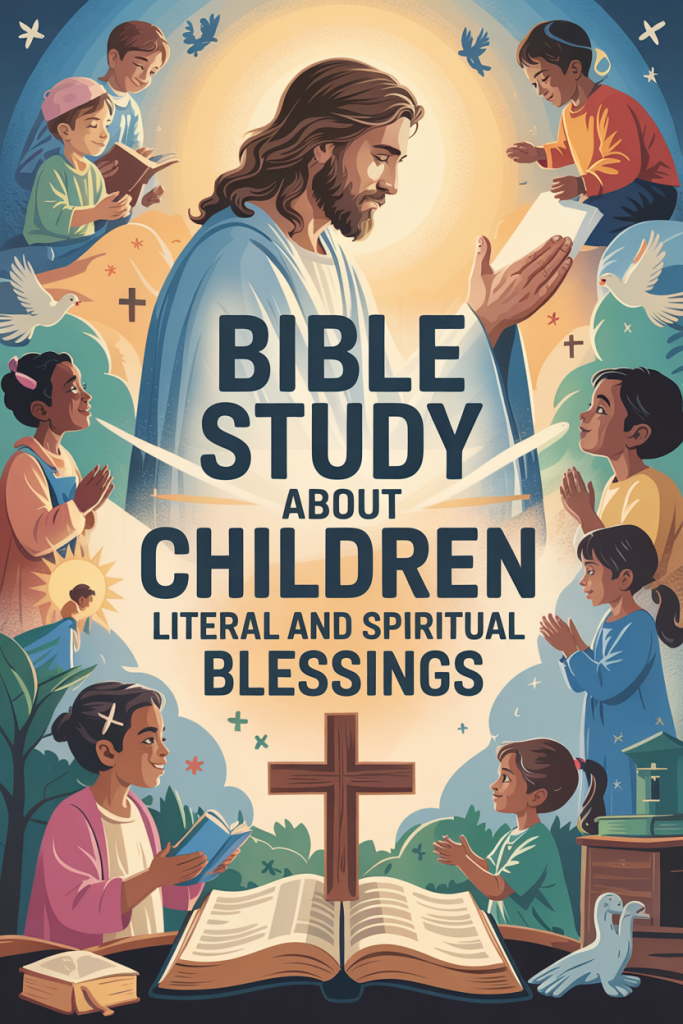
Meaning of “Children” in Scripture
In the original biblical languages, several words convey the idea of children:
- Hebrew (Old Testament): The common word ben means “son” but can refer broadly to a child or descendant. Another term, yeled, denotes a young child (boy or girl). The Hebrew Bible also speaks of one’s “seed” (zera ) or “offspring”, and of “little ones” (e.g. taph for small children). These terms emphasize lineage and youthfulness respectively.
- Greek (New Testament): Multiple words translate as child. Teknon (from tiktō, “to bear”) means a child as an offspring. Huios specifically means a son, often implying legal status or inheritance. Other Greek terms include paidion (a small child or infant), brephos (a newborn/babe), and nepios (an infant or figuratively “immature one”).
The KJV often uses “child” and “son” interchangeably, so the distinction between these terms isn’t always obvious in English.
For example, the KJV phrase “children of Israel” literally means “sons of Israel” in Hebrew – referring to all the descendants of Jacob (Israel).
Similarly, in the New Testament, teknon and huios are both variously translated as “child/children” or “son/sons” in KJV.
This flexible use reflects that any offspring, whether male or female, young or grown, is a “child” in relation to their parents.
In fact, even an adult can be called someone’s child (as in “Abraham’s children”) because the term speaks to relationship and origin, not only age.
The plural “children” can also simply mean descendants or members of a group – for instance, “the children of Israel” means the Israelite people.
Crucially, the Bible uses the language of children in a spiritual sense as well.
Just as a child inherits traits from their parents, people can be called “children” of whatever influences or drives them.
- Scripture speaks of “children of God” to describe those who through faith belong to God’s family, and “children of the devil for those imitating Satan’s works.
- It mentions “children of light” versus “children of darkness,”“children of obedience” versus “children of disobedience.”
In these cases “children of ___” means people characterized by or belonging to that category. For example, “children of disobedience” are those who habitually disobey God.
- Jesus even called the obstinate Pharisees “children of hell” (Matthew 23:15) – a stark term for people reflecting hellish attitudes.
- In contrast, believers are often called God’s little children in the New Testament, highlighting the intimacy, love, and new life we receive from Him (e.g. 1 John 3:1).
We’ll look deeper into these spiritual meanings later on, but from the start we see that “children” in the Bible carries a rich dual meaning: it speaks of actual sons and daughters and it points to our deepest identity in relation to God or to sin.
Physical and Spiritual “Children”
Literal children are celebrated throughout Scripture as a blessing.
In ancient Israel, having children was considered a mark of God’s favor and a source of joy. The Bible notes that “children were regarded as divine gifts… the heritage of the Lord”.
- For example, Psalm 127:3 (KJV) exclaims, “Lo, children are an heritage of the LORD: and the fruit of the womb is his reward.”
From the first chapters of Genesis, when God blessed Adam and Eve to “be fruitful and multiply,” to the stories of the Patriarchs, fertility and offspring were seen as part of God’s covenant blessings.
Infertility, by contrast, was a source of great sorrow and shame in biblical times. We see this in the anguish of Sarah, Rebekah, Rachel, Hannah, and Elizabeth – women who longed for a child and viewed barrenness as a “reproach” or misfortune.
When God granted these women children (Isaac to Sarah, Joseph to Rachel, Samuel to Hannah, John the Baptist to Elizabeth, etc.), it was understood as His gracious intervention.
Thus, on a plain human level, the Bible portrays children as a precious gift and stewardship from God. They continue the family line, bring happiness to parents, and even provide “strength” to a household.
- As Psalm 127:4-5 says, “As arrows are in the hand of a mighty man; so are children of the youth. Happy is the man that hath his quiver full of them.” And Proverbs 17:6 adds, “Children’s children (grandkids) are the crown of old men.”
Clearly, having children was a blessing to be cherished, not an inconvenience.
At the same time, the Bible uses “children” to describe spiritual relationships and identities.
Perhaps the highest compliment in Scripture is to be called a child of God.
- Through faith in Jesus, people are born again into God’s family – literally “born of God” (John 1:12-13, 3:3).
- The Apostle John marvels, “Behold, what manner of love the Father hath bestowed upon us, that we should be called the sons of God” (1 John 3:1, KJV).
The term “sons of God” here means “children of God,” including males and females, and it emphasizes that believers share a family bond with the Father – we are loved, accepted, and guided by Him as His own kids.
This new birth is not physical but spiritual; as John 1:13 says, we “were born, not of blood, nor of the will of the flesh, nor of the will of man, but of God.” In other words, becoming God’s child is a supernatural act of grace, not a natural descent.
Being God’s children also means we become heirs of His promises – much like a son or daughter in biblical times would inherit the family blessings.
Interestingly, the New Testament sometimes distinguishes “children” and “sons” in a subtle way: “Children” (Greek teknon) tends to stress birth and relationship – the fact that we are born into God’s family and share in His life.
“Sons” (Greek huios) can carry a nuance of status and inheritance – the dignity of being recognized as an heir in God’s household. (The KJV uses both terms, so we don’t always see a difference in English.)
- Romans 8:16–17 combines both ideas, saying “The Spirit itself beareth witness with our spirit, that we are the children of God: and if children, then heirs; heirs of God, and joint-heirs with Christ….”
In short, to be God’s child is to belong to Him and to His family forever – what an encouragement!
- On the flip side, Scripture labels those outside of Christ as “children of disobedience” or “children of wrath” (see Ephesians 2:2–3).
This doesn’t mean God hates them as individuals; rather, it describes their spiritual condition – living in disobedience and “under wrath” (deserving judgment).
In Ephesians, Paul contrasts how believers, though once children of wrath, have now been shown mercy and brought into God’s household.
- Jesus, in John 8:44, told some unbelieving Jews, “Ye are of your father the devil, and the lusts of your father ye will do.”
He was pointing out that their actions and character (lying and scheming to kill Jesus) showed them to be behaving more like Satan’s offspring than Abraham’s.
- Similarly, Acts 13:10 records Paul rebuking a sorcerer with the words, “O full of all subtilty… thou child of the devil….”.
These stark phrases remind us that spiritually, who we obey is like our parent – if we follow sin, we align with the “father of lies,” but if we follow God, we become His children.
The good news is that through Christ, we can trade families – leaving behind the broken heritage of sin and joining the beloved family of God.
- “Ye were sometimes darkness, but now are ye light in the Lord: walk as children of light,” says Ephesians 5:8, encouraging us to live out our new identity.
Another beautiful spiritual concept is adoption.
The Apostle Paul teaches that God not only gives us new birth, but He also adopts us as His children (see Romans 8:15, Ephesians 1:5). In Roman culture, an adopted son received full legal rights of inheritance as if born to the family.
Likewise, God chose us and brought us into His household with full status as His own.
- “Because you are sons, God hath sent forth the Spirit of his Son into your hearts, crying, Abba, Father” (Galatians 4:6).
Abba is the Aramaic word for “Daddy” or “Papa” – it’s intensely personal. Imagine that – the Almighty God invites us to address Him with the tenderness of a little child running into a loving father’s arms!
Finally, Scripture draws an important line between physical lineage and spiritual lineage.
- The Jews in Jesus’ day prided themselves on being Abraham’s children by blood – yet Jesus challenged them: “If ye were Abraham’s children, ye would do the works of Abraham” (John 8:39).
- True children resemble their father. The New Testament clarifies that those who share Abraham’s faith are the real children of Abraham in God’s eyes (Galatians 3:7).
This leads to the idea of believers as “children of promise.” Paul uses the story of Abraham’s two sons – Isaac (born by God’s promise to Sarah) and Ishmael (born by human effort to Hagar) – as an allegory in Galatians 4.
Christians, he says, are like Isaac: the children born by God’s miraculous promise, not by the flesh.
- “Now we, brethren, as Isaac was, are the children of promise” (Galatians 4:28, KJV).
We have become Abraham’s offspring not through natural birth but through new birth, and we inherit the blessings God promised.
This spiritual family dynamic shows how deeply the Bible’s concept of children transcends biology – it’s about relationship, character, and promise.
Biblical Instructions about Children
Because children are viewed as a blessing, the Bible gives much instruction on raising and caring for them. Parents have a sacred responsibility to love, teach, and discipline their children in a godly way.
- One of the most famous instructions is Proverbs 22:6, “Train up a child in the way he should go: and when he is old, he will not depart from it.”
This reflects a general principle that early education and guidance have lifelong effects. Parents are called to intentionally “train” (dedicate, start) their children on the right path, introducing them to wisdom and godliness from an early age.
- In the Old Testament, God commanded the Israelites: “And these words, which I command thee this day, shall be in thine heart: and thou shalt teach them diligently unto thy children, and shalt talk of them when thou sittest in thine house, and when thou walkest by the way…” (Deuteronomy 6:6–7).
In other words, teaching children about the Lord was to be a constant, daily practice, woven into normal life – sitting at home, walking along the road, morning and evening.
Faith was never meant to be a once-a-week lesson; God wanted each generation to pass on His truth continually.
Along with teaching, the Bible speaks about discipline.
Far from being abusive, biblical discipline is rooted in love and concern for a child’s well-being.
- Proverbs 13:24 famously says, “He that spareth his rod hateth his son: but he that loveth him chasteneth him betimes.”
This means proper correction is a sign of love – caring enough to guide a child away from folly or danger.
- Children, Scripture notes, are born with a willful or foolish streak that needs training: “Foolishness is bound in the heart of a child; but the rod of correction shall drive it far from him” (Proverbs 22:15).
Loving discipline, administered calmly and fairly, imparts wisdom.
- The Book of Proverbs repeatedly advises parents not to leave a child to their own devices, but to correct and instruct them (see Proverbs 29:15,17).
The goal is not to vent anger, but to shape character.
- Hebrews 12:7-11 later compares God’s discipline of us to a father’s discipline of children – “for whom the Lord loveth He chasteneth.”
This shows that discipline is an expression of love, meant to produce growth and righteousness.
At the same time, the Bible warns parents against being harsh or unfair. Balance is key.
- Ephesians 6:4 instructs, “And, ye fathers, provoke not your children to wrath: but bring them up in the nurture and admonition of the Lord.”
- Similarly, Colossians 3:21 says, “Fathers, provoke not your children to anger, lest they be discouraged.”
In essence, parents should not exasperate or embitter their children through unreasonable demands, constant criticism, or abuse of authority. Such provocation only breeds anger and discouragement.
Instead, fathers (and mothers) are to “bring them up” – a gentle phrase – in the “nurture and admonition” of the Lord.
Nurture implies loving training and care (think nourish), and admonition means instruction or guidance, especially in the Lord’s ways.
The biblical model is a parent who lovingly cultivates a child’s heart and mind toward God, providing correction with patience and encouragement.
The Scriptures also emphasize teaching by example and conversation. As mentioned, Israelite parents were to talk of God’s commandments continually with their kids.
- Proverbs 1:8 appeals, “My son, hear the instruction of thy father, and forsake not the law of thy mother.”
The assumption is that both father and mother are imparting wisdom to the child – wisdom founded on the fear of the Lord. In the New Testament, we see a beautiful picture of faith passed down in young Timothy.
- Paul writes to Timothy, “From a child thou hast known the holy Scriptures” (2 Timothy 3:15), and he credits Timothy’s mother Eunice and grandmother Lois for instilling that faith (2 Tim 1:5).
This godly heritage equipped Timothy to be a strong leader in the church. It’s a reminder to Christian parents (and grandparents) today: teaching children God’s Word from their earliest days is invaluable.
Bible stories at bedtime, praying together, bringing kids to church, modeling Christ-like behavior at home – all of these are ways children learn what living faith looks like.
Practical care for children is another biblical theme. Parents are expected to provide for their children’s needs, laying up resources for them when possible.
- The Apostle Paul alludes to this common-sense principle: “the children ought not to lay up for the parents, but the parents for the children” (2 Corinthians 12:14, KJV).
We naturally understand that moms and dads work hard to feed, clothe, and shelter their little ones; they plan to leave an inheritance if they can.
- “A good man leaveth an inheritance to his children’s children,” says Proverbs 13:22.
While circumstances vary, the heart of a parent is to bless and equip their children for the future – both physically and spiritually.
- Finally, the Bible gives instructions to children as well: “Children, obey your parents in the Lord: for this is right. Honour thy father and mother” (Ephesians 6:1-2).
The fifth of the Ten Commandments enshrines the importance of respecting parents.
- In ancient Israel, reverence for parents was taken so seriously that striking or cursing one’s father or mother was a capital offense under the law (Exodus 21:15,17).
While that severe penalty was specific to Israel’s covenant law, it underscores how much God values the parent-child relationship.
Children are called to respect and listen to their parents, and parents are called to live worthy of that honor by being loving, just, and godly. When both sides follow God’s design, the family becomes a beautiful reflection of God’s own nurturing love and discipline toward us, His children.
Jesus’ Heart for Children
Perhaps nowhere do we see God’s love for children more clearly than in the life of Jesus Christ. In a culture where children had little status, Jesus delighted in them and held them up as examples of the kind of heart God desires.
The Gospels include several touching scenes of Jesus with children. One of the most famous is when parents brought their little ones to Jesus, wanting Him to touch and bless them.
The disciples initially rebuked or shooed those children away, thinking the Lord shouldn’t be bothered.
- But Jesus was indignant and corrected his disciples: “Suffer the little children to come unto me, and forbid them not: for of such is the kingdom of God.”
- He then took the children in His arms, put His hands on them, and blessed them (see Mark 10:13-16, Matthew 19:13-15).
Imagine the warmth of that moment – Jesus, surrounded by giggling toddlers and shy youngsters, placing His hands on each little head and speaking words of love.
The KJV phrase “suffer the little children” means “allow” them – let them come. Christ openly welcomed children, saying they exemplify the kind of people who belong in God’s kingdom.
Jesus not only welcomed children; He also used their humility and trust as a spiritual lesson for adults.
In Matthew 18, the disciples asked Jesus, “Who is the greatest in the kingdom of heaven?”
- Jesus responded with a powerful visual aid: He called a little child to Him, set the child in the midst of them, and said, “Verily I say unto you, Except ye be converted, and become as little children, ye shall not enter into the kingdom of heaven. Whosoever therefore shall humble himself as this little child, the same is greatest in the kingdom of heaven” (Matthew 18:3-4).
What a striking teaching! Jesus pointed to the humility, simplicity, and trust found in a child and told His ambitious disciples, essentially, “Lower yourselves to this level if you want to be truly great.”
A child in that society had no prestige or power; they simply depended on their parents for everything. Jesus says we must have that same dependent, humble heart toward God.
It’s not childishness (immaturity) He commends, but childlikeness – the beautiful qualities of sincerity, teachability, and faith. Children know they need guidance and aren’t too proud to receive.
In the same way, a person who admits their need for God – who comes with open hands like a child – is the one who finds grace. This teaching has comforted many: we don’t have to be scholarly or “important” to know God; we simply need the honest faith of a child.
Jesus further warned people to never harm or mislead a child’s trusting heart.
- Following His statement in Matthew 18 about welcoming children, He gave a sober warning: “But whoso shall offend one of these little ones which believe in me (i.e. cause them to stumble), it were better for him that a millstone were hanged about his neck, and that he were drowned in the depth of the sea” (Matt. 18:6).
- He goes on to say that their angels continually behold the Father’s face in heaven (Matt. 18:10), indicating God’s special concern for their welfare.
These are strong words! Jesus was protective of “little ones,” whether that means young children or humble believers of any age. Leading an innocent person into sin is a grave offense in God’s eyes.
- By contrast, offering even a cup of water to a little one out of discipleship will be rewarded (Matt. 10:42).
- Jesus aligned Himself with the weak and small. He said, “Whosoever shall receive one of such children in my name, receiveth me” (Mark 9:37).
In other words, how we treat the lowliest believer – symbolized by a child – is how we treat Christ Himself.
Throughout His ministry, Jesus made time for children and highlighted their value.
The Gospels note that in the temple, young children shouted praises to Jesus during His triumphal entry: “Hosanna to the Son of David!”
- The religious leaders were indignant, but Jesus answered by quoting Psalm 8: “Yea; have ye never read, Out of the mouth of babes and sucklings Thou hast perfected praise?” (Matthew 21:15-16).
He delighted that these youngsters were worshiping God sincerely when the educated elites would not.
On another occasion after His resurrection, Jesus affectionately addressed His own disciples as “Children” (John 21:5) when calling out to them from the shore – a reminder that in His eyes, we are all His dear children, always under His care and instruction.
Jesus also ministered to children’s needs in miraculous ways. The Gospels record tender miracles like the raising of Jairus’ daughter, a twelve-year-old girl who had died.
- Jesus went to the house, took her by the hand and said, “Talitha cumi,” which means “Little girl, I say unto thee, arise.” Immediately, the girl was restored to life (Mark 5:41-42).
Can you imagine the joy of her parents? Jesus’ compassion in that moment – gently using a pet name (talitha) meaning “little lamb” – demonstrates how precious a child’s life was to Him.
He also healed a boy tormented by an unclean spirit whom the disciples couldn’t help (Mark 9:17-27), showing His power to set even children free from spiritual oppression.
And in one famous miracle, Jesus used a child’s simple lunch to feed a multitude – it was a young boy who offered his five loaves and two fish that Jesus multiplied to feed over 5,000 people.
Though just a small act from a child, Jesus made it an example that no gift is too small in God’s hands.
In all these ways, Jesus affirmed the value, dignity, and example of children. He broke social norms by prioritizing them and using them as a model for true faith.
For Christians, this is both comforting and challenging. It’s comforting because we know God cares about the youngest and weakest among us – every child matters to Him.
It’s also challenging because Jesus calls us to learn from children: to cultivate humility, trust, innocence, and dependence on our Heavenly Father.
In a world that often prizes sophistication and self-reliance, Jesus turns our eyes to a little child and says, “That is the kingdom model.” How encouraging to know that in God’s family, the lowly are the greatest, and even a child can lead the way!
Notable Children in the Bible (and What They Teach Us)
The Bible overflows with stories of children through whom God worked out His purposes. These narratives are not “just for kids” – they carry deep significance for all believers. Let’s look at a few notable examples of children in Scripture and the lessons we can draw from them:
Isaac – The Child of Promise:
Isaac was the long-awaited son born to Abraham and Sarah in their old age. His very name means “laughter,” reflecting the joy (and initial disbelief) of his parents at God’s miraculous gift (Genesis 21:1-7).
Isaac’s birth fulfilled God’s promise that Abraham’s descendants would come through Sarah. Later, when Isaac was a youth, God tested Abraham by asking him to sacrifice Isaac – and then provided a ram in Isaac’s place (Genesis 22).
This dramatic incident foreshadowed God offering His own Son for us, and it earned Abraham the title “father of the faithful.”
Isaac’s life teaches us about faith and God’s faithfulness: he truly was a “child of promise,” born not by human effort but by God’s power.
In the New Testament, Isaac becomes a symbol of all believers who are born by God’s promise, not by works. Just as Isaac brought laughter to his parents, every child of God born by faith brings joy to our Father in heaven.
Moses – Protected for a Purpose:
Moses’ story begins with danger and deliverance. As a baby, he was under threat due to Pharaoh’s decree to drown all Hebrew male infants. Moses’ mother Jochebed hid him in a basket on the Nile River, where Pharaoh’s daughter found and adopted him (Exodus 2:1-10).
This little child, saved by God’s providence, grew up to become the deliverer of Israel from slavery. It’s a powerful example of God’s care for children even in desperate circumstances.
Through the courage of his mother and sister, and the compassion of Pharaoh’s daughter, baby Moses survived what many others did not. His childhood in Pharaoh’s palace uniquely prepared him for his calling.
Moses reminds us that every child has potential in God’s plan, and that God can sovereignly protect and raise up a child to change history.
(In fact, Moses’ preservation as an infant has an interesting parallel in the New Testament: the infant Jesus was also rescued from a king’s murderous decree – Herod’s slaughter of Bethlehem’s babies – when Joseph and Mary fled to Egypt with Him. In both cases, God preserved the child who would become a savior for His people.)
Samuel – Hearing God’s Voice as a Boy:
Samuel was another miracle child, given by God to a barren woman, Hannah. In gratitude, Hannah dedicated Samuel to the Lord’s service, and the little boy was raised in the temple at Shiloh under Eli the priest (1 Samuel 1–2).
Remarkably, God called out to Samuel when he was just a child. One night Samuel heard a voice speaking his name.
- After initially thinking it was Eli, he responded, “Speak, LORD; for thy servant heareth.” (1 Samuel 3:10).
God delivered a message to Samuel even though “he did not yet know the Lord” well at that age. This story shows that God can reveal Himself to a child and even entrust them with His word.
Samuel grew to be a mighty prophet and judge in Israel, guiding the nation and anointing its first two kings. But it all began with the open, listening heart of a little boy.
For Christian parents and teachers, this is a beautiful encouragement: children can experience God! They can learn to hear His voice (primarily through Scripture today) and sense His presence early in life.
We should never underestimate a child’s capacity to know and serve God – Samuel’s example urges us to foster an environment where even the young can respond to God’s call.
David (as a youth) – Faith that Conquers Giants:
While David is mostly known as a king and psalmist, it’s worth remembering he was likely a teenager when he defeated Goliath.
- As the youngest son of Jesse, David wasn’t even considered initially when Samuel came to anoint a new king (1 Samuel 16).
But God saw David’s heart. Soon after, David stepped onto the national stage by facing the giant Goliath with nothing but a sling, a few stones, and total faith in God. “I come to thee in the name of the LORD of hosts,” David declared to Goliath, and God gave him victory (1 Samuel 17:45-50).
- David’s youthful courage shows that a child or teen who trusts in the Lord can overcome fearful odds. “God is with me, so who can be against me?” – David lived that truth as a youth.
It’s a reminder to encourage our young people to be bold in faith. Sometimes their trust in God is more straightforward and less entangled in doubt than that of adults.
Jesus may have had a shepherd boy like David in mind when He commended the praise of children and said “out of the mouth of babes Thou hast perfected praise” – sometimes young hearts see God’s greatness most clearly.
Josiah – A Child King Used by God:
Josiah became king of Judah at only eight years old (2 Chronicles 34:1).
- Despite his youth, he “did that which was right in the sight of the LORD” and as he grew, he led one of the greatest religious reforms in Judah’s history.
By age 16, Josiah began to seek the God of David, and by 20, he started purging idols from the land. He also had the temple repaired, during which the lost Book of the Law was rediscovered. Josiah humbled himself upon hearing God’s law and initiated a national renewal of the covenant.
It’s astounding what this young man accomplished for God before the age of 30.
Josiah’s story is an inspiration that God can work powerfully through children and adolescents who set their hearts on Him. It challenges any notion that someone is “too young” to make a difference.
In God’s eyes, a willing heart matters more than age.
Whether in Josiah’s case of leadership, or in Timothy’s case of ministry (whom Paul exhorted, “let no man despise thy youth,” 1 Tim. 4:12), the Bible is full of examples where God empowered young people.
We can encourage the “Josiahs” among us today to seek the Lord early and boldly stand for what is right.
The Boy with Loaves and Fishes – God Using a Child’s Offering:
In the New Testament, during the feeding of the five thousand, it was a young boy who had the five barley loaves and two small fish that Jesus used for the miracle (John 6:9).
We’re not told much about this lad, but we see that he was willing to give his meager lunch to Jesus – and through that giving, thousands were fed with baskets of leftovers to spare.
This simple act speaks volumes: never think that what you have to offer is too little for God to use.
Children often have generous, uncalculating hearts. That boy didn’t hoard his meal; he entrusted it to Jesus. In turn, Jesus did far more with it than anyone could imagine.
The lesson for us is to bring what we have to the Lord, no matter how insufficient it seems. Whether it’s a child offering a prayer, a few coins of allowance to the offering, or a teenager offering their time and talent, God delights in using the faithful offerings of the young.
Sometimes children lead the way in wholehearted giving and trust, putting adults to shame!
This story encourages us to value children’s contributions in the church and kingdom of God – their prayers, songs, and service are precious and often powerful in God’s eyes.
Jesus Himself as a Child – The Incarnation’s Profound Mystery:
We must not forget that Jesus came into this world as a child – the ultimate example of God working through childhood.
- Every Christmas, Christians celebrate that “unto us a child is born, unto us a son is given” (Isaiah 9:6).
The infinite Son of God became Baby Jesus, wrapped in swaddling clothes and laid in a manger (Luke 2:7). The Almighty entered our human experience in the most vulnerable way – through all the stages of growth from infancy to boyhood to manhood.
We don’t have many stories of Jesus’ childhood, but the ones we have are telling.
- At 12 years old, Jesus astonished the teachers in the Temple with His understanding, and He expressed His first recorded awareness of His unique relationship to God, saying, “Wist ye not that I must be about my Father’s business?” (Luke 2:49).
- Yet Luke also notes that Jesus returned to Nazareth and was obedient to Joseph and Mary, and that “Jesus increased in wisdom and stature, and in favour with God and man” (Luke 2:51-52).
Even the Son of God went through the ordinary process of growing up, experiencing the life of a child. By sanctifying childhood, Jesus showed that every stage of life matters to God – and He demonstrated perfect love and obedience as a son.
Moreover, the image of the Christ child has captured the hearts of believers for centuries: in Jesus, God identifies with even the smallest among us. The King of Kings once toddled and played and skinned His knee; He knows the world of a child intimately.
- And of course, in prophetic fulfilment, Isaiah 7:14 declared the Messiah would be born of a virgin and “shall call his name Immanuel.”
The birth of that special Child in Bethlehem was the turning point of history. Truly, God often starts great works in the form of a child – whether it was Isaac, Samuel, John the Baptist, or Jesus Himself.
- We should never disdain small beginnings (Zechariah 4:10), because with God, a child today could be the hero of faith tomorrow.
These examples (and many others, like Joseph, Daniel, Esther in her youth, Mary the mother of Jesus as a young woman, etc.) reinforce a consistent message: children are integral to God’s story.
Sometimes they are the central actors, other times the protected or promised ones, but always they are under God’s watchful eye.
Each child in Scripture mirrors some aspect of spiritual truth – whether it’s God’s miraculous provision, the need for faithful training, or the embodiment of hope for the future.
As we reflect on these stories, we’re encouraged to value and mentor the children in our lives, knowing God can call and use them at any moment.
We’re also reminded to adopt a childlike faith ourselves, seeing God with wonder and trusting Him against all odds, just as these young saints did.
Symbolism and Spiritual Lessons of “Children”
Beyond the narratives and commands, “children” serve as powerful symbols and metaphors in the Bible. God often uses the imagery of parent and child to help us grasp spiritual realities:
Innocence, Humility, and Dependence:
As Jesus taught, the humility of a child is the model for kingdom greatness. A small child knows they are small; they aren’t consumed with pride or status.
- This humility is symbolically important: “God resisteth the proud, but giveth grace unto the humble” (James 4:6).
Children also exemplify innocence and purity of heart. While not sinless (any parent of a toddler knows children have a sinful nature too!), there is a simplicity and guilelessness in little children that Jesus pointed to.
- He rejoiced in the pure praise of children – the Psalmist said, “Out of the mouth of babes… Thou hast ordained strength” (Ps. 8:2), which Jesus quoted as “perfected praise”.
This suggests that God delights in the genuine, unpretentious worship that even children can offer. Moreover, children are dependent by design – they rely on parents for everything. Spiritually, this dependency is a positive example for us relying on God.
We are all, whether 8 or 80 years old, fully dependent on our Father in heaven for life, breath, provision, protection, and salvation. Jesus modeled this kind of dependence on His Father, and He invites us to trust God for our needs as well.
- He even drew an analogy in prayer: “If ye, being evil, know how to give good gifts unto your children, how much more shall your Father in heaven give good things to them that ask Him?” (Matt. 7:11).
This portrays God as the ultimate loving parent, far surpassing even the best human parent. Thus, every time we see a loving parent-child interaction, it’s a small picture of God’s care for us.
A child sleeping securely in daddy’s arms is a living parable of the believer resting in God. A toddler running to mom for comfort mirrors how we can run to God with our hurts and fears.
No wonder the Bible so often calls us God’s children – it’s meant to assure us that He loves us tenderly and will care for us faithfully, just as the best father or mother would, and then some.
Rebirth and New Life:
The image of newborn babies is used to describe spiritual beginnings. When someone comes to faith, they are essentially spiritual infants who need nurture and growth.
- Peter writes, “As newborn babes, desire the sincere milk of the word, that ye may grow thereby” (1 Peter 2:2).
Just as a baby craves milk, a new believer should earnestly crave God’s Word to grow strong. Paul, too, told the Corinthians that he fed them with “milk, not solid food,” because they were still spiritual babes (1 Cor. 3:1-2).
The implication isn’t negative per se – being a baby Christian is a natural phase – but we’re expected to grow out of infancy into maturity, just as a child eventually moves from milk to meat.
The metaphor teaches us to be patient with young believers (babies don’t become adults overnight!), while also encouraging growth.
Furthermore, the whole concept of being “born again” (John 3:3) is of becoming a spiritual child, starting a brand-new life.
It’s fascinating that Jesus chose birth – the beginning of life – to describe what happens when we believe. It underscores that salvation isn’t just adopting a religion; it’s as radical as a newborn entering the world.
We become spiritual babies – new creations – in God’s family, with a fresh start to learn and develop.
God’s Parental Love and Our Adoption:
Scripture uses parental imagery to convey God’s love and our relationship.
- For instance, Psalm 103:13: “Like as a father pitieth (has compassion on) his children, so the LORD pitieth them that fear Him.”
- And Isaiah 66:13: “As one whom his mother comforteth, so will I comfort you….”
Such verses ascribe both fatherly and motherly qualities to God’s care. He comforts, He provides, He guides, He disciplines – all out of love.
The idea of adoption, as mentioned before, symbolizes how God deliberately chooses and claims us as His own.
- Romans 8:15 says we received “the Spirit of adoption, whereby we cry, Abba, Father.”
This indicates an intimate, secure relationship – we can approach God with the confidence and affection of a child climbing into a parent’s lap. In the Roman world, an adopted child could never be disowned – what a powerful picture of the security of our salvation!
We are forever His. Even when we stray, God often speaks of Himself as a grieving or concerned parent.
- In the Old Testament, when Israel rebelled, God lamented, “I have nourished and brought up children, and they have rebelled against me” (Isaiah 1:2).
- In Hosea 11:1-4, God speaks of Ephraim as a toddler He taught to walk, a child He healed and drew with “cords of love,” only to have the child turn away.
These heartfelt metaphors show that God feels toward us the way a loving parent feels toward a wayward son or daughter – with both sorrow and unquenchable love.
Truly, the parent-child bond is one of the strongest on earth, and God uses it to say, “That’s how I feel about you.” If we being evil love our kids, how much more does our perfect God love us, His children!
Children as Symbols of Future Hope:
In Scripture, children often represent the future and hope. In many prophecies, the presence of children is a sign of blessing.
- Zechariah 8:5, envisioning Jerusalem’s restoration, says, “And the streets of the city shall be full of boys and girls playing in the streets thereof.”
It’s a charming image of peace and prosperity – you don’t have children playing freely if times are dangerous or troubled.
- Isaiah’s vision of the Messiah’s kingdom famously includes, “The wolf also shall dwell with the lamb… and a little child shall lead them” (Isaiah 11:6), along with infants playing safely near once-deadly snakes.
These pictures use children’s fearless play to illustrate the utter peace and safety of God’s restored world. The fact that a “little child” can lead formerly wild animals speaks to a reversal of the curse and the arrival of harmony in creation.
- In another sense, children themselves are a hope – Psalm 127 calls them “arrows in the hand of a warrior,” hinting at how parents launch their children into the world to make an impact for God’s glory.
Each new child of Israel carried the hope of possibly being the promised Messiah or at least advancing God’s plan. In fact, directly, the child Messiah was the hope of Israel.
- Isaiah 9:6’s prophecy “For unto us a child is born, unto us a son is given” encapsulates the expectation that a child would one day deliver them. And that came true in Jesus.
Thus, a child can be a sign of God’s unfolding salvation plan (as baby Isaac was to Abraham, or baby Jesus to the world). Even today, we often see children as embodying the potential for a better future – and biblically, that’s accurate when they’re raised in the Lord.
Each child born into a godly family carries the promise that God’s work continues to the next generation.
Contrast Between Childlikeness and Childishness:
It’s worth noting the Bible distinguishes being childlike (in faith, humility, innocence) from being childish in a negative sense (immature, willfully ignorant).
- Paul says, “Brethren, be not children in understanding: howbeit in malice be ye children, but in understanding be men (mature)” (1 Cor. 14:20).
In other words, don’t be naive or undeveloped in your thinking – grow up intellectually and spiritually – but do be childlike in purity (free of malice).
- Similarly, he writes, “When I was a child, I spake as a child… but when I became a man, I put away childish things” (1 Cor. 13:11).
There’s a time to leave behind juvenile selfishness and tantrums, and sadly some never do.
- Ephesians 4:14 cautions believers against remaining spiritual “children” who are fickle or easily deceived.
So, while we embrace certain childlike qualities, we also strive for maturity in Christ. The paradox is that the greatest mature saints still retain a childlike awe and trust in God even as they exhibit adult wisdom and stability.
Think of an elderly believer whose eyes still light up talking about Jesus’ love – that’s childlike faith with grown-up depth.
Allegories and Types Involving Children:
A few other symbolic uses of children in Scripture deserve mention.
- Paul, in Galatians 4, uses Abraham’s two children (Ishmael by Hagar, and Isaac by Sarah) as an allegory of two covenants – one born “after the flesh” (the law, leading to bondage) and one born by promise (the gospel, leading to freedom). “These are the two covenants,” Paul says (Gal. 4:24).
Thus, Ishmael and Isaac represent living under law vs. under grace, and as noted earlier, believers are “children of promise” like Isaac.
Another type: in the Passover story, the blood of the lamb spared the firstborn sons of Israel from death.
- Those firstborn sons belonged to God and had to be redeemed by a sacrifice thereafter (Exodus 13:13-15).
This points to Jesus as the ultimate firstborn Son whom God gave to redeem us (and interestingly, Jesus is called the “firstborn among many brethren,” meaning through His sacrifice, many more children are brought to glory).
- In the book of Revelation, there’s an image of a woman clothed with the sun who gives birth to a male child destined to rule the nations – many interpret that male child as symbolizing Christ (and perhaps by extension, the church).
- Satan, depicted as a dragon, tries to devour the child, but the child is caught up to God (Rev. 12:1-5).
This dramatic picture recaps in symbolic form the story of Christ’s birth, ascension, and the enemy’s opposition – again showing how a child (Jesus) is central to God’s victory.
- Finally, in a more negative metaphor, James 1:15 personifies sin’s progression as a life cycle: “lust, when it hath conceived, bringeth forth sin: and sin, when it is finished, bringeth forth death.”
Sin is pictured as “giving birth” to death, a stark reminder that what we conceive in our hearts can “birth” destructive outcomes.
So, whether positive or negative, the imagery of conception, birth, and children is woven throughout Scripture’s poetic language.
In summary, children in the Bible are more than just literal persons – they are signposts pointing to spiritual truths.
They remind us of qualities God values (humility, trust), the reality of our dependence, the nature of our relationship with God (as beloved sons and daughters), and the hope of new life and future joy.
Every time we see a child, we have an opportunity to recall these lessons. And every time we consider our status as God’s children, we should respond with gratitude and awe at His fatherly love.
From Old to New: Continuity and Fulfillment
One beautiful aspect of this topic is seeing the continuity from the Old Testament to the New Testament regarding children.
The Old Testament established foundational truths: that children are a blessing, that parents must diligently teach them, and that God often worked through the birth of promised children (Isaac, Samson, Samuel, etc.) to advance His plan.
We also saw Israel collectively called God’s “son” (Exodus 4:22) and God portrayed as a father. These threads find even greater fulfillment in the New Testament.
- For example, God’s promise to “pour out His Spirit on all flesh” in the last days included “your sons and your daughters shall prophesy” (Joel 2:28), which Peter quoted in Acts 2 on Pentecost.
This signifies that under the New Covenant, even young people (sons and daughters) would be full participants in God’s work, gifted by the Holy Spirit.
Indeed, in the church we see young men like Timothy, Titus, John Mark, and others playing key roles alongside older apostles.
The generational faithfulness that the Old Testament so stressed (teaching your children) comes to fruition as the faith is passed to a new generation who themselves receive the Spirit and carry on the mission.
- Another connection: The “seed” (offspring) promised to Eve (Genesis 3:15) and to Abraham (Genesis 22:18) ultimately referred to Christ – the Child who would defeat the serpent and bless all nations.
In that sense, all of Israel’s history was in anticipation of a child – Jesus.
The genealogies and birth narratives in the Gospels highlight this continuity: from Abraham to David to Mary, the line is traced to show Jesus is the promised child of the covenant.
And when that child was born in Bethlehem, the hopes of generations were fulfilled.
- The prophet Simeon, upon seeing the infant Jesus, exclaimed, “Mine eyes have seen Thy salvation” (Luke 2:30). It’s a powerful fulfillment of all the child-centered prophecies – “unto us a child is born” had finally happened.
Moreover, the Old Testament experiences of sonship vs. disobedience set the stage for the New Testament revelations. Israel, as God’s son, often failed – they were the prodigal child in many ways, rebelling against God’s law.
Jesus came as the perfect Son who would succeed where Israel failed, and through His obedience, even to death on a cross, He opened the way for many sinful sons and daughters to return to God.
- Jesus told the parable of the Prodigal Son (Luke 15) which, among other things, reflects God’s heart as a Father ready to forgive and celebrate the return of a wayward child.
That parable resonates with the whole biblical narrative: God has always sought His “lost children.”
In Christ, the estranged can truly become children of God in full standing, clothed in Christ’s righteousness (like the prodigal receiving the father’s robe and ring).
This is a profound theological development: what was hinted in Israel’s sonship is fully realized in believers’ sonship. We cry “Abba, Father” by the Spirit – an intimacy not commonly experienced under the old covenant.
Prophetically, there are also echoes and fulfillments between the Testaments involving children.
- For instance, Jeremiah 31:15 poetically describes Rachel weeping for her children (lamenting the exile of Israel).
- Matthew 2:17-18 cites this verse in reference to the weeping in Bethlehem when Herod killed the male infants.
The connection is that the sorrow of losing children in the Old Testament (exile) found a parallel in the New (Herod’s atrocity) – but both sorrows are answered by God’s plan.
- In Jeremiah 31, God immediately promises to turn mourning into joy and bring the children back. In Matthew, the slaughter of the innocents is followed by God safely bringing His Son out of Egypt (Matt. 2:15) to eventually defeat evil.
Thus the darkest moments involving children (whether Israel’s sons lost or Bethlehem’s babies lost) are not the end of the story – God brings redemption and hope.
- Finally, we see a continuity of ethical teaching: the Old Testament instructed parents to teach children, and in the New, Paul echoes that with “bring them up in the Lord.”
- The Old said honor your parents; the New repeats that command as “the first commandment with promise.”
The wisdom literature said children are a blessing; the New shows Jesus blessing children and Paul fondly referring to converts as his spiritual children.
There’s a beautiful harmony: God’s heart for the family and for spiritual child-parent relationships remains the same.
- What changes is the wider context – the church becomes a family of families, so to speak, where older men are to treat younger men as sons/brothers and older women to younger women as daughters/sisters (Titus 2:1-8, 1 Tim. 5:1-2).
The family language extends to the whole community of faith. We’re all children of God together, and also spiritual siblings.
This is a development from Israel where the community was by physical birth; now it’s by spiritual rebirth. But the relational warmth – the idea that we’re kin – is even stronger.
In conclusion, the theme of “children” forms a golden thread from the start of Scripture to the finish. God created the family unit and delights in populating His world (and heaven) with beloved children.
He chose to save us by sending His own Son as a child, and through that Son to adopt us as His sons and daughters.
He calls us to receive that gift with the simple faith of a child, and then to grow into mature children who reflect our Father’s character.
As we do, we bear the family resemblance – “Abraham’s children” by faith, “children of light” shining in a dark world, “children of the resurrection” destined for eternal life.
Encouragement and Conclusion
For Christian readers today, the study of “children” in the Bible is deeply encouraging and enlightening. It reminds us that God values children – both actual kids and the child in each of us. We learn that:
Children are a Blessing:
If you are a parent, take heart that your labor in raising your kids matters immensely to God. Your children are not burdens but blessings, “heritage of the Lord”. In a world that sometimes treats kids as an inconvenience, the Bible calls them rewards.
Embrace the high calling to love, teach, and nurture them. Even on tough days, know that God sees your faithful parenting and it delights Him. And if you don’t have children of your own, you can still invest in the next generation – as a mentor, teacher, aunt/uncle, or simply a caring church member. Jesus welcomed children; the church, as His body, should do the same.
We Are God’s Children:
No matter your age or status, if you have trusted in Christ, you are a cherished child of God. Let that sink in – a child of the King! He chose you, adopted you, and loves you with parental affection. He even enjoys your company the way a father or mother delights in their little one climbing into their lap.
When you pray “Our Father,” it’s not a distant metaphor – it’s a spiritual reality paid for by Jesus’ blood. Nothing can sever that parent-child bond He has with you; even when you stumble, He is ready to forgive and restore. As a perfect Father, God is guiding you toward maturity. He may discipline at times, but only out of love, to shape you into the best you can be.
You can rest secure in His arms, knowing He will provide for you, protect you, and never abandon you. In a world rife with orphan-hearted people, you have the incredible privilege to cry “Abba, Father” to the Creator of the universe. Live in that identity – it will give you confidence, humility, and hope.
Be Childlike, Not Childish:
In our walk of faith, we’re invited to retain a childlike spirit – to trust our Father’s heart even when we don’t understand, to stay humble and teachable, to marvel at God’s goodness with fresh eyes.
At the same time, we’re encouraged to grow in wisdom and Christlike maturity. Childlike faith is not about remaining spiritually immature; it’s about maintaining purity of devotion. Keep the wonder!
When a child sees something amazing, their eyes widen and they gasp – have we lost that wonder in our worship? Ask God to renew a child’s awe and joy in your heart. As Jesus said, the kingdom of God belongs to such as these. We are most ourselves – God’s little children – when we stand in awe of Him and trust Him fully.
The Legacy of Faith Continues:
Just as Timothy was influenced by his grandmother and mother, realize that your faith can ripple through future generations. Pour into the children and youth around you. They are the “arrows” you can send into a future you won’t see.
Pray with them, read Bible stories to them, answer their curious questions about God. Show them by example how to love Jesus. Even if you feel you don’t know enough – remember, a child’s question can often be answered with simple truths.
And often their insights will surprise and bless you! The Holy Spirit can work in kids too. Involving children in prayer, worship, and service isn’t just teaching them – it’s enriching the whole church.
Jesus didn’t push kids to the side, and neither should we. In fact, sometimes we need to follow their lead – in sincerity, zeal, and enthusiasm for God.
In the end, the word “children” in the KJV Bible speaks to both our hearts and our minds. It speaks to our minds by covering the full spectrum from family life to theology – from diapers to discipleship, we’ve seen how much is packed into this concept.
And it speaks to our hearts by reminding us who we truly are: little children of a great big God.
The Apostle John, as an elderly man, addressed believers repeatedly as “little children” in his letters (see 1 John). You can almost hear the tender tone of a spiritual grandfather encouraging the family of God. So let’s receive the Bible’s message about children with that same tenderness.
May we value and protect the little ones among us, seeing in them a reflection of God’s image and a trust for the future. May we take to heart the instructions God gives us as parents, grandparents, mentors, or teachers, knowing that what we sow into young lives will reap eternal rewards.
May we also gladly embrace our role as God’s children, resting in His love and climbing up into His arms daily through prayer and worship. And may we never lose the childlike wonder that draws us to Jesus – for He stands with open arms, ready to bless us and say, “Of such is the kingdom of heaven.”
In God’s family, we are forever His children – loved, growing, and welcome in His presence.
What a comforting truth that is! So the next time you hear laughter in a child’s voice, or feel a tug on your sleeve from a little hand, or even see a cradle or a kindergarten class, let it remind you: this is how God sees me, and this is how I must come to Him.
In that light, we can all sing with fresh meaning the simple yet profound song many of us learned as children: “Jesus loves the little children….” Indeed, He does – and in His eyes, you are one of those beloved little ones.
Citations
- Hastings, James (ed.). “The Story of Child.” A Dictionary of the Bible (1898). This entry explores the value of children in biblical times, the parent-child relationship, and figurative uses of “children” (e.g. “children of disobedience”)wisdomlib.orgwisdomlib.org. It provides cultural background on how children were viewed as blessings and gives examples of biblical narratives involving childrenwisdomlib.orgwisdomlib.org.
- STEM Publishing – The Bible Treasury. “Teknon and Huios.” This article explains the difference between two Greek terms for “child/son” used in the New Testamentstempublishing.comstempublishing.com. It notes that teknon (child) emphasizes birth and sharing life, whereas huios (son) emphasizes status and inheritance – distinctions often blurred in translationstempublishing.com.
- International Standard Bible Encyclopedia. “Child; Children.” This encyclopedia entry discusses Hebrew and Greek terms for children and outlines biblical attitudes toward children. It confirms that Hebrews saw children as a divine blessingstudylight.org and describes family practices in child-rearing, education, and inheritance in biblical culturestudylight.org.
- Webster’s 1828 / KJV Dictionary. Entry for “Child.” Provides definitions and uses of “child/children” in KJV Englishav1611.comav1611.com. It highlights both literal meanings (offspring, young person) and figurative meanings (one weak in knowledge, a child of God, a child of the devil, etc.), illustrating the breadth of the term’s application in Scripture.
- Ligonier Ministries Devotional. “Children of Promise” (Galatians 4:28–31)learn.ligonier.org. This devotional by Terry Johnson explains Paul’s analogy of believers being like Isaac – “children of promise” born through God’s promise, not by fleshly effort. It emphasizes our spiritual rebirth into God’s family and heirship according to promise, not law.
- Compassion International. “What the Bible Says About Children”compassion.comcompassion.com. An article collecting biblical teachings about children as blessings, the need to protect and value them, and Jesus’ special care for children. It cites verses like Matthew 18:10 and 19:14 and encourages seeing children through God’s eyes.
- Chaim Bentorah Hebrew Word Study. “Tela: Little Child.” This study discusses Jesus’ Aramaic use of “Talitha cumi” when raising Jairus’s daughter, noting talitha (little girl) comes from a root meaning “little lamb”chaimbentorah.com. It illustrates Jesus’ tenderness in addressing the child and a possible wordplay in the original language that portrays the girl as a “wounded lamb” healed by the Good Shepherd.
- OpenBible.info. “44 Bible Verses about Train Up a Child”openbible.infoopenbible.info. A topical list of scriptures related to raising children, including Proverbs 22:6, Ephesians 6:4, Deuteronomy 6:7, Psalm 127:3-5, etc. These verses underpin the study’s points on parental responsibility to teach and discipline children and the blessing children are from God.
- BibleRef.com. Explanation of 2 Corinthians 12:14bibleref.com. Provides context for Paul’s statement that parents save up for children, not vice versa. It reinforces the idea that it’s normal and right for parents to provide for their kids, a principle Paul applied to his relationship with the Corinthian church (spiritually parenting them).
- Brooklyn Museum – James Tissot Artwork. “Suffer the Little Children to Come unto Me” watercolor (1886-1894). This public domain image depicts Jesus surrounded by mothers and children (referencing Mark 10:13-16). It visually supports the section on Jesus blessing the children, capturing the biblical moment in artcompassion.com. The painting is used to help readers envision Jesus’ welcoming posture toward little ones.
Call to Action: The Question That Demands an AnswerIn Acts 2:37 Peter and the Apostles were asked the question – What Shall We do? And in Acts 2:38 Peter answered, Repent, and be baptized every one of you in the name of Jesus Christ for the remission of sins, and ye shall receive the gift of the Holy Ghost. For the promise is unto you, and to your children, and to all that are afar off, even as many as the Lord our God shall call. Do you understand this? After hearing the gospel and believing, they asked what should would do. The answer hasn’t changed friend, Peter clearly gave the answer. The question for you today is, Have you receieved the Holy Spirit Since you believed? If you’re ready to take that step, or you want to learn more about what it means to be born again of water and Spirit, visit: Come, and let the Spirit make you new. |