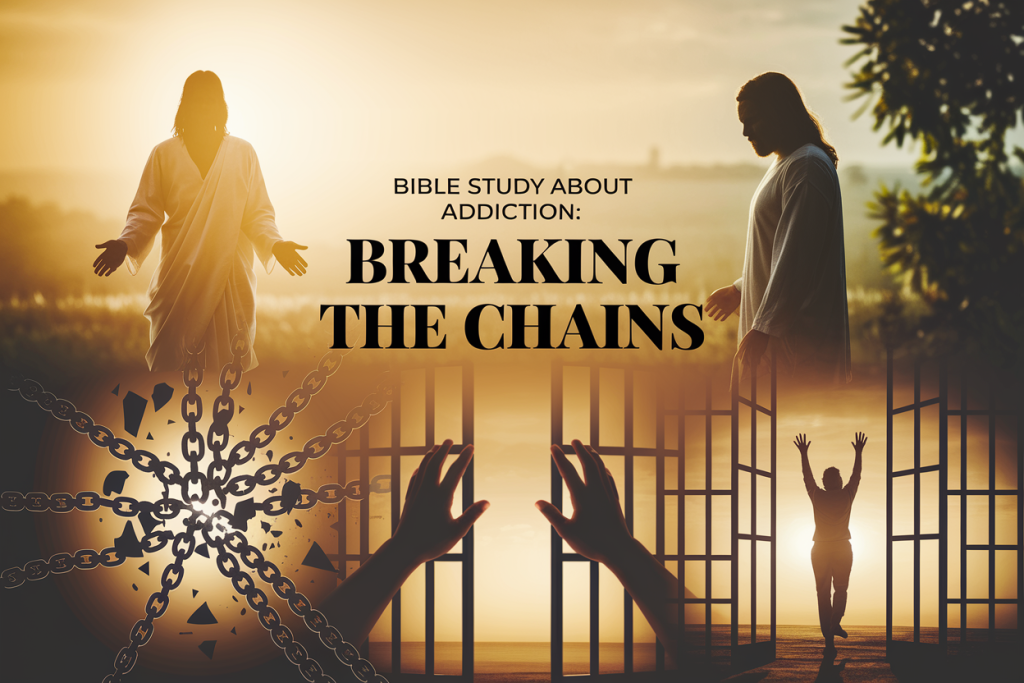
Quick Overview of This Bible Study…
Short on time? I have created a short slide show presentation of some key takeways in our study. The complete, more comprehensive bible study is below…
Addiction is a painful reality that can wear many faces. It might be the familiar pull of alcohol or drugs, the secret grip of lust and pornography, the endless chase for more money or material things, or even an obsession that quietly becomes an idol in our hearts.
If you or someone you love has ever wrestled with any form of addiction, you know it feels like a heavy chain that’s hard to break. I approach this Bible study with empathy and hope — because the Bible, has a lot to say about addiction even if it doesn’t use that exact word often.
From Genesis to Revelation, Scripture addresses our human tendency to get enslaved by sinful habits, and it points us toward true freedom in Christ.
In this study, we’ll explore the Bible to see what God’s Word teaches about addiction in all its forms, how believers are instructed to respond, and the hope we have for breaking free.
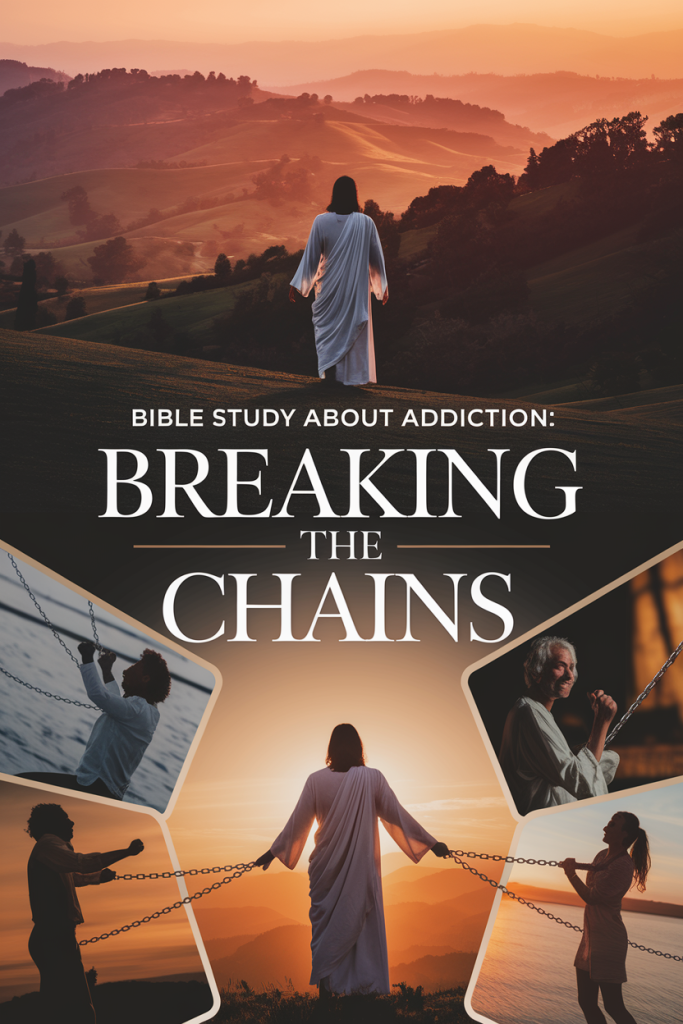
Understanding Addiction in Scripture
When we talk about “addiction,” the KJV Bible rarely uses that specific term. In fact, the only time the word “addicted” appears in the KJV, it’s in a positive sense — describing a family that “addicted themselves to the ministry of the saints,” meaning they devoted themselves to serving others.
Generally, the Bible uses other words to describe the grip of harmful habits and sins. Understanding these biblical terms helps us see that the struggle with addiction is not new; it’s part of the human condition addressed throughout Scripture.
Some of the key terms and concepts include: bondage, slavery, drunkenness, lust, covetousness (greed), and idolatry. Each of these words paints a picture of a life dominated by something other than God.
Bondage/Slavery:
The Bible often describes sinful habits as a form of slavery or bondage. Jesus said...
- “Whosoever committeth sin is the servant of sin” – in other words, a person practicing sin becomes its slave.
Have you ever felt “enslaved” by a behavior you hate but keep returning to? The Apostle Paul understood that feeling.
In Romans 7 he candidly admits that he sometimes couldn’t do the good he wanted to do, and kept doing the evil he hated. That is a perfect description of the cycle of addiction: the will may be there, but something stronger seems to be chaining us down.
The good news? The Bible also talks about freedom from this bondage (we’ll get to that soon!).
Drunkenness (and Substance Abuse):
One of the clearest biblical examples of addictive behavior is drunkenness.
- The Book of Proverbs vividly describes the plight of someone who “tarries long at the wine.”
- It asks, “Who hath woe? who hath sorrow? … who hath wounds without cause?” and answers that it’s those who linger over wine.
- It goes on to paint the picture of a drunk person beaten and sick, yet when they wake they say, “I will seek it yet again.”
That sounds exactly like the cycle of addiction!
- The Bible is honest about how alcohol can deceive and destroy: “Wine is a mocker, strong drink is raging: and whosoever is deceived thereby is not wise.”
- Believers are warned, “be not drunk with wine, wherein is excess.”
The idea isn’t just about wine — it applies to any substance that can master us.
Whether it’s drugs, opiates, or any intoxicant, the principle is the same: God’s people are called to sobriety and self-control, not to be controlled by a substance.
Lust and Sexual Immorality:
Another form of “addiction” addressed in Scripture is unbridled lust or sexual sin. In our modern terms, this could include pornography or serial promiscuity, which many know can be powerfully addictive.
The Bible often uses the word “lasciviousness” (meaning lewdness or debauchery) to describe a state of being driven by lustful passions.
- Jesus raised the standard when He taught that “whosoever looketh on a woman to lust after her hath committed adultery with her already in his heart.”
The issue starts in the heart and mind. Lust can feel overpowering, but Christians are urged to flee from sexual immorality.
- “Flee fornication,” Paul writes — basically, run away from situations that fuel your lust.
- The Apostle Peter lovingly pleads, “Dearly beloved, I beseech you… abstain from fleshly lusts, which war against the soul.”
Notice that phrase: war against the soul.
Anyone who’s felt the pull of a sexual addiction knows it truly is a war inside, filled with guilt and turmoil. But God’s Word doesn’t leave us hopeless; it calls us to purity and provides grace to fight that fight.
Greed and Covetousness:
Not all addictions are substance-related or sexual. Some are more subtle but just as enslaving — like greed.
The Bible uses “covetousness” to describe an excessive desire for more, an appetite for wealth or possessions that is never satisfied. This, too, is portrayed as a kind of idolatry and bondage.
- Jesus warned, “Take heed, and beware of covetousness: for a man’s life consisteth not in the abundance of the things which he possesseth.”
In other words, life isn’t about accumulating stuff. Yet how easily do we get addicted to the rush of earning, buying, or hoarding?
Advertisements and our culture constantly feed this craving. Scripture pointedly calls covetousness idolatry, because we can end up serving money or material things instead of God.
- “Ye cannot serve God and mammon,” Jesus said — you can’t have two masters.
If the pursuit of money, success, or status controls us, we’re in a form of bondage.
- The Bible pulls no punches: “the love of money is the root of all evil” and has led many to ruin.
The challenge for us is to cultivate contentment and generosity as antidotes to greed’s grip.
Idolatry:
This word might make us picture ancient people bowing to statues, but idolatry in the Bible is a much broader concept — and it’s highly relevant to addiction.
An idol is anything we place above God in our devotion or anything we rely on to fill the place in our heart that God is meant to fill.
By that definition, an addiction can absolutely be an idol. The Israelites in the Old Testament repeatedly fell into idol worship, turning to the false gods of their neighbors.
Why? Often because they thought those gods would give them what they wanted (rain, crops, pleasure, etc.). It became a habitual sin — almost an addiction as we’d define it.
At one point, the prophet Jeremiah describes Israel saying, in effect, “It’s no use! I love these foreign gods, and I must go after them.” That tragic statement sounds like an addict who has given up hope of change.
- Idolatry is spiritual addiction. The New Testament warns believers: “Little children, keep yourselves from idols,” and “Flee from idolatry.”
While we may not bow to a golden calf today, we have our own modern idols — from substances and sex to success and self. The Bible calls us to smash those idols (figuratively) and return to the one true God who alone satisfies our deepest needs.
These terms — bondage, drunkenness, lust, covetousness, idolatry, and others like “gluttony” or “worldly passions” — cover what we today bundle under “addiction.”
The consistent message is that these things enslave the human heart and pull us away from God’s best for us. But thankfully, the story doesn’t end there.
Called to Self-Control: Biblical Instructions for Believers
One of the defining characteristics of a Christian empowered by the Holy Spirit is self-control (in the KJV this is often referred to as “temperance”).
God doesn’t command us to resist sin in our own strength and then leave us alone — He gives us His Spirit to help.
The Bible is full of practical instructions to Christians on how to deal with temptations and addictive pulls. Here are some key biblical directives that every believer can apply when facing addictive desires:
“Be sober, be vigilant”
- This charge from 1 Peter 5:8 is a call to be clear-minded and watchful because we have an adversary (the devil) who would love to exploit our weaknesses.
To “be sober” literally cautions against intoxication, but also implies staying spiritually alert, not numb or distracted.
In the context of addiction, it reminds us to stay on guard; a lapse in vigilance can quickly lead to a relapse into old habits.
“Make no provision for the flesh”
Romans 13:14 advises believers to “put ye on the Lord Jesus Christ, and make not provision for the flesh, to fulfil the lusts thereof.”
In plain terms, don’t set yourself up for failure. If you’re battling an addiction, this might mean cutting off access to whatever triggers it — deleting the apps, avoiding the bar, distancing from friends who enable the behavior.
The Bible acknowledges our flesh is weak, so we have to be intentional about not feeding temptations.
“Flee youthful lusts”
- 2 Timothy 2:22 says to literally run away from lusts.
Sometimes the holiest thing to do is not to stay and fight the temptation but to remove ourselves from the tempting situation entirely.
Joseph in Genesis ran from Potiphar’s wife when she tried to seduce him.
Likewise, if a certain environment or pattern consistently leads you into sin, scripture says get out of there! We can’t always trust ourselves to resist in the heat of the moment.
“Resist the devil”
- James 4:7 gives a dual command: “Submit yourselves therefore to God. Resist the devil, and he will flee from you.”
Notice the order: first yield to God, then actively resist Satan’s lies. How do we resist the devil in terms of addiction? By rejecting the lie that “you need this” or “you can’t live without this” — and standing firm on God’s truth instead.
Jesus resisted the tempter in the wilderness by quoting Scripture. We too can wield God’s Word as a weapon when temptation strikes, reminding ourselves of His promises and commands.
“Walk in the Spirit”
- Galatians 5:16 is a powerful key: “Walk in the Spirit, and ye shall not fulfil the lust of the flesh.”
This means as we live each day yielded to the Holy Spirit’s guidance and empowerment, He enables us to say no to those old cravings. It’s not about gritting our teeth with willpower alone; it’s about letting the Spirit lead.
The more we fill our minds and hearts with the things of God — prayer, Scripture, worship, healthy fellowship — the less room there is for the flesh to maneuver.
Prayer and Accountability
- While this point could be a whole study on its own, it’s worth noting: the Bible encourages us to pray for one another and confess our struggles to trusted fellow believers (James 5:16).
We’re not meant to fight our battles alone. Sometimes breaking an addiction requires bringing it into the light with a brother or sister in Christ who can encourage you, pray with you, and help hold you accountable.
- Jesus urged His disciples, “Watch and pray, that ye enter not into temptation: the spirit indeed is willing, but the flesh is weak.”
Honest prayer keeps us connected to our power source (God!) and aware of our need for Him.
In all these instructions, the thread is clear: self-control is part of our calling, but it’s a self-control empowered by God.
The Apostle Paul compared the Christian life to a race or a boxing match, saying “I keep under my body, and bring it into subjection” — like an athlete disciplining his body to win a prize.
We do this not to earn salvation (God’s grace gives us that freely through faith in Christ), but to live out the freedom and new life He’s given us.
Yes, it takes intentional effort and sometimes radical steps, but we’re backed up by the Holy Spirit’s enabling power. The Bible assures us that we’re not destined to be addicts; in Christ, change is possible.
Stories of Struggle: Biblical Examples of Destructive Habits
The Bible isn’t just a rulebook; it’s full of real stories about real people — and many of them struggled repeatedly with certain sins, much like an addiction.
These examples are given not to shame us, but to teach us and give us hope that God can redeem even the messiest situations. Let’s look at a few notable examples:
Noah and Lot – The Snare of Alcohol:
After Noah survived the Flood and received God’s covenant promise, there’s a sad epilogue: Noah planted a vineyard, made wine, and got drunk to the point of uncovering himself (leading to a family incident).
Similarly, Lot (Abraham’s nephew) fell into a drunken stupor that led to grievous sin with his daughters. These are early Biblical cases of alcohol leading even godly men into shameful situations.
While it’s not detailed that Noah or Lot were habitual drunkards, these stories serve as warnings about how one night of indulgence can have lasting consequences.
They also show that even those who have walked closely with God can stumble — a humbling reminder for us all.
Samson – Enslaved by Lust:
Samson was a man with a divine calling and supernatural strength, yet he had a weakness for ungodly relationships.
He repeatedly fell for women who didn’t share his faith or values (culminating in Delilah, who betrayed him). It’s not hard to see Samson’s pattern as a kind of addiction to lust or unhealthy romance.
Time after time, his desires led him into traps.
- Judges tells us “she pressed him daily with her words… so that his soul was vexed unto death” — he literally couldn’t say no after a while.
Samson’s story is heartbreaking: the man who was strongest in physical might became weak and bound when he gave in to lust.
He lost his freedom and strength (quite literally bound in chains and blinded by the Philistines) until he finally turned back to God at the very end.
Samson’s life stands as both a warning (about the destructive end of unchecked lust) and a strange encouragement — because in his final moments, when he humbled himself and called on God, God gave him strength once more to break free (bringing down the enemy’s temple).
It’s a messy story, but it shows that God’s grace can reach a person even after repeated failures.
King Solomon – When Pleasure Becomes Idolatry:
Solomon started his reign asking God for wisdom, and God blessed him mightily. But later in life, Solomon’s heart drifted.
- The Bible says Solomon “loved many strange women” (foreign wives who worshiped other gods), and “his wives turned away his heart.”
He also amassed immense wealth and experimented with every pleasure under the sun (see the Book of Ecclesiastes, where he basically says “I denied myself nothing my eyes desired”).
If anyone could binge on pleasure and possessions, it was Solomon. He effectively became addicted to excess — whether that was in riches, relationships, or grand projects.
In Ecclesiastes, he describes how it all ultimately felt meaningless, “vanity and vexation of spirit.”
Solomon’s life shows how unchecked indulgence, even of things that seem permissible, can lead to spiritual emptiness and idolatry.
The man who built the Temple to honor God later built high places for idol worship because of his compromises. It’s a somber example of how a slow drift into addictive behaviors (in this case, a lust for women and riches) can cool our love for God.
- Yet, Ecclesiastes also suggests that Solomon learned his lesson by the end: he concludes that the whole duty of man is to “fear God and keep His commandments.”
We can hope he found repentance. His story is in Scripture to warn us that no one, however wise or blessed, is immune to temptation — we must guard our hearts.
The Israelites – A Cycle of Idolatry:
Perhaps the most recurring “addiction” storyline in the Bible is the nation of Israel’s repeated falling into idolatry.
In the Book of Judges, there’s a tragic cycle: the people serve the Lord for a time, then gradually start adopting the idol worship and sinful practices of the Canaanites around them.
They become entangled in worshiping Baal, Ashtoreth, and other false gods (often involving drunken orgies or child sacrifice — truly destructive behaviors).
God allows them to experience the bitter consequences (usually oppression by enemies). They cry out in pain, God raises up a deliverer (a Judge) to rescue them, there’s a revival… and then a few years later, they fall back into the same trap.
Sound familiar? It’s like the relapse cycle in addiction.
The prophets later compare Israel’s idolatry to a prostitute or an unfaithful spouse — graphic imagery of being enslaved by misplaced love.
The story of Hosea and Gomer is a powerful example: God tells the prophet Hosea to marry a promiscuous woman, who then keeps running back to adultery.
Hosea has to literally buy her back from slavery at one point. This was a living picture of how God loves His people despite their “addiction” to idols, and how He works to bring them back.
Ultimately, the Old Testament record shows that human effort (even strong kings or prophets) couldn’t permanently break Israel’s addiction to sin.
It was like humanity collectively saying, “Who will deliver me from this bondage?” — setting the stage for the only One who could truly break those chains: Jesus.
The Prodigal Son – Addiction to Pleasures:
Jesus’ parable of the Prodigal Son in Luke 15, while not a historical story, beautifully illustrates the pattern of addiction and repentance.
The younger son demands his inheritance, leaves home, and goes to a far country where he “wasted his substance with riotous living.” You can fill in the blanks — wild parties, harlots, drunkenness; he was totally hooked on having “a good time.”
But eventually, the money ran out, the friends left, and he found himself broken and empty, literally feeding pigs and longing for their slop. This is what hitting rock bottom looks like.
Sin had taken him farther than he ever intended to go.
In that desperate state, he “came to himself” and decided to return to his father, hoping to at least be a servant. To his surprise, the father ran to meet him, embraced him, and restored him as a beloved son.
No lecture, just love and a celebration of his return. This parable gives us a glimpse of God’s heart toward anyone trapped in sinful living: God eagerly awaits our return.
No matter how far we’ve fallen or how addicted we’ve been to worldly pleasures, when we turn back toward Him, He runs to us with forgiveness and welcome.
It’s an intensely hopeful message for the addict: you can always go home to God, and He can restore what was lost.
These stories (and there are many others) highlight both the reality of addictive, destructive behaviors among God’s people and the mercy God extends.
- King David, a “man after God’s heart,” fell into adultery and murder because lust overtook him in a weak moment — yet when he repented, God forgave him (though David still faced painful consequences).
- The Apostle Peter swore he’d never deny Jesus, but under pressure he did so three times (you might say he “caved” to the addiction of fear of man or self-preservation). He wept bitterly, repented, and Jesus lovingly reinstated him.
The common thread is that failure doesn’t have to be final.
The Bible doesn’t whitewash the struggles of its heroes, which helps us realize that God’s grace is big enough to handle our struggles too.
If you see yourself in any of these stories — maybe feeling chained like Samson or having “wasted years” like the Prodigal — take heart that God is in the business of redemption.
Promises of Freedom and Blessings of Overcoming
So far, we’ve seen the Bible diagnose the problem of addiction and call it what it is (bondage, sin, idolatry), and we’ve heard God’s instructions to steer us away from it.
But what about after we’ve fallen, or while we’re struggling? Does God offer hope in the middle of the battle? Absolutely.
In fact, the message of the gospel (the good news about Jesus) is fundamentally about setting captives free. Throughout Scripture, God promises not only to forgive sin, but to break its power in our lives.
Here are some uplifting promises and truths that show the blessings associated with overcoming addiction through God’s help:
“If the Son makes you free, you shall be free indeed.”
- These words of Jesus (John 8:36) are a cornerstone.
Real freedom — “indeed” meaning truly, completely — comes from Jesus Christ, the Son of God.
- He was talking to people who didn’t realize they were in bondage, saying “Whosoever committeth sin is the servant of sin… but the Son abideth forever.”
Jesus has the authority to free us from sin’s slavery because He is the Son in God’s house.
This is a promise addicts can cling to: through a relationship with Jesus, freedom is not just possible, it’s promised. It may not come easily or overnight, but He guarantees a freedom deeper than any chain that binds us.
“Stand fast… in the liberty wherewith Christ hath made us free.”
- Galatians 5:1 exhorts believers that Christ has already made us free, and therefore we should stand firm and not let ourselves be entangled again in a “yoke of bondage.”
When you came to Christ, a decisive break with the old slavery happened — even if you don’t feel it all at once. Part of growing as a Christian (especially one coming out of addiction) is learning to stand in that new identity as a free person.
You’re no longer defined by that addiction; you’re a child of God, free to serve righteousness. This verse also implies that we have to guard our freedom.
It’s possible to “be entangled again,” so we’re urged to resist anything that would pull the yoke of slavery back onto our neck.
The blessing here is the liberty Jesus gives. Liberty to wake up not consumed by craving. Liberty to say yes to good and no to evil. Liberty to experience life with a clear mind and clean heart.
“Sin shall not have dominion over you.”
- Romans 6 is an incredible chapter that declares our position in Christ. It says that if we belong to Jesus, we were crucified with Him and raised with Him, so the “body of sin” might be destroyed (rendered powerless) and we should no longer be slaves to sin.
- Romans 6:14 then boldly states, “For sin shall not have dominion over you: for ye are not under the law, but under grace.”
This is not just a command; it’s a promise of victory. Being “under grace” means God’s unmerited favor and empowering presence are working on our behalf.
We’re not under the old written code that could point out sin but not help us overcome — we’re under a living relationship with Jesus where His grace actually teaches us and strengthens us to say no.
Whenever you feel defeated, declare this truth: Addiction (sin) is not my master; Christ is my Lord, and His grace says I am no longer under the dominion of this habit.
Even if you have to repeat that truth to yourself daily, it’s a powerful mindset rooted in Scripture.
“No temptation… beyond what you can bear”
1 Corinthians 10:13 is often shared as encouragement to anyone struggling with temptation (which certainly includes addictive urges).
- It says, “There hath no temptation taken you but such as is common to man: but God is faithful, who will not suffer (allow) you to be tempted above that ye are able; but will with the temptation also make a way to escape, that ye may be able to bear it.”
Two comforting things here: first, you’re not alone or unique in your temptation — others have faced it and gotten through with God’s help (“common to man”). Second, God filters what He allows to come your way.
In His sovereignty, He knows your limits and promises an escape route. Now, in moments of strong craving or habit, this verse doesn’t mean it’s easy to see the way out (or easy to take it), but it does mean the situation is never truly hopeless.
There is always a way out of sin if we’ll take God’s exit door. It might be a Scripture that pops into mind, a friend calling at just the right time, or the Spirit nudging you to literally step out of the scenario.
The blessing is that God is personally invested in your struggle — “God is faithful” — He doesn’t leave you to fight alone.
“I can do all things through Christ who strengthens me.”
- Philippians 4:13 is often quoted, and for good reason.
It’s a reminder that our strength is not our own. Paul wrote this from prison, talking about being content in any situation through Christ’s strength.
It certainly applies to fighting addiction: Through Jesus’ strength, you can endure withdrawal, you can resist that urge, you can say no one more time, you can take the steps to change.
By ourselves, we are weak (Jesus even told His disciples, “without Me, ye can do nothing”). But we are not by ourselves! We have a Savior who triumphed over every temptation and now offers His strength to us.
- In Hebrews, it says Jesus is a sympathetic High Priest who “was in all points tempted like as we are, yet without sin,” and that He can help (succor) those who are tempted.
Think about that: Jesus knows exactly how strong that pull can be, because He felt the full force of temptation (though He never gave in).
So when you cry out to Him in a tempting moment, you’re talking to someone who truly gets it and can impart the power to overcome.
New Heart, New Start:
- In the Old Testament, God promised a day when He would “give you a new heart and put a new spirit within you… And I will put my Spirit within you, and cause you to walk in my statutes” (from Ezekiel 36:26-27).
This is a prophetic promise of the New Covenant that Jesus inaugurated. When someone becomes a Christian, the Bible says they are a new creation; old things have passed away and all things have become new.
This doesn’t mean all old habits instantly vanish, but it means at the core, God has given you a new heart that is capable of loving Him and desiring holiness.
You’re not the same old person enslaved to sin — you have a new nature in Christ. And God’s own Spirit living in you is constantly working to change you from the inside out.
Many believers who have overcome addictions will say that it was this inner change, gradually reorienting their desires, that led to lasting freedom.
They wanted God more than the addiction, and over time that new affection dislodged the old one. That’s part of the blessing Jesus provides: not just external commandments, but internal transformation.
Restoration and Rewards:
The Bible also speaks of the rewards of overcoming.
- In the letters to the churches in Revelation, Jesus repeatedly says, “To him who overcomes, I will give…” and mentions various rewards (the tree of life, a new name, etc.).
While those have specific contexts, the principle is that God honors perseverance.
- James 1:12 says, “Blessed is the man that endureth temptation: for when he is tried, he shall receive the crown of life.”
Overcoming addiction by God’s grace is one way of enduring temptation, and there is a promised blessing — here James even speaks of a crown of life, a special honor in eternity for those who have loved God enough to persevere under trial.
Even in this life, there are blessings: regained health, restored relationships, a clear conscience, the respect of others, and the joy of being used by God to help others.
Many who break free from addictions go on to minister powerfully to others in similar straits — turning their mess into a message.
- It’s often said, “God will restore the years the locust has eaten,” meaning He can give back the time and opportunities that seemed lost due to our sin.
- He’s in the restoration business. A beautiful Old Testament promise in Psalm 50:15 has God saying, “Call upon me in the day of trouble: I will deliver thee, and thou shalt glorify me.”
There’s a two-fold blessing: our deliverance and God’s glory. Every time someone is freed from the chains of addiction, God is glorified — it’s like a trophy of His grace on display — and that person gets to step into a life that honors God and truly helps others.
In short, the Bible doesn’t just wag a finger at addicts and say “bad, bad.” It extends a hand and says, “Rise up, you can be free!” by the power of Jesus. It offers hope, which is something every struggling heart desperately needs.
The journey out of addiction is often challenging, but God’s Word assures us we’re not traveling it alone and that there’s victory ahead. The promises of God act like sunlight piercing through the dark clouds, guiding us toward freedom.
From Bondage to Freedom: Biblical Imagery and the Gospel Connection
The Scriptures are rich with imagery when it comes to bondage and freedom, often using physical examples to explain spiritual realities.
One of the most powerful pictures in the Bible is the Exodus:
The Israelites were slaves in Egypt, cruelly oppressed and unable to free themselves. God raised up Moses to deliver them.
By God’s mighty hand (through plagues and the miraculous Red Sea crossing), the Israelites went free, leaving slavery behind. They passed through the Red Sea and saw their former captors dead on the shore.
This event is more than history — it’s a foreshadowing of the salvation Christ brings.
In the New Testament, Jesus is often compared to a new Moses, leading a new exodus. Our “Egypt” is slavery to sin; our Pharaoh is like the devil holding people captive.
Jesus came to set us free from that bondage. Just as Israel had to walk out of Egypt and trust God through the Red Sea, we too step out in faith, leaving the old life and trusting God to carry us through the waters of baptism and onward.
Once the Israelites were free, God gave them a new identity (His chosen people) and a Promised Land to look forward to. Similarly, when we’re saved, God calls us His children and gives us the hope of eternal life.
Thinking of addiction in this light: it is a form of spiritual Egypt that God wants to deliver us from. And Jesus is our Way out.
Another rich metaphor is the Year of Jubilee in the Old Testament law.
Every 50th year, debts were canceled, slaves were freed, and land that had been lost returned to its original family owners. It was essentially a societal “reset” and a proclamation of liberty throughout the land.
- When Jesus began His ministry, He read from Isaiah in the synagogue, declaring, “The Spirit of the Lord is upon me, because He hath anointed me to preach good tidings unto the meek… to proclaim liberty to the captives, and the opening of the prison to them that are bound… to proclaim the acceptable year of the Lord.”
He was announcing a sort of ultimate Jubilee — spiritual freedom and restoration through Him. Those phrases “liberty to the captives” and “prison opened for those who are bound” should light up our hearts when we think of any chains, including addiction.
Jesus basically rolled out His mission statement as freeing people from bondage. Every time He cast out an unclean spirit or healed someone, it was a foretaste of the complete freedom He offers from sin’s oppression.
The prophets used poignant symbolism to condemn Israel’s addictions to sin.
For example, Isaiah talks about people dragging their sins with ropes, and being bound by the cords of their sins.
- Proverbs says “his own iniquities shall take the wicked himself, and he shall be holden with the cords of his sins.”
It’s a graphic image of being tied up by the very thing you chose. That’s what addiction feels like — a self-made trap. But then the Bible also gives the counter-image: God breaking those cords and chains.
- In Psalm 107, it describes some who sat in darkness and chains because they rebelled against God’s words, but when they cried to the Lord, “He brought them out of darkness… and brake their bands in sunder.”
Think of a prisoner being led out of a dark dungeon into sunlight with chains shattered! That’s the power of God’s deliverance.
In the Book of Acts, there are literal examples of chains falling off (the Apostle Peter in jail, an angel releases him; Paul and Silas singing in prison when an earthquake opens all the doors). Those physical events mirror what God does spiritually for us.
Even the term “born again” that Jesus used implies a complete new beginning, free from the old nature’s hold.
It’s not turning over a new leaf; it’s receiving a new life. That new birth is possible because of Christ’s redemptive work — His death and resurrection.
On the cross, Jesus took upon Himself all our sins, every addiction, every shame, and broke their power.
- Colossians 2:15 says that at the cross Jesus “disarmed principalities and powers,” basically breaking the spiritual chains that held us.
When He rose from the dead, it was the ultimate declaration of victory. Sin and death could not hold Him, and if we are in Him, they have no right to hold us either.
There’s also the imagery of the old self and the new self.
Paul often writes about “putting off” the old man (like taking off dirty clothes) and “putting on” the new man in Christ.
This is practical for someone overcoming addiction: each day, sometimes each moment, you choose to take off the old identity (“I’m a slave to this, I need it”) and instead put on the new identity (“I’m a beloved child of God, empowered to live differently”).
- Romans 13:12 says “cast off the works of darkness, and let us put on the armor of light.”
- That armor of light can protect us — think of the Armor of God in Ephesians 6 (helmet of salvation, breastplate of righteousness, etc.) which helps us stand against the devil’s schemes.
If addiction is a war, God doesn’t leave us unarmed. He gives us defensive armor and the sword of the Spirit (His Word) to fight back.
Finally, consider the theme of idolatry vs. worship that runs from Old to New Testament.
In the Old Testament, whenever Israel destroyed their idols and returned to worshipping the Lord alone, they had peace and prosperity. In the New Testament, worship is more than rituals; it’s a life lived in surrender to God.
One effective strategy to overcoming addiction is worship — not just singing in church, but daily elevating God to the highest place in your life.
When God is truly first, other things find their proper place (or no place at all, if they’re sinful). The “God-shaped hole” in our hearts, which we often try to fill with substances, pleasures, or busyness, can only be filled by Him.
Augustine said, “Our hearts are restless until they find rest in Thee.” That rings true.
The flipside is, when we persist in idolatry (serving an addiction) it leaves us restless, empty, and under God’s discipline.
But if we surrender that idol and let God fill our heart, there comes a fulfillment and rest that addiction could never provide.
In a way, the Bible calls us not just to abstinence from sin, but to a new addiction — being “addicted” to God’s love and service! Paul wrote about some who “addicted themselves to the ministry of the saints.”
What a concept: channel that all-consuming energy into knowing God, loving others, and doing good. That’s an addiction that won’t destroy you; it will transform you and bring joy.
Conclusion:
The journey through Scripture on the topic of addiction leads us to a clear conclusion: while addiction in all its forms is a form of spiritual bondage that the Bible soberly warns against, the grace and power of God are greater than any chain that binds us.
The Bible doesn’t use the modern jargon, but it certainly understands the human heart.
It acknowledges that we can become slaves to many things — substances, lust, greed, false gods — but it also shouts from the pages that we were made for more. We were created to be in fellowship with God, not shackled to sin.
As a fellow believer and traveler on this road, I speak not from a place of judgment, but from hope. The tone of Scripture to someone struggling is not, “Shame on you,” but rather, “Here’s the way out. Come to Me.”
- Jesus invites, “Come unto me, all ye that labour and are heavy laden, and I will give you rest.”
Rest — doesn’t that sound wonderful?
The restless cycle of addiction can be exchanged for the rest of forgiveness and a new life. It may be a process, and you might stumble along the way, but God’s hand is always there to pick you back up.
Every day is a new day to surrender to God, to ask for the filling of the Holy Spirit (instead of the spirits of alcohol or the high of drugs or the lure of lust), and to renew your mind with His truth.
Over time, those neural pathways of addiction can be rewired by God’s Word and the support of His people. What was once your master can become just a memory of a past life.
Remember, in Christ, you are more than a conqueror.
That’s not motivational hype; that’s Romans 8:37. It means through Jesus’ love, even the giant of addiction can fall before you. It might be one battle at a time, but victory is assured as we stay in Him.
The old hymn says, “He breaks the power of canceled sin, He sets the prisoner free.” This is our heritage as Christians.
If you’re currently struggling, I encourage you: saturate yourself in the Scriptures we’ve discussed. Let the truth of God’s love and the reality of His power sink in. Reach out to a trusted friend or pastor for prayer.
Take it one day — one hour — at a time. Celebrate each small victory. And if you stumble, don’t let the enemy lie to you that “see, you can’t change.”
Get back up, confess it to God, and keep going forward.
The Bible says “a just man falleth seven times, and riseth up again.” The “just” or righteous person is not the one who never falls, but the one who keeps getting up with God’s help.
Lastly, know that your story, with all its battles, can become a beacon for others. God never wastes our pain. The comfort you receive from God, you’ll be able to share with someone else who needs it.
There’s no greater joy than not only being free, but helping pull someone else out of the pit you were in. That’s how God redeems the whole situation.
In Christ, you are not defined by your past or your addiction. You are defined by His love. And whom the Son sets free is free indeed. That’s the truth. That’s our hope. That’s the promise we stand on. Amen.
Citations
- Genesis 9:20-21 – Noah’s drunkenness after the flood.
- Exodus 20:3-5 – The Ten Commandments against idolatry (no other gods, no graven images).
- Proverbs 20:1 – Warning that wine is a mocker and strong drink is raging.
- Proverbs 23:29-35 – Vivid description of the effects of drunkenness and the cycle of “I will seek it yet again.”
- Proverbs 25:28 – “He that hath no rule over his own spirit is like a city that is broken down, and without walls.” (Importance of self-control)
- Proverbs 5:22 – “His own iniquities shall take the wicked himself, and he shall be holden with the cords of his sins.” (Sin’s bondage)
- Isaiah 5:11 – Woe to those who rise early to pursue strong drink until night.
- Isaiah 61:1-2 – Prophecy of the Messiah to proclaim liberty to captives and open the prison to those who are bound (quoted by Jesus in Luke 4:18-19).
- Jeremiah 2:25 – Israel’s refusal to give up idols: “Thou saidst, There is no hope… for I have loved strangers, and after them will I go.”
- Ezekiel 36:26-27 – God’s promise of a new heart and His Spirit to help us walk in His ways (New Covenant promise).
- Hosea 4:11 – “Whoredom and wine and new wine take away the heart.” (How sexual immorality and alcohol impair one’s heart/devotion)
- Luke 15:11-24 – Parable of the Prodigal Son (riotous living and restoration by the father).
- Matthew 5:28 – Jesus’ teaching on lust being adultery in the heart.
- Matthew 6:24 – “Ye cannot serve God and mammon.” (Can’t serve two masters – applies to idols/addictions)
- Matthew 26:41 – “Watch and pray, that ye enter not into temptation: the spirit indeed is willing, but the flesh is weak.”
- John 3:19 – People loved darkness rather than light because their deeds were evil (how sin keeps us from the light).
- John 8:34-36 – “Whosoever committeth sin is the servant of sin… If the Son therefore shall make you free, ye shall be free indeed.”
- Romans 6:12-14 – “Let not sin therefore reign in your mortal body… For sin shall not have dominion over you: for ye are not under the law, but under grace.”
- Romans 7:18-25 – Paul’s struggle with doing what he hates and the cry, “Who shall deliver me…? I thank God through Jesus Christ our Lord.”
- Romans 8:1-2 – “No condemnation to them which are in Christ… the law of the Spirit of life in Christ Jesus hath made me free from the law of sin and death.”
- Romans 12:1-2 – Present your bodies as a living sacrifice; be transformed by the renewing of your mind (key to breaking sinful patterns).
- Romans 13:13-14 – Live honestly, not in drunkenness or lust… “make no provision for the flesh, to fulfil the lusts thereof.”
- 1 Corinthians 6:9-11 – List of those who won’t inherit the kingdom: includes drunkards, idolaters, sexual sinners… “And such were some of you: but ye are washed… sanctified… justified in the name of the Lord Jesus.” (Shows believers were set free from those past addictions)
- 1 Corinthians 6:12 – “All things are lawful unto me, but all things are not expedient… I will not be brought under the power of any.” (Not being mastered by anything)
- 1 Corinthians 6:18-20 – “Flee fornication… your body is the temple of the Holy Ghost… you are bought with a price.”
- 1 Corinthians 9:24-27 – Paul on self-discipline: running the race, fighting, and keeping his body in subjection.
- 1 Corinthians 10:13 – God will not allow you to be tempted beyond what you can bear; will provide a way of escape.
- 2 Corinthians 5:17 – “If any man be in Christ, he is a new creature: old things are passed away; behold, all things are become new.”
- Galatians 5:1 – “Stand fast therefore in the liberty wherewith Christ hath made us free, and be not entangled again with the yoke of bondage.”
- Galatians 5:16-24 – “Walk in the Spirit, and ye shall not fulfil the lust of the flesh.” Lists “works of the flesh” (including idolatry, witchcraft, hatred, drunkenness, revelings, etc.) vs. the fruit of the Spirit (which includes temperance/self-control).
- Ephesians 4:19-24 – Describes those “being past feeling have given themselves over unto lasciviousness” and instructs believers to put off the old man and put on the new man.
- Ephesians 5:18 – “And be not drunk with wine, wherein is excess; but be filled with the Spirit.”
- Philippians 4:13 – “I can do all things through Christ which strengtheneth me.”
- Colossians 3:5 – “Mortify therefore your members… fornication, uncleanness, inordinate affection, evil concupiscence, and covetousness, which is idolatry.”
- 1 Thessalonians 4:3-5 – “This is the will of God, even your sanctification, that ye should abstain from fornication…” (control one’s body in holiness, not lustful passion).
- 1 Thessalonians 5:6-8 – “Let us watch and be sober… putting on the breastplate of faith and love; and for an helmet, the hope of salvation.”
- 1 Timothy 6:10-12 – “For the love of money is the root of all evil… flee these things; and follow after righteousness, godliness, faith, love, patience, meekness. Fight the good fight of faith…”
- 2 Timothy 1:7 – “For God hath not given us the spirit of fear; but of power, and of love, and of a sound mind.”
- 2 Timothy 2:22 – “Flee also youthful lusts: but follow righteousness, faith, charity, peace…”
- Titus 2:11-12 – “For the grace of God… teaches us that, denying ungodliness and worldly lusts, we should live soberly, righteously, and godly.”
- Hebrews 4:15-16 – Jesus as High Priest who was tempted in all ways as we are, yet without sin; we can come boldly for grace and help.
- James 1:12-15 – “Blessed is the man that endureth temptation… when lust hath conceived, it bringeth forth sin: and sin, when it is finished, bringeth forth death.”
- James 4:7-8 – “Submit yourselves therefore to God. Resist the devil, and he will flee from you. Draw nigh to God…”
- 1 Peter 2:11 – “Abstain from fleshly lusts, which war against the soul.”
- 1 Peter 5:8-10 – “Be sober, be vigilant… resist (the devil) steadfast in the faith.” And God will restore, strengthen, and establish you after you’ve suffered a little while.
- 1 John 2:16-17 – “For all that is in the world, the lust of the flesh, and the lust of the eyes, and the pride of life, is not of the Father… And the world passeth away, and the lust thereof: but he that doeth the will of God abideth forever.”
- 1 John 5:21 – “Little children, keep yourselves from idols.”
- Revelation 2:7, 2:17, 2:26, 3:21 – Examples of promises to “him that overcometh” (eat of the tree of life, hidden manna, power over the nations, sit with Christ on His throne, etc.).
- Resource: GotQuestions.org – “How should a Christian view addiction?” (article discussing addiction as anything that takes God’s place, essentially a form of idolatry).
Call to Action: The Question That Demands an AnswerIn Acts 2:37 Peter and the Apostles were asked the question – What Shall We do? And in Acts 2:38 Peter answered, Repent, and be baptized every one of you in the name of Jesus Christ for the remission of sins, and ye shall receive the gift of the Holy Ghost. For the promise is unto you, and to your children, and to all that are afar off, even as many as the Lord our God shall call. Do you understand this? After hearing the gospel and believing, they asked what should would do. The answer hasn’t changed friend, Peter clearly gave the answer. The question for you today is, Have you receieved the Holy Spirit Since you believed? If you’re ready to take that step, or you want to learn more about what it means to be born again of water and Spirit, visit: Come, and let the Spirit make you new. |