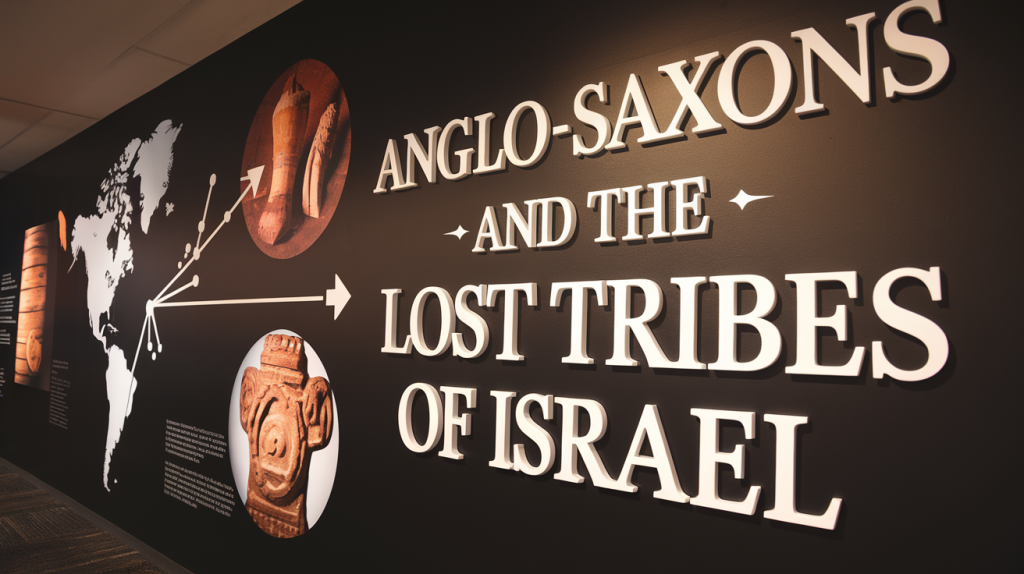
Quick Overview of Anglo-Israel Theory
Short on time? Here’s a quick slide show of key takeaways about the Anglo-Saxon and Lost Tribes theory. The full white paper follows…
Could the Anglo-Saxon, British, and broader Western peoples be descended from the “lost” ten tribes of ancient Israel? This intriguing belief, known as British Israelism or Anglo-Israelism, has captured imaginations for centuries.
Proponents claim that after the ancient Kingdom of Israel fell, its people migrated north and west – eventually populating parts of Europe, the British Isles, and even America. In this post, we’ll explore the scriptural clues, historical trails, royal legends, cultural links, and prophetic interpretations that underpin this theory.
Read on for a fascinating journey through biblical promises, Celtic migrations, royal coronation stones, linguistic puzzles, and prophecy – all woven into the idea that the peoples of Britain and the West carry the legacy of Israel’s lost tribes.
Scriptural Support for the Theory
Believers in the Anglo-Israel connection point to numerous Bible verses and promises that they interpret as foretelling Israel’s development into the modern Western nations. Key examples include:
- Promises to Abraham and Jacob – God told Abraham, “I will make nations of you, and kings shall come from you” (Genesis 17:6), and later promised Jacob (Israel) “a nation and a company of nations shall come from you” (Genesis 35:11). Advocates see the “company of nations” as the British Empire/Commonwealth and the “nation” as the United Statestheology.edulifehopeandtruth.com.
- Jacob’s Blessing of Ephraim and Manasseh – In Genesis 48, Israel (Jacob) blessed Joseph’s two sons. He prophesied Manasseh would become “a people... and he also shall be great” but Ephraim’s descendants would become “a multitude of nations”lifehopeandtruth.com. British-Israel scholars have long identified Ephraim with Great Britain (a group of nations) and Manasseh with America (a single great nation)lifehopeandtruth.comlifehopeandtruth.com. As one writer notes: “Britain became a great commonwealth of nations... while the United States became a great individual nation.”lifehopeandtruth.comlifehopeandtruth.com
Genesis 48:19 – “He [Manasseh] also shall become a people, and he also shall be great; but truly his younger brother [Ephraim] shall be greater than he, and his descendants shall become a multitude of nations.”
- “Scepter” and “Birthright” Promises – British-Israelism distinguishes the biblical promises of kingship (the “scepter” given to Judah’s line) and national blessings (the “birthright” given to Joseph’s line)theology.edu. They cite 1 Chronicles 5:1-2, which says the birthright went to Joseph’s sons even though Judah produced rulers. Thus, Judah’s heirs would always provide a king (ultimately the Messiah), while Joseph’s heirs (Ephraim and Manasseh) would enjoy great material prosperityen.wikipedia.orgtheology.edu.
- A New Home “afar off” – Some prophecies are read as hinting the lost tribes would move to distant lands. For example, 2 Samuel 7:10 says God will “appoint a place for My people Israel, and will plant them, that they may dwell in a place of their own and move no more.” British-Israel believers interpret this as Israel’s new homeland outside the Middle East – ultimately the isles and coastlands of Northwest Europetheology.edu. They also point to Amos 9:9 (“I will sift the house of Israel among all nations”) and Hosea 3:4 (Israel “shall abide many days without a king”) as evidence that Israel’s tribes would wander among nations, lose their original identity, yet be preserved by God for a later purposetheology.edu.
- “Isles” and “Ends of the Earth” – The Bible often mentions Israel’s descendants in the “isles” or “coastlands.” “Hear the word of the Lord, O nations, and declare it in the isles afar off...” (Jeremiah 31:10). Advocates see references like these, and others about spreading “to the west and east, north and south” (Genesis 28:14), as hinting that Israel’s exiled tribes would ultimately live in far-flung coastal nations – notably the British Isles (isles far off)theology.edu.
- Last-Days Identities – Genesis 49 contains Jacob’s prophetic descriptions of his sons “in the last days.” British-Israel teachings map these traits to modern nations. For instance, Joseph’s blessing in Genesis 49:22–26 speaks of him as a “fruitful bough” with branches running over the wall (seen as colonization beyond his borders) and blessings of the heavens, deep, and earth – interpreted as the vast resources and influence of the USA/Britainlifehopeandtruth.comlifehopeandtruth.com. They note that no peoples in history fit the scope of Joseph’s blessings like the Anglo-American powers of the last two centurieslifehopeandtruth.comlifehopeandtruth.com.
In summary, supporters believe biblical prophecy and promises to Israel find striking fulfillment in the rise of the British and American peoples. The unprecedented global empire of Britain and the power and wealth of the U.S. are viewed as the very blessings of Abraham’s seed promised in scripturelifehopeandtruth.com. These scriptural connections form the core foundation of the theory, inspiring efforts to trace Israel’s lost tribes into the pages of history.
Historical Evidence and Migrations to Europe
If the biblical case holds that Israel’s tribes were destined to become “Western” nations, is there historical evidence of Israelites migrating to Europe? British-Israel adherents have assembled a fascinating patchwork of legends and historical hints to trace the journey of the ten lost tribes after their exile:
- Assyrian Exile (8th Century BC) – The story begins in 721 BC, when the Assyrian Empire conquered the northern Kingdom of Israel (Samaria). The Bible records that the ten tribes were deported en masse to “Halah, Habor, Hara, and the river of Gozan” in Mesopotamia and Media (2 Kings 17:6). At this point, these Israelites vanish from the Biblical narrative, hence becoming the “Lost Tribes of Israel.” Historians confirm the Assyrians resettled conquered peoples into their far-flung provincestheology.edu. Thus, by 720 BC large populations of Israelites were living in what is today northern Iraq, Syria, and Iran – on the fringes of the Assyrian and later Persian realms.
- Emergence of Scythians and Cimmerians – Not long after the exile, new nomadic groups appeared north of the Black Sea: the Cimmerians and Scythians. British-Israel literature often equates these with exiled Israelites under new namesen.wikipedia.orgucg.org. Assyrian records refer to a people called Gimirri or Bit Khumri (house of Omri) – possibly referring to deported Israelites (Omri was a king of Israel). Intriguingly, Greek historians described the Cimmerians and Scythians sweeping into Asia Minor and Europe from the steppes in the ensuing centuries. Proponents argue that “Cimmerian” is akin to “Cimri” (from Omri) and that these were Israelite tribes on the moveen.wikipedia.org. The Scythians, known also as Saka or Sacae by the Persians, are similarly linked to Israel: the name Saka is thought to echo “Isaac.” In Hebrew, Isaac is Yitzhak; dropping the initial Y sound yields “Sak”. Thus, they see Sacae as meaning “sons of Isaac” – a fitting label for the lost tribes who were prophesied, “In Isaac shall thy seed be called”theology.edu.
- The “Trail of Dan” – One of Israel’s tribes, Dan, is said to have left a linguistic trail during the migrations. In Joshua 19:47 the Danites were seafarers, and Judges 5:17 hints Dan “abode in ships.” British-Israel researchers suggest Dan’s migrating clans gave their name to rivers and places along the route to Europe. For example, they note the recurrence of “Dan” in geographic names: the Don, Dnieper, and Danube rivers, and even Denmark (which they literally interpret as “Dan’s mark”). Denmark, in fact, is strongly identified with the tribe of Dan – “The land of Denmark is named after Dan, the forefather of the tribe” according to one accounthebrewnations.com. Early Irish legends also tell of a group called the Tuatha de Danaan (“tribe of Dan”) arriving in Ireland in antiquityhwalibrary.com. These clues bolster the idea that Danite Israelites migrated by sea into northern Europe, some eventually reaching the British Isles. To this day, Denmark’s people are called Danes – a name essentially the same as the biblical Danhwalibrary.com.
- Celtic and Anglo-Saxon Connections – As centuries passed, the theory goes, these Scythian-Israelites filtered into Western Europe. They became the Celts, Gauls, and later the Anglo-Saxons. The Cymry (early Welsh) are linked to the Cimmerians (hence “Cimry”)en.wikipedia.org. The Celts who populated Britain by 300–100 BC are viewed as kindred to Scythian-Israelites who had migrated earlier and spread out. Later, during the 5th century AD, the Anglo-Saxons (Germanic tribes) invaded and settled England – and British-Israelites assert that these too were descendants of Israel’s tribes, by then long separated from their Semitic origins but still fulfilling destiny. Notably, the very name “Saxon” is seen as deriving from “Saac’s sons” – i.e. sons of Isaactheology.edu. This, they argue, is why the term “Isaac’s sons” would survive as a tribal name, Saxons, among the peoples who overran Britain.
- Legends of the “Zarah” Line – Some versions of the theory even incorporate old legends about the royal tribe of Judah. Judah had twin sons, Pharez and Zarah, in Genesis 38. King David’s line came through Pharez, but a curious Irish legend (and some early British chronicles) claim a branch of Judah’s family (the Zarah line) migrated very early to the British Isles (via Asia Minor and Spain). Names like “Gathelus” and “Scota” appear in medieval Irish lore, linking the Irish Scotti to a daughter of an Egyptian pharaoh (some tie this to a daughter of King Zedekiah or an earlier Jewish princess). While these stories are semi-mythical, they add color to the idea that people from Judah and Israel found their way to the British Isles in antiquityangelfire.comangelfire.com.
In essence, proponents compile ancient references, place names, and archeological findings to argue that exiled Israelites became the wandering peoples of Europe. They highlight the emergence of European tribes (Cimmerians, Scythians, Celts, Saxons, etc.) in the timeline right after Israel’s disappearance, and the many seeming name coincidences.
By the medieval period, the theory holds that the bulk of the ten tribes had settled into their new lands: the ancestors of the Celto-Germanic nations of Northwest Europe. From there, the stage was set for the next chapter – the rise of the British nation and its global influence, viewed as the modern manifestation of Israel’s promised blessings.
The Throne of David in Britain
One of the most captivating claims of Anglo-Israelism is that the British monarchy itself is a continuation of King David’s dynasty. This idea stems from the biblical promise that David’s line would rule Israel forever. How could that be, if the kingdom of Judah fell in 587 BC? British-Israel advocates answer: the throne was transplanted to the British Isles, where David’s descendants reign to this day
The legend centers on the aftermath of the Babylonian conquest of Jerusalem. The Bible records that King Zedekiah’s sons were killed, but his daughters survived (Jeremiah 41:10). According to the story, the prophet Jeremiah fled Jerusalem, taking with him one of these royal princesses – often named Tea-Tephi in legend – and brought her first to Egypt and then to distant safety in the Isles.
In Ireland, Tea-Tephi supposedly married a local high king, uniting the royal line of Judah with the Irish line en.wikipedia.org. Through this union, the bloodline of David continued. Generations later, as Irish and Scottish kings intermarried, this Davidic line passed on through the Scots, and eventually to the English monarchy when Scotland’s James VI inherited the English throne. Thus, the British royals are alleged to be literal descendants of the Judean House of David en.wikipedia.org.
A fascinating object tied into this narrative is the Stone of Scone (also called the Stone of Destiny or “Jacob’s Pillow”). This sacred stone – an ancient block of sandstone – was used for centuries in the coronation of Scottish and English monarchs. Legend claims it is the very stone Jacob used as a pillow when he dreamed of the ladder to heaven (Genesis 28:18). Jeremiah, it is said, brought Jacob’s stone to Ireland along with the princess en.wikipedia.org.
It became the coronation seat for the kings of Ireland (known there as the Lia Fáil), then was taken to Scotland and placed at Scone Abbey, and finally moved to England under Edward I. For British-Israel believers, the presence of this stone at British coronations is no coincidence – it is a tangible link to Israel’s heritage, fulfilling the promise that David’s throne would not lack a descendant. Even today, the stone (returned to Scotland in 1996) is brought to Westminster Abbey for coronations, symbolizing the monarch’s ancient heritage.
The Stone of Destiny (Stone of Scone), which many identify with the biblical “Jacob’s Pillow,” being carried from Edinburgh Castle in 2023 for the coronation of King Charles III en.wikipedia.org. Legend says the stone was brought to Ireland by Jeremiah along with a Judean princess, enabling the transfer of David’s throne to the British line.
Believers point to God’s covenant with David: “I will establish the throne of his kingdom forever” (2 Samuel 7:13) and Jeremiah 33:17, “David shall never lack a man to sit on the throne of the house of Israel.” If the throne truly endured through a secret relocation to Britain, these verses ring true. They argue that Jesus, when he returns, will take over an existing throne – the British throne, as the only remaining Davidic throne on earth ucg.org.
Thus, Britain’s monarchy is elevated to a pivotal role in God’s plan. Indeed, even the Royal Arms of the UK – featuring a lion and a unicorn as supporters – are seen as echoing biblical symbols (the lion of Judah, and the unicorn representing the re’em of Joseph’s blessing in Deuteronomy 33:17). Everything from the crown itself to the coronation rituals gain a biblical significance in this narrative.
While mainstream historians consider the Tea-Tephi tale to be myth, it remains a cherished part of British-Israel lore. It provides a dramatic link between East and West – suggesting that a tender twig from the House of David was planted in the British Isles, blossoming into a mighty oak that is the British Crown
en.wikipedia.org. For those who hold this belief, the coronation of a British monarch isn’t just a state ceremony – it is the reaffirmation of the oldest royal dynasty in the world, one that traces directly back to King David of Israel.
Cultural and Linguistic Links
Does any cultural evidence support the kinship between the Israelites and Anglo-Saxons? Proponents eagerly point out numerous linguistic quirks, symbols, and customs that hint at hidden Hebrew heritage in the West. Here are a few of the most cited parallels:
- “British” = Covenant People? – It is often noted that the word Brit in Hebrew means “covenant” and ish means “man.” Amazingly, the very name Brit-ish can be interpreted as “covenant man” or “people of the covenant”theology.edu. British-Israel writings from the 19th century onwards have repeated this striking coincidence. Were the British literally the covenant people of God (Israel) all along, encoded in their name? Supporters think so. Critics call it folk etymology – but it remains a popular and memorable claim.
- “Saxons” = Isaac’s Sons – Similarly, the name Saxon is believed to derive from “Isaac’s sons.” Say “Isaac’s sons” quickly, and you get something like “isac-sons” or “saac-sons.” In fact, Herbert W. Armstrong wrote: “How easy for the Y (in Isaac’s Hebrew name Yishaq) to drop out – leaving ‘Saac.’ Is it only coincidence that ‘Saxon’ sounds the same as ‘Saac’s sons’?”theology.edu. This linguistic clue is considered evidence that the Saxon peoples who settled England were descendants of the children of Isaac – a fulfillment of the promise that Abraham’s seed would be called through Isaac.
- Tribal Names in Places – We’ve already noted how the tribe of Dan appears to have left its “mark” in Europe (Danube, Denmark, etc.). Advocates also see Judah/Zerah in names like “Jutland” (the peninsula of Denmark, possibly from Jute = Judah)hebrewnations.com, and even a connection between Saxony and “Isaac.” Some early researchers claimed the ancient Gaelic name for the British Isles, “Brito-nach”, meant “land of the Covenant” in Hebrew. While linguists disagree, these parallels are eagerly embraced by believers as breadcrumbs of Israelite identity scattered in European geography.
- Union Jack & Other Symbols – The very flag of the UK, the Union Jack, is said to have a biblical meaning. Some pamphlets from British-Israel organizations even called it the “Union of Jacob.” (The term “Jack” is thought to come from Jacques/James, which in turn comes from Jacob.) In a 1950s Canadian BIWF pamphlet it was boldly stated: “Our Union Jack represents the Union of Jacob – the Union of the Twelve Tribes of Israel.”activehistory.ca. Indeed, the flag combines the crosses of three patron saints (England, Scotland, Ireland), but in this theory it covertly symbolizes the reunification of Israel’s tribes under the Union of Jacob’s name. Likewise, the red, white, and blue colors often used by the UK and USA are sometimes said to mirror ancient Israelite banners (red for sacrifice, blue for divine law, white for purity). Even the prevalence of the Lion symbol in British heraldry is linked to the Lion of Judah – the tribe of Judah’s emblem (Genesis 49:9) is a lion, and the British coat of arms famously features multiple lions.
- Customs and Law – Some have drawn parallels between British common law and Israel’s law, or cultural practices. For example, the early Anglo-Saxons observed a Sabbath-like day of rest (though on Sunday), and their legal codes were influenced by biblical concepts. The idea of being a “chosen people” with a divine mission resonated strongly in British and American culture (think of the Puritans seeing themselves as a New Israel). This, say advocates, was no coincidence but a latent memory of Israelite ancestry. Circumstantial as these cultural echoes may be, they add to the mosaic of evidence.
To illustrate some of these linguistic connections, consider the following examples:
| Term/Name | Proposed Hebrew Origin or Meaning |
|---|---|
| Brit-ish | From Hebrew brit (covenant) + ish (man) – “covenant man,” i.e. people of the covenanttheology.edu. |
| Saxon | Derived from “Isaac’s sons” (Saac’s sons → Saxons)theology.edu. Implies the Saxon peoples are the sons of Isaac. |
| Denmark | “Dan-Mark,” meaning Dan’s mark or territoryhebrewnations.com. The tribe of Dan’s legacy in the name of the Danish people (Danes = Dan). |
| Union Jack | Nickname for UK flag interpreted as “Union of Jacob,” uniting the flags (tribes) under Jacob (Israel)activehistory.ca. |
| Tuatha de Danaan (Irish lore) | Means “Tribe of Dan.” Legends of this ancient people in Ireland are taken as echoes of the Israelite tribe of Dan arriving by seahwalibrary.com. |
Of course, mainstream linguists would argue these are coincidences or folk etymologies. But to those who believe, such coincidences are too consistent to ignore. The cultural affinity of the British with Old Testament narratives – for instance, British and American folk in the 19th century readily identifying with Israel’s mission and destiny – is seen as a kind of inherited memory.
In the 19th century, enthusiasts compiled long lists of Hebrew words purportedly found in Gaelic or Welsh, and noted Israelite-style practices among the Celts. While much of that hasn’t stood up to scholarly scrutiny, it fueled the British-Israel movement’s conviction that “Deep in the roots of Western civilization lies an Israelite core.” They see the success, values, and even the symbols of the West as a modern reflection of ancient Israel.
Prophetic Connections to the UK and USA
Beyond history and linguistics, British-Israelism places great emphasis on biblical prophecy, asserting that many end-time prophecies about “Israel” actually refer to the UK, USA, and related nations today. This prophetic framework provides a rationale for why identifying the lost tribes matters.
- “In the Last Days” – As mentioned, Genesis 49 is considered a roadmap for Israel’s tribes in the end times. Joseph’s descendants (Ephraim and Manasseh) were to be “a fruitful bough… whose branches run over the wall” (49:22) – seen as colonization and spreading abroad. They would be a people blessed “unto the utmost bound of the everlasting hills” (49:26), enjoying agricultural and mineral riches (the bounty of “heaven above... the deep... the breasts and womb” – Gen 49:25)lifehopeandtruth.comlifehopeandtruth.com. This, in prophecy students’ eyes, perfectly describes the vast natural wealth and global reach of the United States and British Empire in the last few centuries. No other nations have “pushed the peoples to the ends of the earth” as much as the British (who settled in the far corners) and the Americans (who became a superpower with worldwide influence).
- Blessings and Curses – Deuteronomy 33 also contains Moses’ blessings on the tribes, and these too are mined for clues. For example, Moses said of Joseph: “His horns are like the horns of unicorns: with them he shall push the people together to the ends of the earth” (Deut. 33:17, KJV). British-Israel interpreters saw the two “horns” as the dual world powers – Britain and America – pushing or leading peoples globally. They even note the British coat of arms includes a unicorn, and the U.S. seal an eagle with arrows, symbols supposedly foreseen in scripture. Additionally, promises like “possess the gates of your enemies” (Genesis 22:17) are said to have been fulfilled when the British Empire controlled strategic sea gates (Suez Canal, Gibraltar, Panama by the U.S., etc.)theology.edu.
- Two Houses Reunited – Many prophecies speak of regathering Israel from exile. While most apply these to a return of the Jews to Israel, Anglo-Israel believers think it refers to reunification of Ephraim (the House of Israel) with Judah in the future. Hosea describes Ephraim (often used as name for the northern tribes) as a “mix among the nations” and prophesies God will restore them. Ezekiel’s famous prophecy of the two sticks (Ezek. 37:16–22) – one labeled Joseph/Ephraim and one Judah – becoming one in God’s hand is taken literally: one day, the “stick” of Joseph (British/America and fellow Israelite nations) and the “stick” of Judah (the Jews) will be reunited as one nation again under Christ. Thus, even the existence of the modern state of Israel (Judah) and the prominence of the UK/USA (Joseph) are seen as setting the stage for end-times events, when both houses of Israel will recognize each other and their Messiah.
- Prophetic Warnings – Not all is rosy: If Britain and America are Israel, then the biblical warnings to Israel apply to them too. Advocates often caution that just as ancient Israel and Judah were punished for turning from God, so a fall awaits the UK/USA if they do not repent. In fact, some interpret the “great tribulation” prophecies as a future captivity or downfall specifically of these nations identified as modern Israel. For instance, passages in Isaiah, Jeremiah, and Hosea about Israel’s cities being laid waste or Israel being punished by powerful enemies are read as foretelling national calamity for the U.S. and Britain if they forsake God. This prophetic angle was especially emphasized by writers like Herbert Armstrong, who felt a divine mission to warn the English-speaking peoples of coming punishment and eventual restoration as part of God’s plantheology.edutheology.edu.
In summary, the theory holds that the Anglo-American nations are the key “Israel” of prophetic interest in the Bible. Their rise was the fulfillment of ancient promises, and their future is tightly interwoven with biblical prophecy. This view can dramatically reshape one’s understanding of world events: for example, seeing the decline of the British Empire or the challenges facing America through a biblical lens of Leviticus 26’s blessings and curses for Israel.
Below is a quick reference of how some of the Lost Tribes are said to correspond to modern nations and their prophetic roles:
| Tribe (Ancient Israel) | Modern Nation(s) Identified | Prophetic Role/Note |
|---|---|---|
| Ephraim (son of Joseph) | United Kingdom & British Commonwealth | “Company of nations” multitude of peopleslifehopeandtruth.com; a leading colonial power, now a commonwealth. |
| Manasseh (son of Joseph) | United States of America | The “great nation”lifehopeandtruth.com; powerful, blessed with resources and military strengthlifehopeandtruth.com. |
| Judah (royal tribe) | The Jews (modern Israel) & British Royal Family (Davidic line) | Retains the scepter (kingship) promisetheology.edu. Jewish people preserved, and a prince of Judah allegedly sits on Britain’s throne. |
| Reuben | France | Once powerful (the firstborn of Jacob) but “unstable as water” (Genesis 49:4). France’s history of glory and decline is cited as paralleling Reubenhwalibrary.com. |
| Dan | Denmark; also part of Ireland | A seafaring tribe, left its name (“Dan”) across Europehebrewnations.com. Denmark (Danmark) literally means “Dan’s Mark.” Some of Dan also in Irish legend (Tuatha de Danann). |
| Zebulun | The Netherlands | “Zebulun shall dwell by the seashore” (Gen 49:13) – a maritime trading people. The Dutch indeed dwell by the North Sea coast and are famed for trade and shippinghwalibrary.com. |
| Naphtali | Norway (and some in Sweden) | “Naphtali is a deer let loose” (Gen 49:21) – seen as a free, prosperous people in beautiful highlands. Norway’s fjords and wealth (fish, oil) fit “satisfied with favor, full of blessing” (Deut 33:23)hwalibrary.com. |
| Asher | Belgium (and Luxembourg) | “Asher’s bread shall be rich, and he shall yield royal dainties” (Gen 49:20). Interpreted as the richness of Belgian cuisine (fine chocolates, etc.) and prosperityhwalibrary.com. |
| Gad | Switzerland | Gad is described as a troop (Gen 49:19) and blessed with defensive strength. Switzerland’s citizen army and legacy of decisively repelling enemies (and hosting international heads – “to Gad come the heads of the people”hwalibrary.com) match this. |
(Note: These identifications vary among different proponents, but this table reflects common assignments in traditional British-Israel literature
The prophetic narrative woven by this theory is grand in scope: it suggests that the saga of the Bible is ongoing, with the Anglo-Saxon peoples playing a central role as the continuation of biblical Israel. From the perspective of those who believe it, understanding this identity unlocks the true meaning of prophecy and God’s plan for the end times – including the eventual reunion of all tribes and the restoration of the Kingdom of God, with Jesus on the throne of David.
Conclusion: An Identity Written in Stone?
The idea that the Anglo-British and related nations are descendants of Israel’s lost ten tribes is certainly a remarkable narrative. It attempts to connect Stonehenge to Jerusalem, the Union Jack to Jacob, and the kings of England to King David. It’s a story of exile and reunion, promise and fulfillment – suggesting that the Bible’s covenant people have been with us all along in the modern world, shaping history.
Skeptics label British Israelism a pseudohistorical theory, noting that genetics and mainstream scholarship don’t support a direct Israelite lineage for Western Europeans
en.wikipedia.org. Yet, the belief persists in various forms, passed down through books, sermons, and yes, blog posts like this. It has inspired many to read their Bibles with fresh eyes, seeing correlations between scripture and current events. For some, it’s uplifting to think their nation has a special place in prophecy; for others, it’s a compelling framework for interpreting the tumult of world affairs.
Whether one takes it as literal truth, intriguing allegory, or just a cultural curiosity, the Anglo-Israel theory undeniably weaves a tapestry that spans millennia and continents. It invites us to ponder the migrations and minglings of peoples long ago and consider how identity and destiny can be intertwined. At the very least, exploring this theory gives a deeper appreciation for the spiritual self-perception that once motivated the British-Israelites – a sense of inherited purpose, captured in phrases like “a people of the covenant” or “Israel redeemed.”
In the end, the connection between the West and the tribes of Israel may not be something that can be conclusively proven in this age. But the legacy of those ancient tribes – the idea of a chosen people under God’s guidance – has undoubtedly left its imprint on Western thought. And who knows? If the theory were true, it would mean that many of us carry a heritage far older and more biblical than we ever imagined.
Regardless of one’s stance, the enduring allure of this narrative speaks to a broader truth: peoples everywhere seek meaning in their origins. The Anglo-Israel theory is one culture’s quest to link its lineage to the sacred history of the Bible – to see the hand of God in the rise of an empire, the coronation of a monarch, or even the naming of a nation. And in that sense, it reminds us that history, faith, and identity are often tightly interwoven, forming the very fabric of how we understand ourselves in the great story of humanity.
Call to Action: The Question That Demands an AnswerIn Acts 2:37 Peter and the Apostles were asked the question – What Shall We do? And in Acts 2:38 Peter answered, Repent, and be baptized every one of you in the name of Jesus Christ for the remission of sins, and ye shall receive the gift of the Holy Ghost. For the promise is unto you, and to your children, and to all that are afar off, even as many as the Lord our God shall call. Do you understand this? After hearing the gospel and believing, they asked what should would do. The answer hasn’t changed friend, Peter clearly gave the answer. The question for you today is, Have you receieved the Holy Spirit Since you believed? If you’re ready to take that step, or you want to learn more about what it means to be born again of water and Spirit, visit: Come, and let the Spirit make you new. |