Quick Overview of This Bible Study…
Short on time? I have created a short slide show presentation of some key takeaways in our study. The complete, more comprehensive bible study is below…
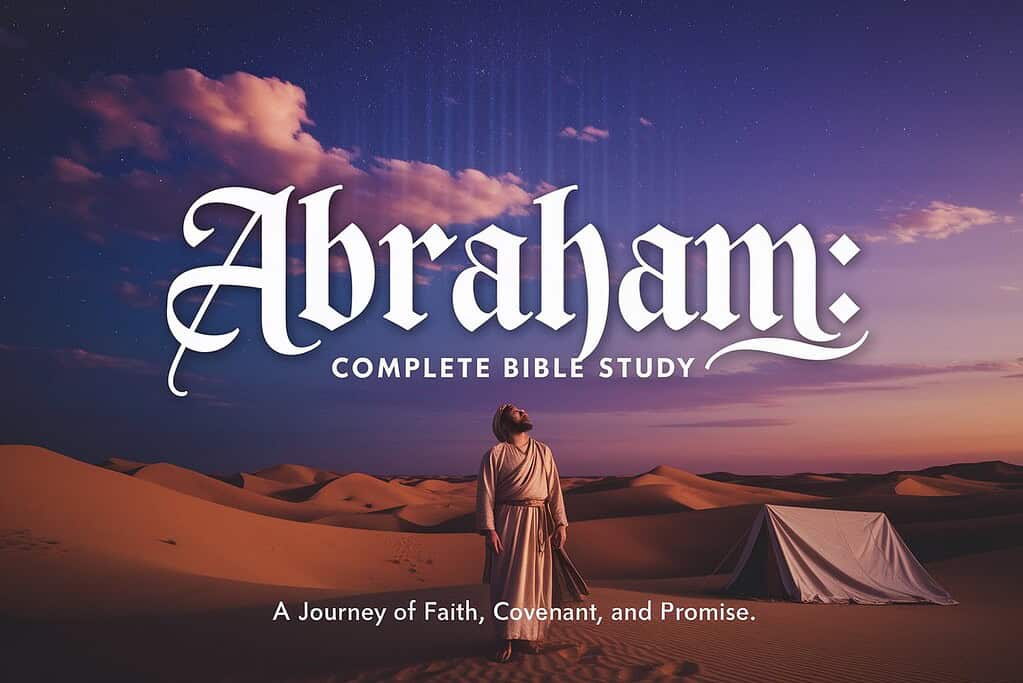
What comes to mind when you hear the name Abraham? For many, Abraham is a towering figure of faith – the man who left everything to follow God into the unknown.
He’s mentioned hundreds of times in Scripture and honored as the “father of us all” in the faith.
Yet Abraham’s story isn’t just ancient history; it’s surprisingly relatable. He faced uncertainties, made mistakes, waited (and waited!) for promises to come true, and learned to trust God one day at a time.
In this friendly Bible study, we’ll walk through Abraham’s journey as told primarily in the King James Version (KJV) of the Bible.
Along the way, we’ll explore how his life speaks to our own: his faith, his covenant with God, the blessings promised through him, and even how his story connects to Jesus Christ.
We’ll keep things conversational – as if we’re friends chatting about these deep truths – and we’ll be honest about the struggles and triumphs of living a life of faith.
Called to Leave – Stepping Out in Faith
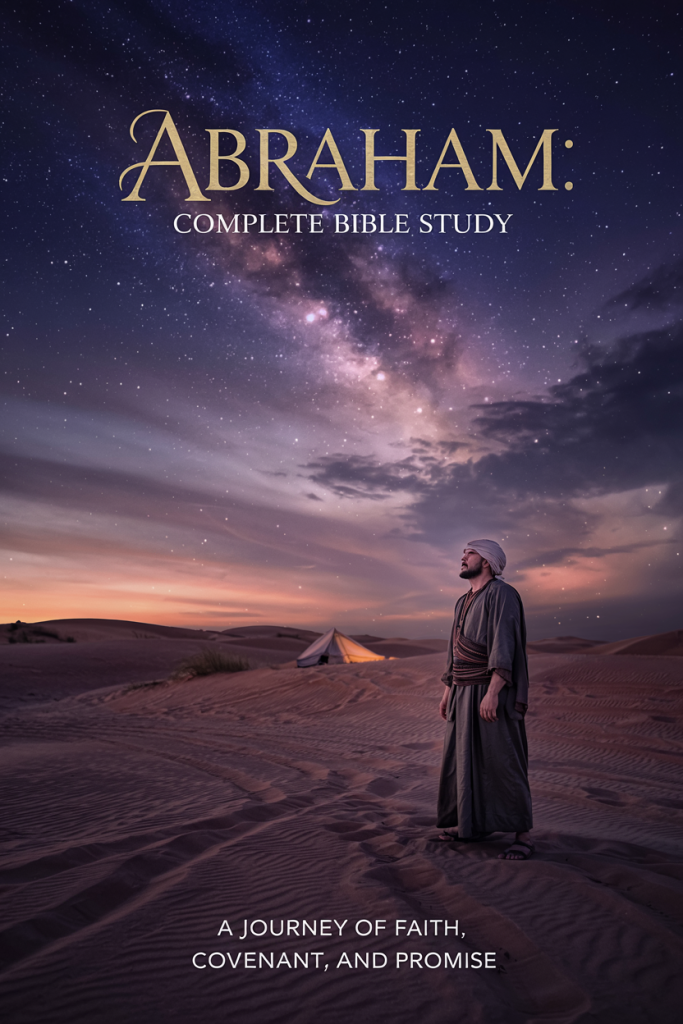
The first time we meet Abraham (initially called Abram), God calls him to do something radical.
- “Now the LORD had said unto Abram, Get thee out of thy country, and from thy kindred, and from thy father’s house, unto a land that I will shew thee” (Genesis 12:1, KJV).
Imagine being told to pack up everything and leave behind your hometown, your relatives, and all that’s familiar – without even knowing your destination! That’s exactly what happened to Abram. God essentially said, “Trust me… I’ll show you where to go.”
Abram’s response is short and sweet: he obeyed.
- Genesis 12:4 says, “So Abram departed, as the LORD had spoken unto him.” In the New Testament, the writer of Hebrews highlights this obedience: “By faith Abraham, when he was called to go out… obeyed; and he went out, not knowing whither he went” (Hebrews 11:8).
Can you picture it? Seventy-five years old (Genesis 12:4 tells us Abram’s age), loading up camels and donkeys, saying goodbye to the only life he’d known in Ur (and Haran), and heading off with his wife Sarai and his nephew Lot.
It was a journey of pure trust. He didn’t have Google Maps or even a clear itinerary – just God’s promise.
And what a promise it was! God gave Abram a threefold promise when He called him (Genesis 12:2-3):
- A Land: “unto a land that I will shew thee… Unto thy seed will I give this land” (Genesis 12:1,7). God promised to lead Abram to a new homeland – the land of Canaan.
- A Great Nation: “And I will make of thee a great nation, and I will bless thee, and make thy name great” (Genesis 12:2). Though Abram had no children at the time, God said he would father a great nation. (Talk about a leap of faith for a childless man in his seventies!)
- A Blessing for All: “and in thee shall all families of the earth be blessed” (Genesis 12:3). This part of the promise hinted that Abram’s impact would reach far beyond his own family – it would bless all peoples. Christians understand this as an early announcement of the gospel, that through Abraham’s lineage, Jesus Christ would come to bless every nation.
Abram didn’t see the whole picture, but he trusted the One who called him. This is often where our journey with God begins too – with a call to trust Him beyond what we can see.
Have you ever felt God nudging you out of your comfort zone?
Maybe not to physically move cities, but perhaps to take a step of faith in a relationship, a ministry, or a career change. It’s scary, right? We naturally crave security and clarity.
Abram’s example encourages us that trusting God’s voice is always worth it, even when details are sparse.
The Lord said “I will show you,” and Abram had to walk before the when/where/how was revealed. In the same way, God often asks us to step out in faith first, and then He guides us step by step.
The Journey and the Covenant
- As Abram journeyed south into Canaan, God appeared to him and reaffirmed the promise: “Unto thy seed will I give this land” (Genesis 12:7).
In response, Abram built an altar to worship the Lord. This becomes a pattern in Abraham’s life – wherever he goes, he worships. He pitched tents to live in (being a nomad in a strange land), but he built altars to the Lord.
- That says something about his priorities: he knew he was a pilgrim on earth and that his permanent home was with God (Hebrews 11:9-10 speaks of him looking for a heavenly city built by God).
We might ask ourselves: Do I “pitch my tent” and “build my altar” in the right places? In other words, am I holding loosely to worldly comfort while holding tightly to God?
However, Abram’s journey of faith was not a straight line upward – it had bumps and detours.
Soon after arriving in Canaan, a famine hit (Genesis 12:10). Abram decided to go down to Egypt to escape the famine.
- There, he fell into fear and, unfortunately, compromised the truth by passing off Sarai as his sister instead of his wife (Genesis 12:11-20).
This led to some messy situations. It’s a bit comforting (in a strange way) to see that even this great man of faith had moments of fear and failure.
He was human, like us. Abram’s lapse reminds us that trusting God is a learning process. There will be times we act out of fear rather than faith. But God is merciful.
In Egypt, God protected Sarai and Abram despite Abram’s failure, and got them safely back to Canaan. If you’ve ever stumbled in your faith walk, take heart: God’s grace can cover and redeem our missteps, just as He did for Abram.
Back in Canaan, God’s promise still stood, but years were passing and Abram and Sarai remained childless.
In Genesis 15, we find Abram struggling with questions – and who wouldn’t? God had said “great nation,” yet Abram’s only potential heir was a servant in his household (Genesis 15:2).
- In a honest conversation with God, Abram essentially asks, “What will you give me, Lord, since I still have no child?” (paraphrasing Genesis 15:2-3).
I love that the Bible includes this scene. It shows Abram talking candidly with God about his doubts and desires. Faith isn’t the absence of questions; faith means bringing those questions to God and trusting His answer.
God responds with a reaffirmation and a vivid object lesson: look at the stars.
- “And He brought him forth abroad, and said, Look now toward heaven, and tell (count) the stars, if thou be able to number them… So shall thy seed be” (Genesis 15:5).
Under the night sky, with likely thousands of stars overhead, God basically says, “Trust me, Abram, your descendants will be uncountable.” And in that moment, Abram makes a simple but life-changing choice: he believes God.
- Genesis 15:6 declares, “And he believed in the LORD; and He counted it to him for righteousness.”
This one sentence is one of the key truths in the Bible. Abram wasn’t declared “righteous” because he did some great work or followed a law; it was his faith – his trust in God’s promise – that God “counted” as righteousness.
In other words, Abram was put in right standing with God through faith alone.
- The New Testament emphasizes this over and over (see Romans 4:3 and Galatians 3:6, which both quote Genesis 15:6).
For us as Christians, this is huge: it’s a picture of how our faith in Jesus is counted as righteousness.
Just as Abram believed God’s promise of a son and many descendants (which ultimately leads to Christ), we believe in God’s promised Son, Jesus, and God counts us as righteous in Him.
Salvation has always been by grace through faith – Abram’s story illustrates that beautifully.
God formalized His promise to Abram through a covenant.
In the latter half of Genesis 15, there’s a curious scene where Abram sacrifices several animals, and then in a deep sleep he sees a smoking furnace and a burning lamp passing between the pieces of the sacrifices (Genesis 15:9-18).
Strange as it sounds to modern readers, this was an ancient covenant ceremony. Normally, both parties to a covenant would walk between the slain animal pieces, symbolically saying, “If I break this covenant, let me be like these animals.”
But notably, Abram doesn’t walk through – only the fiery presence of God does.
God is essentially saying His promise is one-sided and unconditional: He will fulfill it by His own oath, no matter what.
- In fact, much later the book of Hebrews reflects on this, saying, “When God made promise to Abraham, because He could swear by no greater, He sware by Himself” (Hebrews 6:13).
God put His own name on the line to guarantee the covenant with Abraham. What a faithful God we have! Even when we falter, He remains true to His word.
In Genesis 17, about 13 years after that covenant ceremony, God appears to Abram again to reaffirm (God does a lot of reaffirming – He knows we need the reminders!).
- Here, God gives Abram a new name: Abraham. God says, “Neither shall thy name any more be called Abram, but thy name shall be Abraham; for a father of many nations have I made thee” (Genesis 17:5).
In Hebrew, Abram meant “exalted father,” but Abraham means “father of a multitude.”
It’s as if God doubles down on the promise every time Abraham might doubt – even changing his very name to reflect the coming reality. And remember, at this point Abraham still doesn’t have the promised son with Sarah!
- Talk about calling things which are not as though they were (see Romans 4:17).
- Sarai’s name is also changed to Sarah, meaning “princess,” with God promising “she shall be a mother of nations; kings of people shall be of her” (Genesis 17:16).
- God then establishes circumcision as the sign of this covenant (Genesis 17:10-11) – a physical mark in Abraham’s family line to remind them of God’s promise.
(For Abraham, this was an act of obedience at 99 years old – which could be a whole discussion on commitment and trust!)
By this time, Abraham had a son, Ishmael, through Hagar (Sarah’s maid – we’ll talk about that in a moment), but God made it clear that the covenant promise would come through Sarah’s child, not through Hagar’s.
God even specifies the name of the promised son: Isaac, which means “laughter” (Genesis 17:19). Why “laughter”?
Perhaps because when Abraham first heard God say that 90-year-old Sarah would bear a child, he fell on his face and laughed in amazement (Genesis 17:17).
And later, when Sarah herself overheard the promise, she laughed too – albeit in disbelief at first (Genesis 18:12).
But Isaac’s name would always remind them (and us) that what seems impossible and laughable to us is absolutely possible with God. “Is any thing too hard for the LORD?” God asks in Genesis 18:14.
It’s a rhetorical question that still stirs our hearts today. The obvious answer is no! The God of Abraham can do the impossible. He brings life out of barrenness, hope out of hopelessness.
When we find ourselves quietly laughing in disbelief (“Yeah, right, God could never fix this situation…”), remember Sarah’s laugh and God’s gracious response. He turned her skeptical chuckle into joyful laughter when Isaac was born at last (Genesis 21:6).
Faith and Failures on the Way
Before we get to that long-awaited birth, let’s not skip over the in-between years, because this is where Abraham and Sarah’s humanity really shows.
God had promised them a son from Sarah’s own womb, but years passed and nothing happened. Have you ever waited on God for something and felt like time was your biggest enemy? You start to wonder if you heard God right or if you need to do something to make it happen.
Sarah certainly felt that. In Genesis 16, she comes up with a culturally acceptable but faith-challenging plan: she urged Abraham to have a child with her maidservant, Hagar.
According to their customs, a child born to Hagar could be considered Sarah’s. Abraham, perhaps out of desperation to see God’s promise fulfilled, agreed to this plan. Hagar became pregnant and gave birth to Ishmael.
Now, Ishmael did become a great nation in his own right (God gave promises to Hagar about Ishmael’s future too, Genesis 16:10-12, and later blessed Ishmael for Abraham’s sake).
But this detour caused a lot of heartache and family strife – Hagar and Sarah’s relationship broke down, and Hagar eventually fled, only to return after God’s intervention (Genesis 16).
In the long run, Ishmael’s descendants and Isaac’s would have tension for generations.
The story of Hagar and Ishmael is a poignant reminder: trying to force God’s promises to come true by our own schemes often backfires.
It’s hard to blame Abraham and Sarah too much – waiting 10 years (at that point) in a culture where childbearing was so significant had to be incredibly tough on them emotionally and socially.
Sarah probably felt inadequate and forgotten. Abraham likely felt torn between loving his wife and longing for God’s promise to happen. They took matters into their own hands, and the consequences were messy.
Yet, God didn’t abandon them or cancel His plan.
Despite their impatience, God in His mercy still reaffirmed that Isaac would be born as the child of promise. This gives me hope. How often have we gotten ahead of God or tried to “help” Him out because we felt we were at the end of our rope?
We might make a mess, and there may be consequences to deal with (as Abraham’s family experienced), but God can redeem our mistakes and still bring about His purposes.
After all, one of God’s names revealed in the Abraham story is El Shaddai – “God Almighty” (Genesis 17:1). He is all-powerful; our missteps cannot derail His ultimate plan.
In fact, by the time we reach Genesis 17 and 18, Abraham has learned to trust more patiently.
When God visited Abraham again and confirmed that Isaac would be born within a year, Abraham and Sarah were well into old age – 99 and 89 respectively. They had waited 25 years since the initial promise!
- But finally, in Genesis 21, the joyous moment arrives: “And the LORD visited Sarah as He had said… For Sarah conceived, and bare Abraham a son in his old age, at the set time of which God had spoken to him” (Genesis 21:1-2).
- They named him Isaac, and Sarah declared, “God hath made me to laugh, so that all that hear will laugh with me” (21:6). Her laughter of doubt had turned into the laughter of joy and awe.
Before moving on, there’s another aspect of Abraham’s character shining through these chapters: his growing relationship with God.
- Abraham isn’t a distant follower; he’s actually called the “Friend of God” in Scripture (see James 2:23, and also 2 Chronicles 20:7, Isaiah 41:8).
One beautiful example of this is in Genesis 18. The Lord (in the form of a mysterious three visitors) comes to Abraham’s tent.
Abraham rushes to show hospitality – preparing a meal, personally serving his guests. It turns out the visitors are on their way to assess the wickedness of Sodom and Gomorrah.
- But before they go, the Lord decides to share with Abraham what He is about to do: “Shall I hide from Abraham that thing which I do?” (Genesis 18:17).
What a remarkable line – God “confides” in Abraham about His plans, almost as a friend would. Abraham then engages in an extraordinary dialogue, interceding for the city of Sodom, pleading that if even 10 righteous people are found, the city would be spared (Genesis 18:23-32).
Abraham’s heart for others (especially knowing his nephew Lot lived there) and his boldness to converse with God show a maturing faith that cares about mercy and trusts God’s justice.
- This scene also subtly teaches us about prayer: Abraham approached God with humility (“I am but dust and ashes,” 18:27) but also with persistence (“Oh let not the Lord be angry, and I will speak just once more…” 18:32).
Do we realize we can talk to God as friend to friend, while still honoring Him as Lord?
- Jesus later says to His disciples, “I have called you friends” (John 15:15).
It’s mind-blowing but true: God desires a real relationship with His people. Abraham’s life exemplified that closeness. He built altars, prayed, listened, even questioned, but always returned to fellowship with God.
No wonder he earned the title “God’s friend.” And if Abraham, with all his ups and downs, could walk that closely with the Lord, so can we through Christ. It’s not reserved for super-saints; it’s for every believer willing to draw near to God.
The Ultimate Test of Obedience
Isaac grew up the apple of Abraham and Sarah’s eye – the beloved son of promise. Just when everything seems to be happily ever after, Genesis 22 hits us with a stunning turn of events:
- God tests Abraham with an unthinkable command. “And He said, Take now thy son, thine only son Isaac, whom thou lovest, and get thee into the land of Moriah; and offer him there for a burnt offering upon one of the mountains which I will tell thee of” (Genesis 22:2).
Wait… what?! Sacrifice his son? The very son God had miraculously provided and on whom all those promises rested? It’s hard to imagine the horror or confusion that might have flooded Abraham’s heart.
The Bible, interestingly, doesn’t describe Abraham’s emotions; it simply shows his response of obedience.
- “And Abraham rose up early in the morning… and went unto the place of which God had told him” (22:3).
Early in the morning – no delay, no bargaining (unlike his earlier bargaining for Sodom!). It seems by now Abraham has learned to trust God completely, even when asked to surrender what he loves most.
The journey to Mount Moriah took three days (22:4).
What a heavy three days that must have been. Abraham had time to think, even to turn back, but he stayed the course.
- Isaac, who by now was a youth (some believe a teenager or older), carried the wood for the sacrifice on his back (22:6).
- As they climbed, Isaac noticed something was odd and asked, “My father… behold the fire and the wood: but where is the lamb for a burnt offering?” (22:7).
- Abraham’s answer is profound: “My son, God will provide himself a lamb for a burnt offering” (22:8).
On one level, he’s avoiding telling Isaac the full truth, but on another level, it’s a statement of faith – God will provide.
- Hebrews 11:17-19 sheds light on Abraham’s mindset: it says Abraham believed that if necessary, God could raise Isaac from the dead to fulfill His promises.
In a sense, Abraham had such confidence in God’s covenant that he knew Isaac’s story couldn’t end on that mountain.
Faith trusts God’s promises even when facing a contradiction. Abraham didn’t know how God would do it, but he trusted that God would either stop this or resurrect his son.
- At the last moment, as Abraham took the knife to slay Isaac, the Angel of the Lord called out, “Lay not thine hand upon the lad… for now I know that thou fearest God, seeing thou hast not withheld thy son, thine only son from me” (Genesis 22:12).
- Relief must have flooded Abraham’s soul. Indeed, there in a thicket was a ram caught by its horns – a substitute provided by God (22:13).
- With overflowing gratitude, Abraham offered the ram instead and named that place Jehovah-jireh, meaning “The LORD will provide” (22:14).
What Abraham spoke in faith (“God will provide a lamb”) God fulfilled by providing a ram as a sacrificial replacement for Isaac.
This dramatic event was not only a pivotal moment for Abraham; it was rich with symbolism pointing to Jesus Christ.
Christians have long seen the parallels: A father, offering his dearly loved only son (sound familiar? “God so loved the world that He gave His only begotten Son…” John 3:16) as a sacrifice.
The son carries the wood up the hill, like Jesus carried the cross.
- The location, Mount Moriah, is believed by some to be in the vicinity of what would later be Jerusalem – potentially the same area where Jesus was crucified.
- And the concept of a substitutionary sacrifice – the ram taking Isaac’s place – foreshadows how Jesus, the Lamb of God, would die in our place.
- In fact, when Abraham said “God will provide himself a lamb,” it’s almost prophetic. Ultimately, God provided Himself in the person of Jesus, the Lamb of God, to be the sacrifice for our sins.
- Jesus once remarked, “Your father Abraham rejoiced to see my day: and he saw it, and was glad” (John 8:56).
Some theologians think that could mean, in moments like this on Moriah, Abraham got a glimpse of God’s heart and plan of redemption – enough to “see” ahead dimly to the day of Christ.
After Abraham’s test of faith, God speaks again from heaven, reaffirming the covenant yet again, but this time with the weight of an oath:
- “By myself have I sworn, saith the LORD, for because thou hast done this thing… That in blessing I will bless thee… and in thy seed shall all the nations of the earth be blessed; because thou hast obeyed my voice” (Genesis 22:16-18).
It’s as if God says, “Abraham, you have shown your absolute faithfulness to Me; now I’m swearing by My own name that I will absolutely fulfill everything I’ve promised.”
This moment sealed Abraham’s legacy as the supreme example of obedient faith.
- Centuries later, James would write about it: “Was not Abraham our father justified by works, when he had offered Isaac his son upon the altar? … by works was faith made perfect” (James 2:21-22).
James isn’t contradicting the idea of faith; he’s showing that Abraham’s obedience in that extreme test proved the genuineness of his faith. Abraham didn’t just say he trusted God – he demonstrated it.
That’s why Scripture honors him as God’s friend and as the father of those who believe.
For us, Abraham’s near-sacrifice of Isaac can be a challenging story. It raises questions: Would I be willing to surrender everything to God if He asked?
That’s a hard question. It’s one thing to trust God for a blessing; it’s another to trust Him when He asks for something back.
While God is not going to ask us to literally do what Abraham did (in fact, the Bible never records God ever repeating such a request – it was a unique test, and God never intended for Isaac to die), He does ask for our whole hearts.
- Jesus said, “He that loveth son or daughter more than me is not worthy of me” (Matthew 10:37).
God wants to be first in our life – above even the most precious blessings He’s given us. The comforting truth is that God is a provider and a redeemer. If we put Him first, we can trust that ultimately we won’t lose out.
Abraham got Isaac back and then some. In giving up, he gained. It’s a paradox of faith: surrender leads to blessing. Abraham learned that in dramatic fashion.
The Legacy: Abraham in the New Testament and Beyond
Abraham’s story doesn’t end in Genesis. His influence reverberates throughout the rest of the Bible.
In fact, apart from Moses, Abraham might be the most frequently mentioned Old Testament figure in the New Testament.
Why? Because Abraham’s life and God’s promises to him set the stage for the entire plan of salvation that unfolds in Christ.
One major thread is the idea that followers of Jesus are spiritually children of Abraham. The Apostle Paul spends a lot of time on this in his letters.
- To the Romans he writes that Abraham is “the father of all them that believe” (Romans 4:11) – meaning it’s not about being Jewish or Gentile, but about sharing Abraham’s faith.
- Abraham was declared righteous by faith before he was circumcised, making him the prototype of God’s saving grace for both the circumcised (Jews) and uncircumcised (Gentiles) who believe (Romans 4:9-12).
- Paul even calls him “the father of us all” (Romans 4:16) and says “(as it is written, I have made thee a father of many nations)” (4:17), referring to God’s promise in Genesis.
- It’s amazing – when God renamed him “father of a multitude,” He wasn’t only thinking of Israel’s twelve tribes; He was thinking of the multitude of believers from all nations who would come to Him by faith.
If you are a Christian today, you are one of those stars in the sky and sands on the seashore that God showed Abraham! You are part of the fulfillment of God’s promise that Abraham would have innumerable descendants. How cool is that?
- To the Galatians, Paul makes it very plain: “Know ye therefore that they which are of faith, the same are the children of Abraham” (Galatians 3:7).
He explains that the real intent of God’s promise “in thee shall all nations be blessed” (the one given in Genesis 12:3) was God announcing the gospel ahead of time – that through Abraham’s lineage (specifically through Jesus, Abraham’s ultimate descendant) people from every nation would be blessed with salvation (Galatians 3:8).
- He continues, “So then they which be of faith are blessed with faithful Abraham” (3:9). The phrase “faithful Abraham” is a beautiful way to remember him – a man full of faith, and faithful to God.
Now, Abraham isn’t just a figure of warm, fuzzy faith; he also intersects with some deep theological discussions in the New Testament.
For instance, James and Paul might seem to emphasize different things with Abraham – Paul emphasizing faith (Romans 4) and James emphasizing works (James 2) – but they are like two sides of the same coin.
- Paul argues against any idea that our works can earn us salvation, pointing out that Abraham simply believed and was justified (Romans 4:2-5).
- James, on the other hand, argues against a shallow “faith” that has no evidence, pointing out that Abraham proved his faith by what he did (James 2:21-23).
Both use Abraham to make their case, and both are right. True faith results in action. Abraham’s life demonstrated this: he believed God’s promise in Genesis 15 (the moment of inward faith), and years later he offered Isaac in Genesis 22 (the outward action).
- James says “the scripture was fulfilled which saith, Abraham believed God… and he was called the Friend of God” (James 2:23).
In other words, Abraham’s obedience completed the picture of his faith. For us, it’s a reminder that believing in God is not just mentally agreeing – it’s trusting Him in a way that affects our choices.
The New Testament also reveals that Jesus Christ is the ultimate fulfillment of what Abraham’s story was pointing toward.
Take that phrase “in thy seed shall all nations be blessed” which God spoke to Abraham.
- Paul zeroes in on the word “seed” in Galatians 3:16: “He saith not, And to seeds, as of many; but as of one, And to thy seed, which is Christ.”
Paul saw in that promise a reference to one particular offspring of Abraham – namely Jesus – through whom the blessing would come.
- And indeed, Jesus was a descendant of Abraham (Matthew 1:1 starts the genealogy: “Jesus Christ, the son of David, the son of Abraham”).
When we bring the gospel to any person, of any nation, and they put their faith in Jesus, the blessing of Abraham is reaching another family of the earth. This was God’s big plan all along.
Even the concept of covenant we see with Abraham finds fulfillment in Jesus.
The Abrahamic Covenant was foundational, but it pointed forward to the New Covenant in Christ’s blood.
God’s promise to Abraham’s physical descendants (which included the land of Canaan, etc.) was a step toward the greater promise that through Abraham’s line would come the Savior and a spiritual family from every nation.
- Jesus is the mediator of a better covenant (Hebrews 8:6), but we only understand that against the backdrop of God’s faithful covenant love demonstrated to Abraham and his offspring Israel.
- When Zechariah, the father of John the Baptist, prophesied at his son’s birth, he praised God for remembering “His holy covenant; the oath which He sware to our father Abraham” (Luke 1:72-73).
In sending Jesus (from the house of David, of Abraham’s lineage), God was keeping the oath He swore to Abraham to bless the world through his seed. It’s all connected!
There’s also an interesting allegorical use of Abraham’s story in the New Testament:
in Galatians 4, Paul uses Sarah and Hagar (the two mothers of Abraham’s children) as an illustration of two covenants – one of promise and freedom (Sarah, corresponding to the Jerusalem above, mother of believers) and one of bondage (Hagar, corresponding to Mount Sinai and the bondage of the law).
It’s a complex argument Paul makes to show that believers in Christ, like Isaac, are children of promise, not children of slavery.
The key takeaway from that (without diving into every detail) is that being a child of Abraham spiritually means we’re free and heirs according to God’s promise, not slaves trying to earn God’s favor by law.
- “We, brethren, as Isaac was, are the children of promise” (Galatians 4:28).
It’s amazing how events from Abraham’s life, like the birth of his two sons, carried a symbolic meaning that Paul could use to teach about law and grace.
Abraham even shows up in Jesus’ parables and teaching.
In one parable about a rich man and a poor beggar (Luke 16:19-31), Jesus portrays “Abraham’s bosom” as a place of comfort and rest for the faithful after death.
Father Abraham is depicted gently explaining to the rich man why he cannot cross from torment to comfort. This shows how Jews of Jesus’ day held Abraham in highest esteem – as the patriarch welcoming his children in the afterlife.
Jesus used that imagery to make a point about faith and repentance (and perhaps a hint that being a physical child of Abraham, like the rich man likely was, isn’t what saves you).
Another time, Jesus had a dialogue with some of His skeptics who were proud of being Abraham’s descendants.
- They claimed, “Abraham is our father,” to which Jesus replied, in essence, “If you were Abraham’s children, you would do what Abraham did” (see John 8:39).
- Jesus made the striking statement that, as mentioned earlier, Abraham foresaw His day and rejoiced (John 8:56).
Those who truly follow Abraham’s example would likewise put faith in Jesus.
All this to say: Abraham’s fingerprints are all over the Bible’s redemptive story.
From Genesis to Revelation, the life of Abraham testifies to God’s faithfulness and the power of faith.
- In Hebrews 11, the great “faith hall of fame,” Abraham and Sarah get a significant mention for living as strangers on earth holding onto God’s promise (Heb. 11:8-16) and for the sacrifice of Isaac (11:17-19).
And when Hebrews 12 then points us to Jesus as the author and finisher of faith, we realize that the faith Abraham had was ultimately faith in God’s ability to raise the dead and fulfill promises – the same kind of faith we place in the risen Christ. It’s one continuous thread of trust in God’s salvation.
Lessons from Abraham for Our Lives
Now, let’s bring it down to where we live. How does Abraham’s journey help you and me in our daily Christian walk? Here are some key lessons and encouragements we can take from this patriarch’s life:
Trust God One Step at a Time:
Abraham obeyed God’s call without knowing the full plan. We often want God to show us the whole road map, but He usually gives us just enough light for the next step.
Is God asking you to take a step of faith?
It could be something big like a career move or something small like reaching out to someone in need. Follow Abraham’s example and step out, even if you don’t have all the answers.
God is utterly reliable. Proverbs 3:5-6 (though not about Abraham specifically) sums it up well: “Trust in the LORD with all thine heart; and lean not unto thine own understanding.” Abraham did that, and God proved faithful each time.
Anchor in God’s Promises:
During the long wait, what kept Abraham going was God’s repeated promises. He clung to the words God spoke to him.
We too have promises from God – “I will never leave thee, nor forsake thee” (Hebrews 13:5), “All things work together for good to them that love God” (Romans 8:28), and so many more.
When circumstances shout the opposite, recall what God has said. Abraham literally looked up at the stars to remind himself of God’s promise; maybe we need tangible reminders too (a journal of promises, an encouraging verse on a sticky note, etc.).
Faith comes by hearing the word of God (Romans 10:17) – Abraham heard God’s word and it built his faith. We have the Bible full of His words to us. Let’s use it to feed our trust.
Honesty with God:
Abraham questioned and even expressed doubts to God (“What will You give me, God, since I’m childless?”). Instead of hiding our confusion or fears, we can bring them to God in prayer.
God didn’t rebuke Abraham for asking; instead He graciously reassured him.
We can take our anxieties and questions to God – He already knows them, and He invites us to cast our cares on Him (1 Peter 5:7).
A real relationship with God involves real conversations. Abraham’s life of prayer – whether building altars in gratitude or pleading for Sodom – shows that God is personal and listens to His friends.
Imperfect People Can Have Extraordinary Faith:
Abraham had his messy moments – fear in Egypt, the whole Hagar situation, even laughing at God’s promise initially. Yet none of those defined him in the end. God saw Abraham’s whole heart and journey.
This encourages us that perfection is not a prerequisite for being used by God. You and I might feel unworthy or like we’ve blown it too many times.
But look at Abraham (and many other Bible heroes) – flawed, yet God’s grace at work in them was the defining factor. If you’ve stumbled, don’t quit. Return to the altar like Abraham did.
God can redeem your story and still fulfill His purposes in you. Your faith can grow stronger through failures when you surrender them to God.
Obedience Often Requires Sacrifice:
Abraham’s ultimate test was giving up Isaac. While God likely won’t test us in that exact way, being a Christian does call for surrender.
It might be surrendering a personal ambition if God is leading you a different way, or letting go of a relationship that’s hindering your walk with Christ, or giving of your resources when it hurts.
Jesus said, “If any man will come after me, let him deny himself, and take up his cross daily, and follow me” (Luke 9:23).
Abraham essentially took up the cross of obedience when he bound Isaac on that altar. But remember, whenever we let go of something for God, we’re really entrusting it to One who can either give it back in a better way or replace it with something far greater.
Abraham received Isaac back and the huge blessing that flowed from that obedience. You simply cannot outgive God. If He’s prompting you to yield something, do it with faith that Jehovah-Jireh will provide what you truly need.
Living for a Bigger Story:
Abraham realized he was part of a larger story – God’s redemptive plan for the world.
Hebrews 11:10 says he was looking forward to a city with foundations designed by God, not just settling down comfortably in Canaan.
We, too, are living in God’s big story. Our lives find deepest meaning when we see them in the context of God’s kingdom.
My daily work, my family, my service – they all matter because they fit into God’s plan to bless the world through Christ. Abraham raising Isaac well mattered, because Isaac carried on the promise.
You raising your children, or mentoring someone, or serving faithfully in church, matters more than you know in God’s tapestry of history.
And like Abraham, we also look for a “city” beyond this life – an eternal home God has prepared. That perspective can keep us going when things on earth disappoint. We’re pilgrims like Abraham; our best is yet to come.
Friendship with God is Possible:
Perhaps one of the most beautiful legacies of Abraham is being called God’s friend. It speaks of intimacy, trust, and mutual love. Through Jesus, we have been brought into that kind of relationship with God.
Jesus said if we abide in Him, we are His friends, and He shares with us what He is doing (John 15:15).
Think about how Abraham got to hear God’s plans and even gently influence them through prayer. Do we take time to simply be with God, listen to His heart, and share ours?
Being a friend of God isn’t reserved for Bible heroes. It’s the invitation of the gospel to all of us. It might seem astonishing – Me, a friend of the Almighty? – but that’s the power of what Jesus did, reconciling us.
Abraham’s life encourages us to cultivate that closeness. Build “altars” in your life – places or moments of worship and prayer – and meet with your Lord often. Over time, your life will shine God’s presence like Abraham’s did.
The Power of Legacy:
Abraham’s impact was generational. God often introduced Himself to later generations as “the God of Abraham, Isaac, and Jacob.”
Because of Abraham’s faithfulness, Isaac learned faith, Jacob (his grandson) heard of God’s promises, and so on. Even today, three major world religions look to Abraham as a key figure (though they understand him differently) – Judaism, Christianity, and Islam.
But focusing on our context: what spiritual legacy will we leave?
We don’t have to be famous or have our names in history books. But if we influence even one person toward God, or raise our children to know the Lord, or encourage a friend to trust God, we are part of a ripple effect that can last for generations.
You never know – from your small acts of faith, God might raise up many others after you who will walk with Him. Abraham never saw in his lifetime how vast his family of faith would be.
We similarly might not see the full impact of our faithfulness. But walk by faith anyway – Heaven will reveal the fruit.
Conclusion: Walking in the Footsteps of Faith
Abraham’s life is like a rich tapestry woven with threads of trust, testing, failure, triumph, waiting, and blessing. Most of all, it’s a story of God’s faithfulness and Abraham’s growing faith in response.
From the moment he left his comfort zone in Ur, to the day he climbed Moriah to surrender his son, Abraham proved that a life yielded to God is a life that truly blesses the world.
He wasn’t perfect, but he was devoted. He stumbled, but he kept journeying on with God. And God was with him every step, as friend and guide.
As everyday believers in the 21st century, we can find a friend in Father Abraham – not to worship him (he would be the first to direct us to worship God alone), but to learn from his example.
We too are called to leave (perhaps leave our old ways or attachments), to believe (even when it seems impossible), to wait (God’s timing is worth it), to sometimes sacrifice (knowing God provides), and to hope in the ultimate fulfillment of God’s promises (which for us centers on Jesus’s return and our eternal home).
- Maybe you are in a season that feels like Genesis 12 – God is prompting a new beginning and you need courage to step out.
- Or perhaps you’re in a long Genesis 15 season – holding onto a promise but battling doubt in the wait.
- You might relate to Genesis 16 – facing consequences of a choice where you ran ahead of God.
- You could be savoring a Genesis 21 moment – finally seeing a breakthrough and laughing with joy.
- Or you might be facing a Genesis 22 test – where God is asking you to trust Him with something precious.
Wherever you find yourself, Abraham’s story speaks a timely word: God can be trusted with it all.
Abraham would be the first to tell us that it’s worth it to follow God.
- Hebrews 6:15, reflecting on Abraham, says, “And so, after he had patiently endured, he obtained the promise.”
There’s light at the end of the tunnel for those who hold on to God. And more importantly, Abraham’s life points us to Jesus – the One in whom all of God’s promises are “Yes and Amen” (2 Corinthians 1:20).
Jesus said that Abraham rejoiced to see His day. Abraham caught glimpses of a Savior and a heavenly country from afar. We have the privilege of knowing that Savior, Jesus, personally now.
That gives us an even greater reason to live by faith than Abraham had, because we’ve seen God’s promise fulfilled in Christ’s death and resurrection.
So, dear friend, be encouraged.
- Walk in the footsteps of faithful Abraham (Romans 4:12).
- Not in your own strength, but in the grace God provides.
- When you stumble, remember Abraham and get back up.
- When you wonder “how long, Lord?” remember Sarah’s joy when Isaac finally came.
- When you fear, recall that God is your shield just as He told Abram (Genesis 15:1).
- And when you doubt, look up at the stars – remember that God kept His word to Abraham and He will keep His word to you.
In the end, the same God who called Abraham by name calls you by name. The same God who counted Abraham’s faith as righteousness counts your faith in Jesus as righteousness. The same God who provided a ram on Moriah provided His own Son at Calvary for you.
With a God like that, we can face the unknown with hope. May we, like Abraham, be called friends of God as we journey in faith. And may all the families of the earth be blessed – starting with those around us – as we live out and share the faith of our father Abraham.
Citations:
- Holy Bible, King James Version – Genesis chapters 11-25 (primary narrative of Abraham’s life)
- Holy Bible, King James Version – New Testament references to Abraham (Hebrews 11; Romans 4; Galatians 3; James 2; John 8; etc.)
- GotQuestions.org – Article “Who was Abraham in the Bible?” (for historical insights on Abraham’s background)
- King James Bible Dictionary – Entry on “Abraham” (for name meanings and titles like “Friend of God”)
- Blue Letter Bible – David Guzik’s Study Guide on Genesis 15 (for context on covenant ceremony and promises)
- BibleHub.com Commentaries – Commentary on Genesis 22 (for understanding the parallels between Isaac’s sacrifice and Jesus)
Call to Action: The Question That Demands an AnswerIn Acts 2:37 Peter and the Apostles were asked the question – What Shall We do? And in Acts 2:38 Peter answered, Repent, and be baptized every one of you in the name of Jesus Christ for the remission of sins, and ye shall receive the gift of the Holy Ghost. For the promise is unto you, and to your children, and to all that are afar off, even as many as the Lord our God shall call. Do you understand this? After hearing the gospel and believing, they asked what should would do. The answer hasn’t changed friend, Peter clearly gave the answer. The question for you today is, Have you receieved the Holy Spirit Since you believed? If you’re ready to take that step, or you want to learn more about what it means to be born again of water and Spirit, visit: Come, and let the Spirit make you new. |