The Son Who Wanted a Throne
Abimelech grew up in the shadow of greatness. His father, Gideon, had led Israel to victory over the Midianites with only three hundred men, proving once and for all that God – not numbers – brought deliverance. But once the battles ended and the cheers faded, Gideon returned to his home in Ophrah with seventy sons. Seventy. And among them was Abimelech, born to a concubine from Shechem, a half-son in a house too full of history for him to feel at home. He saw his brothers as reminders of his lesser birth, and the thought festered: if he could not belong, he would rule.
It started with whispers. Shechem was his mother’s city, a proud Canaanite town that liked power and resented Israel’s judges. Abimelech knew how to speak their language. “Remember,” he told them, “I am your bone and your flesh. Would you rather have seventy rulers, or one man – one of your own – reign over you?” The crowd murmured in agreement. Soon, silver poured from the temple of Baal-berith into his hands – thirty pieces for every betrayal. With that money, he hired what Scripture calls “vain and light persons.” Rough men who followed him not for vision but for the pay. And together, they rode toward Ophrah, not as family, but as executioners.
The Stones That Cried for Justice
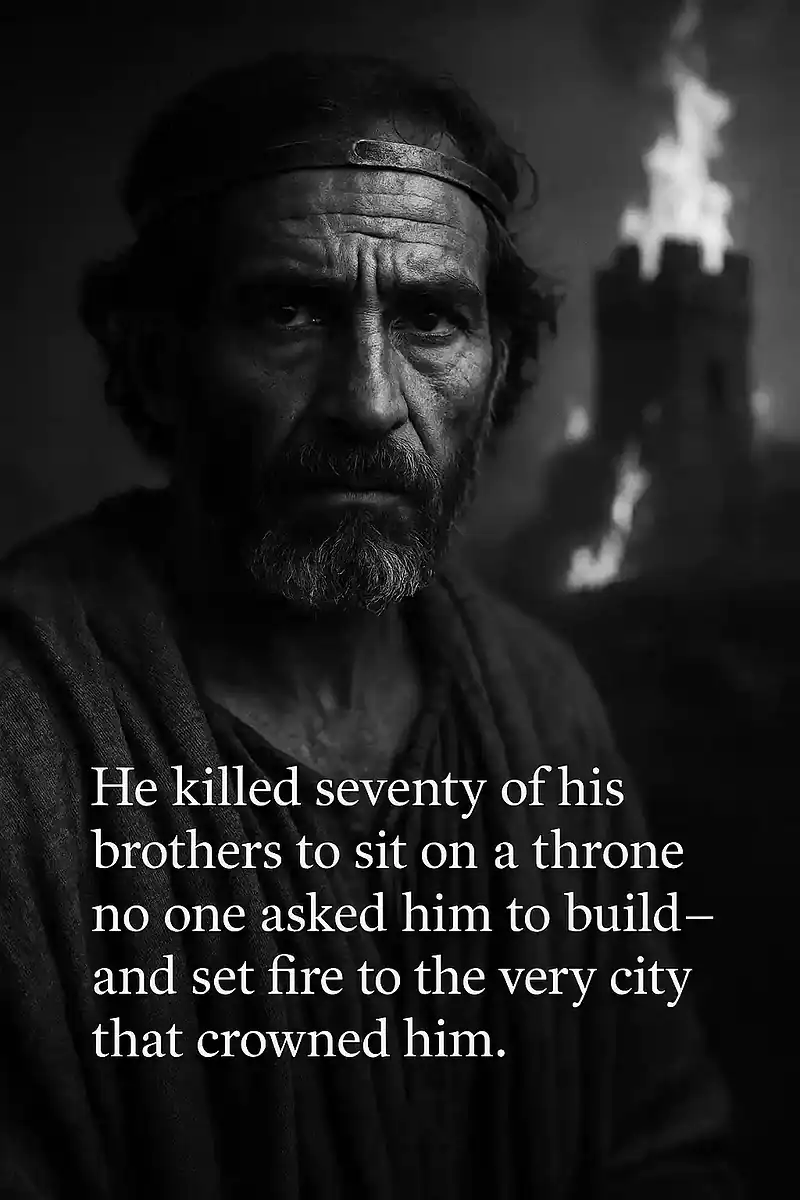
The Bible tells it with haunting simplicity: Abimelech slew his seventy brothers upon one stone. Seventy names. Seventy lives. One stone soaked in blood. Only Jotham, the youngest, escaped by hiding. Imagine the silence after the screams faded – the kind of silence that doesn’t heal but hardens. Abimelech stood over the stone that bore his family’s blood, crowned himself king, and thought the throne was secure.
But God never sleeps through injustice. From Mount Gerizim, Jotham’s voice echoed like thunder. He told a parable that day – a warning disguised as a fable. The trees, he said, once sought a king. They asked the olive, the fig, and the vine – each refused, unwilling to leave their God-given purpose to “wave over the trees.” Finally, they turned to the bramble, a worthless thornbush that offered shade it couldn’t truly give. “Come and put your trust in my shadow,” said the bramble. “If not, let fire come out of the bramble and devour the cedars of Lebanon.” Then Jotham fled, and the words hung heavy. The people chose the bramble. And fire was coming.
When Power Turns to Paranoia
Abimelech ruled three short years. But his reign, built on fear and ambition, began to crumble from within. Shechem, the city that crowned him, grew restless. The same men who had once shouted his name now whispered his downfall. Bandits waited on the roads, robbing his messengers. Rumors spread that God was stirring up division between Abimelech and Shechem – for He was. Judgment was on the move.
A man named Gaal arrived, bold and boastful, saying, “Who is Abimelech, that we should serve him?” His words lit the match. But Zebul, the city’s ruler, secretly loyal to Abimelech, sent word to the king: “Come by night and set an ambush.” At dawn, Gaal looked up and saw shadows on the mountains. Zebul taunted him: “Where is thy mouth now?” Abimelech attacked, scattering Gaal’s men. You’d think victory would satisfy him. But for a man whose crown was born from blood, peace was impossible. He turned on the very city that made him king.
The Fire of Shechem
Abimelech led his men to Shechem and took the city by surprise. The streets ran with chaos. Those who survived fled to the temple of Baal-berith, thinking the god they once paid silver to would protect them. But Abimelech, driven by rage more than strategy, ordered his men to cut branches from the forest. He stacked them against the temple’s walls and set them on fire. About a thousand men and women died that day, trapped in their own place of worship. The man who had been bought by Baal’s silver now burned Baal’s house with his own hands. The bramble king had set the world aflame – and didn’t even notice the smoke rising toward heaven.
The Stone That Finished the Story
After Shechem, Abimelech marched on Thebez. Again, the people fled to a tower, seeking refuge. History was repeating itself – but this time, God intervened. As Abimelech drew near to set fire again, a woman from the wall dropped a piece of millstone. It struck his head and crushed his skull. Wounded and humiliated, he called to his armor-bearer, “Draw thy sword, and slay me, that men say not of me, A woman slew him.” And his servant obeyed. Thus ended the reign of the bramble king.
Scripture says, “God rendered the wickedness of Abimelech, which he did unto his father, in slaying his seventy brethren.” The same stone that began his bloodshed became the symbol of his downfall. Abimelech’s life was a warning carved in tragedy – how ambition without repentance burns everything it touches, even its own name.
When God’s Justice Waits but Never Sleeps
Abimelech’s story could have ended differently. If only he had inherited Gideon’s humility instead of his sword. But pride is a fire that never cools on its own – it consumes until God puts it out. And yet, even here, we see the mercy of the Lord: He allowed time, years even, for repentance. God didn’t strike Abimelech down immediately. He gave him rope – enough to reveal his heart before the nation. Justice delayed is never justice denied when it comes from the throne of heaven.
We may not be kings, but we all face the same temptation: to rule our own lives, to force our own crowns, to build kingdoms where God never told us to. The story of Abimelech is what happens when ambition outpaces obedience. The question for us isn’t whether we’ll lead – it’s whether we’ll let the Lord lead through us. The greatest danger isn’t that God won’t give us success, but that He might, and we’ll use it to build altars to ourselves.
The Modern Mirror
Today’s culture still crowns bramble kings. They look impressive for a moment – sharp, bold, quick to promise shade. But brambles can’t give what only God can. They burn too easily. Whether it’s a politician, a preacher, or a personal desire, anything enthroned above obedience to the Lord ends in ashes. The fire might not come from wood and oil anymore, but it comes just the same – broken families, betrayed trust, hollow success.
If you’ve ever built something on pride, you know how fragile it is. But God still writes mercy over ruins. The same Lord who let Abimelech fall is the One who lifts the humble. When you let go of control, you find peace that power can’t give. When you yield your throne, you find the true King waiting to rule in righteousness.
The Shadow That Points to Christ
Abimelech is the anti-type, a shadow of what Jesus would never be. Abimelech killed his brothers to become king; Jesus gave His life to make us His brethren. Abimelech ruled through fear; Jesus reigns through love. Abimelech burned those who hid in false temples; Jesus saves all who run to Him for refuge. The bramble brought death to those who trusted it; the Vine brings life to all who abide in Him.
In the end, the story of Abimelech is not just a caution – it’s a contrast. Every false king falls, but Christ remains. Every selfish kingdom burns, but His endures forever. And for all who have ever built towers of pride, there’s still grace enough to rebuild on the Rock that cannot be moved.
For the Lord of justice is also the Lord of mercy – and His fire refines what sin tried to destroy.
Call to Action: The Question That Demands an AnswerIn Acts 2:37 Peter and the Apostles were asked the question – What Shall We do? And in Acts 2:38 Peter answered, Repent, and be baptized every one of you in the name of Jesus Christ for the remission of sins, and ye shall receive the gift of the Holy Ghost. For the promise is unto you, and to your children, and to all that are afar off, even as many as the Lord our God shall call. Do you understand this? After hearing the gospel and believing, they asked what should would do. The answer hasn’t changed friend, Peter clearly gave the answer. The question for you today is, Have you receieved the Holy Spirit Since you believed? If you’re ready to take that step, or you want to learn more about what it means to be born again of water and Spirit, visit: Come, and let the Spirit make you new. |