

Experience the joyous celebration of Christ’s birth as we explore the biblical meaning behind “A Multitude of the Heavenly Host Praising God”, a song inspired by Luke 2:8-14 and other Scriptures.
Discover how this powerful event fulfilled prophecies, revealed God’s glory, and brought peace to the world. This video blends worship, scripture, and storytelling to reflect on the angelic proclamation to the shepherds and the Savior’s humble arrival in Bethlehem. Perfect for worship, Bible study, and deepening your faith through music.
Make Sure You Watch My Video: I would love for you to subscribe to my YouTube channel as well…
Song Lyrics: A Multitude of the Heavenly Host Praising God
Verse 1:
In the fields, beneath the stars,
The shepherds watched from near and far.
Then suddenly, the sky was bright,
An angel spoke in radiant light.
Verse 2:
“Fear not,” the angel’s voice proclaimed,
“Good tidings of joy, a King is named.
In Bethlehem, the Savior’s born,
A child to bring new life this morn!”
Chorus:
A multitude of the heavenly host,
Praising God, they made it known!
“Glory to God in the highest place,
Peace on earth, through God’s grace!”
Verse 3:
Then heavenly voices filled the air,
With songs of praise beyond compare.
“Glory to God, the angels sing,
The Prince of Peace, our Savior King!”
Verse 4:
The shepherds rushed, their hearts aflame,
To find the child, and praise His name.
In humble awe, they bowed their knees,
To witness Heaven’s joy and peace.
Chorus:
A multitude of the heavenly host,
Praising God, they made it known!
“Glory to God in the highest place,
Peace on earth, through God’s grace!”
Verse 5:
The stars above, the earth below,
Rejoiced at Christ, the King who’d show.
A Lamb of God, both meek and mild,
Yet Heaven’s glory filled the child.
Verse 6:
And still, today, the echoes ring,
Of angels’ songs that ever sing.
“Glory to God, and peace we bring,
For Christ is born, our Savior King!”
Outro:
A multitude of voices sing,
In joy and praise to Christ the King.
“Glory to God, let all proclaim,
The Savior born, His holy name!”
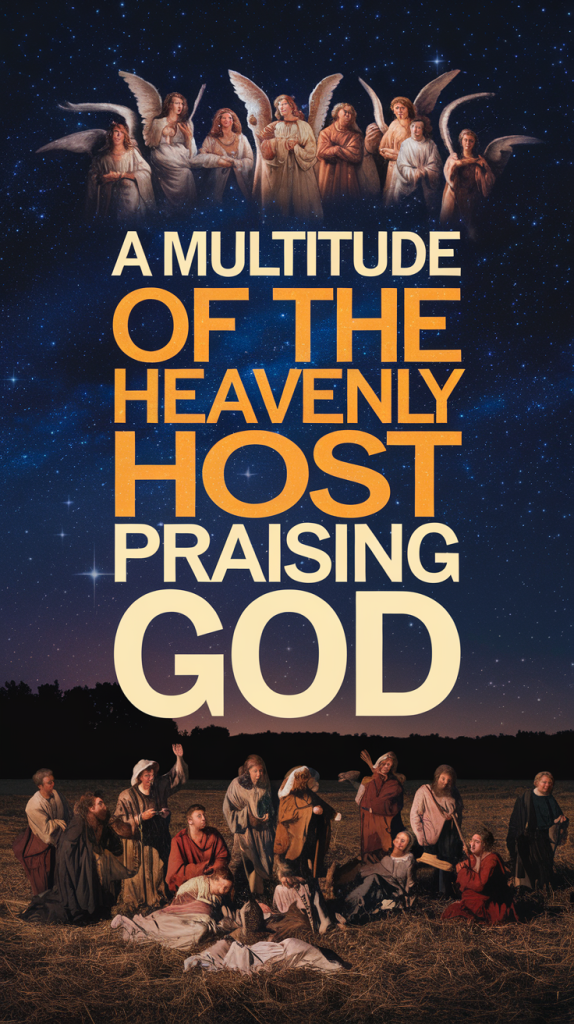
The Meaning Behind “A Multitude of the Heavenly Host Praising God”
Introduction to the Song
The song, “A Multitude of the Heavenly Host Praising God,” celebrates one of the most profound moments in the Bible: the angelic proclamation of Jesus’ birth to the shepherds in Luke 2:8-14.
This pivotal event doesn’t just mark the arrival of a child—it heralds the fulfillment of centuries of prophecy, the unveiling of God’s salvation plan, and the beginning of a new covenant between God and humanity. Through its verses and chorus, the song invites us to marvel at the wonder of the Incarnation and join the heavenly hosts in giving glory to God.
Verse 1: The Shepherds’ Encounter
“In the fields, beneath the stars,
The shepherds watched from near and far.
Then suddenly, the sky was bright,
An angel spoke in radiant light.”
This verse sets the stage for the miraculous event. The shepherds, ordinary men tending their flocks at night, represent humility and humanity’s need for salvation. In a quiet, dark moment, the sky is suddenly illuminated—a visual representation of Jesus, the Light of the World, breaking into the darkness (John 1:5). The angel’s appearance is not random; God often chose humble people, like David the shepherd, to fulfill His purposes. This reflects the theme that God’s kingdom is for all, especially the lowly and meek.
Foreshadowing:
This verse echoes past moments of divine encounters, such as Moses at the burning bush (Exodus 3:2) or Isaiah’s vision of God’s glory (Isaiah 6:1-4). In each instance, God reveals Himself in light, symbolizing His holiness and presence.
Verse 2: The Angel’s Announcement
“Fear not,” the angel’s voice proclaimed,
“Good tidings of joy, a King is named.
In Bethlehem, the Savior’s born,
A child to bring new life this morn!”
The angel’s words directly reference Luke 2:10-11. The command “fear not” reassures the shepherds, reflecting how God’s message of salvation brings peace, not fear. The angel’s announcement is the fulfillment of Micah 5:2, which prophesied that the ruler of Israel would come from Bethlehem. This verse emphasizes Jesus’ role as the Savior, bringing new life to a fallen world—a fulfillment of Isaiah 9:6, where the coming child is described as the Prince of Peace.
Significance of Bethlehem:
Bethlehem, the City of David, ties Jesus to King David’s lineage, fulfilling the covenant God made in 2 Samuel 7:12-16, promising a kingdom that would last forever. This birth marks the beginning of that eternal reign.
Chorus: The Heavenly Praise
“A multitude of the heavenly host,
Praising God, they made it known!
‘Glory to God in the highest place,
Peace on earth, through God’s grace!'”
The chorus highlights Luke 2:13-14, where the angels burst into praise, declaring God’s glory and the peace brought by Jesus. Their song is not just a celebration of His birth but also a proclamation of reconciliation between God and humanity through Christ. This moment mirrors other heavenly celebrations in Revelation 5:11-12, where multitudes of angels praise the Lamb.
Peace on Earth:
This peace is not just the absence of conflict but the restoration of harmony between God and man. It fulfills Isaiah 53:5, where the suffering servant would bring peace through His sacrifice.
Verse 3: The Host of Angels
“Then heavenly voices filled the air,
With songs of praise beyond compare.
‘Glory to God,’ they all did sing,
The Prince of Peace, our Savior King!”
This verse emphasizes the awe-inspiring nature of the angelic host. The mention of the “Prince of Peace” ties directly to Isaiah 9:6, affirming that Jesus’ mission is to bring peace through His rule. The multitude of angels reflects the overwhelming joy and magnitude of Jesus’ birth, reminding us of God’s grandeur and His love for humanity.
Verse 4: The Shepherds’ Response
“The shepherds rushed, their hearts aflame,
To find the child, and praise His name.
In humble awe, they bowed their knees,
To witness Heaven’s joy and peace.”
The shepherds’ response mirrors that of true faith: immediate and enthusiastic action. They obey the angel’s words and find the baby lying in a manger (Luke 2:16). Their humility and worship foreshadow the response God desires from all who encounter Jesus. This verse also recalls the Magi’s later worship in Matthew 2:11, emphasizing that Jesus is worthy of worship by all.
Verse 5: Creation Rejoices
“The stars above, the earth below,
Rejoiced at Christ, the King who’d show.
A Lamb of God, both meek and mild,
Yet Heaven’s glory filled the child.”
This verse reflects the universal impact of Jesus’ birth. All of creation rejoices, as Paul writes in Romans 8:19-21, where creation awaits redemption. The imagery of the Lamb of God recalls John 1:29, where John the Baptist identifies Jesus as the one who takes away the sin of the world.
Verse 6: Eternal Echoes of Praise
“And still, today, the echoes ring,
Of angels’ songs that ever sing.
‘Glory to God, and peace we bring,
For Christ is born, our Savior King!'”
This final verse reminds us that the angels’ song of praise didn’t end on that night—it continues eternally. Revelation 7:9-12 shows a vision of people from every nation praising God alongside angels, echoing this heavenly worship. The message of Christ’s birth, peace, and salvation remains relevant for all generations.
Outro: A Lasting Celebration
“A multitude of voices sing,
In joy and praise to Christ the King.
‘Glory to God, let all proclaim,
The Savior born, His holy name!'”
The outro ties the narrative together, calling all who hear the song to join the angels’ praise. It reflects Philippians 2:10-11, where every knee will bow and every tongue confess that Jesus Christ is Lord.
Conclusion: What Christ Has Fulfilled
This song tells a powerful story of Jesus’ birth as the fulfillment of God’s promises, bringing peace and redemption. Through the angelic announcement, we see God’s glory revealed, the fulfillment of prophecy, and the establishment of Jesus as King and Savior. The humble shepherds remind us of the simplicity of faith, while the angels’ praise points us to the ultimate joy of heaven.
Christ has fulfilled:
- Micah 5:2: Born in Bethlehem as the ruler of Israel.
- Isaiah 7:14: Born of a virgin, Emmanuel—God with us.
- Isaiah 9:6: The Prince of Peace bringing eternal hope.
- 2 Samuel 7:12-16: Establishing an everlasting kingdom.
This song is an invitation to celebrate with awe and wonder the incredible gift of Jesus Christ, just as the angels and shepherds did that holy night.
FAQ: 10 Interesting Facts About the Story of the Angelic Announcement to the Shepherds
1. Why Did the Angels Announce Jesus’ Birth to Shepherds?
The angels appeared to shepherds because they symbolized humility and the everyday person. Shepherds were often seen as lowly in society, yet God chose them to be the first to hear the good news of the Savior’s birth, reflecting Luke 19:10: “For the Son of man is come to seek and to save that which was lost.”
2. What Is the Significance of the Angels’ Words, “Fear Not”?
The phrase “fear not” is repeated throughout the Bible when God reveals Himself or sends a message (e.g., Genesis 15:1, Isaiah 41:10). It reassured the shepherds that this was not a moment of judgment but a message of joy and peace. It reminds us of God’s love and His desire to bring salvation, not condemnation.
3. What Does “Good Tidings of Great Joy” Mean?
The angels proclaimed “good tidings of great joy” in Luke 2:10, announcing the arrival of Jesus, the Savior. This phrase echoes Isaiah 52:7, which speaks of those who bring good news of peace and salvation. The birth of Jesus is the ultimate “good news,” as it marks the beginning of God’s plan to redeem humanity.
4. Why Was Bethlehem Chosen as Jesus’ Birthplace?
Bethlehem fulfilled the prophecy of Micah 5:2, which foretold that a ruler would come from Bethlehem, the city of David. It also connects Jesus to King David’s lineage, fulfilling God’s covenant in 2 Samuel 7:12-16. Bethlehem, though small and humble, reminds us of how God uses the insignificant to accomplish His purposes.
5. Why Did the Angels Sing “Glory to God in the Highest”?
The angelic chorus in Luke 2:14 is a declaration of God’s glory and the peace that comes through Jesus. This peace is not merely the absence of conflict but the restoration of harmony between God and man. This praise also mirrors the eternal worship described in Revelation 5:11-12.
6. How Many Angels Appeared to the Shepherds?
The Bible doesn’t specify the exact number, but Luke 2:13 describes “a multitude of the heavenly host.” This suggests a vast number, likely thousands, filling the sky with radiant light and praise, symbolizing the magnitude of Christ’s birth.
7. What Is the Symbolism of the Manger?
The manger, where Jesus was laid (Luke 2:7), symbolizes humility and accessibility. Though He is King of Kings, Jesus came into the world in the simplest of settings, reflecting Philippians 2:6-8, which describes Him taking on human form and humbling Himself for our salvation.
8. What Was the Shepherds’ Reaction to the Angels?
Initially, the shepherds were “sore afraid” (Luke 2:9), a natural reaction to witnessing the glory of God. However, their fear turned to faith as they obeyed the angel’s message and went to Bethlehem to find the baby (Luke 2:15-16). Their response shows how encountering God leads to action and worship.
9. How Does This Story Fulfill Old Testament Prophecies?
This event fulfills several prophecies:
- Micah 5:2: The Messiah would be born in Bethlehem.
- Isaiah 7:14: The virgin birth of Emmanuel, “God with us.”
- Isaiah 9:6-7: A child born to bring peace and reign on David’s throne.
- Psalm 98:3: God’s salvation revealed to the world.
10. Why Is This Story Important for Christians Today?
The angelic announcement highlights the universal message of salvation. The shepherds represent how God reaches out to the humble and undeserving, offering peace through Jesus. This story reminds Christians to respond with faith and worship, just as the shepherds did, and to share the “good tidings” of Christ with others.
Call to Action: The Question That Demands an AnswerIn Acts 2:37 Peter and the Apostles were asked the question – What Shall We do? And in Acts 2:38 Peter answered, Repent, and be baptized every one of you in the name of Jesus Christ for the remission of sins, and ye shall receive the gift of the Holy Ghost. For the promise is unto you, and to your children, and to all that are afar off, even as many as the Lord our God shall call. Do you understand this? After hearing the gospel and believing, they asked what should would do. The answer hasn’t changed friend, Peter clearly gave the answer. The question for you today is, Have you receieved the Holy Spirit Since you believed? If you’re ready to take that step, or you want to learn more about what it means to be born again of water and Spirit, visit: Come, and let the Spirit make you new. |