Let’s get straight to the question.
Did Paul actually say when Jesus was coming back?
Because if you read his letters, especially 1 Thessalonians 4:15–18, it can feel like he expected it soon. Maybe even in his lifetime.
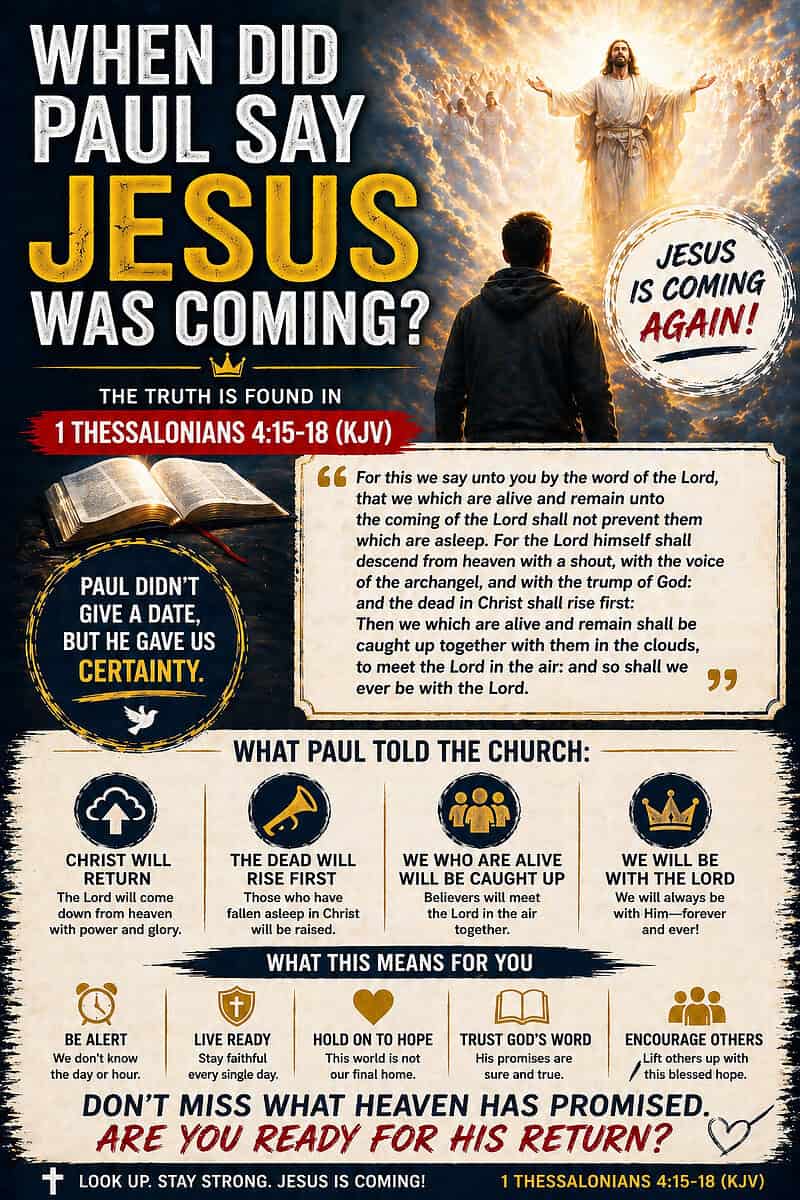
“For this we say unto you by the word of the Lord, that we which are alive and remain unto the coming of the Lord…”
That phrase stands out.
“We which are alive.”
So was Paul saying, “It’s happening any moment, and we’ll still be here”?
Or is something deeper going on?
Let’s slow this down and read it honestly.
What Paul Actually Said in 1 Thessalonians
Paul was writing to believers who were worried.
Some Christians had already died, and the question was simple:
“Did they miss the coming of Jesus?”
So Paul answers with clarity and comfort:
“The dead in Christ shall rise first:
Then we which are alive and remain shall be caught up together with them…
And so shall we ever be with the Lord.”
Notice the focus.
He’s not giving a date.
He’s explaining what happens.
He’s reassuring them that no one is left out.
Those who have died in Christ are not behind. They are raised first.
So this passage is not about timing. It’s about order and hope.
Did Paul Expect It in His Lifetime?
This is where people get stuck.
Because Paul uses language like “we who are alive.”
And at first glance, it sounds like he expected to still be here when it happened.
But look closer.
Paul often speaks pastorally. He includes himself with his audience.
It’s like saying, “When this happens to us,” even if the timing isn’t specified.
He’s identifying with the believers he’s writing to.
And here’s something important.
In other places, Paul clearly shows he doesn’t know the exact timing.
He talks about the coming of the Lord as something to be ready for, not something scheduled.
The Early Church Lived With Expectation
The early believers had a strong sense that Jesus could return at any time.
Not because they had a date.
But because Jesus had promised He would return.
So they lived ready.
That’s the key.
Expectation without prediction.
They didn’t build timelines. They built lives that were prepared.
And Paul encouraged that mindset.
Paul’s Message Was Urgency, Not a Date
If you read Paul’s letters as a whole, a pattern shows up.
He doesn’t focus on “when.”
He focuses on “how you should live because of it.”
Stay ready.
Stay faithful.
Stay grounded.
That’s the emphasis.
Because knowing the exact time wouldn’t actually help if your life isn’t aligned.
So Paul points people back to readiness, not speculation.
The Day of the Lord Comes Unexpectedly
Right after 1 Thessalonians 4, Paul continues into chapter 5.
And he says this:
“The day of the Lord so cometh as a thief in the night.”
That tells you everything you need to know about timing.
Unexpected.
Not predictable.
Not something you can map out.
So if someone tries to lock down a date, they’re stepping outside of what Paul taught.
The Real Concern: Being Unprepared
Paul wasn’t trying to satisfy curiosity.
He was addressing concern.
People were worried about loved ones who had died.
And Paul says, “Don’t grieve without hope.”
Because when Jesus returns, the dead in Christ rise first.
That shifts everything.
The focus moves from fear… to hope.
From confusion… to assurance.
Having a Form of Godliness but Denying the Power
Now here’s where this connects to something deeper.
In 2 Timothy 3:5, Paul warns about people:
“Having a form of godliness, but denying the power thereof”
This matters in this conversation.
Because it’s possible to talk about the Second Coming… without living in light of it.
To debate timelines, discuss theories, even quote passages… but not actually be ready.
That’s form without power.
Power shows up in how you live.
In staying alert. Staying faithful. Staying grounded in truth.
Pentecost: Why the Early Church Was Ready
Think about what happened after Pentecost in Acts 2.
The Holy Spirit was poured out.
And from that point on, believers didn’t just believe Jesus was coming back.
They lived like it mattered.
There was boldness. There was urgency. There was focus.
Why?
Because the Spirit was active in them.
The same Spirit who reminds, convicts, and leads.
So readiness wasn’t driven by fear.
It was driven by the presence of God working in them.
What “We Who Are Alive” Really Means
Let’s come back to that phrase.
“We who are alive and remain.”
Instead of reading it as a prediction, read it as inclusion.
Paul is saying, “Whether we are alive at that moment or not, here is how it unfolds.”
He’s placing himself alongside believers, not setting a timeline.
Because the truth is simple.
Some believers will be alive when Jesus returns.
And some will have already passed.
Paul is covering both.
Why This Still Matters Today
This isn’t just a historical question.
It affects how you live right now.
If you’re trying to figure out the exact timing, you’ll miss the point.
Because the point is readiness.
The early church didn’t know the day.
But they lived like it could happen at any time.
And that shaped everything.
Their priorities. Their focus. Their choices.
Final Thought: Don’t Miss the Purpose
So when did Paul say Jesus was coming?
He didn’t give a date.
He gave a mindset.
Be ready.
Stay grounded.
Live with expectation.
Because the coming of the Lord is certain.
The timing is not revealed.
And the goal isn’t to figure it out.
It’s to be prepared.
So instead of asking, “When is it happening?”
Ask yourself, “Am I ready if it happens?”
That’s the question Paul was really answering.
Call to Action: The Question That Demands an AnswerIn Acts 2:37 Peter and the Apostles were asked the question – What Shall We do? And in Acts 2:38 Peter answered, Repent, and be baptized every one of you in the name of Jesus Christ for the remission of sins, and ye shall receive the gift of the Holy Ghost. For the promise is unto you, and to your children, and to all that are afar off, even as many as the Lord our God shall call. Do you understand this? After hearing the gospel and believing, they asked what should would do. The answer hasn’t changed friend, Peter clearly gave the answer. The question for you today is, Have you receieved the Holy Spirit Since you believed? If you’re ready to take that step, or you want to learn more about what it means to be born again of water and Spirit, visit: Come, and let the Spirit make you new. |