Let’s not pretend this is just an Old Testament problem.
Idolatry didn’t disappear. It just got quieter.
Less obvious. Less carved in wood. More wrapped in culture, comfort, and things that don’t look dangerous at first glance.
That’s why Asherah matters.
Not because you’re tempted to bow to a wooden pole… but because what Asherah represents is still very much alive.
And if you don’t recognize it, you can drift into it without even realizing.
What Was Asherah, Really?
When you see the word “Asherah” in Scripture, it can be confusing.
Is it a person? A god? An object?
The answer is… all of the above, depending on the context.
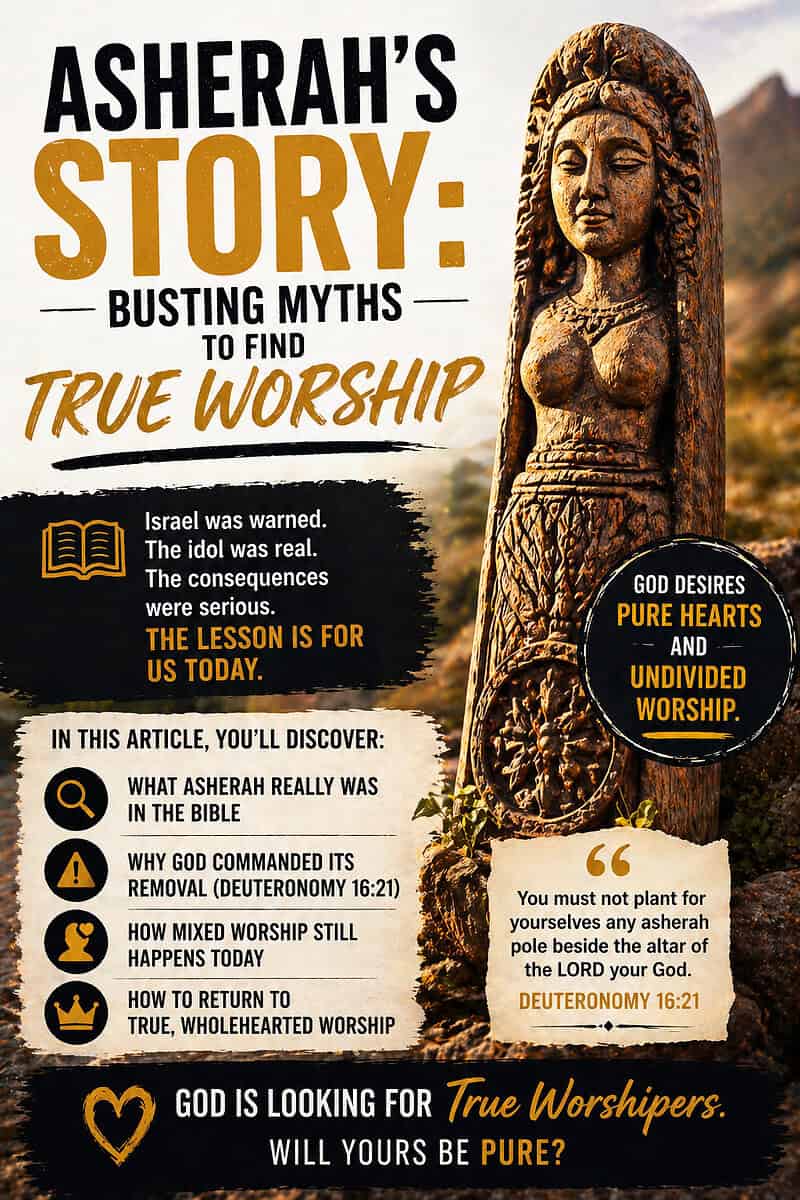
Historically, Asherah was associated with fertility worship in the ancient Near East. She was considered a goddess connected to life, growth, and provision. But in Israel’s context, the word “Asherah” often refers to wooden poles or sacred trees set up near altars.
These weren’t harmless decorations.
They were symbols tied to worship practices that mixed truth with falsehood.
And that mixture is what made them so dangerous.
God Was Very Clear About It
Deuteronomy 16:21 says:
“Thou shalt not plant thee a grove of any trees near unto the altar of the Lord thy God, which thou shalt make thee.”
That word “grove” is often tied to Asherah.
God didn’t say, “Be careful with it.”
He said don’t plant it at all.
Why?
Because it represents a blending of worship.
Trying to honor God… while holding onto something He never approved.
And that’s where things start to go wrong.
The Real Issue Wasn’t the Object… It Was the Heart
Let’s go deeper.
The danger wasn’t just the pole.
It was what it represented.
People were trying to worship the Lord… but also keep elements of surrounding cultures that felt appealing.
Things that promised blessing.
Things that seemed to “help” life along.
Fertility. Prosperity. Control over outcomes.
Does that sound familiar?
Because the heart behind that hasn’t changed.
Mixing Worship Is Still a Problem Today
Here’s where this gets uncomfortable.
Modern idolatry doesn’t usually look like ancient idolatry.
You’re not setting up a carved pole in your backyard.
But the temptation to mix worship?
That’s still here.
It shows up when you trust God… but also lean heavily on something else for security.
Money.
Status.
Approval.
Control.
You say you trust God for provision… but your peace rises and falls with your bank account.
You say God directs your life… but your decisions are driven by what keeps you comfortable.
That’s the same pattern.
Different form. Same root.
Why Subtle Idolatry Is So Dangerous
Obvious idolatry is easier to reject.
But subtle idolatry blends in.
That’s what Asherah represented.
It wasn’t always about abandoning God completely.
It was about adding something alongside Him.
And that’s where deception lives.
Because it feels harmless.
Even helpful.
But over time, it shifts your trust.
And God doesn’t share that space.
Not because He’s trying to control you… but because He knows anything you put beside Him will eventually take from you what only He can give.
The Pattern in Israel’s History
If you read through Judges and Kings, you’ll see this cycle repeat.
The people turn to God.
Then they drift.
They set up high places.
They bring in Asherah.
Things seem fine for a while.
Then everything starts to break down.
Oppression. Confusion. Loss.
And then they cry out to God again.
Over and over.
It wasn’t random.
It was connected to what they allowed into their worship.
And every time reform came, one of the first things removed was the Asherah.
Because true worship and mixed worship cannot coexist.
True Worship Requires Separation
This is where it becomes personal.
You can’t seek God fully while holding onto things that compete with Him.
Not because God is distant.
But because your heart gets divided.
Jesus said no one can serve two masters.
You’ll lean toward one and pull away from the other.
That’s not just a principle.
It’s reality.
So when God told Israel not to plant Asherah near His altar, He wasn’t being restrictive.
He was protecting the purity of their relationship with Him.
What Might “Asherah” Look Like in Your Life?
Let’s make this practical.
What are the things that quietly sit beside your faith?
The things you rely on when God feels too slow?
The things that shape your decisions more than His Word?
It might not look spiritual at all.
It could be:
Chasing security instead of trusting God’s provision.
Needing constant approval to feel okay.
Holding onto control because surrender feels risky.
Building your identity around something other than who God says you are.
Those things don’t seem like idols.
But if they take the place of trust, they function like one.
Breaking the Pattern
The good news is this.
Every time Israel turned back to God, restoration was possible.
But it always started with removal.
Tearing down what didn’t belong.
Not managing it.
Not adjusting it.
Removing it.
That takes honesty.
It takes humility.
And it takes a willingness to say, “God, if this competes with You, it has to go.”
That’s where true worship begins again.
Worship in Spirit and Truth
Jesus said in John 4 that true worshippers will worship the Father in spirit and in truth.
Not mixed.
Not blended.
Not adjusted to fit comfort.
Spirit and truth.
That means your worship is aligned with who God really is… not who you want Him to be.
And your trust is placed fully in Him… not divided across other things.
Final Thought
Asherah isn’t just a piece of history.
It’s a warning.
Not about ancient people doing strange things… but about how easy it is to drift without noticing.
You don’t wake up one day and decide to replace God.
It happens slowly.
By adding things beside Him.
By trusting what you can see more than what He said.
So take a moment and look honestly.
Is there anything sitting next to God in your life?
Anything sharing the space that belongs to Him alone?
Because true worship isn’t about adding more.
It’s about clearing out what doesn’t belong.
And when you do that…
You don’t lose anything real.
You finally see God clearly again.
Call to Action: The Question That Demands an AnswerIn Acts 2:37 Peter and the Apostles were asked the question – What Shall We do? And in Acts 2:38 Peter answered, Repent, and be baptized every one of you in the name of Jesus Christ for the remission of sins, and ye shall receive the gift of the Holy Ghost. For the promise is unto you, and to your children, and to all that are afar off, even as many as the Lord our God shall call. Do you understand this? After hearing the gospel and believing, they asked what should would do. The answer hasn’t changed friend, Peter clearly gave the answer. The question for you today is, Have you receieved the Holy Spirit Since you believed? If you’re ready to take that step, or you want to learn more about what it means to be born again of water and Spirit, visit: Come, and let the Spirit make you new. |