The Camp Was Dying
The sun beat down on Israel’s camp at Shittim, but the heat wasn’t the problem. Death was.
It started quietly. A few people collapsed near the tabernacle. Then more. Then hundreds. By midday, families were screaming, tearing their clothes, throwing dust on their heads. Mothers clutched children who had been laughing that morning. Fathers stared at sons who would never stand again.
Twenty-four thousand people. Gone. In hours.
This wasn’t war. This wasn’t an enemy army. This was judgment – the wrath of God unleashed because Israel had done the unthinkable. They had bowed to Baal. They had joined themselves to the women of Moab, not just in body but in worship. They had turned their backs on the covenant and chased after foreign gods.
And now the plague was tearing through the camp like wildfire.
Moses stood at the door of the tabernacle with the elders, weeping. What else could they do? God had spoken: execute the leaders who led the people into idolatry. But even as they obeyed, the dying continued. The ground was soaked with tears. The air was thick with grief.
And in the middle of it all, one man walked into camp like nothing was wrong.
The Moment That Shook Everything
His name was Zimri, a leader in the tribe of Simeon. A prince. Someone who should have known better. And he wasn’t alone.
He had a Midianite woman on his arm. Her name was Cozbi, daughter of a Midianite chief. Beautiful, foreign, forbidden. And Zimri brought her right past Moses, right past the weeping congregation, right past the bodies, and took her into his tent.
In full view of everyone.
It was defiance. It was rebellion. It was a slap in the face to God and to every soul mourning at the tabernacle door. While Israel wept for their sin, Zimri flaunted his.
The elders stood there, frozen. Shocked. Maybe too broken to move.
But one man wasn’t frozen.
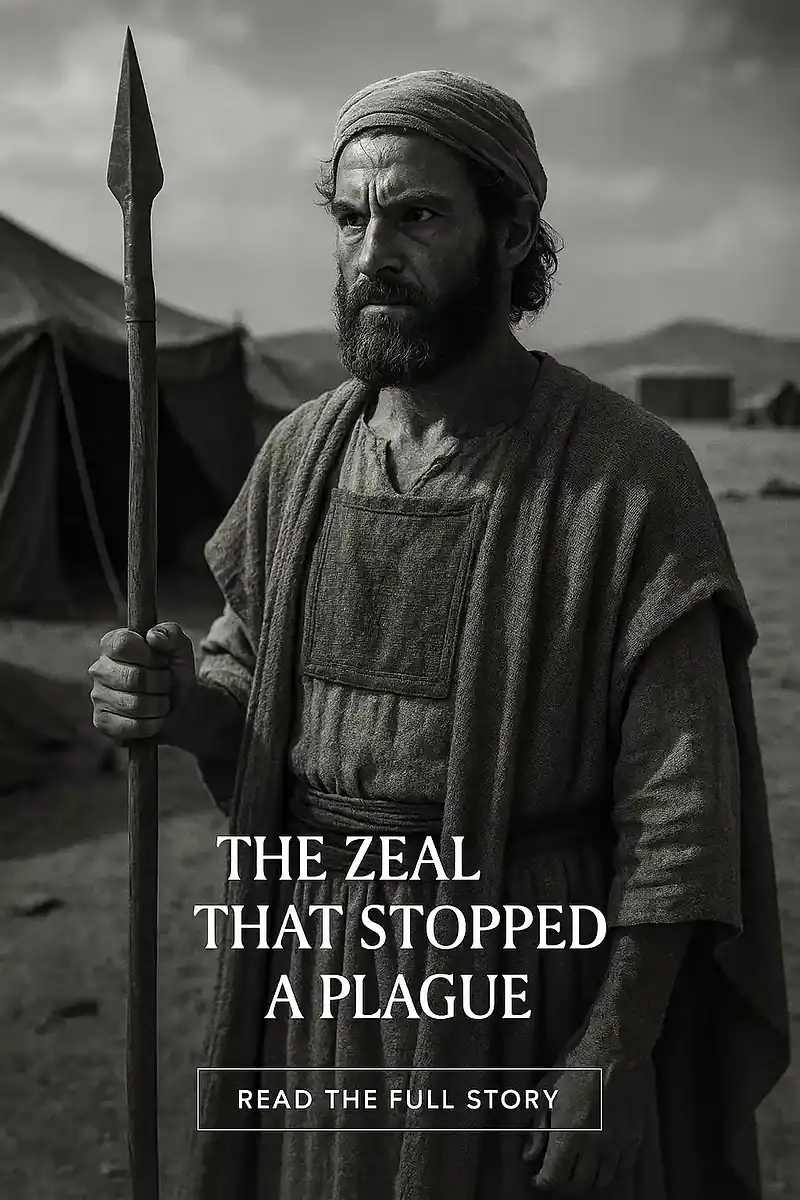
Phinehas, son of Eleazar, grandson of Aaron the high priest, saw what was happening. And something rose up in him. Not rage. Not revenge. Zeal. Holy, burning, unshakable zeal for the honor of God.
He didn’t ask permission. He didn’t call a meeting. He grabbed a javelin and went after them.
The Tent, the Spear, and the Silence
Phinehas walked into that tent with one thing on his mind: covenant faithfulness. This wasn’t about human emotion. This wasn’t vigilante justice. This was about God’s holiness being trampled, God’s people being destroyed, and someone needing to stand in the gap.
He found them together. Zimri and Cozbi, wrapped in their sin, blind to the death outside.
Phinehas didn’t hesitate. He thrust the javelin through both of them, piercing them together in one blow. The tent fell silent. The camp fell silent.
And then, just as suddenly as it had started, the plague stopped.
No more bodies. No more screams. The judgment lifted. The wrath of God was turned away. And Israel, gasping and trembling, realized what had just happened.
One man’s zeal had saved the nation.
What God Said About Phinehas
You’d think Phinehas might be condemned. After all, he just killed two people without a trial, without a command, without waiting for Moses.
But God didn’t condemn him. God commended him.
The Lord spoke to Moses and said:
“Phinehas, the son of Eleazar, the son of Aaron the priest, hath turned my wrath away from the children of Israel, while he was zealous for my sake among them, that I consumed not the children of Israel in my jealousy. Wherefore say, Behold, I give unto him my covenant of peace: And he shall have it, and his seed after him, even the covenant of an everlasting priesthood; because he was zealous for his God, and made an atonement for the children of Israel.” (Numbers 25:11-13)
Read that again.
God gave Phinehas a covenant of peace. An everlasting priesthood. Not because Phinehas was perfect, but because he was zealous for God’s glory. He stood up when no one else would. He acted when everyone else was paralyzed. He loved God more than he loved his own reputation, his own safety, or his own comfort.
And because of that zeal, atonement was made. The people were spared. The covenant was kept.
Zeal Is Not Anger
Let’s be clear: zeal is not rage. It’s not uncontrolled emotion. It’s not self-righteous fury.
Zeal is love on fire. It’s the kind of passion that refuses to stand by while what you love is destroyed. It’s what made Jesus overturn tables in the temple. It’s what made Paul say, “I could wish that myself were accursed from Christ for my brethren” (Romans 9:3). It’s what made Phinehas act when everyone else stood still.
Phinehas wasn’t angry at Zimri. He was heartbroken over God’s dishonor. He saw the covenant being mocked, the people being destroyed, and he couldn’t stay silent.
That’s biblical zeal. It’s rooted in love for God and love for people. It moves with courage, not cruelty. It defends what is holy, not what is personal.
And here’s the thing: we need that kind of zeal today.
Where Is Our Zeal?
We live in a time when the church has grown comfortable. We’ve learned to coexist with compromise. We’ve been taught that passion is divisive, that boldness is unloving, that standing firm is judgmental.
But where is the zeal for God’s glory?
Where are the believers who will stand up when truth is mocked, when sin is celebrated, when the Word of God is twisted? Where are the Phinehas hearts who say, “Not on my watch”?
We don’t need more violence. We don’t need more self-righteousness. But we desperately need more holy zeal. The kind that prays with urgency. The kind that speaks truth even when it’s costly. The kind that refuses to let the enemy steal, kill, and destroy without a fight.
Phinehas didn’t wait for permission. He didn’t form a committee. He saw what needed to be done, and he did it. And because of that, a nation was saved.
The Covenant of Peace
Here’s the beautiful irony: Phinehas was given a covenant of peace because he wielded a spear.
That sounds backward, doesn’t it? But it’s not. Because sometimes peace is only possible when someone is willing to fight for it. Not with fists, but with faith. Not with violence, but with unshakable conviction.
Phinehas brought peace to Israel because he stopped the plague. He ended the judgment. He turned away God’s wrath. And God honored him for it.
That covenant of peace wasn’t just for Phinehas. It was for his descendants. It was a promise that extended through generations. And here’s the stunning part: Jesus Himself came through the line of Aaron. The priesthood that Phinehas preserved became the priesthood that pointed to Christ, our ultimate High Priest.
Phinehas’s zeal didn’t just save a generation. It protected the lineage that would bring the Savior.
The Greater Zeal
But as powerful as Phinehas’s story is, it’s just a shadow of something greater.
Because there was another Man who stood in the gap when judgment was falling. Another One who saw sin destroying the people He loved and said, “I’ll take the spear.”
His name is Jesus.
Where Phinehas thrust a javelin through two sinners, Jesus allowed a spear to pierce His own side. Where Phinehas’s zeal turned away wrath for a moment, Jesus’s sacrifice turned away wrath forever. Where Phinehas made atonement for Israel, Jesus made atonement for the world.
“For the zeal of thine house hath eaten me up,” Jesus said (John 2:17, quoting Psalm 69:9). His zeal wasn’t just passion. It was total, sacrificial love. He didn’t just stop a plague. He conquered death. He didn’t just preserve a covenant. He became the covenant.
Phinehas stood between God and Israel with a weapon. Jesus stood between God and humanity with His own body.
And because of His zeal, we have peace. Not temporary peace, but eternal peace. Not a covenant that lasts for generations, but a covenant that lasts forever.
What This Means for Us
So what do we do with this story?
We ask God to give us the zeal of Phinehas – not to harm, but to protect. Not to destroy, but to defend. Not to judge, but to intercede.
We pray for courage to stand when everyone else is sitting. To speak when everyone else is silent. To act when everyone else is paralyzed by fear or comfort or compromise.
We remember that zeal without love is just noise (1 Corinthians 13:1). But love without zeal is weak. We need both. We need hearts that burn with passion for God’s glory and hands that move with grace toward people.
And most of all, we thank Jesus. Because His zeal saved us. His courage redeemed us. His sacrifice made us whole.
Phinehas stopped a plague. Jesus stopped death itself.
That’s the kind of Savior we serve.