The Calm Before the Corruption
It began quietly, as most deceptions do – not with thunder or fire, but with a whisper that sounded almost right. Hymenaeus sat among the believers, nodding at the teachings of Paul, his eyes sharp, his tongue clever. He spoke like one who knew Scripture well. Maybe he did. He could quote the prophets, reason with precision, and seem every bit the devoted disciple. But somewhere between zeal and pride, something inside him shifted.
Faith that once anchored him began to drift. He learned the ways of argument before learning the heart of God. The church was growing, lives were changing, and yet, his own heart grew restless. He wanted to be known not for faithfulness, but for being right.
The Seeds of Subtle Rebellion
Ephesus was alive with conversation – merchants calling out in the marketplace, sailors shouting from the harbor, and believers gathering in homes to study the words of Paul. In those gatherings, Hymenaeus began to teach too. At first, his voice blended with the rest – humble, eager, trustworthy. But then he began to say things that sounded… new. Progressive. “The resurrection,” he said one evening, “has already happened.”
The room fell silent. Some frowned, some leaned in. The words itched in their ears – dangerous because they felt intelligent. “We are already raised with Christ,” he reasoned, “so there is no need to wait for some future resurrection.”
It sounded close to truth, but it robbed the gospel of its power. Hymenaeus was clever enough to dress a lie in Scripture and make it look holy.
When Truth Becomes a Casualty
Paul heard about it. From far away, word reached him that Hymenaeus and his companion, Philetus, were “swerving from the truth.” It wasn’t just wrong doctrine – it was wreckage. Believers were stumbling, hope was fading, and faith was cracking under confusion.
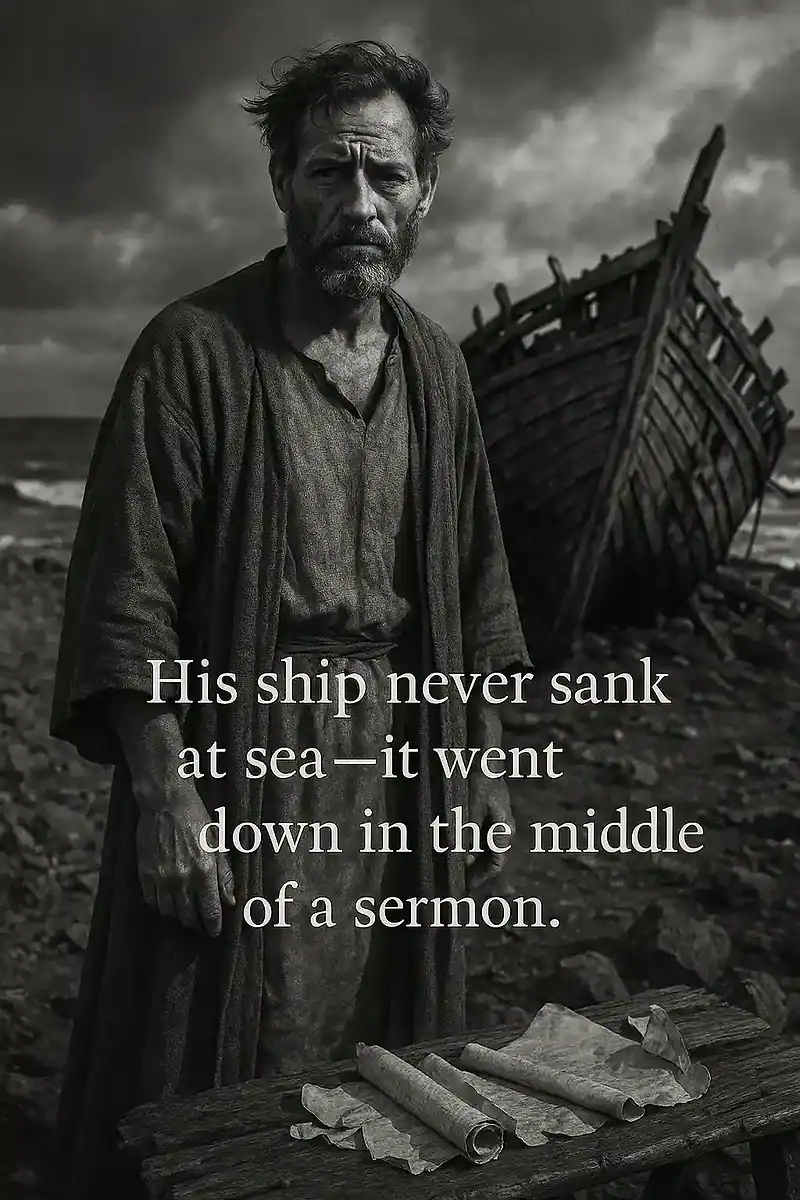
So Paul wrote to Timothy, his beloved son in the faith. “Holding faith, and a good conscience,” he said, “which some having put away concerning faith have made shipwreck: of whom is Hymenaeus and Alexander.”
Shipwreck. The word carried salt and sorrow. Paul knew what it meant to feel a ship torn apart by storm. He’d lived it once on the sea – and now he used it to describe a soul.
A Ship Torn Apart
Hymenaeus was once steady, like a vessel made for long voyages. But pride had been the unseen reef beneath the surface. Each argument, each boast, each careless twisting of Scripture scraped against it until the hull of faith splintered. The vessel sank not from one blow but from many small compromises.
He thought he was steering toward enlightenment, but he was drifting toward ruin.
The Lord had warned long before: “Every idle word that men shall speak, they shall give account thereof.” But Hymenaeus’ words were not idle – they were heavy with consequence.
The Fractured Fellowship
Timothy faced the heartbreaking duty of correction. The fellowship was strained; falsehood had divided hearts. Some who once sang side by side now whispered doubts. The young pastor, still tender in years but strong in spirit, had to stand firm. Paul instructed him to “charge some that they teach no other doctrine.”
Hymenaeus resisted. He thought Paul was harsh, narrow, outdated. He couldn’t see that holiness always feels constraining to those who crave applause. His rebellion wasn’t just against doctrine – it was against authority, against correction, against God Himself.
And when Paul said he had “delivered Hymenaeus unto Satan,” it wasn’t cruelty – it was mercy in disguise. It was a boundary that might lead to repentance, the spiritual equivalent of cutting away a diseased limb to save the body.
The Weight of Words
Every word Hymenaeus spoke carried the echo of something lost. The church that once respected him now prayed for him. His influence had become his downfall. He’d wanted a platform; instead, he became a warning.
Sometimes judgment comes not as lightning, but as silence. The same God who opened Paul’s mouth to preach could also close another’s. Hymenaeus, who once commanded crowds, found his words hollow. The authority he’d claimed for himself slipped through his fingers like sand.
The Divine Reckoning
Scripture doesn’t tell us if Hymenaeus ever repented. His name stands like a caution sign in Paul’s letters – a reminder of what happens when someone treats God’s truth like clay to be molded instead of treasure to be guarded.
It’s sobering, because it wasn’t ignorance that ruined him – it was arrogance. The man who thought he could refine truth ended up ruining his faith.
And yet, even here, grace lingers. The door of repentance wasn’t barred. As long as breath remains, mercy can still call a man home.
The Lesson in the Ruins
The story of Hymenaeus isn’t about one man’s failure – it’s about the slow corrosion that can happen when pride replaces purity. The same voice that once said “Christ is risen” can later whisper “Did God really mean that?”
We might shake our heads at Hymenaeus, but his shadow reaches across centuries into our pulpits, platforms, and comment sections. Every believer who twists truth for applause walks the same shoreline where his ship once broke apart.
Faith doesn’t collapse in a single day – it erodes when we start loving the sound of our own opinions more than the Word that formed the world.
Modern Parallels and the Call to Guard Truth
Today, we live in a sea of opinions, where everyone claims to speak “their truth.” But truth doesn’t belong to us – it belongs to God. The Word of God is not clay to shape; it’s an anchor to hold. When we treat it lightly, we drift.
Every preacher, every teacher, every believer has to decide: Will I handle the Word to impress people, or to honor the Lord?
Paul’s warning to Timothy still matters: “Study to show yourself approved unto God, a workman that needeth not to be ashamed, rightly dividing the word of truth.” That’s the steady hand on the wheel when waves rise.
The Anchor Still Holds
Hymenaeus’ name faded into history, but his story didn’t. It still speaks. It tells us that faith must be guarded, humility must be chosen, and truth must be held tighter than reputation.
There’s a sobering beauty in how Scripture ends his story – not with vengeance, but with an unfinished sentence. It leaves room for repentance, for anyone who’s drifted too far. Because Christ is still the anchor, and His grace can reach even those who have shipwrecked themselves.
A Closing Reflection
Somewhere in the mystery of grace, even the man who broke faith can be restored by the One who never fails. The sea may have swallowed his ship, but not his soul – if he only turned back.
That’s the miracle that humbles us all: no one is too lost to be found, and no word is too broken to be redeemed by the Word made flesh.
And so the story ends where all truth begins – in the mercy of Christ, who still calms the waves and restores the fallen.