The wine was sweet in his throat, but power was sweeter.
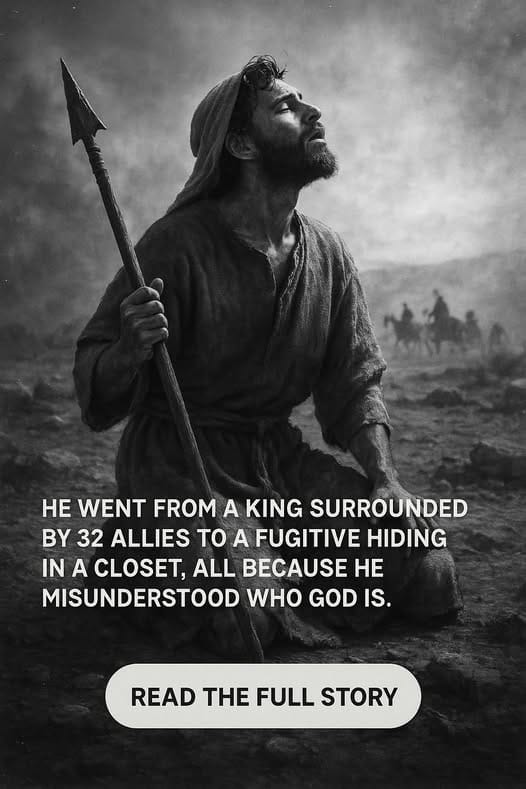
Ben-hadad, King of Aram, sat in his opulent war tent, the air thick with the smell of spiced wine, sweat, and arrogant confidence. Outside, the walls of Samaria stood silent, a prize already won. Around him, 32 vassal kings – puppets on his string – drank and laughed, their loyalty bought with fear.
A messenger entered, bowing so low his forehead touched the dust.
“My lord, O king,” the man trembled, “Ahab of Israel… he has refused your second message. He says he will give his gold, his silver, and his wives. But he will not allow your servants to search his house.”
A “search.” That was the polite word. Ben-hadad had meant plunder. He had meant humiliate. He had meant break.
A dark fire lit in Ben-hadad’s eyes. The laughter in the tent died. He had offered Ahab submission, and the weak-willed king had accepted. Then, to test the limits of his power, Ben-hadad had tightened the screw, demanding the right to ransack the palace. And the worm had turned.
“Go back,” Ben-hadad growled, his voice a low thunder. “Tell that… king… ‘May the gods do so to me, and more also, if the dust of Samaria shall be enough for handfuls for all the people who follow me!'”
It was more than a threat. It was a theological statement. His gods were greater. His army was greater. His will was supreme. He would grind Samaria, and its pathetic little local god, into powder.
A Defeat That Makes No Sense
The battle plan, when it came, was laughable.
Ahab, apparently stirred by some prophet, was sending out… the servants. The young, untrained pages and servants of the provincial princes. 232 of them.
Ben-hadad was in his pavilion at noon, already deep into the wine, when the report came. “A small band is coming out of the city.”
He waved a hand dismissively, sloshing his goblet. “It doesn’t matter. Whether they come out for peace or for war, take them alive. We’ll make a sport of them.”
He turned back to his drink. The next thing he heard was not the cheer of victory, but a scream.
Then another. Then the sound of a thousand men panicking.
Ben-hadad stumbled out of his tent into chaos. His massive, professional, overwhelming army was… fleeing. They were terrified, breaking ranks, and running from this tiny band of 232 boys who, empowered by a sudden and terrifying strength, were slaying every man in their path. The 7,000-man army of Israel followed, and the rout was absolute.
His commanders grabbed him, threw him on a horse, and he fled. The Great King Ben-hadad, lord of 32 kings, a fugitive, escaping with a ragged remnant of his command.
The humiliation was worse than the defeat. It was illogical. It was impossible. It was a cosmic error.
The Worst Theological Advice in History
He spent the winter brooding. His power was broken, his reputation shattered. His servants, however, had a theory. They approached him carefully, their heads bowed.
“My lord,” one advisor began, “we know what went wrong. We have studied the God of Israel.”
Ben-hadad’s eyes narrowed.
“Their God… He is a God of the hills,” the servant explained, his voice gaining confidence. “Samaria is in the mountains. That is why they were stronger than us. It’s obvious.”
A murmur of agreement went through the court. It made perfect sense. Every god had a domain. Hadad was god of the storm. Dagon was god of the grain. And this “Yahweh”… clearly, he was a mountain god.
“But,” the advisor continued, a slow smile spreading, “let us fight them in the plain. In the valley. He has no power there. Surely, we will be stronger than they. We will drag their hill god into the valley and drown him.”
Hope, cold and sharp, returned to Ben-hadad. Of course. That was it. He hadn’t been defeated by a superior God, just a specialized one. He had fought on the enemy’s home turf.
“Rebuild the army,” Ben-hadad commanded, his voice returning. “Match it man for man, chariot for chariot. And remove those 32 drunken kings. Put captains in their place. Professional soldiers.”
This time, there would be no mistakes. This time, they would fight in the valley.
When God Overhears Your Battle Plan
Spring came. The Aramean army, reborn and massive, marched to Aphek, a city in a wide, flat plain. They “filled the country,” a sea of bronze and iron.
And then, Israel arrived.
When the scouts saw them, they laughed. Pitched on the hillside, the army of Israel looked like “two little flocks of kids.” They were a joke. A rounding error.
Ben-hadad rode to the front line, drinking in the sight. This would be a slaughter. This would restore his name.
But in the Israeli camp, another man was walking. A man of God, sent with a message for Ahab. And the message wasn’t for Ahab alone; it was for the king staring at them from across the plain.
The prophet stood before Israel and declared, “Thus says the LORD: ‘Because the Arameans have said, “The LORD is God of the hills, but He is not God of the valleys,”… therefore, I will deliver all this great multitude into your hand, and you shall know that I am the LORD.'”
God had heard Ben-hadad’s strategy meeting. And He had taken it personally.
The God of the Valleys
For seven days, the two armies faced each other. The Arameans, confident. The Israelites, terrified, but clinging to a promise.
On the seventh day, the battle was joined.
It wasn’t a battle. It was a judgment.
The power that had filled 232 boys now filled an army. The Israelites cut through the Aramean ranks like a scythe through grass. The Arameans, who trusted in their numbers and their valley, had no answer for the God of the valley. Their strength melted. Their courage vanished.
In a single day, Israel struck down 100,000 Aramean footmen.
Ben-hadad, seeing the slaughter, fled again. But this time, there was nowhere to run. He and the remaining survivors scrambled into the city of Aphek, barring the gates. They were trapped, but at least they were safe.
And then the walls fell down.
Not from a siege engine. Not from an earthquake. The stone wall simply… collapsed. It fell on the 27,000 men hiding behind it.
Ben-hadad, the King of Aram, the man who would grind Samaria to dust, was found by his servants, hiding in an “inner chamber” – a closet. A storage room. He was shaking, stripped of his crown, his army, his pride, and his theology.
His advisors, the same men who gave him the “hill god” theory, now had a new idea. “Behold now, we have heard that the kings of the house of Israel are merciful kings. Let us put sackcloth on our loins and ropes on our heads, and go out to the king of Israel. Perhaps he will save your life.”
The man who demanded everything now begged for anything. The king who believed God was confined to the hills had just been crushed by the God of the valleys.
He Is Lord of Your Valley, Too
It’s such a human story, isn’t it? We still do this. We try to put God in a box.
We have our “hilltop” faith. We’re great at being believers on Sunday morning. We’re happy to call Jesus the God of our family, our quiet time, our small group. We praise Him in the light, in the good times, when we’re on the “hills” of life.
But what about the valley?
What about the “valley” of a terrifying diagnosis? The “valley” of a crippling debt? The “valley” of a rebellious child, a broken marriage, or a secret, private addiction?
We walk into that place, and suddenly, like Ben-hadad’s advisors, we create a new theology. We start to believe, “God isn’t here. This is my fight. This is the plain. God doesn’t do this.” We think our problem is too big, too messy, too “earthly” for the God of the heavens.
And God overhears our battle plan. He hears us say, “He is a God of the hills, but not of the valleys.”
And with breathtaking love, He steps right into our mess and says, “Therefore… I will deliver you. And you will know that I am the LORD.”
From a Falling Wall to a Riven Side
The story of Ben-hadad shows us the sovereignty of God. The falling wall at Aphek is a terrifying display of His power over every domain. There is no place, no problem, no king, and no strategy that is outside His rule.
But glory to God, the story doesn’t end there. That Old Testament judgment shows us His reach, but the New Testament shows us His heart.
The final word on God’s power in the valley isn’t a wall falling on us; it’s a cross standing for us.
Jesus is the ultimate proof that God is Lord of the valleys. He willingly left the highest hill of heaven to come down to the deepest, darkest, most broken valley of human existence. He walked the plain of our sin, our sickness, and our death. He didn’t just meet us in the valley; He became the valley for us, taking all of our judgment onto Himself.
The wall fell on 27,000 Arameans, but the weight of the world fell on Christ. The God of the hills became the man of the valleys, so that we could be rescued from both.
He is not a God of the hills or the valleys. He is the God of the hills and the valleys, and every single place in between.
Call to Action: The Question That Demands an AnswerIn Acts 2:37 Peter and the Apostles were asked the question – What Shall We do? And in Acts 2:38 Peter answered, Repent, and be baptized every one of you in the name of Jesus Christ for the remission of sins, and ye shall receive the gift of the Holy Ghost. For the promise is unto you, and to your children, and to all that are afar off, even as many as the Lord our God shall call. Do you understand this? After hearing the gospel and believing, they asked what should would do. The answer hasn’t changed friend, Peter clearly gave the answer. The question for you today is, Have you receieved the Holy Spirit Since you believed? If you’re ready to take that step, or you want to learn more about what it means to be born again of water and Spirit, visit: Come, and let the Spirit make you new. |