Quick Overview of This Bible Study…
Short on time? I have created a short slide show presentation of some key takeaways in our study. The complete, more comprehensive Bible study is below…
Then sang Deborah and Barak... – so begins Judges Chapter 5, introducing us to one of the Bible’s most remarkable women. Deborah shines in Scripture as a prophetess, a judge, a warrior-leader, and even a poet.
Her story in Judges 4–5 is an inspiring tale of faith and courage amid a dark era. In this deep dive, we’ll explore who Deborah was, what her name means, how she led Israel to victory, and how her life connects to broader biblical themes.
We’ll also draw out lessons for Christians today – all in a friendly, down-to-earth way.
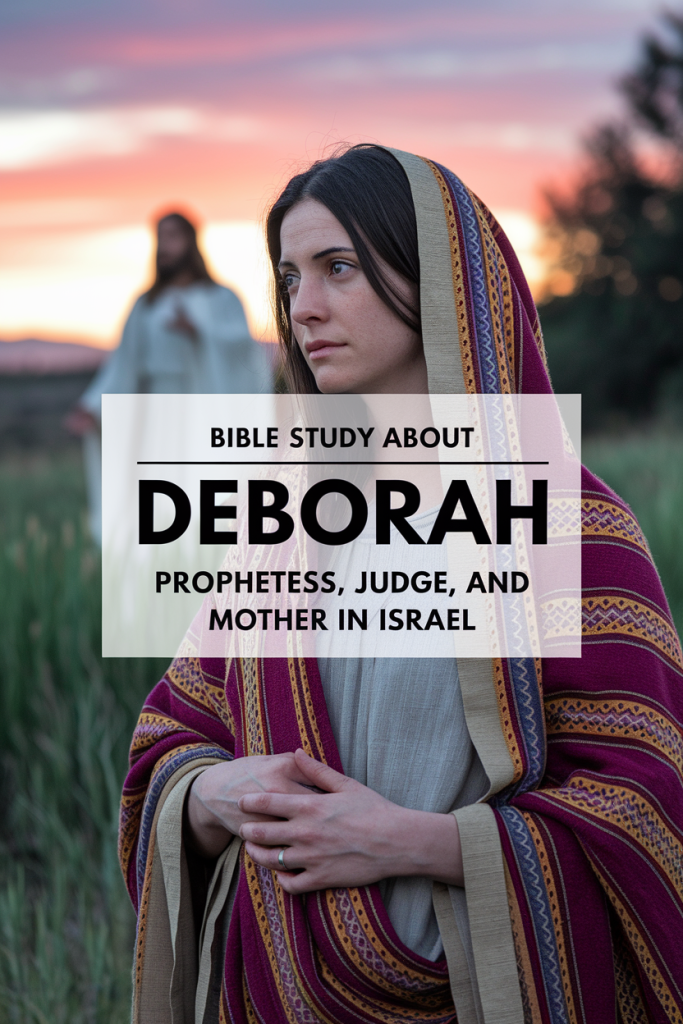
Deborah’s Name and Role: What’s in a “Bee”?
The very name Deborah (Hebrew D’vorah) literally means “bee.” Yes, like the honeybee! At first that might seem cute or odd for a leader, but it carries spiritual symbolism.
According to ancient Jewish teaching, the Hebrew people (and the Torah, God’s Word) are compared to bees in several ways:
Sweet and Sting:
A bee’s honey is sweet, but its sting is sharp. God’s Word, delivered through Deborah, was sweet to the obedient but stung those who disobeyed.
In fact, Deborah’s message brought blessing and “sweet” victory to Israel, but a painful end to God’s enemies.
Just as honey is sweet to the taste, “sweeter also than honey and the honeycomb” is God’s truth to those who follow it (Psalm 19:10).
Yet for Sisera (the enemy general) and those who “follow not His commands,” the Lord’s judgment would sting.
Following a Leader:
Bees follow their leader in a swarm, and Israel “swarmed” to Deborah.
Despite being one of the few female leaders in Scripture, Deborah had a God-given authority that people recognized and followed.
Like a queen bee in a hive, she rallied the nation around her guidance – though she herself was following God as her leader.
Working for Others:
Bees collect pollen not for themselves but for the hive’s benefit. Similarly, Deborah served not for personal gain but for God’s people. Her efforts nourished Israel spiritually and physically (bringing 40 years of peace).
She even refers to herself as “a mother in Israel”, highlighting her nurturing, selfless leadership. Like a mother bee tending the hive, Deborah cared for her nation’s well-being.
Humility:
Finally, a bee is a lowly insect, a reminder to stay humble. Deborah’s humility is seen in how she gives God the credit for victory and calls herself just “a mother” rather than a queen or hero.
She doesn’t seek fame; she seeks God’s will. This humility made her a vessel God could use mightily – a good lesson for us today!
Beyond her name, Deborah’s titles and roles also speak volumes. Judges 4:4 introduces her as “Deborah, a prophetess, the wife of Lapidoth” who was “judging Israel”.
Let’s unpack that:
Prophetess:
Deborah was one of only a handful of women in the Old Testament given this title.
As a prophetess, she heard God’s voice and shared His Word with others. In fact, her role as prophet is mentioned first, even before her judging role – showing the priority of God’s word in her life.
She sought the Lord’s guidance and then boldly proclaimed “the LORD God of Israel hath commanded…” (Judges 4:6). In a very real sense, Deborah was God’s spokeswoman to His people.
Judge:
Deborah is also the only female among the twelve judges who led Israel in that era. These judges were not courtroom judges in robes, but leaders and deliverers raised up by God. They would settle disputes during peace and rally the tribes in war.
Deborah held court under a palm tree (later called “the Palm of Deborah”), where Israelites came to her for counsel and justice (Judg. 4:5).
That palm tree was an open-air court – symbolically a neutral place of fairness where anyone could approach.
Picture her sitting under swaying palm branches, imparting wise judgments with God’s law in her heart. She was renowned for her wisdom and people trusted her leadership.
“Wife of Lapidoth”:
This phrase can simply mean she was married to a man named Lapidoth. But interestingly, in Hebrew it can also be translated as “woman of torches” or “woman of lightning”.
Lapidoth relates to flashes or flames.
Some scholars think this could hint at Deborah’s fiery character or spiritual fervor. Others note it connects to the name of Barak (the military commander she works with), since Barak means “lightning” in Hebrew.
We don’t know for sure, but it’s as if the text is winking that Deborah was a bright light in Israel’s dark times – a torch woman igniting faith in others. Fiery or not, she certainly lit a spark under Barak (pun intended)!
Leader & Mother:
Deborah describes herself in her victory song as “a mother in Israel”. This is a tender way to see a leader.
She wasn’t a tyrant commanding armies for glory; she was a mother-figure, protecting and caring for her children (the Israelites). Like a mom, she both nurtured (through her counsel and faith) and defended (through decisive leadership in battle).
She even calls out when “villages ceased” and chaos reigned in Israel, “until that I Deborah arose… a mother in Israel”. Sometimes a mother’s touch is exactly what a nation needs – strong love in action.
In short, Deborah’s identity is rich: a humble “bee” with a prophetic voice, a fiery woman of light, a just judge, a courageous military leader, and a loving mother to her people. It’s no wonder she’s held up as one of the most influential women of the Bible.
Now, knowing who she is, let’s revisit the thrilling story of what she did.
The Story (Judges 4): Deborah Leads Israel to Victory
To set the scene: Israel in Deborah’s day was in one of its rebellious slumps. The Book of Judges tells of cycles where Israel would forget God, fall into sin, get oppressed by enemies, then cry out to God for help – and God would raise up a deliverer (a judge).
Deborah steps into history during one of these low points. The Israelites had been oppressed for twenty years under Jabin, a Canaanite king, and his fearsome general Sisera, who commanded 900 iron chariots (ancient tanks!) (Judges 4:2-3).
The people were bullied and afraid; village life had ceased (Judg. 5:6-7). They desperately needed deliverance.
Enter Deborah.
She is already respected as a judge and prophetess.
- In Judges 4:6-7, she summons a man named Barak (from the tribe of Naphtali) and gives him a startling message from God: “Hath not the LORD God of Israel commanded, saying, Go and draw toward mount Tabor, and take with thee ten thousand men... And I will draw unto thee Sisera, the captain of Jabin’s army... and I will deliver him into thine hand”?
In plain terms, God was directing Barak to gather an army from the tribes of Naphtali and Zebulun, march to Mount Tabor, and God would lure Sisera’s forces out – setting Sisera up for defeat. It was a divine battle plan.
Barak hears this prophecy, and his response is both faith mixed with fear.
- He says, “If thou wilt go with me, then I will go: but if thou wilt not go with me, then I will not go” (Judg. 4:8).
You can almost imagine Deborah raising an eyebrow here. Barak’s name means “lightning,” but he won’t strike without Deborah by his side!
Still, we can sympathize – Sisera’s army was intimidating, and Deborah clearly carried God’s presence. Barak wanted that assurance of God’s favor (embodied by Deborah) with him.
- Deborah agrees to go to battle with Barak, but she delivers a gentle rebuke-cum-prophecy: “I will surely go with thee: notwithstanding the journey thou takest shall not be for thine honour; for the LORD shall sell Sisera into the hand of a woman” (Judg. 4:9).
In other words, “Alright, I’ll come – but know this, the glory of the victory will go to a woman, not you.”
This might have stung Barak’s pride (there’s that bee sting!). It was unusual for a woman to get the battle honors, but Deborah was foretelling exactly what would happen. Barak would win the battle, but a woman would ultimately take down Sisera.
- With the plan set, Barak mustered 10,000 troops and went up Mount Tabor, with Deborah alongside (Judg. 4:10).
When Sisera heard of this Israelite rebellion, he rallied his chariots and army to the Kishon River below Tabor. The stage was set – ragtag foot soldiers of Israel on the hill, and Sisera’s professional chariot force in the valley.
- At the critical moment, Deborah gave the go-order. “Up; for this is the day in which the LORD hath delivered Sisera into thine hand. Is not the LORD gone out before thee?” (Judg. 4:14).
This statement radiates faith. Deborah essentially says, “Go now! God has already won the battle ahead of you!” Encouraged, Barak charges down Mount Tabor with his men.
And indeed, the Lord intervenes: Judges 4:15 says “the LORD discomfited (routed) Sisera, and all his chariots, and all his host, with the edge of the sword before Barak.” The mighty Sisera’s army fell into chaos and was soundly defeated.
Though the text in chapter 4 is sparse on details, Deborah’s song in chapter 5 gives more color.
- It appears God sent a furious rainstorm: “The river of Kishon swept them away, that ancient river” (Judg. 5:21).
Those heavy iron chariots likely got stuck in mud as the Kishon River flooded. Even “the stars in their courses fought against Sisera” (5:20) – poetic language for heavenly forces aligning to help Israel.
In any case, Sisera’s technological advantage was neutralized by a God-ordained downpour.
- Panic ensued as Barak’s men swooped in. Sisera’s troops were slaughtered, and Sisera himself abandoned his chariot and fled on foot (Judg. 4:15,17).
Now comes the twist that fulfills Deborah’s prophecy. Sisera, exhausted and desperate, runs to the tent of a woman named Jael.
- She’s the wife of Heber, a Kenite ally of King Jabin (Judg. 4:17).
- Jael greets Sisera warmly: “Turn in, my lord, fear not,” she says, covering him with a blanket (4:18).
- She even gives him milk to drink when he asks for water – perhaps a motherly touch to lull him into a false sense of security (4:19).
Sisera, thinking he’s safe, falls into a deep sleep in Jael’s tent.
Jael then takes action – and it’s not for the squeamish! While Sisera is sleeping, Jael silently takes a long tent peg and a hammer. Steeling her nerves, she drives the peg through Sisera’s temple into the ground (Judg. 4:21).
Not exactly a “peaceful” womanly act, but in doing this, Jael single-handedly takes out the feared oppressor of Israel. Sisera is killed instantly. When Barak arrives chasing Sisera, Jael calmly shows him the gruesome proof – “Behold, there lies Sisera dead, and the tent peg is in his temple” (4:22).
Thus, as Deborah foretold, the honor of the victory went to a woman. Two women, in fact, partnered in this deliverance: Deborah who orchestrated the battle under God’s command, and Jael who finished off the enemy general.
The chapter ends recording Israel’s triumph: “God subdued on that day Jabin the king of Canaan” and Israel gained strength until Jabin was destroyed (4:23-24).
Freedom was won! What a dramatic victory – achieved by faith, boldness, and a few nails (both literally and figuratively).
Let’s pause and imagine the scene: An entire nation delivered from cruel oppression because one woman listened to God and had the courage to act on His word, and another woman seized the moment to strike down evil.
Deborah’s faith sparked Barak’s action; Jael’s hand drove the final blow. It’s the stuff of epic movies, yet it’s history written in Scripture for our instruction.
Before moving on, consider this personal takeaway: Are there battles in our lives where we feel outmatched like Israel versus Sisera?
Deborah’s story reminds us that if God is leading the charge, no enemy – no matter how “iron-chariot” strong – can stand.
We might feel inadequate on our own (Barak certainly did), but God often places “Deborahs” in our life – people who encourage our faith and point us back to God’s promises.
And sometimes He calls us to be a Deborah for someone else, speaking courage into fearful hearts.
Now, after the adrenaline of battle, what did Deborah do? She did what any worshipful soul would: she sang!
The Song of Deborah (Judges 5): Praise, Poetry, and Prophecy
Chapter 5 of Judges records “The Song of Deborah,” a victory hymn believed to be composed and led by Deborah (and Barak).
If Judges 4 was the action movie, Judges 5 is the celebratory music video – full of poetic imagery, spiritual reflection, and yes, some holy taunting of the defeated foe.
This ancient song gives us insight into Deborah’s heart and the spiritual significance of the triumph.
- The song opens with a call to praise God: “Praise ye the LORD for the avenging of Israel, when the people willingly offered themselves” (Judg. 5:2).
Right away, Deborah directs the glory to God, the true Deliverer. She also acknowledges the people’s volunteer spirit.
This leader doesn’t sing about her own heroics; she sings about God’s power and the bravery of those who answered the call. It’s a beautiful example of a leader giving credit to God and others, not herself.
Deborah then recounts how God Himself marched out to fight: “LORD, when thou wentest out of Seir... the earth trembled, and the heavens dropped, the clouds also dropped water” (5:4).
This refers to God sending the storm that routed Sisera – the earthquake-like thunder, the torrential rain. Even “the mountains melted” (5:5) before God. This language mirrors other biblical songs of deliverance (like Moses’ song in Exodus 15).
It’s as if Deborah is saying, “Just like God shook Sinai in the past, He showed up for us at Mount Tabor!” She recognizes the victory was a miraculous act of God.
In the next verses, Deborah paints the grim picture of Israel’s condition before the deliverance. “The inhabitants of the villages ceased... until I Deborah arose... a mother in Israel” (5:7).
Highways were empty and travelers sneaked by backroads (5:6) – a sign of fear and oppression. She notes “they chose new gods; then was war in the gates” (5:8), pointing out that Israel’s idolatry had brought this trouble (no shield or spear among 40,000 in Israel – they were disarmed and defenseless).
Deborah rising as a “mother” indicates she stepped into this chaos to care for and lead her people back to God. It’s a humble way to describe her leadership, almost like, “I just did what a mom would do when her kids are in danger.”
The song then shifts to rally everyone to praise and remember.
“Speak, ye that ride on white asses, ye that sit in judgment, and walk by the way” (5:10) – meaning, all of you from every walk of life, talk about this! Sing about how God delivered us.
In verse 12, we even get a glimpse of Deborah cheering herself on: “Awake, awake, Deborah: awake, awake, utter a song!” and to Barak, “Arise, Barak, and lead thy captivity captive” (5:12).
That phrase “lead thy captivity captive” is interesting – it means “take your captives, O captor!” – Barak is told to parade the defeated enemy, a sign of total victory.
(Fun fact: this phrasing echoes in the New Testament describing Christ’s victory over Satan – more on that later.)
Deborah’s song also highlights the cooperation (or lack thereof) among the tribes of Israel in the battle. She praises the tribes that answered the call: “the people of the LORD went down for me against the mighty” (5:13).
Ephraim, Benjamin, Machir (Manasseh), Zebulun, Naphtali – these fought valiantly (5:14,18). Especially Zebulun and Naphtali “jeoparded their lives unto the death in the high places”, true heroes.
But she also notes some tribes that were missing in action: Reuben had “great thoughts of heart” but stayed among his flocks listening to sheep bleats (5:15-16).
Gilead (Gad) lingered, Dan hung back at his ships, Asher stayed at the coast (5:17).
It’s like a roll call with some awkward silences – “Where were you guys?” Deborah doesn’t shy away from gently calling out those who shirked their duty.
In fact, she outright curses the city of Meroz for not coming to help: “Curse ye Meroz... because they came not to the help of the LORD, to the help of the LORD against the mighty” (5:23).
Strong words! The lesson is clear: when God’s people are called to fight evil, sitting on the sidelines is a serious failing. (I’m sure the inhabitants of Meroz regretted that choice every time this song was sung.)
On the positive side, Deborah gives highest honor to Jael in her song – and here we see her prophetic word about a woman getting the glory come full circle. She sings: “Blessed above women shall Jael the wife of Heber the Kenite be, blessed shall she be above women in the tent”.
That’s very high praise – “most blessed of women”! Jael is celebrated as a fearless instrument of God. Deborah vividly recounts the scene: Sisera asked for water, Jael gave him milk and curds in a lordly dish (a hospitable gesture) (5:25).
Then: “She put her hand to the nail, and her right hand to the workmen’s hammer” and drove the nail through his head (5:26). “At her feet he bowed, he fell, he lay down: ... he fell down dead” (5:27).
The repetition drives home Sisera’s complete defeat at a woman’s hands. One can imagine the Israelites cheering every time they sang this part! It might sound gory to us, but in their context this was rejoicing that a great evil had been vanquished.
Deborah doesn’t glorify violence gratuitously; she glorifies God’s justice delivered through an unlikely hero, Jael.
A poignant touch: Deborah even empathizes with Sisera’s mother in the song. In verses 28–30, she imagines the mother of Sisera peering out her window, wondering why her son’s chariot is late returning.
Her ladies-in-waiting try to comfort her (perhaps with sarcasm in the song) saying, “They’re dividing the spoil – a girl or two for every warrior, and rich fabrics for Sisera” (paraphrasing 5:30).
Of course, we know Sisera wasn’t coming home at all. This contrast between Sisera’s mother’s false hope and the reality highlights the totality of God’s victory.
The mighty have fallen, and the tables are turned – the ones who thought they’d get Israelite girls as spoil were defeated by an Israelite (well, Kenite) woman.
Deborah ends the song with a powerful final line that doubles as a prayer and a principle: “So let all thine enemies perish, O LORD: but let them that love Him be as the sun when he goeth forth in his might” (5:31).
What a beautiful benediction! May all God’s enemies meet the same fate as Sisera – and may those who love God rise and shine in full strength like the sun at dawn.
It’s her way of saying “God, bring down the wicked, and bless Your faithful ones with victorious power and brightness.”
In fact, Jesus echoes a similar thought in the New Testament: “Then shall the righteous shine forth as the sun in the kingdom of their Father” (Matthew 13:43).
Deborah’s prayer came true in her time – “the land had rest forty years” (5:31). And ultimately, it points to the final triumph of God’s love over evil.
Take a moment to appreciate that Deborah was not only a warrior and leader, but also a worshiper and poet. She led the people in both battle and praise.
This balance is instructive: after victory, she didn’t forget to thank the One who made it possible. How often do we pray desperately in crisis but forget to sing God’s praises when the crisis passes?
Deborah shows us the importance of testifying and celebrating God’s goodness, so that others remember His deeds and future generations know the story.
Her song stands as one of the oldest recorded poems in Scripture.
It’s similar to Miriam’s song in Exodus 15 (after crossing the Red Sea) and even has shades of Hannah’s prayer (1 Samuel 2) and Mary’s Magnificat (Luke 1).
In all these, we see women lifting their voices to exalt God’s salvation. Deborah may well have inspired later believers to do the same.
Lessons from Deborah for Today’s Believers
Deborah lived over three millennia ago, but her life is brimming with lessons for Christians. As someone who “deeply trusts and believes the Word,” I find Deborah’s story personally encouraging. Let’s highlight a few key takeaways (consider these Deborah’s instructions to us, if you will):
Have Courageous Faith in God’s Word:
Deborah shows unwavering confidence in what God speaks. When she says “Has not the Lord commanded…?”, she’s basically staking everything on God’s promise. And He delivered!
We’re called to a similar faith – to take God at His Word. It might not be about fighting chariots, but perhaps it’s trusting God in a career move, a ministry, or confronting a personal “giant.”
If God has made a promise (in Scripture or by His Spirit’s leading), we can move forward courageously.
Like Deborah told Barak, “Is not the Lord gone out before thee?” – remember, God goes before us too. This doesn’t mean we’ll never feel fear (Barak had his doubts), but faith means acting on God’s word despite fear.
And God is gracious – He gave Barak the encouragement of Deborah’s presence.
In our journey, He often gives us the encouragement of fellow believers, mentors, or friends to boost our faith.
Don’t hesitate to seek support when you’re struggling to obey; just don’t let fear paralyze you. Ultimately, “God hath not given us the spirit of fear; but of power, and of love, and of a sound mind” (2 Tim 1:7).
God Can Use Anyone – No Exceptions:
Deborah’s very role shatters a lot of preconceived notions. In a male-dominated culture, she led an entire nation. Clearly, God’s calling is not limited by our human categories. He chose a woman to be the spiritual and political leader in that time – something that might have been shocking then.
This reminds us of Paul’s words, “There is neither male nor female: for ye are all one in Christ Jesus” (Galatians 3:28).
God gives gifts and roles as He wills. Deborah’s story should encourage women (and men) today: your gender, background, or status does not limit how God can work through you.
What matters is a willing heart and obedience. She was a wife (possibly, or “woman of torches”), possibly a homemaker (if the “making wicks for the Tabernacle lamps” theory is true) – yet also a prophetess and leader. Many of us wear multiple “hats” too!
Don’t let anyone tell you God can’t call you because you don’t fit a usual mold. If He calls, He equips and breaks societal norms if needed. Deborah also shows that strong leadership can go hand in hand with humility and nurturing.
Whether you’re leading a church group, your family, or an office project, do it with the courage of a warrior and the heart of a caring mother/father. People will see God’s character in that balance.
Seek Justice and Stand Up in Evil Times:
Deborah arose when others were sitting down. She didn’t wait for someone else to fix Israel’s problems. Her example calls us to rise against injustice and evil in our world.
- There’s a time to sit and counsel under the palm tree, but there’s also a time to say “Up! This is the day!” and charge into action (Judg. 4:14).
As Christians, we shouldn’t be content to hide in the hills when there are battles to fight – whether it’s fighting human trafficking, speaking up for the oppressed, or spiritually battling in prayer for our community.
Deborah literally went to the battlefield; for us, spiritual warfare is often fought on our knees in prayer or by actively doing what’s right in society.
- Ephesians 6:13 says “take unto you the whole armor of God, that ye may be able to withstand in the evil day.”
Deborah’s armor was her faith in God’s word; ours is the same, along with righteousness, salvation, the gospel of peace, etc. Don’t be a Meroz – those villagers who did nothing when God’s cause needed them (Judg. 5:23).
That verse actually says they didn’t come “to the help of the LORD,” implying that not acting was seen as refusing to help God Himself. Ouch. If you see a need and feel that tug in your spirit, be willing to step up. You might be the “Deborah” God is calling for that situation.
Work Together in God’s Plan:
One striking aspect of Deborah’s story is partnership. She didn’t fight alone; she worked with Barak, and ultimately Jael’s part was crucial. In the body of Christ, we are meant to work as a team.
Some of us are Deborahs (visionary leaders), some are Baraks (faithful generals/executors), some are Jaels (seizing spontaneous opportunities to serve).
All are needed to secure the victory God wants to give. The New Testament compares the church to a body with many parts, each vital (1 Corinthians 12).
Imagine if any part in Deborah’s story had said “nah, I won’t bother” – the outcome might have been different.
Thankfully, Deborah answered God’s call, Barak gathered the troops, 10,000 unnamed heroes volunteered to fight, and Jael delivered the coup de grâce.
Likewise, we each have a role. Don’t underestimate the importance of your obedience – even if you’re just one tent-peg-wielding person in the middle of nowhere, God can use you to bring down strongholds!
Also, note how Deborah encouraged Barak instead of belittling him for hesitating. She agreed to go with him.
Sometimes strong believers need to come alongside those who are weaker in faith, not to co-enable doubt but to strengthen them until they can stand firm. It’s a beautiful picture of bearing one another’s burdens (Gal. 6:2).
The Power of Praise and Remembering:
Deborah didn’t skip the victory party – she led it. After God gives us a breakthrough, big or small, sing your song of praise!
You might not write a new hymn like she did, but take time to genuinely thank God and even share the testimony with others. It solidifies our faith and inspires others.
Deborah’s song also teaches us to remember the lessons of our battles. She praised those who fought and noted those who didn’t. In our lives, when God brings us through challenges, reflect on it: who were the helpers God sent?
Who maybe disappointed us?
How can we encourage the helpers (and perhaps graciously challenge the idle)?
Every experience can teach and sanctify us if we don’t rush past it. Also, use your talents for God’s glory. Deborah clearly had a talent for poetry/music, and she used it to honor God.
If you have gifts – music, writing, art, strategic thinking, hospitality – bring them into God’s service. Your “song” might be what cements a move of God into a lasting legacy.
Let God’s Word Be Sweet to You (Even When It Stings):
Remember Deborah’s name meaning “bee”? The bee imagery reminds us that God’s word can comfort and convict. When Deborah gave Barak God’s command, it came with a sting (his hesitation was exposed) but also a sweet promise of victory.
As believers, we should welcome both aspects of God’s word in our lives – the honey and the sting. The Bible will sometimes challenge our pride or sin (sting), but if we receive it, it brings sweetness and life.
- Proverbs 27:6 says “Faithful are the wounds of a friend.”
God’s rebukes through Scripture or a prophetic word are like a sting that ultimately brings healing (kind of like a bee’s venom can have medicinal uses!).
Deborah’s prophecy contained a corrective for Barak, but it didn’t disqualify him – it actually helped purify his motive (he knew he wasn’t in it for personal glory) and he still became a hero of faith.
So, when you read the Word or sense the Holy Spirit’s conviction, don’t shy away. Let it do its work, and you’ll taste the honey of God’s grace on the other side.
7. “Mother in Israel” – Spiritual Motherhood/Fatherhood:
Deborah embraced a maternal role for her people. In the church, we need spiritual mothers and fathers – those who will care for others with a selfless love, mentor the young, and protect the vulnerable. You don’t have to be biologically a parent to have this role.
Deborah had no mention of physical children; her children were the people she led. Ask God to give you a mother’s heart (if you’re a woman) or a father’s heart (if you’re a man) for those He’s put in your life.
That means being willing to nurture (teach, encourage, correct) and sacrifice for others’ good. Paul even described himself in maternal terms at times (1 Thess. 2:7, “like a nursing mother” caring for the church).
This kind of leadership is servant-hearted. If more of us led with a “mother in Israel” mindset, the family of God would be stronger and well-nourished in love.
Phew, that’s a lot – but Deborah’s life really is a gold mine of spiritual insights. And we’re not done yet! Let’s zoom out even further and see how Deborah’s story connects to Jesus and the New Testament.
From Deborah to Jesus: Foreshadows and Biblical Patterns
One of the exciting parts of Bible study is seeing how Old Testament stories whisper hints about the ultimate Savior, Jesus Christ, and the overall redemption story. Deborah’s account in Judges 4–5 is no exception. Here are some connections and patterns to ponder:
Deborah as a “Savior” Figure:
In Judges, each deliverer (judge) was a kind of mini-rescuer sent by God. They saved Israel from human oppressors, albeit temporarily. Deborah fits this pattern – she saved her people from Jabin and Sisera’s tyranny.
This foreshadows Jesus Christ, the ultimate Deliverer, whom God sent to save not just Israel but all of us from the oppression of sin and the devil.
The scale is different (eternal salvation vs. temporal), but the idea is the same: “God heard the cries of His people and raised up a deliverer.”
In fact, Nehemiah 9:27 looking back on the Judges era says God gave them “saviours” to rescue them. Deborah was one of those saviors with a small “s.”
She gives us a glimpse of Jesus’ saving work – He leads us to victory against our enemy (Satan) and gives us peace. Where Deborah’s victory gave 40 years of rest, Jesus’ victory gives us eternal rest and peace with God.
Crushing the Enemy’s Head – Genesis 3:15 Echo:
- Remember how Jael defeated Sisera? She literally crushed his head with a nail.
- This is a striking (pun intended) parallel to the first prophecy of the Messiah in Genesis 3:15, where God says the seed of the woman would bruise (crush) the serpent’s head.
- Many Bible readers and scholars have noticed that Jael’s “smashing” victory foreshadows Christ’s victory over Satan.
- Sisera, the oppressive enemy, can be seen as a figure of Satan or evil powers.
- A woman (Jael) was the instrument to defeat him – just as a woman (Mary, through giving birth to Jesus) was instrumental in bringing the serpent-crusher into the world.
- And Jesus, the offspring of the woman, crushed the head of the ultimate enemy, Satan, through His work on the cross and resurrection.
- Colossians 2:15 says Jesus “spoiled principalities and powers” (like disarming and shaming the enemy), which is spiritually akin to driving a spike through the devil’s plans.
- Deborah’s song even blesses Jael “above women” for this act, which interestingly parallels what Elizabeth says to Mary in Luke 1:42, “Blessed art thou among women”.
- Both Jael and Mary are praised for being blessed among women – one for a physical deliverance, one for a spiritual deliverance.
It’s a beautiful thread connecting the Old and New Testaments: through the courage and obedience of women, God brought decisive victory – one over a cruel general, one over the ancient Serpent.
This doesn’t mean Deborah’s story was directly predicting Mary, but it establishes a pattern of God using the unlikely to defeat the strong, and highlights the role of faithful women in His plan.
“Lead Captivity Captive”:
Deborah’s rallying cry to Barak in Judges 5:12, “Arise, Barak, and lead thy captivity captive,” is echoed in the New Testament description of Jesus’ triumph.
- Ephesians 4:8, referencing Psalm 68, says of Christ, “When he ascended up on high, he led captivity captive, and gave gifts unto men.”.
This phrase means Jesus took captives in His victory procession – specifically, He took captivity itself (the things that once enslaved us) as His captive.
It’s a poetic way to say He utterly conquered the enemy and now parades them in defeat.
Barak’s victory parade with captives foreshadows this. In Deborah’s day, the enemy’s power (Sisera and his army) was broken and they were taken captive/destroyed.
In Jesus’ case, the enemies of our soul – sin, death, and the devil – were led captive when Jesus rose and “paraded” His victory (figuratively speaking).
It’s as if every time we read “lead thy captivity captive” about Barak, God is winking and saying, “One day My Son will do this on the cosmic scale.” How awesome is that?
Deborah: Prophet and Judge; Jesus: Prophet, Priest, and King:
Deborah holds the rare dual role of prophet and judge (leader).
In Israel’s history, the only other person with that combo was Samuel. These dual offices point to the fullness of Christ’s offices.
Jesus is our ultimate Prophet (the Word of God incarnate), our ultimate Judge/King (ruling and delivering His people). He even is our Priest (which Deborah wasn’t, though she did some priest-like functions by leading worship).
Deborah’s leadership brings a taste of what a righteous ruler who listens to God can accomplish – safety, justice, peace.
Jesus, in a far greater way, rules with perfect righteousness and compassion.
When we see Deborah arbitrating under the palm tree, we can think of Christ who will one day judge the world with perfect justice (Acts 17:31).
When we see Deborah as “a mother in Israel,” we can think of Jesus who likened Himself to a mother hen wanting to gather Jerusalem under His wings (Luke 13:34). There are echoes for those with ears to hear.
A Woman Leading God’s People – a Hint of the Spirit to Come:
In the Old Testament, it was uncommon for a woman to lead the nation, especially in war and worship.
Deborah’s leadership can be seen as a preview of the New Testament era, where *“your sons and *your daughters shall prophesy” (Joel 2:28, fulfilled in Acts 2:17).
Under the New Covenant, the Holy Spirit empowers both men and women to speak God’s word and serve according to their gifts. Deborah was an early example of a Spirit-filled woman leading God’s people with His authority.
The fact that God chose Deborah at that time cut against cultural norms – much like Jesus choosing women to be the first witnesses of His resurrection, or the Apostle Paul acknowledging women laboring alongside him in the gospel (Phil. 4:3, Romans 16).
It’s a reminder that God’s ways are often upside-down to the world’s expectations.
Deborah’s Song and Mary’s Song – Reversals of the Mighty and Humble:
When I read Deborah’s song, I can’t help but think of Mary’s Magnificat in Luke 1:46-55. Both songs praise God for throwing down the mighty and uplifting the humble.
Deborah sings of mighty kings of Canaan falling, while a humble housewife Jael is exalted above women.
Mary sings, “He hath put down the mighty from their seats, and exalted them of low degree” (Luke 1:52).
This theme of God’s upside-down kingdom – where the proud are humbled and the lowly are lifted – runs through Scripture. Deborah’s story is a concrete example: a humble leader and a homemaker bring down a proud general. It’s the gospel pattern in miniature.
Ultimately, Jesus himself modeled this by humbling Himself to defeat Satan; He didn’t overthrow Rome with legions, but surrendered to death on a cross – and that turned out to be the tent peg that crushed the serpent’s head!
Because of that, “God hath highly exalted Him” (Phil. 2:9).
So Deborah’s narrative prepares us to expect unexpected deliverers and methods from God – culminating in the cross of Christ, which seemed like defeat but was the greatest victory.
Finally, Deborah’s closing prayer “let those that love Him be as the sun in its might” reminds me of the destiny of believers in Christ.
- Jesus, the Sun of Righteousness (Malachi 4:2), shares His light with us.
- He said “I am the light of the world” (John 8:12)
- and also “Ye are the light of the world” (Matt. 5:14).
- In Daniel 12:3 we’re told the wise who turn many to righteousness will shine as the stars forever.
Deborah’s desire that God’s lovers shine like the sun finds its ultimate fulfillment in the Kingdom of God, where we will shine with His reflected glory, victorious and at rest, never to be oppressed again.
In Conclusion…
Deborah’s story may be ancient, but its relevance is fresh. We see in her a person of deep devotion, bold action, and godly wisdom. She challenges us to listen for God’s voice and obey it, to step up in faith even when odds are against us, and to give God credit every step of the way. She also reminds us that God values willing hearts over worldly status – he can raise up a “bee” to take down a “bully,” any day!
Perhaps most importantly, Deborah’s life points us to the greater Savior, Jesus. Her part in God’s story makes us appreciate the Master Storyteller – how God works through the weak to confound the strong, through women like Deborah and Jael then, and ultimately through the seeming weakness of the cross to triumph over evil. It’s a thread of deliverance, leadership, prophecy, and obedience that runs from the time of the Judges straight to Calvary and on to today.
So, what can we do with what we’ve learned? Maybe you identify with Deborah – you feel a call to lead or speak up for God in a tough situation. Go for it with humility and courage. Maybe you relate to Barak – you believe God, but you’re hesitant and want support. Ask for that help, but don’t miss out on the honor of obedience. Or maybe you’re like one of the people of Israel, longing for deliverance in some area. Cry out to God – He hears, and He can send the help you need, sometimes from unexpected places.
And when victory comes, sing your song! It doesn’t have to be poetry, but let God and others know how He came through. Your testimony will be like sweet honey to those who hear, and maybe a bit of a sting to the enemy who wanted you to stay down.
In the spirit of Deborah, I’ll end with her own words: “So let all Thine enemies perish, O Lord; but let them that love You be as the sun when he goes forth in his might” (Judg. 5:31). May we, by loving and obeying God as Deborah did, shine with His light and warmth in our generation. Amen.
Citations
- Susan J. Nelson, “Who Was Deborah in the Bible? Her Story and Significance.” Christianity.com, updated Oct 10, 2023christianity.comchristianity.com – Used for insights on Deborah’s roles, name meaning (“bee”) and Midrash comparisons of Israel to bees.
- Baruch S. Davidson, “Why Am I Named After a Bee? – The Jewish name of Deborah (Devorah).” Chabad.orgchabad.orgchabad.org – Provided the Midrash details on the bee symbolism (honey and sting, etc.) and noted the two women named Deborah in Scripture.
- K. Gallagher, “Deborah the Bee Part II.” Grace in Torah (April 24, 2014)graceintorah.netgraceintorah.net – Discussed the Hebrew phrase “eshet lapidot” meaning “woman of torches,” indicating Deborah’s fiery character or role, and the connection of her and Barak’s names to lightning/fire.
- The Holy Bible, King James Version – Scripture quotations throughout, especially Judges chapters 4–5 (the primary text). Key verses cited include Judges 5:7【21†L1-L3}, Judges 5:24【20†L1-L4】, etc., as well as cross-references like Luke 1:42kingjamesbibleonline.org and Ephesians 4:8bibleref.com.
- Davy Ellison, “Women Who Foreshadow Christ.” The Gospel Coalition (Sept 15, 2022)thegospelcoalition.org – Noted how Jael’s action in Judges 4 foreshadows Genesis 3:15 and Christ’s victory (the “serpent’s head” being crushed), supporting the typology of Deborah’s story pointing to Jesus.
- “Hebrews 11:32 – Barak’s Faith.” BibleStudyTools.combiblestudytools.com – Background on Barak’s inclusion in the faith hall of fame, noting his initial diffidence but ultimate obedience under Deborah’s guidance.
Call to Action: The Question That Demands an AnswerIn Acts 2:37 Peter and the Apostles were asked the question – What Shall We do? And in Acts 2:38 Peter answered, Repent, and be baptized every one of you in the name of Jesus Christ for the remission of sins, and ye shall receive the gift of the Holy Ghost. For the promise is unto you, and to your children, and to all that are afar off, even as many as the Lord our God shall call. Do you understand this? After hearing the gospel and believing, they asked what should would do. The answer hasn’t changed friend, Peter clearly gave the answer. The question for you today is, Have you receieved the Holy Spirit Since you believed? If you’re ready to take that step, or you want to learn more about what it means to be born again of water and Spirit, visit: Come, and let the Spirit make you new. |