
Quick Overview of “Unshakable: Discovering the Life-Changing Power of Faith”
Short on time? Here’s a concise 10-slide summary of our deep dive into faith in the KJV. Scroll through the key takeaways before diving into the full study below…
Faith, a cornerstone of the Christian tradition, resonates throughout the pages of the King James Version (KJV) of the Bible. Its significance is evident in the numerous mentions and the profound impact it has on the lives and destinies of biblical figures.
As Hebrews 11:1 eloquently states, "Now faith is the substance of things hoped for, the evidence of things not seen".
Here, faith is presented not merely as intellectual assent but as a tangible assurance, a confident expectation of future realities, and a compelling conviction about unseen truths.
The word "substance" in the KJV often denotes something real and existing, suggesting that faith provides a genuine grounding for hope. Similarly, "evidence" implies a form of proof, indicating that faith offers a basis for believing in what is not visible to the natural eye.
This understanding moves faith beyond a passive acceptance to an active and confident reliance.
This exploration will delve into the multifaceted nature of faith as portrayed in the KJV, examining the lives of key individuals, the narratives that highlight its power, and the symbolism that enriches its meaning.
Pillars of Faith: Character Studies in the KJV
Examining the lives of prominent biblical figures offers profound insights into the practical application and diverse expressions of faith. Their journeys, marked by both triumphs and trials, serve as enduring examples of what it means to believe and trust in God.
Abraham: Obedience and Trust in the Unseen
Abraham stands as a foundational figure in the narrative of faith, frequently recognized as the "father of faith." His life is a testament to the power of obedience and unwavering trust in the unseen God.
In Genesis 12:1-3, God's call to Abraham resonates: "Get thee out of thy country, and from thy kindred, and from thy father's house, unto a land that I will shew thee".
The magnitude of this command is underscored by Abraham's response, as Hebrews 11:8 notes, "By faith Abraham, when he was called to go out into a place which he should after receive for an inheritance, obeyed; and he went out, not knowing whither he went".
The phrase "not knowing whither he went" emphasizes the complete reliance on God's direction, a crucial element of faith.
Abraham's willingness to leave behind the familiar comforts of his home and journey to an unknown destination highlights a profound trust in God's guidance despite the uncertainty of the future.
Furthermore, Abraham's sojourn in the promised land is described in Hebrews 11:9: "By faith he sojourned in the land of promise, as in a strange country, dwelling in tabernacles with Isaac and Jacob, the heirs with him of the same promise".
Living in tents, a temporary dwelling, signifies that Abraham's ultimate hope rested not in earthly possessions or permanent settlements but in the fulfillment of God's promise of a future inheritance.
This transient lifestyle demonstrates a continued reliance on God's word and a forward-looking faith toward the "city which hath foundations, whose builder and maker is God" (Hebrews 11:10).
The ultimate test of Abraham's faith came with the command to offer his son Isaac as a sacrifice, as recounted in Hebrews 11:17-19: "By faith Abraham, when he was tried, offered up Isaac: and he that had received the promises offered up his only begotten son, of whom it was said, That in Isaac shall thy seed be called: Accounting that God was able to raise him up, even from the dead; from whence also he received him in a figure".
This pivotal moment reveals the extraordinary depth of Abraham's trust in God's power and promises. The KJV phrase "when he was tried" underscores that faith is often tested, and Abraham's response demonstrates the strength that comes from deep trust.

His willingness to obey this seemingly impossible command, believing that God could even raise Isaac from the dead, showcases a faith that prioritized God's will above his own deepest desires and understanding.
Abraham's life serves as a powerful illustration that faith involves active obedience to God's commands, even when the path ahead is unclear, and unwavering trust in His promises, even when those promises appear impossible from a human perspective.
His consistent actions based on God's word, despite the lack of immediate evidence or logical explanation, reveal a profound reliance on God's character and faithfulness.
The connection between obedience and faith is a recurring theme throughout Abraham's story. His obedience was not a blind act but stemmed directly from his belief in God's trustworthiness.
This suggests a dynamic relationship where faith motivates obedience, and obedience, in turn, can strengthen and deepen one's faith. The key instances of Abraham's faith, along with their corresponding KJV references, are summarized in the table below:
| Instance of Faith | KJV Reference(s) |
| God's Call and Abraham's Departure | Genesis 12:1-3, Hebrews 11:8 |
| Sojourning in the Promised Land | Hebrews 11:9-10 |
| Offering Isaac as a Sacrifice | Hebrews 11:17-19, Genesis 22:1-19 (implied) |
Moses: Choosing God Over Worldly Power
Moses stands as another towering figure whose life embodies faith in the face of immense adversity and temptation. His story highlights the willingness to forsake worldly comforts and embrace the path chosen by God.
The initial act of faith in Moses' life is attributed to his parents, as Hebrews 11:23 states, "By faith Moses, when he was born, was hid three months of his parents, because they saw he was a proper child; and they were not afraid of the king's commandment".
The KJV's use of "proper child" suggests that they recognized something special or divinely favored in Moses, which fueled their faith to defy Pharaoh's decree to kill all male Hebrew infants.
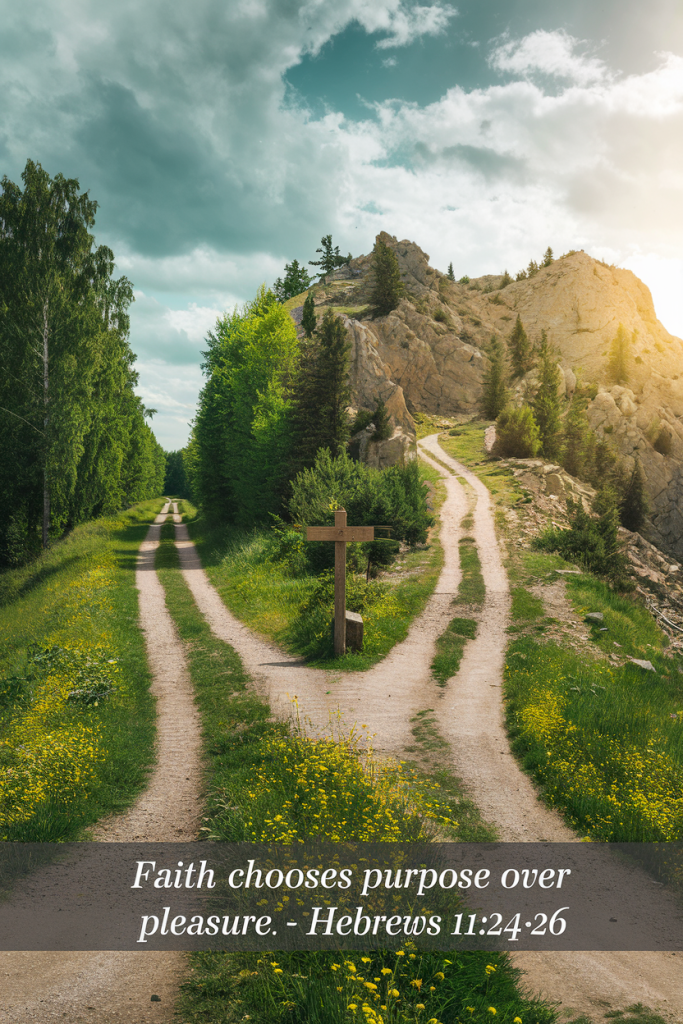
As Moses matured, his faith led him to a pivotal decision, as described in Hebrews 11:24-26: "By faith Moses, when he was come to years, refused to be called the son of Pharaoh's daughter; Choosing rather to suffer affliction with the people of God, than to enjoy the pleasures of sin for a season; Esteeming the reproach of Christ greater riches than the treasures in Egypt: for he had respect unto the recompence of the reward".
Moses' refusal of a life of privilege and power in the Egyptian court, choosing instead to identify with the enslaved Israelites, demonstrates a faith that prioritized spiritual identity and future reward over present comfort and status.
The phrase "reproach of Christ" in Hebrews 11:26 is a significant insight, suggesting that even in the Old Testament, faith looked forward to the Messiah and the suffering He would endure.
This indicates a profound understanding that true riches lie not in earthly possessions but in aligning oneself with God's purposes.
Moses' faith continued to be evident in his leadership of the Israelites out of Egypt. Hebrews 11:27 notes, "By faith he forsook Egypt, not fearing the wrath of the king: for he endured, as seeing him who is invisible".
This act of defiance against the most powerful ruler of the time was rooted in Moses' unwavering belief in God's promise of deliverance. His perseverance "as seeing him who is invisible" highlights the crucial role of focusing on God's presence and power, even when facing daunting circumstances.
Furthermore, the crossing of the Red Sea, recounted in Hebrews 11:29, "By faith they passed through the Red sea as by dry land: which the Egyptians assaying to do were drowned", stands as a powerful testament to the faith of both Moses leading and the Israelites following God's miraculous intervention.
Despite the seemingly insurmountable obstacle of the sea before them and the pursuing Egyptian army behind, their faith in God's promise of deliverance led to their miraculous escape.
Moses' life exemplifies that faith involves a willingness to forsake worldly comforts and power for the sake of God and His people, driven by a firm conviction in a greater, unseen reward.
His actions directly contradicted his privileged position, indicating a prioritization of spiritual values over material ones.
This broader implication highlights that true faith often requires sacrifice and a fundamental reorientation of one's priorities, choosing the path of righteousness even when it is difficult or unpopular.
David: Faith in Battles and Dependence on God

David, the shepherd who became king, is revered as a man after God's own heart (Acts 13:22), whose life was punctuated by moments of remarkable faith.
The description in Acts 13:22, "I have found David the son of Jesse, a man after mine own heart, which shall fulfil all my will," suggests that David's faith was deeply intertwined with his desire to please God.
One of the most iconic displays of David's faith is found in the story of his encounter with Goliath in 1 Samuel 17.
Despite his youth and inexperience as a warrior, David exhibited unwavering confidence in God's ability to deliver him from the seemingly invincible giant.
His recounting of past deliverances from the lion and the bear (1 Samuel 17:34-37) reveals that his faith was built upon previous experiences of God's faithfulness, fostering a deep-seated trust in God's continued protection.
David's powerful declaration of faith before facing Goliath is recorded in 1 Samuel 17:45: "Then said David to the Philistine, Thou comest to me with a sword, and with a spear, and with a shield: but I come to thee in the name of the Lord of hosts, the God of the armies of Israel, whom thou hast defied".
This statement underscores David's reliance on God's power and authority, symbolized by the title "Lord of hosts," rather than his own strength or skill. This reliance on divine power demonstrates a faith that transcends human limitations and acknowledges God's sovereignty over all circumstances.
Furthermore, David's life reveals a consistent practice of sustaining his faith through prayer, as indicated in Psalms 27:1: "(A Psalm of David.) The LORD is my light and my salvation; whom shall I fear? the LORD is the strength of my life; of whom shall I be afraid?".
This declaration reflects David's profound trust in God as his protector and deliverer, providing both guidance ("light") and rescue ("salvation").
This intimate relationship with God, nurtured through prayer, was a constant source of strength and confidence for David.
Romans 4:6-8 refers to David's understanding of justification by faith: "Even as David also describeth the blessedness of the man, unto whom God imputeth righteousness without works, Saying, Blessed are they whose iniquities are forgiven, and whose sins are covered. Blessed is the man to whom the Lord will not impute sin".
This highlights that David recognized God's grace in providing righteousness through faith, independent of human efforts.
David's life illustrates that faith involves a deep personal relationship with God, characterized by unwavering trust in His power to overcome challenges and a profound recognition of His grace and mercy.
His courage and victory over Goliath were a direct consequence of his faith in God's ability to act on his behalf, demonstrating a clear link between faith and tangible outcomes.
David's vulnerability and dependence on God, even in his role as king, underscore the fundamental principle that true strength lies in reliance on the divine.
The Disciples: From Doubt to Belief
The disciples, who walked and ministered alongside Jesus, provide a compelling narrative of faith's development from initial doubt to steadfast belief.
Their journey highlights that faith is not always unwavering but can grow and strengthen through personal encounters with the divine and the teachings of Christ.
One notable instance of the disciples' early struggles with faith is recounted in Matthew 14:22-31, where Jesus walks on water.
Initially mistaking Jesus for a ghost, their fear revealed a lack of understanding and trust in His power. Peter's attempt to walk on water at Jesus' command demonstrates an initial act of faith, but his subsequent doubt when he focused on the stormy conditions led him to begin sinking.
Matthew 14:30 records Peter's faltering faith: "But when he saw the wind boisterous, he was afraid; and beginning to sink, he cried, saying, Lord, save me." Jesus' immediate response in verse 31, "O thou of little faith, wherefore didst thou doubt?" underscores their developing faith and the tendency to waver when faced with overwhelming circumstances.
The KJV's use of "boisterous" emphasizes the intensity of the storm, highlighting the significant challenge to Peter's belief.
Recognizing their need for stronger faith, the disciples made a direct request to Jesus in Luke 17:5: "And the apostles said unto the Lord, Increase our faith".
Jesus' response in verse 6, likening faith to a grain of mustard seed that could uproot a sycamine tree, illustrates the immense potential of even seemingly small faith when directed towards God.
This parable emphasizes that the power lies not in the quantity of faith but in its quality and the object upon which it is placed.
As the disciples continued to witness Jesus' miracles, hear His teachings, and experience His presence, their faith gradually matured.
The book of Acts recounts their transformation after the resurrection, where they boldly proclaimed the Gospel despite facing persecution.
Acts 6:7 notes the growth of the early church and that "a great company of the priests were obedient to the faith", indicating the disciples' successful ministry rooted in their now strengthened faith.
Acts 14:22 describes Paul and Barnabas "strengthening the souls of the disciples, and exhorting them to continue in the faith, and that we must through much tribulation enter into the kingdom of God", highlighting the ongoing nature of faith development and the importance of encouragement within the community of believers.
The phrase "obedient to the faith" suggests that faith involves a commitment to the teachings and principles of Christianity, leading to transformative action.
The disciples' journey from initial fear and doubt to courageous proclamation demonstrates that faith is not always a static state but a dynamic process of growth and strengthening through experiences, instruction, and the grace of God.
Their transformation after encountering the resurrected Christ was particularly pivotal in solidifying their belief and empowering them for their mission.
This narrative trend suggests that consistent exposure to God's presence and works, coupled with a willingness to learn and grow, can deepen one's faith over time.
Faith in Action: Exploring Biblical Narratives in the KJV
Beyond individual examples, major biblical narratives in the KJV vividly illustrate the power and implications of faith in various contexts. These stories provide profound lessons on trusting God's promises and acting upon His word.
Noah's Ark: Faith as Obedience to Divine Warning
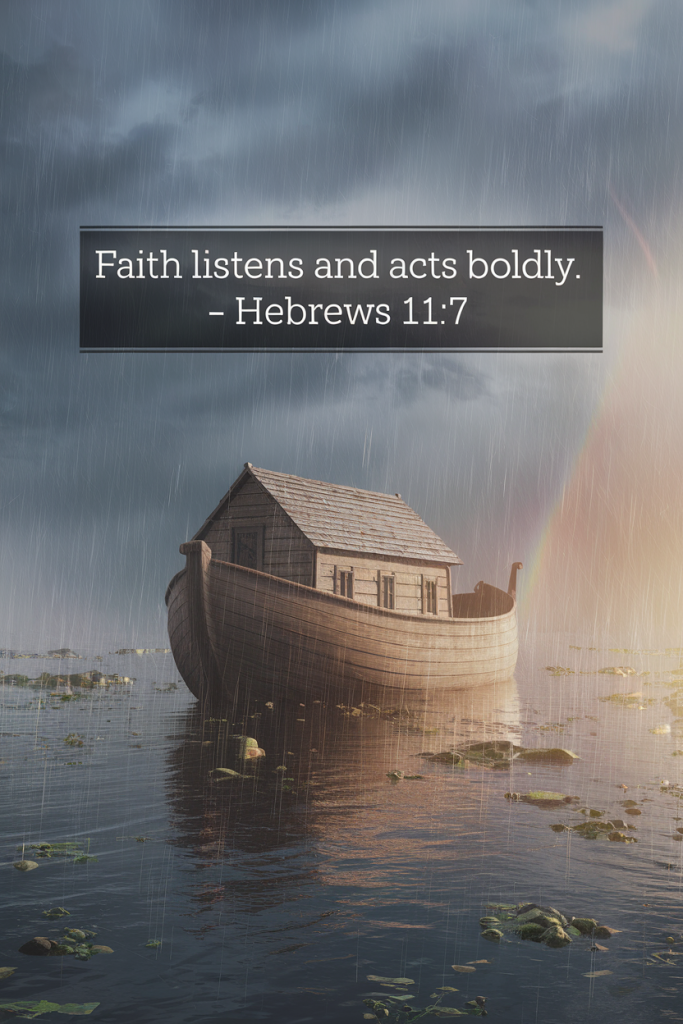
The story of Noah and the ark, recounted in Genesis 6-9 and highlighted in Hebrews 11:7, stands as a powerful testament to faith as obedience to divine warning.
Faced with God's pronouncement of a global flood, a phenomenon unprecedented in human experience, Noah's response was one of unwavering faith.
Hebrews 11:7 states, "By faith Noah, being warned of God of things not seen as yet, moved with fear, prepared an ark to the saving of his house; by the which he condemned the world, and became heir of the righteousness which is by faith."
Noah's obedience in diligently constructing the ark according to God's specific instructions, despite the lack of any prior evidence of such a cataclysm, underscores the essence of faith as trusting in God's word even when it contradicts human experience or understanding.
The KJV's phrase "moved with fear" suggests a reverent awe and respect for God's power and judgment, which motivated his obedience and action.
Noah's act of faith not only ensured the salvation of his family but also served as a condemnation of the unbelieving world that disregarded God's warning.
This highlights the significant consequences of both faith and unbelief. Noah's story underscores the principle that faith involves believing God's pronouncements and acting accordingly, even when those pronouncements pertain to events that have never occurred before.
His commitment to building the ark, a task that likely seemed foolish or unnecessary to his contemporaries, demonstrates a profound trust in God's knowledge and power.
It also reveals that faith can lead to actions that may appear illogical or strange from a worldly perspective but are ultimately vindicated by divine intervention.
The Exodus: Faith in God's Deliverance
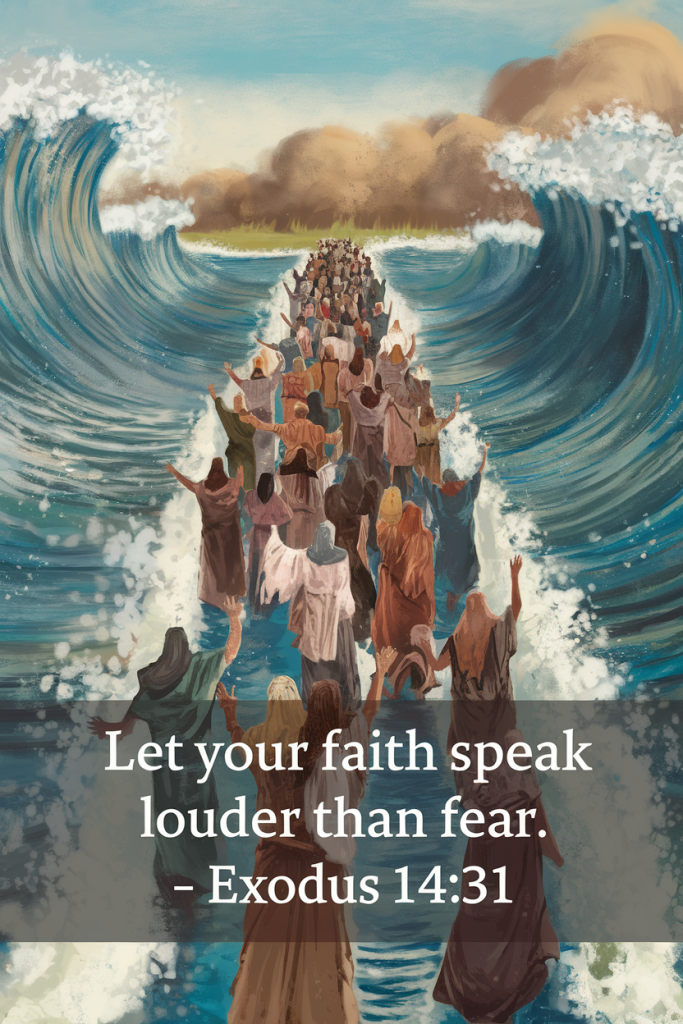
The epic narrative of the Israelites' exodus from Egypt, spanning Exodus 1-15, provides a compelling illustration of faith in God's promise of deliverance from oppression.
While the faith of Moses, their leader, has already been discussed, this narrative also highlights the faith of the Israelites in following God's leading through the wilderness after witnessing the miraculous plagues and the dramatic parting of the Red Sea.
The initial acts of faith, such as the Hebrew midwives Shiphrah and Puah fearing God rather than Pharaoh and refusing to kill the male children (Exodus 1:17), set the stage for the larger deliverance.
Their defiance of the king's command, rooted in their reverence for God, demonstrates that faith can inspire courage in the face of earthly authority.
Hebrews 11:29 specifically references the Israelites' passage through the Red Sea: "By faith they passed through the Red sea as by dry land: which the Egyptians assaying to do were drowned".
Despite the seemingly impossible situation of being trapped between the sea and the pursuing Egyptian army, their faith, prompted by Moses' leadership and God's promise, led them to walk on dry ground through the parted waters.
Exodus 14:31 further notes, "And Israel saw that great work which the LORD did upon the Egyptians: and the people feared the LORD, and believed the LORD, and his servant Moses", indicating that the miraculous nature of their deliverance itself fostered belief and strengthened their faith in God and His chosen leader.
It is important to acknowledge that the Israelites' journey was not without instances of wavering faith and murmuring against God and Moses. Their complaints in the wilderness often contrasted sharply with the miraculous acts of deliverance they had witnessed.
Nevertheless, the overarching narrative of the Exodus illustrates that faith in God's promises of deliverance can sustain people through difficult journeys, even when doubts and hardships arise.
The miraculous nature of their escape from Egypt and their continued sustenance in the wilderness served as constant reminders of God's power and faithfulness, even when they faltered in their belief.
The Exodus story underscores that even in the face of daunting obstacles and moments of doubt, a fundamental trust in God's ability to fulfill His promises can lead to liberation and guidance.
The Story of Job: Faith Amidst Unfathomable Suffering
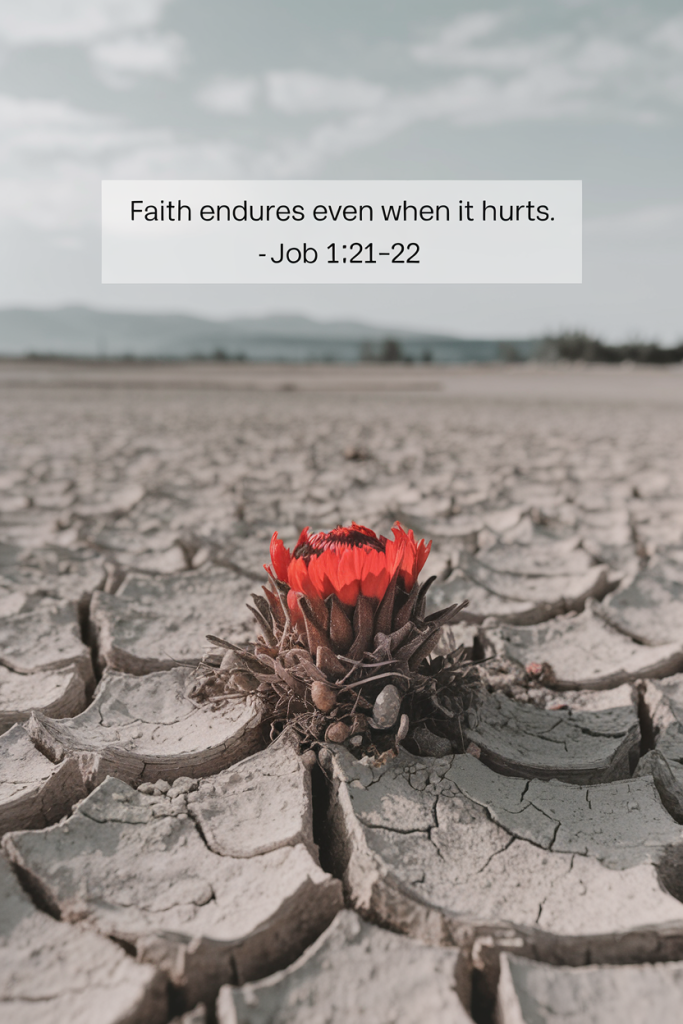
The book of Job (Job 1-42) presents a profound exploration of faith in the context of extreme and seemingly inexplicable suffering.
Job, initially described as "perfect and upright, and one that feared God, and eschewed evil" (Job 1:1), endured the loss of his wealth, his children, and his health in rapid succession.
Despite these devastating losses, Job's initial response, as recorded in Job 1:21-22, demonstrated unwavering faith: "And said, Naked came I out of my mother's womb, and naked shall I return thither: the Lord gave, and the Lord hath taken away; blessed be the name of the Lord. In all this Job sinned not, nor charged God foolishly".
This remarkable reaction reveals a faith that is not dependent on material blessings or comfortable circumstances but is rooted in a deep reverence and trust in God's sovereignty.
The KJV's emphasis on Job not sinning or charging God foolishly highlights the purity and strength of his initial faith.
As Job's suffering persisted and his friends offered interpretations that blamed him for his misfortunes, Job grappled with doubt and a desire to understand why such calamities had befallen him.
His dialogue with his friends reveals the tension between his initial faith and the overwhelming pain and confusion he experienced. However, even in his darkest moments, Job maintained an underlying belief in God's ultimate justice and sovereignty.
His eventual encounter with God in Job 38-41 led to a profound transformation. Job's response to God's powerful questions, recorded in Job 42:5-6, signifies a renewed and deeper faith: "I have heard of thee by the hearing of the ear: but now mine eye seeth thee.
Wherefore I abhor myself, and repent in dust and ashes". This encounter transformed Job's intellectual understanding of God into a personal, experiential knowledge, leading to a deeper level of faith and humility.
The story of Job demonstrates that even in the face of extreme suffering and unanswered questions, faith in God's sovereignty and ultimate justice can endure and lead to a more profound understanding of the divine.
Job's journey from initial unwavering faith through intense doubt and back to a more intimate knowledge of God illustrates the complexities and resilience of faith in the midst of trials.
It suggests that true faith is not the absence of doubt but the persistent trust in God even when understanding is limited and circumstances are overwhelming.
Illustrating Faith: Symbolism and Metaphor in the KJV
The King James Bible often employs symbolic language and metaphors to convey deeper spiritual truths about faith, enriching our understanding of this essential concept.
Light and Darkness: Faith as Spiritual Illumination

The metaphor of light and darkness is frequently used in the KJV to illustrate the nature and impact of faith.
Light typically represents truth, knowledge, goodness, and God's presence, while darkness symbolizes ignorance, sin, evil, and the absence of God.
Faith, in this context, can be understood as a spiritual illumination that guides believers away from the darkness of doubt and towards the truth and presence of God.
For instance, John 3:21 states, "But he that doeth truth cometh to the light, that his deeds may be made manifest, that they are wrought in God."
While this verse does not explicitly mention "faith," it implies that those who align themselves with God's truth are drawn to the light, which can be linked to the illuminating aspect of faith.
Faith enables individuals to discern and embrace God's truth, which is often presented as light in contrast to the darkness of the world's deceptions and uncertainties.
Similarly, 1 John 1:5-7 speaks of God as light and encourages believers to walk in the light, implying that faith leads to a life lived in accordance with God's revealed truth, dispelling the darkness of sin and error.
The consistent association of light with goodness and truth in scripture suggests that faith acts as a beacon, revealing God's will and providing clarity in spiritual matters, dispelling the darkness of uncertainty and offering a clear path forward based on divine revelation.
Seeds and Fruit: The Growth and Manifestation of Faith

The imagery of seeds and fruit serves as a powerful metaphor for the growth and outward manifestation of faith in the KJV.
The parable of the mustard seed, found in Matthew 13:31-32 and Matthew 17:20, beautifully illustrates how even a small beginning of faith can develop into something significant and impactful.
Matthew 17:20 records Jesus saying, "If ye have faith as a grain of mustard seed, ye shall say unto this mountain, Remove hence to yonder place; and it shall remove; and nothing shall be impossible unto you."
The contrast between the tiny mustard seed and its potential to grow into a large plant capable of providing shelter highlights the transformative power of even a seemingly insignificant amount of genuine faith.
The KJV's emphasis that "nothing shall be impossible unto you" underscores the limitless possibilities that faith unlocks.
The concept of faith producing good fruit is evident in the emphasis on being "faithful" and the description of the fruit of the Spirit in Galatians 5:22: "But the fruit of the Spirit is love, joy, peace, longsuffering, gentleness, goodness, faith, Meekness, temperance".
Here, "faithfulness" itself is listed as a fruit of the Spirit, indicating that genuine faith is not merely an internal belief but actively manifests in godly character and actions.
Just as a healthy tree naturally produces good fruit, a genuine faith will invariably lead to actions and attitudes that reflect God's character and will.
This analogy underscores that faith is not a static concept but has an inherent potential for growth and will inevitably bear tangible results in the believer's life, demonstrating its reality and impact on the world.
Journeys: The Pilgrimage of Faith

The metaphor of a journey or pilgrimage is frequently employed in the KJV to represent the life of faith, with its inherent challenges, obstacles, and ultimate destination.
This imagery underscores the idea that faith is not a one-time event but an ongoing process of growth and reliance on God. The journey of Abraham, as described in Hebrews 11:8-10, exemplifies this metaphor.
His departure from his homeland to an unknown destination, based solely on God's call, marks the beginning of a lifelong journey of faith.
Similarly, the Israelites' forty-year sojourn in the wilderness, recounted throughout the book of Exodus, represents a collective journey of faith, marked by both moments of trust and periods of doubt as they followed God's leading towards the promised land.
Hebrews 11:13-16 further emphasizes this theme, describing these Old Testament believers as "strangers and pilgrims on the earth".
The KJV's use of "strangers and pilgrims" highlights that their true home and ultimate hope were not in this earthly realm but in a heavenly country, a "city which hath foundations, whose builder and maker is God" (Hebrews 11:10).
Thus, the life of faith is often portrayed as a journey requiring perseverance, unwavering trust in God's guidance, and a constant focus on the ultimate destination – a heavenly city prepared by God for those who believe.
This metaphor effectively captures the dynamic nature of faith, involving movement, progress, and sometimes setbacks, all while relying on God for direction and strength along the way.
Building on a Rock: Faith as a Sure Foundation

The parable of the wise and foolish builders, recounted in Matthew 7:24-27, utilizes the metaphor of building on a rock to illustrate the importance of faith as a sure foundation for life.
In this parable, Jesus likens the wise man to one who "heareth these sayings of mine, and doeth them," building his house upon a rock, while the foolish man hears the sayings but does not act upon them, building his house upon the sand.
Matthew 7:24 explicitly states, "Therefore whosoever heareth these sayings of mine, and doeth them, I will liken him unto a wise man, which built his house upon a rock."
The rock in this context represents obedience to Jesus' teachings, which is rooted in faith. The wise builder's house withstands the storms and floods, symbolizing the trials and tribulations of life, because it has a solid foundation.
In contrast, the foolish builder's house collapses under pressure. This parable underscores that a life built on the principles of faith and obedience to Christ's words provides a secure and unshakeable foundation, enabling believers to weather the storms and challenges they inevitably face.
The contrast with the foolish builder who built on sand highlights the vulnerability and instability of a life not firmly rooted in faith and obedience.
Furthermore, the image of a rock is also used in other KJV passages to symbolize God's steadfastness and the security found in Him.
For example, Psalm 18:2 declares, "The Lord is my rock, and my fortress, and my deliverer; my God, my strength, in whom I will trust; my buckler, and the horn of my salvation, and my high tower."
These verses reinforce the idea that God is the ultimate rock on which faith can be built, offering unwavering support and protection to those who trust in Him.
Conclusion: The Enduring Significance of Faith in the KJV
In conclusion, the King James Bible presents faith as a multifaceted and essential element of a life devoted to God.
Through the examination of key figures like Abraham, whose obedience and trust in the unseen laid the foundation for a lineage of faith; Moses, who chose divine purpose over worldly power; David, whose reliance on God in the face of adversity provides a model of dependence; and the disciples, whose journey from doubt to belief illustrates the transformative power of encountering Christ, the KJV showcases faith in action.
The narratives of Noah's Ark, the Exodus, and the story of Job further emphasize that faith involves obedience to divine warnings, trust in God's deliverance, and perseverance through unfathomable suffering.
Moreover, the symbolic language employed in the KJV, such as light and darkness, seeds and fruit, journeys, and building on a rock, enriches our understanding of faith as spiritual illumination, a growing and manifesting reality, a lifelong pilgrimage, and a sure foundation for life.
Ultimately, the significance of faith in the KJV is perhaps most powerfully summarized in Hebrews 11:6: "But without faith it is impossible to please him: for he that cometh to God must believe that he is, and that he is a rewarder of them that diligently seek him".
This verse underscores the fundamental necessity of faith in one's relationship with God. Therefore, the enduring message of the KJV encourages believers today to cultivate and live by faith, embracing obedience, trust, and perseverance as they navigate their own journeys, building their lives on the solid rock of God's Word and promises.