Quick Overview of This Bible Study…
Short on time? I have created a short slide show presentation of some key takeaways in our study. The complete, more comprehensive bible study is below…
The Mercy Seat, a sacred golden lid on the Ark of the Covenant, isn't just a historical artifact; it represents the profound way God chose to meet humanity.
Found first in the Old Testament within the Holy of Holies, it symbolized God's throne of mercy amid His people's sinfulness, where blood sacrifices temporarily covered Israel's transgressions.
Remarkably, this golden seat guarded by cherubim foreshadows Christ’s atoning sacrifice, making the Mercy Seat central to understanding redemption.
How exactly does this ancient artifact unveil the Gospel message and relate directly to Christ’s work? Let's explore the powerful biblical connections hidden in plain sight.
1. Old Testament Analysis
Design and Instructions for the Mercy Seat (Exodus 25:17–22)
The Mercy Seat is first introduced in Exodus 25 as part of God’s instructions to Moses for the Tabernacle. Exodus 25:17 commands, “thou shalt make a mercy seat of pure gold” of specific dimensions (about 2.5 cubits long by 1.5 cubits wide) (42 Bible Verses About Mercy-Seat - QuotesCosmos).
This golden slab formed the lid of the Ark of the Covenant. On it were placed two golden cherubim, one on each end, facing each other with wings outstretched to cover the mercy seat (42 Bible Verses About Mercy-Seat - QuotesCosmos).
The cherubim were made of one piece with the cover and “their faces shall look one to another; toward the mercy seat shall the faces of the cherubims be” (42 Bible Verses About Mercy-Seat - QuotesCosmos) (42 Bible Verses About Mercy-Seat - QuotesCosmos).
This design symbolized a throne – indeed, the cherubim together “formed a seat for Yahweh”, indicating that the mercy seat represented God’s throne among His people (Mercy seat - Wikipedia).
Exodus 25:21–22 explains the purpose of this sacred object. The mercy seat was to be placed on top of the Ark, covering the tablets of the testimony inside (42 Bible Verses About Mercy-Seat - QuotesCosmos).
God told Moses, “there I will meet with thee, and I will commune with thee from above the mercy seat, from between the two cherubims” (42 Bible Verses About Mercy-Seat - QuotesCosmos).
In Israel’s worship, the mercy seat thus marked the very presence of God – the place where the Shekinah (Divine Presence) would dwell in the Holy of Holies.
It was a meeting point between God and man, but only by God’s invitation and under strict conditions.
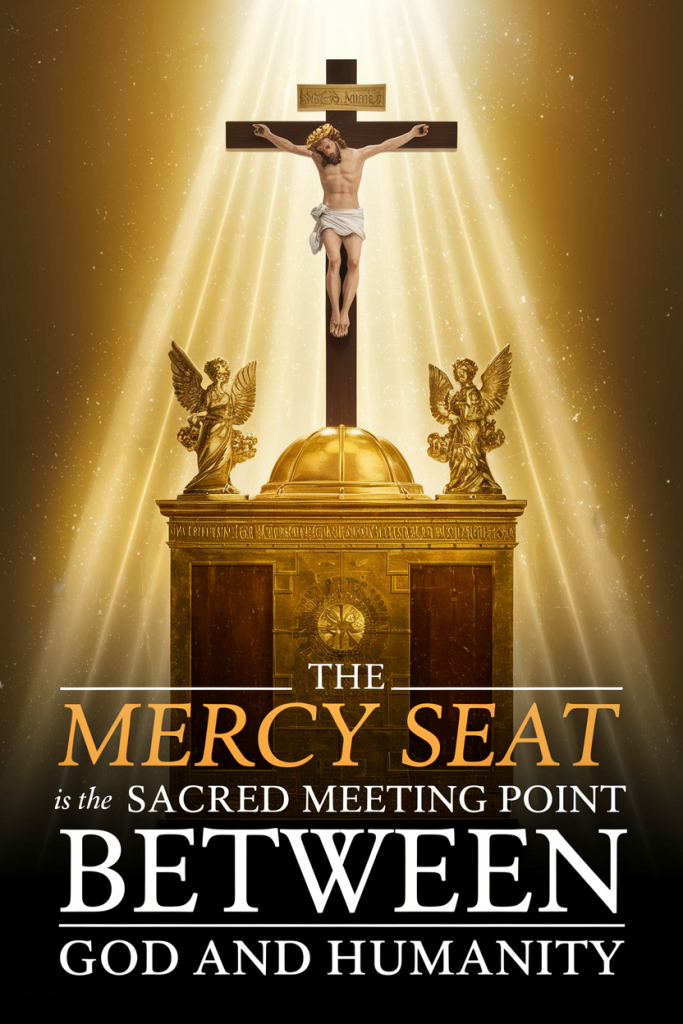
The mercy seat, as a golden cover shielding the law tablets in the Ark, also conveyed mercy triumphing over judgment: God’s law lay inside the Ark, and the blood-sprinkled cover provided atonement for breaches of that law ( Hebrews 9:5 & Romans 3:25 - Christ Jesus: Our Propitiation | Christian Courier).
In essence, it “concealed from the Lord’s view the ever-condemning judgment of the law” when sacrificial blood was applied ( Hebrews 9:5 & Romans 3:25 - Christ Jesus: Our Propitiation | Christian Courier).
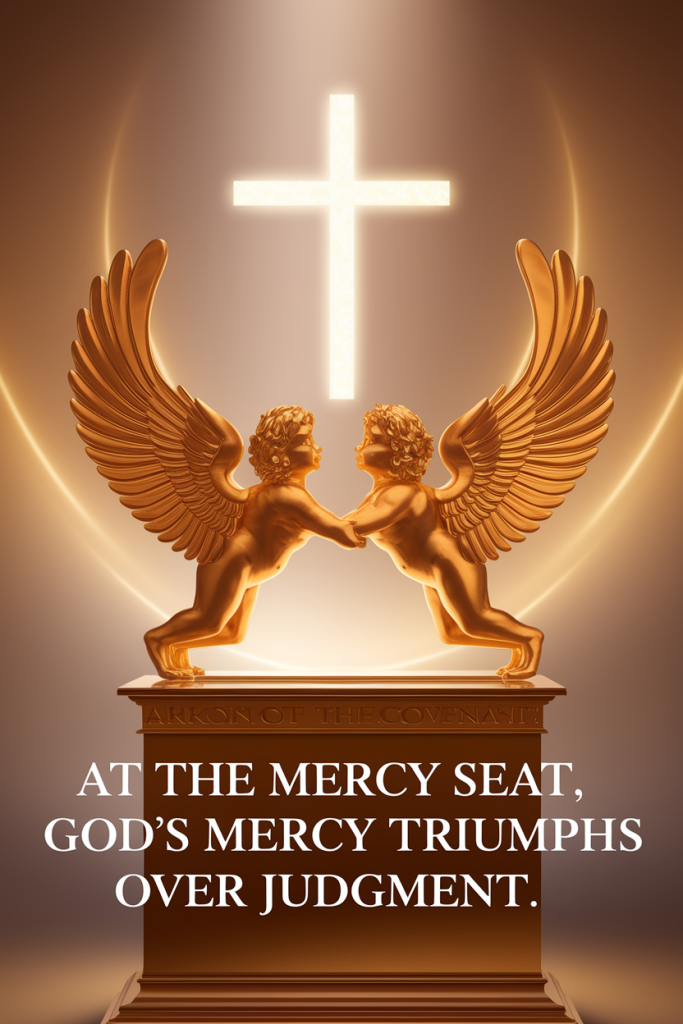
Through this imagery, God taught Israel that atonement (covering of sin) was required for Him to dwell among them.
Each element of Exodus 25:17–22 – the pure gold material, the cherubim, the positioning – underscores the holiness and significance of the mercy seat in the Tabernacle.
Placement in the Tabernacle and Holy of Holies
Multiple verses in Exodus reiterate the mercy seat’s location and sanctity. Exodus 26:34, for example, specifies that the mercy seat was to be put “upon the ark of the testimony in the most holy place” (42 Bible Verses About Mercy-Seat - QuotesCosmos).
This indicates that the Ark with its mercy seat was kept in the innermost chamber (Holy of Holies) of the Tabernacle, behind the veil.
Exodus 30:6 further instructs that the golden altar of incense be placed “before the veil… before the mercy seat that is over the testimony, where I will meet with thee” (42 Bible Verses About Mercy-Seat - QuotesCosmos).
In other words, the altar stood just outside the curtain that screened the mercy seat – emphasizing that the mercy seat was the central meeting point with God, though hidden from ordinary view.
Only the High Priest could approach it, and that too only at the appointed time (as later detailed in Leviticus).
These instructions show the careful ordering of Israel’s worship space: the mercy seat was the focal point of God’s presence, separated by a veil due to His holiness.
When the Tabernacle was constructed, these commands were faithfully carried out.
Bezalel crafted the Ark and the mercy seat exactly as described: “he made the mercy seat of pure gold” with the specified dimensions, and made the two cherubim on its ends of one piece with it (42 Bible Verses About Mercy-Seat - QuotesCosmos) (42 Bible Verses About Mercy-Seat - QuotesCosmos).
This is recorded in Exodus 37:6–9, confirming that the mercy seat was fashioned according to the heavenly pattern God showed Moses.
Finally, at the Tabernacle’s completion, Moses “took and put the testimony into the ark… and put the mercy seat above upon the ark” (42 Bible Verses About Mercy-Seat - QuotesCosmos) (Exodus 40:20).
Thus, the mercy seat was installed in the Tabernacle’s inner sanctuary as the lid over the Ark containing the covenant law.
All these verses stress that the mercy seat was integral to the Ark – indeed, without the mercy seat the Ark was incomplete. It was not merely a cover but a sacred throne for the invisible God who dwelt in glory between the cherubim.
Role in Atonement Rituals (Leviticus 16)
The mercy seat’s most critical function in Israelite worship is seen on the Day of Atonement (Yom Kippur), described in Leviticus 16.
God warns Aaron in Leviticus 16:2 that he cannot enter the Holy of Holies at will “before the mercy seat which is upon the ark” lest he die, “for I will appear in the cloud upon the mercy seat” (42 Bible Verses About Mercy-Seat - QuotesCosmos).
This highlights the lethal holiness of God’s presence on the mercy seat – unauthorized approach would result in death.
To enter on the Day of Atonement, the High Priest had to create a protective cloud of incense.
Leviticus 16:13 says he must burn incense “that the cloud of the incense may cover the mercy seat that is upon the testimony, that he die not” (Lev.16 - Bible, King James Version).
Only under the cover of this aromatic cloud could the High Priest safely stand before the mercy seat.
Then came the blood atonement rites. Leviticus 16:14–15 details how the High Priest would sprinkle the blood of the sin offerings on and before the mercy seat.
First, he sprinkled the bull’s blood “upon the mercy seat eastward; and before the mercy seat… seven times” (42 Bible Verses About Mercy-Seat - QuotesCosmos) to atone for his own sins and those of his house.
Then he slaughtered the goat for the people’s sins and did likewise, bringing its blood “within the veil…and sprinkle it upon the mercy seat, and before the mercy seat” (42 Bible Verses About Mercy-Seat - QuotesCosmos).
By this ritual, the mercy seat was doused with sacrificial blood to make atonement for Israel’s transgressions each year.
In effect, the blood on the mercy seat “covered” Israel’s sins from God’s sight, symbolically satisfying divine justice so that mercy could be given ( Hebrews 9:5 & Romans 3:25 - Christ Jesus: Our Propitiation | Christian Courier) ( Hebrews 9:5 & Romans 3:25 - Christ Jesus: Our Propitiation | Christian Courier).
The mercy seat thus functioned as the center of expiation – the place where the penalty of the law (death for sin) was propitiated by the life-blood of a substitute.
This is why the Hebrew term for mercy seat, kapporet, is related to kipper, “to atone/cover” (Mercy seat - Wikipedia).
Culturally and religiously, every detail – from the required incense to the seven-fold sprinkling of blood – underscored the solemnity of approaching the mercy seat.
It was here that God’s mercy was sought through sacrificial atonement, foreshadowing a greater sacrifice to come.
God’s Presence and Communication Above the Mercy Seat
Beyond atonement rituals, the Old Testament portrays the mercy seat as the unique place of God’s self-revelation. As noted, God told Moses He would meet and speak from above the mercy seat (Ex. 25:22).
This promise was fulfilled during Israel’s wilderness journey. For example, “when Moses was gone into the tabernacle of the congregation to speak with [God], he heard the voice of one speaking unto him from off the mercy seat that was upon the ark of testimony, from between the two cherubims” (42 Bible Verses About Mercy-Seat - QuotesCosmos) (Numbers 7:89).
This remarkable verse shows that Moses, and later the High Priests, received divine oracles from the space above the mercy seat – as if God sat enthroned between the cherubim and spoke to His servant.
In Leviticus 16:2 God described appearing “in the cloud upon the mercy seat” (42 Bible Verses About Mercy-Seat - QuotesCosmos), likely referring to the cloud of incense and perhaps the glow of the divine glory.
Thus, the mercy seat was not an idol or image of God, but it marked the footstool of God’s invisible throne on earth.
This concept is echoed throughout Israel’s history. The Lord is repeatedly called the one “which dwelleth between the cherubims” (42 Bible Verses About Mercy-Seat - QuotesCosmos).
When the Ark was brought to battle or moved, it signified God’s enthroned presence going with His people (see 1 Samuel 4:4; 2 Samuel 6:2).
The Psalms also invoke God as the Shepherd of Israel “thou that dwellest between the cherubims”, imploring Him to shine forth and save (Psalm 80:1) (42 Bible Verses About Mercy-Seat - QuotesCosmos).
In worship, Israelites understood that the Ark and its mercy seat were God’s throne – the earthly point of contact with the heavenly King.
The cherubim imagery reinforced God’s majesty and holiness, recalling the attendants of God’s throne seen in visions (cf. Isaiah 6:1–2, Ezekiel 1:26–28).
No human was typically allowed to see the mercy seat, since it was veiled and approached only by the High Priest with blood. Yet its existence assured Israel that God was with them and accessible by means of sacrifice and priestly intercession.
The mercy seat, in effect, was the mercy of God in tangible form – God sitting on a throne of grace (mercy) rather than a throne of judgment for His covenant people.

The Mercy Seat in Later Old Testament Tradition
After the Tabernacle period, the mercy seat continued to play a role when Solomon built the First Temple.
The Ark of the Covenant with its mercy seat was installed in the Holy of Holies of the Temple (1 Kings 8:6–7), flanked by large sculptured cherubim. King David had already given Solomon a plan for the Temple’s design, including “the pattern… of the place of the mercy seat” (1 Chronicles 28:11, KJV) (42 Bible Verses About Mercy-Seat - QuotesCosmos).
This suggests the mercy seat’s location and function were carefully preserved from the Tabernacle schema into the permanent Temple structure.
In Solomon’s Temple, the concept remained the same: the inner sanctuary was dominated by the Ark and mercy seat, overshadowed by cherubim, where the High Priest would yearly offer atonement (see Leviticus 16, cf. Hebrews 9:7).
Tragically, the First Temple was destroyed by the Babylonians, and the Ark (with the mercy seat) disappeared from history.
By the time of the Second Temple (built after the exile, later expanded by Herod), there was no Ark of the Covenant in the Holy of Holies – it remained an empty chamber save for a foundation stone according to Jewish tradition (leviticus - Was there anything behind the curtain of the Second Temple? - Biblical Hermeneutics Stack Exchange).
Nonetheless, the Day of Atonement ritual continued. Historical records indicate that in the Second Temple the High Priest still entered the inner sanctum with incense and blood, sprinkling the blood on the spot where the mercy seat would have been.
Since “the Second Temple had no ark,” the High Priest sprinkled the blood “where the Ark would have been” (on or toward the Foundation Stone) (Holy of Holies - Wikipedia).
The incense was also offered there, though by then it was placed on a golden incense altar moved into the Holy of Holies on Yom Kippur (Holy of Holies - Wikipedia).
This adaptation shows the enduring understanding that atonement had to be made “before the mercy seat” – even in its absence, the atoning blood was applied to the symbolic location of God’s throne.
Jewish tradition in the Talmud affirms that the Holy of Holies was empty in the Second Temple except for this foundation stone (called Eben Shetiyyah) on which the High Priest sprinkled the blood (leviticus - Was there anything behind the curtain of the Second Temple? - Biblical Hermeneutics Stack Exchange).
Some apocryphal texts (e.g. 2 Maccabees 2:4-8) suggest the prophet Jeremiah hid the Ark before the exile, to be revealed again in the messianic age.
In any case, by the first century A.D. the Mercy Seat was known only through the Scriptures and yearly rituals that longed for the true atonement. This historical gap created an expectation that God’s mercy and presence would somehow return in fullness – an expectation Christians believe is fulfilled in Jesus Christ.
2. New Testament Connections
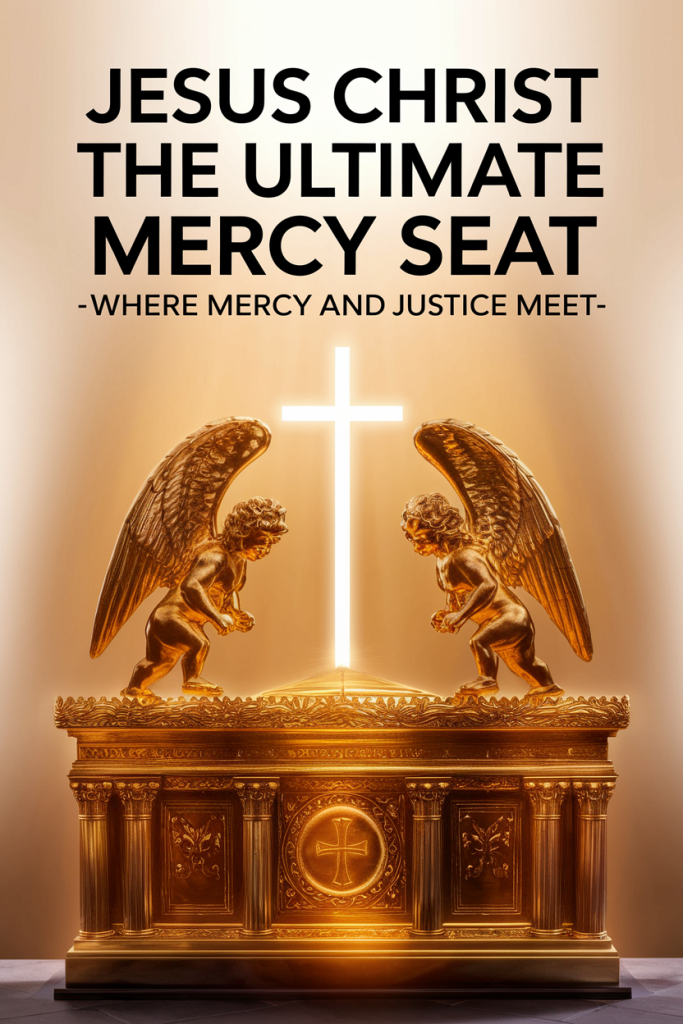
Direct References to the Mercy Seat in the New Testament
Although the term “mercy seat” is primarily an Old Testament phrase, the New Testament explicitly references it in a couple of places, connecting it to Christ.
Hebrews 9:5 is a direct reference: describing the furnishings of the ancient Tabernacle, it speaks of the Ark of the Covenant and “over it the cherubims of glory shadowing the mercyseat” (Hebrews 9:5 - King James Bible).
The Greek word used here for “mercy seat” is hilastērion, the same word the Greek Septuagint used for the Ark’s cover (Mercy seat - Wikipedia).
The author of Hebrews assumes the reader’s familiarity with the mercy seat’s significance, saying of these things “we cannot now speak particularly” (Heb 9:5). His focus, rather, is on how these old symbols pointed to Christ.
Just a few verses later, Hebrews explains that the High Priest entering the Holy of Holies once a year foreshadowed Christ’s work: “Christ being come an high priest of good things… by his own blood he entered in once into the holy place, having obtained eternal redemption for us” (Hebrews 9:11–12).
While Hebrews 9:5 names the mercy seat, the broader chapter shows Jesus fulfilling what the mercy seat represented – the meeting place of holy God and sinful man, bridged by sacrificial blood.
Another direct reference in Greek occurs in Romans 3:25, though many English translations render it differently.
Paul writes that we are justified freely by God’s grace “through the redemption that is in Christ Jesus: whom God hath set forth to be a propitiation through faith in His blood” (Rom 3:24–25, KJV).
Here the term “propitiation” is hilastērion in Greek – literally “mercy seat” (Mercy seat - Wikipedia). Paul deliberately uses sacrificial language: Jesus, in His death, is presented by God as the hilastērion, meaning the atoning sacrifice or place of atonement.
In the Septuagint and Hebrews 9:5, hilastērion denotes the mercy seat where blood was sprinkled to appease God’s wrath on sin (Mercy seat - Wikipedia) (Mercy seat - Wikipedia).
By applying it to Jesus, Paul teaches that Christ is now the “mercy seat” for humanity ( Hebrews 9:5 & Romans 3:25 - Christ Jesus: Our Propitiation | Christian Courier) ( Hebrews 9:5 & Romans 3:25 - Christ Jesus: Our Propitiation | Christian Courier).
In other words, the mercy seat was a type; Christ’s crucifixion is the reality. Through Jesus’s blood, God’s justice is satisfied and mercy is granted to sinners who have faith.
This Romans passage links directly back to Leviticus 16: as the High Priest brought blood to the mercy seat for Israel’s sins, so Christ brought His own blood before God for all sins once for all.
Christ as the True Mercy Seat and Atoning Sacrifice
The New Testament writers portray Jesus both as the High Priest and the atoning sacrifice, fulfilling the entire mercy seat ritual.
As noted, hilastērion in Romans 3:25 presents Christ as the place of atonement – He is the fulfillment of all that the golden lid signified ( Hebrews 9:5 & Romans 3:25 - Christ Jesus: Our Propitiation | Christian Courier).
The Book of Hebrews elaborates that Christ entered the greater, heavenly Holy of Holies after His ascension. Hebrews 9:24 states, “Christ is not entered into the holy places made with hands… but into heaven itself, now to appear in the presence of God for us.”
Just as the high priest carried blood into the Holy of Holies, Jesus brought the value of His shed blood into God’s presence to obtain eternal redemption (Heb 9:12).
Unlike the old priests, however, Jesus did this “once for all”, securing a perfect and permanent atonement (Heb 9:25-28, 10:12).
In this sense, the mercy seat – which always had fresh blood on it each year – finds its ultimate fulfillment in the cross, where Jesus’ blood was shed, and in heaven, where Jesus presents that finished work.
The connection is so strong that some scholars and theologians say Jesus Himself is the “mercy seat” of the New Covenant.
Just as the mercy seat was the means by which Israel’s sin was covered, so Jesus’ sacrifice covers our sin and turns away God’s wrath ( Hebrews 9:5 & Romans 3:25 - Christ Jesus: Our Propitiation | Christian Courier).
In 1 John 2:2 and 4:10, for instance, Jesus is called the “propitiation” (Greek hilasmos) for our sins – a term closely related to hilastērion.
This means His death fully satisfied the requirements of God’s justice, allowing mercy to flow to us. When Mary Magdalene came to Jesus’ tomb on Resurrection morning, she saw two angels sitting at the head and foot of where Jesus’ body had lain (John 20:12).
Many commentators have noted that this scene evokes the image of the cherubim on each end of the mercy seat (John 20:12 and she saw two angels in white sitting where the body of Jesus had lain, one at the head and the other at the feet.) (John 20:12 and she saw two angels in white sitting where the body of Jesus had lain, one at the head and the other at the feet.).
In a sense, the empty tomb becomes the new Mercy Seat: the place where atonement was accomplished by Jesus’ death and validated by His resurrection.
The two angels in white recall the golden cherubim, and the absent body testifies that the sacrifice was accepted by God (John 20:12 and she saw two angels in white sitting where the body of Jesus had lain, one at the head and the other at the feet.).
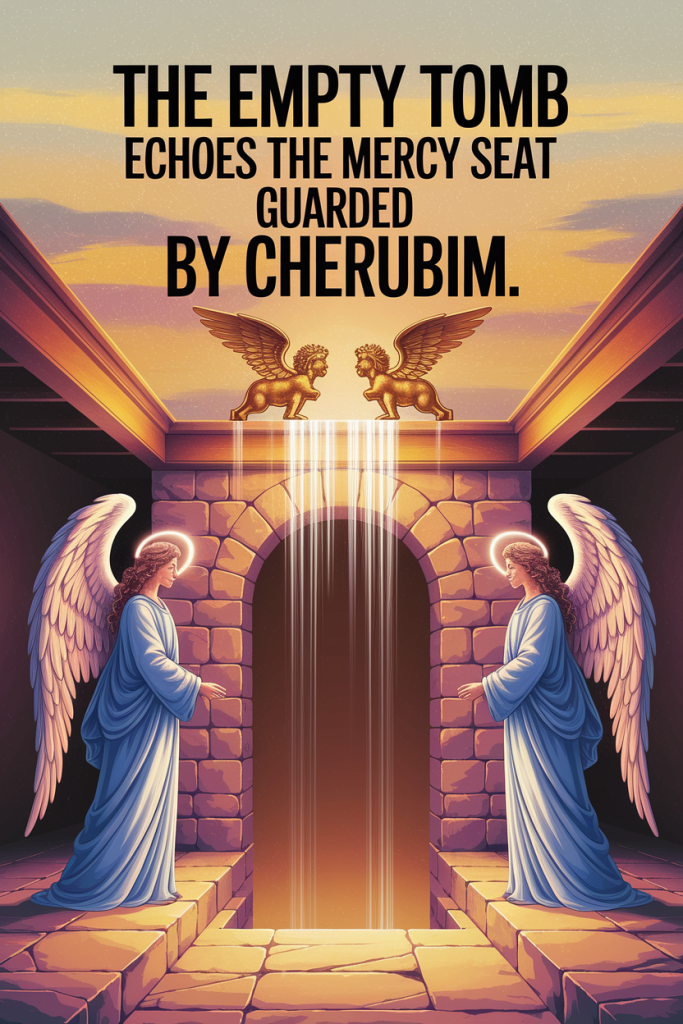
This beautiful parallel illustrates that through Christ’s work, the function of the mercy seat – to be the meeting place of mercy, where atoning blood satisfies divine justice – has been perfectly fulfilled.
Jesus is both the High Priest sprinkling the blood and the Lamb of God whose blood is sprinkled.
The Throne of Grace: Believers’ Access Through Christ
Because Jesus has fulfilled the role of the mercy seat, the New Testament describes a new reality for believers: free access to God’s presence. Hebrews 4:16 urges, “Let us therefore come boldly unto the throne of grace, that we may obtain mercy, and find grace to help in time of need.”
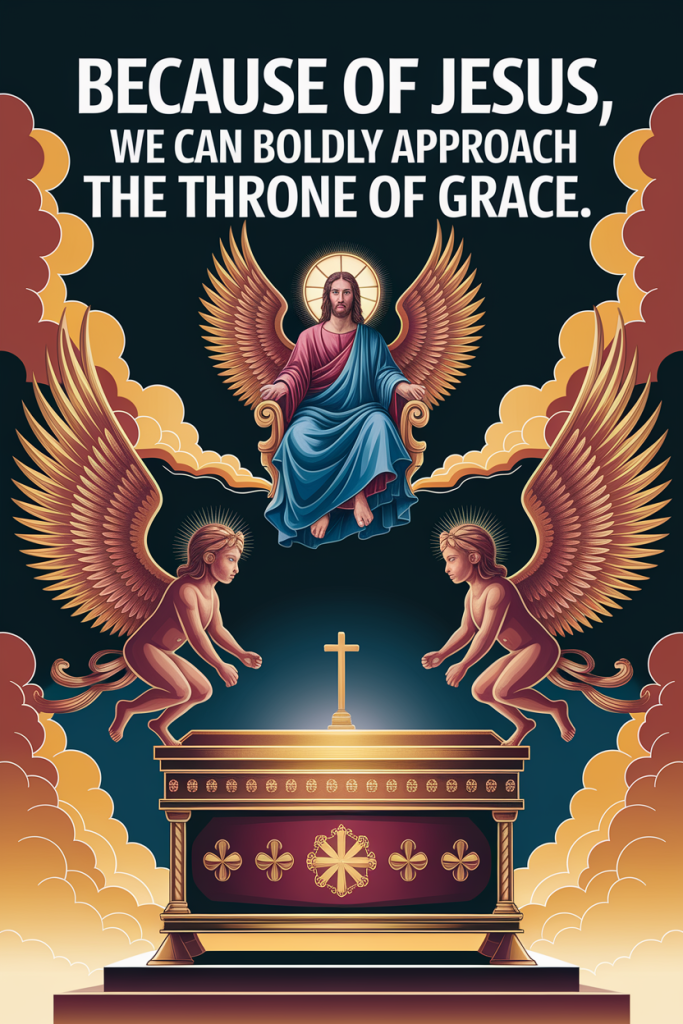
The “throne of grace” can be seen as a New Testament way of referring to what the mercy seat represented – God’s throne of mercy. Under the Old Covenant, only the High Priest could approach the mercy seat, and only with blood, trembling.
But after Christ’s sacrifice, the veil is torn and God invites all who are in Christ to draw near with confidence (Matthew 27:51, Hebrews 10:19-22). In essence, the mercy seat has become the throne of grace for us (What the Bible says about Throne of Grace).
Whereas it was once inaccessible to the common worshiper, now every believer can come into the Holy of Holies spiritually.
This connection is noted by Bible teachers: “When the Good Shepherd gave His life in bloody sacrifice for sinners once for all… the Mercy Seat became a ‘throne of grace’ (Hebrews 4:16)” (What the Bible says about Throne of Grace).
We no longer fear death in God’s presence because Christ’s blood continually speaks on our behalf, just as the blood on the mercy seat covered Israel.
Furthermore, Christ’s ongoing ministry of intercession is highlighted by the mercy seat imagery.
In the Old Testament, the High Priest interceded for the people in the Holy of Holies, his mediation symbolized by the blood on the mercy seat. In the New Testament, Jesus is our High Priest who “ever liveth to make intercession” for us (Hebrews 7:25).
He is seated at the right hand of God – a position that indicates the work is finished and accepted.
Some theologians describe Christ’s exalted seat as the true Mercy Seat in heaven, where His own blood is the eternal testimony of our atonement (John 20:12 and she saw two angels in white sitting where the body ...) (Mary Magdalene at the Mercy Seat - Bold Grace).
In practical terms, this means believers can always find mercy and help from God through Jesus. Our confidence to pray and be forgiven rests entirely on Jesus’ finished atoning work.
The mercy seat of old was sprinkled with animal blood; the throne of grace is established by Jesus’ blood.
Every time we approach God in prayer or worship, we are benefiting from what the mercy seat foreshadowed – the gracious presence of God made available by a sacrifice for sin.
3. Typology and Thematic Links
Foreshadow of Jesus’ Work as High Priest and Sacrifice
The mercy seat is a rich type (foreshadowing) of Jesus Christ’s redemptive work.
As High Priest, Jesus parallels the actions of Israel’s high priest on the Day of Atonement, and as the sacrifice, He parallels the blood that was applied. In typology, the High Priest = Christ and the mercy seat = the Cross (and its atoning effect).
The Book of Hebrews makes this crystal clear: the Levitical high priest entered a sanctuary made with hands with the blood of goats and bulls, but Jesus, our greater High Priest, entered the greater sanctuary of heaven with His own blood to secure eternal atonement (Heb 9:11-14) ( Hebrews 9:5 & Romans 3:25 - Christ Jesus: Our Propitiation | Christian Courier).
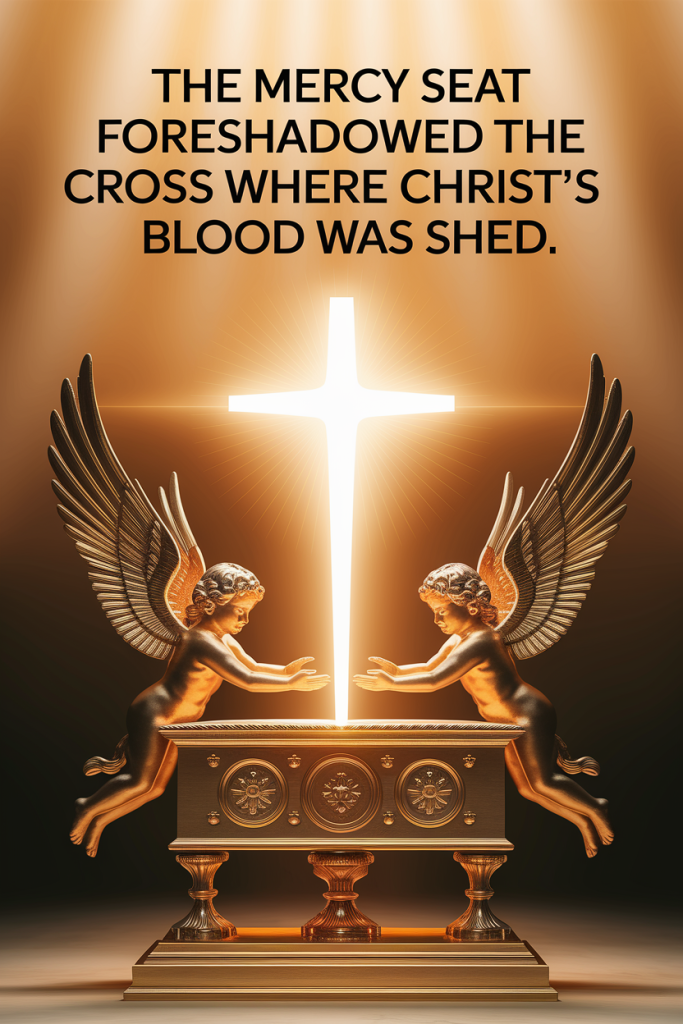
The mercy seat, where blood was sprinkled, foreshadowed the cross of Calvary, where Christ’s blood was shed. Just as the blood on the mercy seat symbolically covered the sins of Israel for a year, so Jesus’ blood actually cleanses and covers our sins forever.
Romans 3:25’s use of hilastērion for Christ shows that Paul intentionally saw Jesus’ sacrifice as the antitype of the mercy seat (Mercy seat - Wikipedia) (Mercy seat - Wikipedia).
Moreover, the mercy seat was where atonement (“kapparah”) was accomplished – its very name is related to kippur (as in Yom Kippur, “Day of Atonement”).
This foreshadows Jesus as “the Lamb of God who takes away the sin of the world” (John 1:29). The Lamb’s blood, once applied, means no further offering is needed (Hebrews 10:14, 18).
In the Old Testament, the sight of the blood on the mercy seat each year meant that the penalty of the law had been temporarily satisfied ( Hebrews 9:5 & Romans 3:25 - Christ Jesus: Our Propitiation | Christian Courier).
This pointed forward to the moment when Christ would cry, “It is finished,” indicating that the law’s demands were met in full by His death. Thus, the mercy seat prefigured the means of our reconciliation.
It was as if, in the Tabernacle, God was showing a small-scale model of the greater reconciliation He would accomplish through His Son.
The High Priest’s intercession there foreshadowed Christ’s intercession, and the sprinkled blood foreshadowed Christ’s once-for-all sacrifice.
In this way, Jesus is the fulfillment of both the priestly ministry and the sacrificial victim required for atonement.
Parallels Between the Mercy Seat, the Crucifixion, and the Throne of Grace
When we compare the Old Testament mercy seat with the New Testament revelation, several powerful parallels emerge. First, consider the location: The mercy seat was placed “above the testimony” (Exodus 25:21) – that is, above the Law inside the Ark.
Likewise, at the crucifixion, God’s mercy in Christ is “above” the Law, triumphing over the judgment that the Law demanded for our sins (Colossians 2:13-14).
The blood on the mercy seat came from a substitutionary victim; at the cross, Jesus is our substitute, and His blood satisfies God’s justice. In both cases, blood is the key to atonement: “it is the blood that maketh an atonement for the soul” (Leviticus 17:11).
Another parallel is the presence of the cherubim/angels. As noted, the two cherubim on the mercy seat have a striking New Testament echo in the two angels at Jesus’ tomb.
The Gospel of John describes “two angels in white sitting, the one at the head, and the other at the feet, where the body of Jesus had lain” (John 20:12).
This scene symbolically mirrors the cherubim at either end of the mercy seat (John 20:12 and she saw two angels in white sitting where the body of Jesus had lain, one at the head and the other at the feet.).
It is as if God arranged the tomb scene to say: Here is the true Mercy Seat!
The angels’ posture testifies that Jesus’ sacrifice has been accepted and that mercy is now poured out on the basis of His blood (John 20:12 and she saw two angels in white sitting where the body of Jesus had lain, one at the head and the other at the feet.).
The empty slab where Jesus’ body rested (and from which He rose) becomes a picture of the fulfilled mercy seat, with heavenly witnesses declaring the work completed.
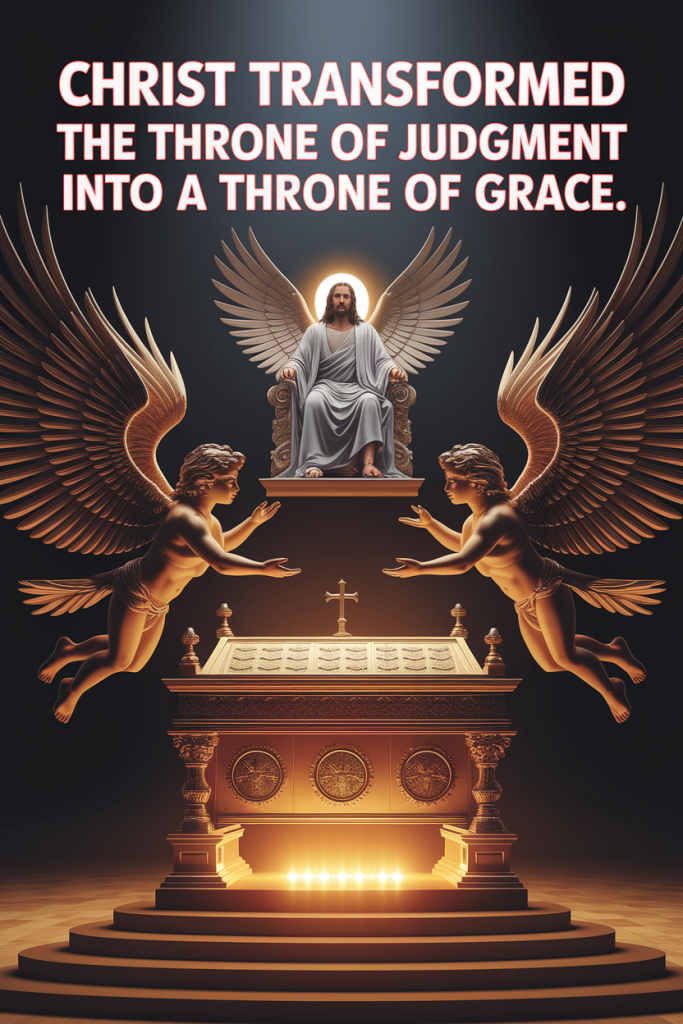
Finally, we see a parallel in the concept of God’s throne. In the Old Testament, the mercy seat was effectively God’s throne on earth – a throne of judgment tempered by mercy.
In the New Testament, the throne of God is explicitly called the “Throne of Grace” (Hebrews 4:16), inviting us to draw near for mercy.
This change signifies that because of Jesus’ atonement, God relates to believers on the basis of grace, not law. The throne that would have been one of judgment is now a throne of grace.
We can even say, in theological terms, that Calvary’s cross was God’s mercy seat where the ultimate sacrifice was offered, and now heaven’s throne is a mercy seat for all who are in Christ (What the Bible says about Throne of Grace).
When Christ died, the veil guarding the Holy of Holies ripped open (Matthew 27:51), showing that the way to God’s presence (the mercy seat) is opened for all who come through Jesus.
Thus, the mercy seat’s typology finds its culmination in the cross (atonement accomplished) and the throne of grace (atonement applied to give us access to God).
These themes highlight a consistent biblical message: God provides a way to meet with humanity through mercy, by means of a sacrifice. The mercy seat was a shadow; Jesus Christ is the reality.
4. Secondary Considerations
Jewish Traditions and Second Temple Perspectives
In Jewish tradition, the loss of the Ark and mercy seat was deeply felt, yet it was understood as part of God’s plan. As mentioned, during the Second Temple period the Holy of Holies contained only the Foundation Stone.
The High Priest still performed the Yom Kippur ritual by sprinkling blood on that spot, “where the Ark [and mercy seat] would have been”, as a memorial of the earlier practice (Holy of Holies - Wikipedia).
Rabbinic sources (e.g. Mishnah Yoma) describe how the High Priest would sprinkle blood toward the empty space.
This shows that even without the physical mercy seat, its symbolic role endured – reinforcing the idea that atonement and God’s mercy were central to Jewish faith.
Interestingly, the prophet Jeremiah had foretold that one day the Ark would not be missed, and Jerusalem would be called the throne of the Lord (Jeremiah 3:16-17) (leviticus - Was there anything behind the curtain of the Second Temple? - Biblical Hermeneutics Stack Exchange).
Some see this as a hint that the mercy seat’s significance would be surpassed by a greater manifestation of God’s throne and presence under the New Covenant.
After the Temple’s destruction (70 A.D.), the concept of the mercy seat in Judaism became more abstract, since there was no temple or ark.
Synagogues to this day have an “Ark” (aron kodesh) for the Torah scrolls, often with a curtain (parochet), and interestingly, the decorative veil valance in synagogues came to be called kaporet (the Hebrew word for mercy seat) (Mercy seat - Wikipedia).
This linguistic carry-over shows the lasting honor of the mercy seat’s memory – it remained a symbol of the Torah and God’s presence.
Yet, without a temple or sacrifices, Jewish worship shifted focus from physical atonement rituals to prayer, good deeds, and repentance, trusting in God’s mercy generally (Hosea 6:6, for example).
Some later Jewish commentators even allegorized the mercy seat, seeing it as symbolizing God’s attribute of mercy covering the demands of justice (the tablets).
In summary, Jewish tradition remembers the mercy seat as a sacred meeting point with God, now absent but hoped-for in the restoration of the Temple.
Christians believe that this hope finds fulfillment not in a rebuilt gold cover, but in Messiah Yeshua, who brings the very presence and mercy of God to us.
The Septuagint and Terminology Influences on the New Testament
The Greek translation of the Hebrew Scriptures (the Septuagint, LXX) had a notable impact on how New Testament writers understood and communicated the mercy seat’s meaning.
In the Hebrew Bible, the mercy seat is kapporet, from the root kapar meaning “to cover, atone.” The LXX translators rendered kapporet as hilastērion (ἱλαστήριον) (Mercy seat - Wikipedia).
This Greek word essentially means “place or means of propitiation/atonement.” It was a somewhat rare term in classical Greek, primarily used in a religious context for an atoning sacrifice (Mercy seat - Wikipedia).
By using hilastērion for the mercy seat, the Jewish translators conveyed that the gold cover on the Ark was intimately connected with atonement and appeasing God’s wrath (since that is where blood was offered to atone for sin).
The Latin Vulgate later translated this term as propitiatorium (Mercy seat - Wikipedia), from which we derive the English word “propitiation.” All of this set the stage for the New Testament.
When Paul wrote to the Romans, he chose the word hilastērion in 3:25 intentionally. As noted, most English Bibles say “propitiation” or “sacrifice of atonement” there, but Paul was likely evoking the entire Day of Atonement drama by naming Jesus as the hilastērion.
Early Jewish Christians, familiar with the LXX, would immediately think of the mercy seat in the Holy of Holies. Likewise, the author of Hebrews, in 9:5, uses hilastērion when recalling the Ark’s lid.
This shared terminology underscores how the theology of atonement carries over. The mercy seat was the place of propitiation; Jesus is now the person of propitiation.
The LXX usage also helps us see the connection between the Old Covenant symbols and New Covenant realities. The New Testament didn’t need to re-explain what “mercy seat” meant – by using hilastērion and related words, it tapped into a rich vein of meaning already present in Jewish thought.
In short, the Septuagint’s translation of kapporet to hilastērion provided the linguistic bridge for the apostles to declare, “Jesus is our atonement cover, our mercy seat.”
It highlights the continuity of God’s salvation plan: the same God who met Israel at the mercy seat now meets all people in Christ, granting mercy on the basis of shed blood.
Conclusion:
The study of the mercy seat in Scripture reveals a powerful thread of redemption and communion with God.
In the Old Testament, the mercy seat was literally the covering over the law where sacrificial blood was offered – a place of holiness, judgment, and mercy intertwined.
In the New Testament, all that the mercy seat stood for is realized in Jesus Christ, our High Priest and sacrifice. Through Him, the way into the holiest is opened and the throne of judgment has become the throne of grace.
The mercy seat’s gold and cherubim reflected God’s kingship; Christ now reigns as merciful King and eternal High Priest.
The blood on the mercy seat foreshadowed the precious blood of Christ, “the Lamb slain from the foundation of the world,” which cleanses us and speaks better things than the blood of goats.
Thus, the mercy seat is more than an ancient artifact; it is a theological paradigm for understanding God’s mercy through atonement.
From Exodus to Hebrews, the message is consistent: sinful humanity can find mercy in God’s presence through the blood of a divinely provided sacrifice.
The King James Version’s presentation of the mercy seat illuminates this gospel truth woven through the Bible, inviting us to appreciate how carefully God prepared the way for our salvation.
Sources: The Holy Bible, KJV (Exodus 25, Leviticus 16, etc.); Biblical scholarship and commentary on the mercy seat (Mercy seat - Wikipedia) ( Hebrews 9:5 & Romans 3:25 - Christ Jesus: Our Propitiation | Christian Courier) ( Hebrews 9:5 & Romans 3:25 - Christ Jesus: Our Propitiation | Christian Courier) (Holy of Holies - Wikipedia); New Testament teachings connecting Christ to the mercy seat (Romans 3:25 (Mercy seat - Wikipedia), Hebrews 9:5; Hebrews 4:16 (What the Bible says about Throne of Grace), etc.); and historical Jewish tradition regarding the Second Temple and the Ark (Holy of Holies - Wikipedia) (leviticus - Was there anything behind the curtain of the Second Temple? - Biblical Hermeneutics Stack Exchange). These all testify to the central theme of God’s mercy through atonement embodied by the mercy seat and fulfilled in Jesus Christ.
Call to Action: The Question That Demands an AnswerIn Acts 2:37 Peter and the Apostles were asked the question – What Shall We do? And in Acts 2:38 Peter answered, Repent, and be baptized every one of you in the name of Jesus Christ for the remission of sins, and ye shall receive the gift of the Holy Ghost. For the promise is unto you, and to your children, and to all that are afar off, even as many as the Lord our God shall call. Do you understand this? After hearing the gospel and believing, they asked what should would do. The answer hasn’t changed friend, Peter clearly gave the answer. The question for you today is, Have you receieved the Holy Spirit Since you believed? If you’re ready to take that step, or you want to learn more about what it means to be born again of water and Spirit, visit: Come, and let the Spirit make you new. |