Quick Overview of This Bible Study…
Short on time? I have created a short slide show presentation of some key takeaways in our study. The complete, more comprehensive bible study is below…
The Tabernacle is far more than an Old Testament curiosity; it is a gospel sermon in wood, fabric, and gold. Its study enriches our understanding of faith, redemption, and God’s desire to live among us.
As we appreciate its structure and significance, we join a long line of believers who have looked at the Tabernacle and seen the beauty of Christ.
And with the writer of Hebrews we can say: “We have such an high priest” and “such a hope” (Hebrews 8:1, 6:19) that was once reflected in the Tabernacle and is now realized in Jesus, the Messiah, the true Tabernacle who leads us to God.
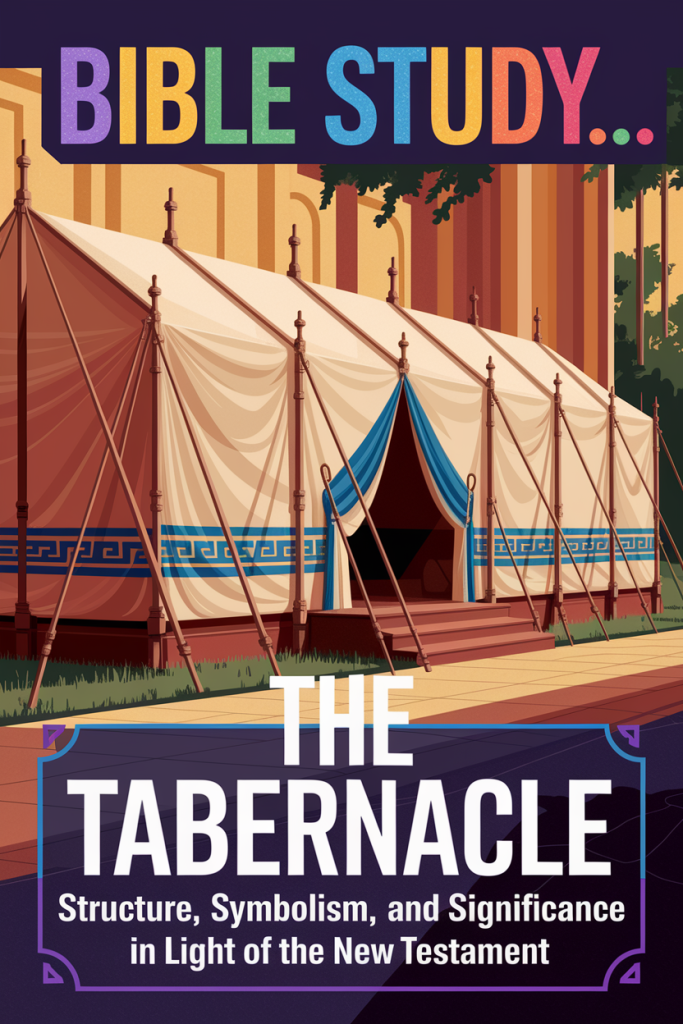
Historical Background of the Tabernacle
The Tabernacle (Hebrew Mishkan, “dwelling place”) was the portable sanctuary God instructed Moses to build at Mount Sinai (What Was the Tabernacle (Mishkan)? | My Jewish Learning).
It served as God’s dwelling among the Israelites during the Exodus and wilderness journey: “And let them make me a sanctuary; that I may dwell among them” (Exodus 25:8, KJV) (EXODUS 25:8 KJV "And let them make me a sanctuary; that I may dwell among them.").
Constructed around 1440–1400 BC (traditional dating), this sacred tent was used from the time of Moses through the conquest of Canaan (Tabernacle - Wikipedia).
For about 440 years it remained central to Israel’s worship, until King Solomon built a permanent Temple in Jerusalem which superseded the Tabernacle as God’s dwelling place around 957 BC (Tabernacle - Wikipedia).
Purpose:
The Tabernacle was where God met with His people. A cloud of God’s glory visibly filled it upon completion (Exodus 40:34-35 KJV - "Then a cloud covered the tent of the congregation,..."), symbolizing God’s presence in the camp.
The Israelites encamped around it by tribes, signifying that God was at their center (Numbers 2). It was also called the “tent of meeting” because Moses and the priests would meet the Lord there (Exodus 33:7-11).
Construction:
Skilled artisans (Bezalel and Aholiab) crafted it from free-will offerings of gold, fabrics, skins, wood, etc. (Exodus 35:21; 36:1-7).
It was made precisely “according to all that I show thee, after the pattern of the tabernacle” (Exodus 25:9, KJV), indicating a divinely revealed blueprint (EXODUS 25:8 KJV "And let them make me a sanctuary; that I may dwell among them.").
Portability:
The structure was designed to be dismantled and carried. As Israel journeyed, the Tabernacle was taken down and transported by the Levites (Numbers 4) so that God’s “tent” moved with His people (Tabernacle - Wikipedia).
This portability foreshadowed later Jewish worship in exile, where synagogues became “portable sanctuaries” wherever the people sojourned (What Was the Tabernacle (Mishkan)? | My Jewish Learning).
Central Worship:
Sacrifices, prayers, and festivals revolved around the Tabernacle. It was the site of daily burnt offerings, the annual Day of Atonement rites, and other Levitical ceremonies (Leviticus 1–17).
The Levitical priesthood was ordained to serve here (Exodus 28–29). Through the Tabernacle system, God taught Israel about holiness, atonement, and reconciliation with Himself (Leviticus 16:33-34).
After the Israelites entered Canaan, the Tabernacle was set up at Shiloh (Joshua 18:1) and other locations. Eventually, Solomon’s Temple replaced it, but its legacy endured.
Many features of the Temple worship (and even later synagogue traditions) were directly patterned after the Tabernacle’s design and rituals (Tabernacle - Wikipedia) (Tabernacle - Wikipedia).
Thus, the Tabernacle stands as a crucial link in Israel’s religious history, bridging the Exodus to the Temple era and providing rich symbolism later fulfilled in Christ.
Structure and Furnishings of the Tabernacle
The Tabernacle’s layout had three main zones of increasing sanctity: the Outer Court, the Holy Place, and the Holy of Holies (Tabernacle - Wikipedia) (Tabernacle - Wikipedia).
Each area contained specific items of sacred furniture, all made according to God’s instructions (Exodus 25–30).
The design taught that as one moved closer to God’s presence (in the innermost chamber), greater holiness and atonement were required. Here is an overview of the structure and its key furnishings:
Outer Court (Courtyard):
A rectangular fenced enclosure (~150 by 75 feet) with one entrance gate on the east side (Exodus 27:9-16). Inside stood the brazen altar and the bronze laver (Tabernacle - Wikipedia):
- Altar of Burnt Offering (Brazen Altar) – A large bronze-covered wooden altar at the entrance, used for animal sacrifices (Exodus 27:1-8). Here the daily burnt offerings and sin offerings were made, emphasizing that sacrifice for sin is the first need in approaching a holy God (Hebrews 9:22).
- Laver (Bronze Basin) – A round basin of bronze filled with water (Exodus 30:18-21). The priests had to wash their hands and feet here before entering the tent or offering sacrifice, symbolizing purification. It taught the need for cleansing from defilement before serving God (cf. Psalm 24:3-4).
The Holy Place:
The first chamber of the tent (also called the “sanctuary” (CHURCH FATHERS: Homily 15 on Hebrews (Chrysostom))), entered by a curtain. Only priests could enter this room, where three pieces of furniture stood (Tabernacle - Wikipedia):
- Golden Lampstand (Menorah) – A solid gold lampstand with seven lamps, kept burning continually with pure olive oil (Exodus 25:31-37). It provided light in the tent and symbolizes God’s light and life. Shaped like a flowering tree, it hearkened back to the tree of life and forward to the Messiah as “the light of the world” (John 8:12, KJV).
- Table of Showbread (Bread of the Presence) – A wooden table overlaid with gold, holding twelve loaves of bread (one for each tribe) set out before the Lord (Exodus 25:23-30). The bread was replaced weekly and eaten by the priests (Leviticus 24:5-9). It signified God’s continual provision and fellowship with His people – ultimately pointing to Christ as “the bread of life” (John 6:35, KJV).
- Altar of Incense – A small gold-covered wooden altar in front of the veil (the curtain to the inner room) (Exodus 30:1-8). Priests burned sweet incense on it every morning and evening. The rising incense represented the prayers of the people ascending to God (Heaven Invades Earth: Understanding the Symbolism & Purpose of the Tabernacle) (cf. “Let my prayer be set forth before Thee as incense”, Psalm 141:2, KJV). On the Day of Atonement, the high priest also put blood on the horns of this altar to cleanse it (Leviticus 16:18-19).
The Holy of Holies:
The innermost chamber, a perfect cube (15 feet per side), separated by a thick veil. This was the most sacred space – God’s throne room on earth – which only the high priest could enter, and only once a year on the Day of Atonement (Hebrews 9:7). Inside this room was one item:
- The Ark of the Covenant – A gold-plated wooden chest containing the two stone tablets of the Ten Commandments, a golden pot of manna, and Aaron’s rod that budded (CHURCH FATHERS: Homily 15 on Hebrews (Chrysostom)).
- The Ark was the symbol of God’s covenant presence. Its lid was the Mercy Seat (atonement cover) made of pure gold with two golden cherubim facing each other (Exodus 25:10-22). God promised to appear in glory above the Mercy Seat (Leviticus 16:2, Exodus 25:22).
- On the Day of Atonement, the high priest sprinkled blood on the Mercy Seat to atone for the sins of Israel (Leviticus 16:14-15). This ritual dramatized God’s mercy covering the Law (which Israel had broken) through a blood sacrifice.
Each element of the Tabernacle’s design was rich in theological meaning. The layout taught that access to God required sacrifice and cleansing, and even then a veil barred the way into the holiest presence.
Yet, as we will see, “the figures of the true” (Hebrews 9:24) in this sanctuary were “patterns of things in the heavens” (Hebrews 9:23, KJV) – earthly symbols of spiritual realities ultimately fulfilled in the New Testament.
Tabernacle Items and New Testament Fulfillment
Many Christians believe the Tabernacle’s structure and furnishings were “a shadow of heavenly things” (Hebrews 8:5, KJV) that find their fulfillment in Christ and the gospel. The table below summarizes the key items of the Tabernacle and how each foreshadows a New Testament truth:
| Tabernacle Component | Description & Function (OT) | New Testament Fulfillment |
|---|---|---|
| One Entrance Gate | Only one door on east side to enter court (Exodus 27:16). | Christ is the only way to the Father – “I am the door: by me if any man enter in, he shall be saved” (John 10:9, KJV) (JOHN 10:9 KJV "I am the door: by me if any man enter in, he shall be saved, and shall go in and out, and find pasture."). |
| Brazen Altar (Sacrifice) | Blood sacrifices offered daily for atonement of sin (Leviticus 4:29-30). | Jesus’ Cross – the once-for-all sacrifice. He is “the Lamb of God, which taketh away the sin of the world” (John 1:29, KJV) and by His blood we have redemption (Hebrews 9:12). |
| Laver (Wash Basin) | Priests washed to purify themselves before serving (Ex. 30:20-21). | Spiritual cleansing – Christ washes us from sin. Believers are washed by water of the Word and regeneration of the Holy Spirit (Ephesians 5:26, Titus 3:5). Baptism symbolizes this cleansing (Acts 22:16). |
| Lampstand (Light) | Seven-branched oil lamp giving light in Holy Place (Ex. 25:37). | Jesus the Light – “I am the light of the world” (John 8:12, KJV). The oil is often seen as the Holy Spirit anointing. The church also shines as light in Christ (Matthew 5:14-16; Revelation 1:20). |
| Table of Showbread | Twelve loaves of bread continually before God (Ex. 25:30). | Jesus the Bread – “I am the bread of life” who satisfies our spiritual hunger (John 6:35, KJV). Also symbolizes fellowship with God; Jesus institutes the Lord’s Supper with bread as His body (Luke 22:19). |
| Altar of Incense | Fragrant incense burned to God (Ex. 30:7-8). | Prayer and Intercession – Incense represents prayers rising to heaven (Heaven Invades Earth: Understanding the Symbolism & Purpose of the Tabernacle) (cf. Revelation 8:3-4). Jesus intercedes for us like a high priest with incense (Hebrews 7:25, Nine:24). Believers’ prayers are a sweet aroma (Revelation 5:8). |
| Veil (Curtain) | Thick curtain barring entry to Holy of Holies (Ex. 26:31-33). | Christ’s Flesh – The veil symbolized the barrier of sin. When Jesus died, “the veil of the temple was rent in twain” (Matthew 27:51, KJV), signifying that His flesh opened the way to God (Heaven Invades Earth: Understanding the Symbolism & Purpose of the Tabernacle) (Hebrews 10:19-20). |
| Ark of the Covenant | Chest holding Law tablets; God’s throne on Mercy Seat (Ex. 25:16-22). | God’s Presence in Christ – The Ark was God’s dwelling; Jesus is Emmanuel, “God with us” (Matthew 1:23). The Law inside the Ark was perfectly kept by Christ, who fulfilled the Law (Matthew 5:17). The Mercy Seat (atonement cover) foreshadows Christ as our propitiation (the atoning sacrifice) by His blood (Romans 3:24-25 KJV). In Christ, God’s justice and mercy meet (1 John 2:2). |
| High Priest (Aaron) | Mediated between Israel and God; entered Holy of Holies with sacrifice on Day of Atonement (Lev. 16:15-17). | Jesus our High Priest – “a high priest of good things to come” who entered heaven itself with His own blood (Hebrews 9:11-12, 9:24 KJV). Christ is sinless and eternal, mediating a New Covenant (Hebrews 4:14; 7:26; 8:6). |
| Priests (Levitical) | Offered sacrifices and prayers daily; had to be from Aaron’s line (Ex. 28:1). | Believer’s Priesthood – In Christ, all believers become a “royal priesthood” (1 Peter 2:5,9, KJV) with direct access to God, offering spiritual sacrifices of praise and service (Hebrews 13:15). |
Scripture references are from the King James Version (KJV).
This remarkable correspondence between the Tabernacle’s elements and New Testament truths is not coincidental.
The New Testament itself explicitly teaches that the Tabernacle was a prophetic symbol: “the law having a shadow of good things to come” (Hebrews 10:1, KJV) and those priests “serve unto the example and shadow of heavenly things” (Hebrews 8:5, KJV).
In other words, the physical rituals of the Tabernacle were an “enigmatic” preview of God’s plan in Christ (CHURCH FATHERS: Homily 15 on Hebrews (Chrysostom)).
Early Christian theologians and the Apostles saw in the Tabernacle a gospel blueprint hidden in Old Testament form.
Theological Connections to New Testament Themes
The Tabernacle’s significance comes alive when we examine how it connects to key New Testament themes.
Through symbols and rituals, it prepared the way for understanding Christ, the work of the Holy Spirit, the nature of faith, the principle of sacrifice, the role of priesthood, and the promise of salvation. Below, we explore each of these connections:
Christ Foreshadowed in the Tabernacle
From a Christian perspective, Jesus Christ is the true fulfillment of the Tabernacle’s meaning.
The Gospel of John declares, “the Word was made flesh, and dwelt among us” (John 1:14, KJV) (JOHN 1:14 KJV "And the Word was made flesh, and dwelt among us, (and we beheld his glory, the glory as of the only begotten...").
The word “dwelt” in Greek (eskēnōsen) literally means “tabernacled.” Just as God’s presence dwelt in the ancient tent, in Jesus “God with us” took up residence among humanity (Heaven Invades Earth: Understanding the Symbolism & Purpose of the Tabernacle).
We beheld His glory, as Israel once saw God’s glory descend on the tent (Exodus 40:34-35 KJV - "Then a cloud covered the tent of the congregation,..."). Key parallels include:
God-Man Union:
The Tabernacle was a meeting point of God and man – “where God and man could meet” (Heaven Invades Earth: Understanding the Symbolism & Purpose of the Tabernacle).
Jesus, being fully God and fully man, is the ultimate meeting place of God and humanity. He is the “one mediator between God and men” (1 Timothy 2:5) – a living Tabernacle.
In Him, divinity and humanity are united, which is why John says Jesus showed God’s glory and presence in bodily form (John 1:14) (Heaven Invades Earth: Understanding the Symbolism & Purpose of the Tabernacle).
The Veil as Christ’s Flesh:
The inner veil, which prevented access to God’s presence, is explicitly linked to Christ. Hebrews teaches that Jesus opened a new way to God “through the veil, that is to say, His flesh” (Hebrews 10:20, KJV) (Heaven Invades Earth: Understanding the Symbolism & Purpose of the Tabernacle).
When Christ’s flesh was torn on the cross, the Temple veil tore in two (Heaven Invades Earth: Understanding the Symbolism & Purpose of the Tabernacle), ending the separation. Through Jesus’ body, believers now “enter into the Holiest” presence of God with boldness (Hebrews 10:19-22, KJV).
High Priest and Sacrifice:
In the Tabernacle, the high priest and the sacrifice were distinct – the priest offered a lamb. In Christ, He is both the High Priest and the Lamb of sacrifice.
The Epistle to the Hebrews emphasizes that Christ as High Priest entered not an earthly Holy of Holies but heaven itself, with the offering of His own blood, thus securing eternal redemption (Hebrews 9:11-12, 24).
What the high priest did with animal blood yearly, Jesus did once for all with His own blood (CHURCH FATHERS: Homily 15 on Hebrews (Chrysostom)).
Early Christian teachers like John Chrysostom noted that the earthly Holy of Holies was a figure of “heaven”, and Christ’s ascension there with His blood fulfilled the Tabernacle’s purpose (CHURCH FATHERS: Homily 15 on Hebrews (Chrysostom)).
Every Part Speaks of Christ:
Christians throughout history have seen virtually every part of the Tabernacle as symbolizing some aspect of Christ’s person or work.
For example, Clement of Alexandria (2nd century) taught that the golden lampstand was an “enigma as a symbol of Christ”, shining divine light (Clement of Alexandria, The Stromata, or Miscellanies ).
The Showbread is often seen as pointing to Christ’s life-giving presence. The Ark of the Covenant, containing the Law, foreshadows Christ the Word of God, perfectly keeping God’s law and embodying God’s throne of grace (Romans 3:25).
In sum, Jesus is the true Tabernacle (Hebrews 8:2) – the ultimate dwelling place of God among men and the fulfillment of all that the Tabernacle signified.
The Holy Spirit and God’s Presence
The Tabernacle was filled with God’s Spirit and glory, and in the New Testament the Holy Spirit continues that indwelling presence:
Shekinah to Spirit:
In the Old Testament, God’s presence was evidenced by the Shekinah glory cloud that filled the Tabernacle (Exodus 40:34-35 KJV - "Then a cloud covered the tent of the congregation,..."). In the New Testament, God’s presence fills the “tabernacles” of His people.
Believers collectively are described as the Temple of God indwelt by the Holy Spirit (1 Corinthians 3:16, 6:19). At Pentecost, tongues of fire rested on each believer (Acts 2:3-4), echoing how the pillar of fire rested on the Tabernacle (Exodus 40:38).
Now, instead of a tent of skin, human hearts are God’s sanctuary. The church is “a spiritual house” (1 Peter 2:5) being built for God’s dwelling, with Christ as the cornerstone (Ephesians 2:19-22) (Heaven Invades Earth: Understanding the Symbolism & Purpose of the Tabernacle) (Heaven Invades Earth: Understanding the Symbolism & Purpose of the Tabernacle).
Lampstand – Oil of the Spirit:
The continually burning lampstand was fueled by pure olive oil, often interpreted as a symbol of the Holy Spirit’s anointing.
Just as the lamp gave light, the Holy Spirit enlightens believers to truth and empowers them to shine in a dark world.
In Revelation, seven torches before God’s throne are called “the seven Spirits of God” (Revelation 4:5), reinforcing the link between the Menorah’s light and the Holy Spirit.
Incense – Prayer in the Spirit:
The fragrant incense, symbolic of prayer, reminds us that true prayer is empowered by the Holy Spirit. Believers pray “in the Holy Ghost” (Jude 20) and the Spirit intercedes for us (Romans 8:26).
In the Tabernacle, incense had to be ignited by fire from the altar (Leviticus 16:12-13); likewise, Christian prayer is ignited by the fire of the Spirit.
Thus, the Tabernacle shows a pattern of Spirit-filled worship – illumination, intercession, and sanctification – that carries into New Testament faith.
Faith and Access to God
Under the Old Covenant, worshippers approached God through the Tabernacle system by obedience and ritual, but these acts were effective only if joined with sincere faith in God’s promise.
The New Testament emphasizes that those symbols have given way to the reality: faith in Jesus Christ is now the way to draw near to God. The Tabernacle illustrates principles of faith:
From Shadow to Substance:
Hebrews explains that the Tabernacle ceremonies were the “shadow,” and Christ is the substance (Hebrews 10:1).
Old Testament believers had to trust that through the priest’s intercession and the sacrifice’s blood, God would cover their sins. This was essentially faith in God’s provision (though they did not see Christ yet).
Now that Christ has come, our faith is explicitly in His finished work. We no longer bring goats or lambs, but we “draw near with a true heart in full assurance of faith” (Hebrews 10:22) because of Jesus’ shed blood.
Bold Access:
The veil indicated restricted access – only the high priest, and with fear and trembling. But “we have boldness to enter into the Holiest by the blood of Jesus” (Hebrews 10:19, KJV).
This boldness is essentially faith – taking God at His word that Christ’s death truly opened the way.
When the veil tore at Christ’s death, it was God’s dramatic invitation to all His people to come into His presence by faith, not by earthly ritual (Heaven Invades Earth: Understanding the Symbolism & Purpose of the Tabernacle).
No longer must we stand afar; like the high priest on the Day of Atonement we can “come boldly unto the throne of grace” every day (Hebrews 4:16).
Walking by Faith, Not by Sight:
Clement of Alexandria pointed out that the masses who only believe what their five senses perceive remain outside the deeper sanctuary of truth (Clement of Alexandria, The Stromata, or Miscellanies ) (Clement of Alexandria, The Stromata, or Miscellanies ).
The Tabernacle’s hidden inner room teaches that we must trust God’s unseen presence. “We walk by faith, not by sight” (2 Corinthians 5:7, KJV) (Clement of Alexandria, The Stromata, or Miscellanies ).
The outer court was open and visible to all, but the Holy of Holies was veiled – accessible only by trust in God’s command.
Similarly, the Christian life calls us to believe in realities we cannot yet see (Hebrews 11:1). Christ has entered heaven, inviting us to follow in faith until the day we see Him face to face.
Sacrifice and Atonement: From Lambs to the Lamb of God
The entire Tabernacle system revolved around sacrifice for sin – a constant reminder that “without shedding of blood is no remission” (Hebrews 9:22, KJV). These sacrifices find their ultimate meaning in Jesus’ sacrificial death:
Continuous Sacrifices vs. Once for All:
At the Tabernacle altar, morning and evening sacrifices were offered daily (Exodus 29:38-39), and many more on feast days – an unending stream of animal blood that could never fully remove sin (Hebrews 10:4).
On the Day of Atonement, this pattern culminated in the high priest offering blood in the Holy of Holies once each year (Leviticus 16:34).
The New Testament reveals these as types: Jesus, the Lamb of God, by one sacrifice of Himself accomplished what millions of animal sacrifices could not. “But this man, after he had offered one sacrifice for sins for ever, sat down on the right hand of God” (Hebrews 10:12, KJV).
The repetition has given way to finality. As Chrysostom noted, even the Old Covenant hinted at a single ultimate sacrifice by having one special sin offering yearly (CHURCH FATHERS: Homily 15 on Hebrews (Chrysostom)) – Christ fulfilled this in reality.
Blood on the Mercy Seat:
The high priest sprinkled blood on the Mercy Seat to cover the broken Law underneath. This propitiation (appeasing of wrath) was symbolic, pointing to Christ’s blood which truly propitiates God’s justice.
Romans 3:25 (KJV) says God set forth Christ “to be a propitiation through faith in His blood.” The Greek word for “propitiation” (hilastērion) can mean mercy seat.
Thus, Jesus is the Mercy Seat where God’s justice and mercy meet. By His blood, God can be “just and the justifier” of those who believe (Romans 3:26) – forgiving sin without compromising righteousness.
Life for Life – Substitution:
At the altar, an innocent victim died in place of the guilty worshipper. This ingrained the principle of substitutionary atonement. Jesus perfectly embodied this as “the just for the unjust, that He might bring us to God” (1 Peter 3:18).
Isaiah 53:5 prophesied, “He was wounded for our transgressions… the chastisement of our peace was upon Him.”
Every time an Israelite laid his hand on a sacrifice’s head (Leviticus 4:4), it signified transferring guilt to a substitute – just as our sins were laid on Christ (Isaiah 53:6).
Therefore, the Tabernacle sacrifices were living illustrations of the Cross, preparing people to grasp the meaning of Jesus’ death as the ultimate atonement.
Priesthood: Aaron’s Line and Christ’s Eternal Priesthood
The Tabernacle introduced the priesthood – a chosen mediator who could approach God on behalf of others. This finds its fulfillment and transformation in the New Testament:
Aaron vs. Christ:
Aaron the high priest (and his descendants) were sinners who had to offer sacrifices for their own sins as well as the people’s (Hebrews 5:1-3). Their priesthood was temporary – priests died and passed on the role.
In contrast, Jesus is the sinless High Priest who “needeth not daily, as those high priests, to offer up sacrifice, first for his own sins, and then for the people’s” (Hebrews 7:27, KJV).
By virtue of His indestructible life, He holds His priesthood forever (Hebrews 7:24). He is a priest “after the order of Melchizedek,” superior to Aaron’s order (Hebrews 7:11).
The Levitical priests served in an earthly tent, but Christ ministers in the heavenly sanctuary at God’s right hand (Hebrews 8:1-2). Thus, Christ’s priesthood fulfills and surpasses the Aaronic priesthood the Tabernacle had established.
Mediation:
In the Tabernacle, people could not approach God directly; they brought offerings to the priest. The priest stood in the gap, wearing twelve gemstones on his breastplate representing Israel’s tribes (Exodus 28:29) as he entered God’s presence.
This foreshadowed Christ, who carries us upon His heart into God’s presence. “For there is one God, and one mediator between God and men, the man Christ Jesus” (1 Timothy 2:5, KJV).
Christ’s intercession is continual – “He ever liveth to make intercession for them” (Hebrews 7:25, KJV), just as incense was continually rising on the golden altar for Israel. We rely on His mediation now, rather than an earthly priest.
Believer Priests:
A dramatic shift in the New Testament is the concept of the priesthood of all believers. Because Jesus has opened the way, every believer has direct access to God.
Peter declares Christians “a royal priesthood, an holy nation” (1 Peter 2:9, KJV). We no longer need a human priest to stand between us and God, since Christ has done so.
Instead, we ourselves offer spiritual sacrifices: our bodies (Romans 12:1), praise (Hebrews 13:15), good works, and the gospel (1 Peter 2:5).
In worship, Christians have a form of liturgy analogous to the Tabernacle’s, but now spiritualized – e.g. prayer instead of incense, self-surrender instead of animal sacrifice, etc.
In the Book of Revelation, redeemed saints serve God day and night in His temple and are called priests of God (Revelation 1:6, 5:10).
What was restricted to one tribe (Levi) under the Old Covenant has become the privilege of all God’s children under the New Covenant.
Salvation and the Presence of God
Ultimately, the Tabernacle was about God’s desire to dwell with His people – a theme that reaches its climax in the New Testament doctrine of salvation and our hope of glory:
The Journey of Salvation Foreshadowed: Many interpreters see the layout of the Tabernacle as a roadmap of salvation. A sinner begins outside, separated by sin.
He enters through the one gate (Christ), first encounters the altar (the Cross, justification), then the laver (sanctification, cleansing).
As a redeemed believer (priest unto God), he fellowships in the Holy Place – illuminated by the Spirit (lampstand), fed by the presence of Christ (bread), and offering prayers (incense).
Finally, the goal is to enter the Holy of Holies – to behold God’s glory and enjoy intimate communion with Him.
This final step was not available under the Old Covenant (except representatively by the high priest), but in Christ, “we all, with unveiled face, beholding…the glory of the Lord, are changed into the same image” (2 Corinthians 3:18).
In worship now, “we have access by faith into this grace” (Romans 5:2), and one day in eternity we will see Him face to face. The Tabernacle thus portrays the full journey: from atonement at the altar to adoration in God’s immediate presence.
God Dwelling with His People – Now and Forever:
The Tabernacle was an early fulfillment of God’s promise, “I will dwell among the children of Israel, and will be their God” (Exodus 29:45).
In Christ, this promise deepens – “If a man love me…My Father will love him, and We will come unto him, and make Our abode with him” (John 14:23, KJV).
The Holy Spirit indwelling us means God has pitched His tent in our hearts. This points forward to the ultimate vision in Revelation: “Behold, the tabernacle of God is with men, and He will dwell with them, and they shall be His people, and God Himself shall be with them, and be their God” (Revelation 21:3, KJV). In the eternal state, the symbolism becomes reality – there is “no temple” building in the New Jerusalem “for the Lord God Almighty and the Lamb are the temple” (Revelation 21:22).
The Tabernacle was a microcosm of Heaven (Heaven Invades Earth: Understanding the Symbolism & Purpose of the Tabernacle) (Heaven Invades Earth: Understanding the Symbolism & Purpose of the Tabernacle) – a place where heaven and earth met.
Through salvation, heaven and earth are reconciled in Christ, and in the new creation God and redeemed humanity will tabernacle together forever. The temporary tent in the wilderness gave way to a permanent relationship in glory.
Jewish Traditions and the Tabernacle’s Legacy
The Tabernacle’s impact did not cease when it was replaced by the Temple; it continued to influence Jewish worship and thought in various ways:
From Tabernacle to Temple: Solomon’s Temple inherited the blueprint of the Tabernacle (1 Kings 8, 2 Chronicles 3–5).
The Holy Place and Holy of Holies of the Temple were twice the size of the Tabernacle’s, but contained the same three furnishings and Ark.
At the Temple’s dedication, again “the glory of the LORD filled the house” (1 Kings 8:10-11), just as it had filled the Tabernacle (Exodus 40:34-35 KJV - "Then a cloud covered the tent of the congregation,...").
The Ark of the Covenant remained the central sacred object until the Babylonian exile (tradition holds that it was hidden or lost at that time).
Even in the Second Temple (516 BC – 70 AD), which lacked the Ark, the layout and daily offerings continued per the Mosaic instructions.
The Yom Kippur (Day of Atonement) ritual, for example, was still based on Leviticus 16 – the High Priest would sprinkle blood in the Holy of Holies (on the Foundation Stone where the Ark once sat).
Synagogue Design:
After the Temple’s destruction (70 AD) and the end of animal sacrifices, Jewish worship shifted fully to local synagogues and prayer-houses. Notably, synagogue architecture deliberately echoes the Tabernacle/Temple pattern (Tabernacle - Wikipedia) (Tabernacle - Wikipedia).
Every synagogue has a focal point at the front called the aron kodesh (holy ark) where Torah scrolls are kept – analogous to the Ark of the Covenant which held God’s Law (Tabernacle - Wikipedia).
The aron kodesh is the holiest spot in the synagogue, akin to the Holy of Holies. A continuously lit lamp (ner tamid) hangs before it, reminiscent of the ever-burning Menorah lamp (Tabernacle - Wikipedia).
There is often a reading table (bimah) in the center, symbolically corresponding to the altar of offerings or incense (Tabernacle - Wikipedia).
During certain blessings (e.g. the priestly benediction on holy days), Jewish kohanim (priests descended from Aaron) stand at the front and bless the congregation – just as their ancestors ministered in the Tabernacle (Tabernacle - Wikipedia).
These traditions show a conscious continuation of Tabernacle themes: reverence for God’s Word (tablets/Torah), the light of God’s presence, sacrifice (now of praise and prayer instead of animals), and the blessing of the priesthood.
Feast of Tabernacles (Sukkot):
One of Israel’s major festivals, Sukkot (Leviticus 23:34-43), commemorates the wilderness period when Israel lived in booths (tents) and God dwelt among them in the Tent of Meeting.
Jews build temporary booths each year to remember living under God’s care. Significantly, Sukkot also celebrates God’s dwelling presence – in Temple times it was a feast of rejoicing over God’s provision and presence.
In later Jewish literature, the Tabernacle’s dedication (Exodus 40) is linked with the timing of Sukkot.
In the Gospel of John, Jesus likely alludes to Sukkot themes when He speaks of giving living water and being the light of the world (John 7:37-38, 8:12) during that festival, tying the Tabernacle symbolism (water = God’s provision, light = God’s presence) to Himself.
Shekinah Theology:
Jewish rabbis coined the term Shekinah (from shakan, “to dwell”) to refer to the Divine Presence, especially as manifest in the Tabernacle/Temple.
They taught that the Shekinah glory accompanied Israel and that even after the Temple’s destruction, when ten faithful Jews gather the Shekinah is with them (Pirkei Avot 3:6).
The Tabernacle thus contributed to the concept that God’s presence can dwell among His people in community and worship – an idea that carries into both synagogue worship and, in Christian understanding, into the church (Matthew 18:20).
Continuation of Sacrifice?:
Without a Temple, Jewish practice could no longer include animal sacrifices, so prayer, repentance, and charity became “spiritual sacrifices” (Hoshea 14:2 in Hebrew uses “bulls of our lips” to mean prayers).
Yet, traditional Jewish prayers (such as the Amidah) still plead for the rebuilding of the Temple and return of the sacrificial system.
The Tabernacle is thus remembered not only as a past event but as a model for a hoped-for future where God’s house will be restored.
Some Jewish scholars also view the world itself as a kind of cosmic tabernacle for God’s presence, and human beings as mini-sanctuaries when they uphold God’s law.
In summary, Jewish tradition regards the Tabernacle (Mishkan) as the first step in an unfolding history of God’s dwelling with Israel – a history that moved from **Mishkan to Temple, to synagogue, and (in the Christian narrative) to the body of believers as God’s temple.
The physical form changed, but the ideal remained: “I will set My tabernacle among you” (Leviticus 26:11).
This promise resonates through time, finding an unexpected fulfillment in the New Testament claim that Messiah Jesus is the ultimate Tabernacle, and echoing forward to the hope of God dwelling with redeemed humanity forever.
Early Christian Reflections on the Tabernacle
The early Church theologians (Church Fathers) eagerly employed tabernacle typology to illuminate Christian doctrine. They inherited the New Testament’s own interpretive cues – especially the Epistle to the Hebrews – and expanded on them in their preaching and writings:
New Testament Foundation: The Epistle to the Hebrews (c. 60s AD) can be seen as the first Christian “commentary” on the Tabernacle. It explicitly describes the layout of the tent and declares it a figure or “parable for the time then present” (Hebrews 9:8-9).
Hebrews says the priests serving in the tabernacle “serve unto the example and shadow of heavenly things” (Hebrews 8:5, KJV) and that Christ has now entered the greater, heavenly holy place.
This apostolic writing set the stage for seeing every detail as foreshadowing Christ. For example, Hebrews identifies Christ with the High Priest, the perfect sacrifice, and even the veil of the Tabernacle (Heaven Invades Earth: Understanding the Symbolism & Purpose of the Tabernacle).
The early fathers frequently cited these interpretations. John Chrysostom (4th century), in his homilies on Hebrews, emphasized that the Holy of Holies symbolized heaven and that Jesus passing through the heavens is like the High Priest passing through the veil – “through the veil of His flesh” (CHURCH FATHERS: Homily 15 on Hebrews (Chrysostom)).
Thus the New Testament itself invited believers to find Christ-centered meaning in the Tabernacle.
Clement of Alexandria (c. 150–215):
Clement was among the first to write an extensive allegorical interpretation of the Tabernacle. In his Stromata, he calls the Tabernacle an elaborate enigma of spiritual truths.
He saw the colors of the veils (blue, purple, scarlet, white) as representing the elements of the universe (Clement of Alexandria, The Stromata, or Miscellanies ), and the seven lamps of the Menorah as representing the seven planets or the “seven eyes/Spirits of the Lord” (Clement of Alexandria, The Stromata, or Miscellanies ).
More directly relevant, Clement taught that the lampstand is a symbol of Christ who enlightens the world (Clement of Alexandria, The Stromata, or Miscellanies ), and that the bread on the table signifies the unity of the Church (God’s people sustained together as one loaf) (Clement of Alexandria, The Stromata, or Miscellanies ).
He even linked the veil and the screen to the need to go beyond the five senses (symbolized by the five pillars) to perceive God (Clement of Alexandria, The Stromata, or Miscellanies ), stating that the Son of God reveals the Father to our spiritual senses (Clement of Alexandria, The Stromata, or Miscellanies ).
While some of Clement’s interpretations stray into a speculative mode (mixing Greek philosophy with biblical typology), his overarching idea is clear: the Tabernacle was a “mystical” foreshadowing of Christian realities.
He took seriously the principle that “almost the whole of Scripture speaks in enigmas (types)” (Clement of Alexandria, The Stromata, or Miscellanies ).
Irenaeus of Lyons (c. 130–202):
Irenaeus, a Church Father who combatted Gnostic heresies, stressed that all Scripture points to Christ.
He wrote, “If any one…reads the Scriptures with attention, he will find in them an account of Christ…for Christ is the treasure which was hid in the field, and pointed out by means of types and parables.” (Types, Shadows, and Symbols of Christ Seen by the Church Fathers | Religious Studies Center).
Though Irenaeus does not detail the Tabernacle furnishings as Clement does, his approach supports the idea that the Tabernacle and its operations were prophetic types of Christ’s work.
For instance, Irenaeus saw the sacrificial system as foreshadowing the sacrifice of Christ, and the earthly sanctuaries as prefiguring the heavenly realities.
The unanimity among early fathers was that Christ is present throughout the Old Testament in shadowy form, and the Tabernacle was a prime example of those shadows.
Origen (c. 185–254) and others:
Origen, another Alexandrian theologian, wrote homilies on Exodus and Leviticus with allegorical interpretations of the Tabernacle.
He compared the journey through the Tabernacle to the soul’s journey to God, and the High Priest’s actions on the Day of Atonement to Christ’s redemptive work.
Later, St. Augustine (354–430) continued to affirm that the Tabernacle/Temple rituals signified deeper truths.
Augustine wrote, “Often the reference [in the Old Testament] is allegorical…perhaps in a verbal prophecy, perhaps in the symbolic action of some literal institution (such as the tabernacle and its services) – but Christ is ‘either directly or indirectly’ the subject.” (CHURCH FATHERS: Homily 15 on Hebrews (Chrysostom)) (CHURCH FATHERS: Contra Faustum, Book XII (Augustine)).
In other words, the consensus was that the Tabernacle was about Christ and His Church, once you understood it with enlightened eyes.
The Tabernacle and the Church:
Early Christians also drew parallels between the Tabernacle and the Church. Just as God dwelt in the Tabernacle, so He dwells in the Church through the Spirit.
Some saw the Church itself prefigured in the tent. For example, the curtains and boards that made up the tent were many individual pieces joined to form one house – a type of the members of the Church being joined in unity.
The portable nature of the Tabernacle was likened to the Church’s pilgrim status on earth: we are journeying toward the heavenly city, “moving” as God leads, just as the Tabernacle moved in the wilderness.
When the Cloud moved, Israel followed (Numbers 9:17-18); so the Church is led by the Holy Spirit.
Even the idea that the Tabernacle had an earthly and a heavenly aspect (the earthly tent vs. the heavenly reality it mirrored) played into early Christian Platonist thought – seeing the Church on earth as the earthly atrium of the heavenly sanctuary.
Worship Practices:
The early Church did not attempt to replicate the literal rituals of the Tabernacle (since Christ’s sacrifice ended the need for them), but they did see their own worship in continuity with the symbolism.
E.g., incense was adopted in Christian liturgy, not as a sacrifice, but as a symbol of prayer (as in Psalm 141:2).
Churches were eventually built to resemble basilicas or even with a layout reminiscent of the Temple (nave = Holy Place, sanctuary = Holy of Holies).
While the very earliest Christians met in homes, by the time of the Constantinian churches, the sense of a sacred space reflecting God’s heavenly throne room was present.
The Lord’s Supper was seen as corresponding in some sense to the Showbread – a sign of God’s covenant presence and provision through Christ’s body.
Thus, through sacrament, architecture, and prayer, the legacy of the Tabernacle influenced how the early Christians envisioned their worship as entering the Holy of Holies in a spiritual manner.
In sum, the early church fathers consistently taught that the Tabernacle was “written for our admonition” (cf. 1 Corinthians 10:11) and was full of types and shadows of Christ.
They marveled that a nomadic tent in the desert, crafted under Moses’ direction, contained in it the blueprint of God’s plan of salvation.
Such insights not only enriched their theology but also gave them confidence in the unity of Scripture – that the same God who gave the Law to Israel also preached the Gospel beforehand through those laws (Galatians 3:8).
The Tabernacle was a prime example of this, and remains for believers today a powerful visual aid of the work of Jesus Christ.
Conclusion
The study of the Mosaic Tabernacle reveals a multifaceted treasure of spiritual truth. Historically, it was the heart of Israel’s worship, a holy place where sacrifices were made and forgiveness sought, where God’s glory dwelt among men.
Theologically, every facet of the Tabernacle – its structure, priesthood, and rituals – anticipated the person and work of Jesus Christ.
The New Testament authors and early Christians recognized in this ancient tent a prefiguration of the Gospel: Christ is the ultimate High Priest, the perfect Sacrifice, the living Bread, the Light of the world, and even the Presence of God veiled in human flesh.
By fulfilling the Tabernacle’s symbolism, Jesus opened the way for us to enter God’s presence with confidence and to experience the indwelling Holy Spirit.
Moreover, the Tabernacle’s theme of God dwelling with His people threads through Jewish tradition and finds its culmination in the Christian hope of eternity.
What began with a moveable tent in the wilderness ends with the vision of “a tabernacle of God with men” forever (Revelation 21:3).
The Apostle John’s stark declaration “I saw no temple [in the city], for the Lord God Almighty and the Lamb are the temple of it” (Revelation 21:22) signals that the purpose of the Tabernacle will be fully realized – unbroken fellowship between God and redeemed humanity.
Thus, the Tabernacle is far more than an Old Testament curiosity; it is a gospel sermon in wood, fabric, and gold. Its study enriches our understanding of faith, redemption, and God’s desire to live among us.
As we appreciate its structure and significance, we join a long line of believers who have looked at the Tabernacle and seen the beauty of Christ.
And with the writer of Hebrews we can say: “We have such an high priest” and “such a hope” (Hebrews 8:1, 6:19) that was once reflected in the Tabernacle and is now realized in Jesus, the Messiah, the true Tabernacle who leads us to God. (Heaven Invades Earth: Understanding the Symbolism & Purpose of the Tabernacle) (CHURCH FATHERS: Homily 15 on Hebrews (Chrysostom))