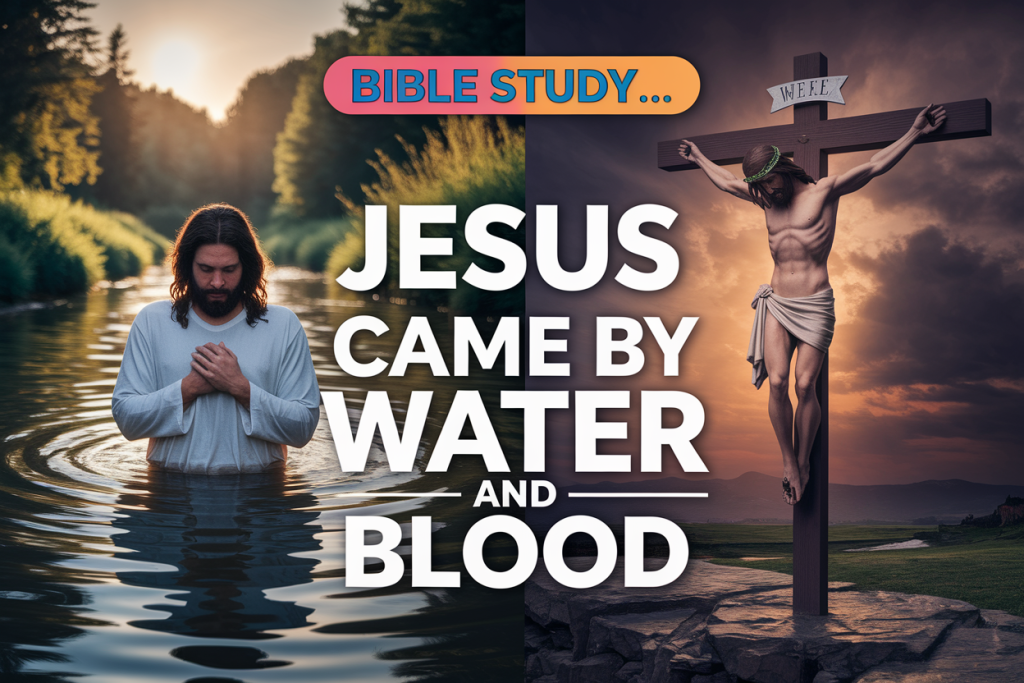
Quick Overview of This Bible Study…
Short on time? I have created a short slide show presentation of some key takeaways in our study. The complete, more comprehensive bible study is below…
“This is He who came by water and blood—Jesus Christ; not by water only, but by water and blood” (1 John 5:6).
This brief phrase from the Apostle John’s first epistle has puzzled and inspired readers through the centuries (1 John 5:6 Commentary | Precept Austin) (What Is the Meaning of 1 John 5:6–8? | Redemption of Humanity).
What did John mean by “water and the blood,” and why emphasize that Jesus came not by water only?
In this report, we will conduct an in-depth biblical study of 1 John 5:6, examining its context, Old Testament foreshadows, New Testament connections, and various theological interpretations (patristic, historical, and modern).
We will also explore the symbolic, doctrinal, and Christological significance of “water and the blood,” drawing on Scripture and respected commentaries.
The goal is a thorough and structured understanding of who and what “water and blood” refer to, when and where these elements appear in Christ’s work, why John highlights them, and how they function in God’s redemptive plan.
Context and Purpose of 1 John 5:6
Immediate Context: 1 John 5:5–8 forms part of John’s concluding affirmations about Jesus as the Son of God.
In verse 5, John asks, “Who is it that overcomes the world except the one who believes that Jesus is the Son of God?”
He then answers in verse 6 by identifying Jesus as “He who came by water and blood.” John immediately adds, “And it is the Spirit who bears witness, because the Spirit is truth” (5:6b), and goes on to say “there are three that testify: the Spirit and the water and the blood; and these three agree” (5:7–8).
The context is one of testimony or witness: John presents the water, the blood, and the Spirit as three witnesses that affirm Jesus’s identity as the Christ, the Son of God (1 John 5:6 Commentary | Precept Austin) (1 John 5:6 Commentary | Precept Austin).
Thus, “came by water and blood” is tied to how Jesus’s mission and identity are divinely attested.
“He who came” – Identifying Jesus: The phrase “This is He” points back to Jesus Christ (1 John 5:6 Commentaries: This is the One who came by water and blood, Jesus Christ; not with the water only, but with the water and with the blood. It is the Spirit who testifies, because the Spirit is the truth.).
John is referring to the historical coming of Jesus – His incarnation and public ministry.
To say Jesus came “by” or “through” (Greek dia) water and blood implies that these elements were integral to His coming and mission on earth (1 John 5:6 Commentaries: This is the One who came by water and blood, Jesus Christ; not with the water only, but with the water and with the blood. It is the Spirit who testifies, because the Spirit is the truth.).
In other words, John is highlighting two key components of Jesus’s mission that characterize who He is and what He did.
Early in the letter, John had stressed that Jesus is truly the Christ who “came in the flesh” (1 John 4:2) – a direct rebuttal to anyone denying Jesus’s real humanity or the reality of His saving work.
Now in 5:6, John specifies how Jesus came and how God testified about Him: through “water and blood,” with the Holy Spirit Himself bearing witness (1 John 5:6 Commentary | Precept Austin) (1 John 5:6 Commentary | Precept Austin).
John’s Purpose – Combating Error:
Most scholars agree that John wrote these words, in part, to counter false teachings about Christ in the late first century.
A chief concern was to refute early Gnostic or docetic heresies which denied or downplayed either Jesus’s true humanity or the saving significance of His death.
One such teaching, associated with the figure Cerinthus, taught that “the divine Christ” descended upon the man Jesus at His baptism (water) and departed before the crucifixion, so that it was only a mere man who died on the cross (1 John 5:6 Commentaries: This is the One who came by water and blood, Jesus Christ; not with the water only, but with the water and with the blood. It is the Spirit who testifies, because the Spirit is the truth.).
Thus, some false teachers taught that Christ came by water (i.e. was manifested at Jesus’s baptism) but not by blood (they claimed the Christ did not suffer and die).
John pointedly corrects this: Jesus Christ “did not come by water only, but by water and blood.” In other words, the same Jesus who was baptized in the Jordan is also the one who shed His blood on the cross – there is no separation (1 John 5:6 Commentaries: This is the One who came by water and blood, Jesus Christ; not with the water only, but with the water and with the blood. It is the Spirit who testifies, because the Spirit is the truth.) (1 John 5:6 Commentary | Precept Austin).
John insists on the unity of Jesus’s mission in baptism and crucifixion to show that the Son of God truly underwent death for our salvation.
Early Christian readers would have recognized this as a direct rebuttal to those who “found it impossible to hold that the divine Christ could die,” as some heretics did (1 John 5:6 Commentary | Precept Austin).
John’s emphasis on the blood (“not by water only…”) targets this error: the blood of Christ’s death is absolutely essential to His identity and work, just as His baptism (water) was important at the start of His ministry (1 John 5:6 Commentary | Precept Austin).
In sum, John’s purpose is both historical (to point to real events in Jesus’s life that testify to Him) and doctrinal (to affirm the full truth of the Incarnation against false claims).
The Witness of the Spirit:
Along with the water and the blood, John says the Holy Spirit bears witness to Jesus (1 John 5:6b-8). The Spirit’s testimony is mentioned likely because the Spirit of God was present and active at both the “water” and the “blood,” and continues to testify to Christ.
For example, at Jesus’s baptism (water), the Spirit descended visibly as a dove and the Father’s voice declared Jesus His beloved Son – a powerful witness of Jesus’s divine Sonship (see Mark 1:10–11, John 1:32–34).
During Jesus’s crucifixion (blood), the Spirit was at work as well (Christ “through the eternal Spirit offered himself without blemish to God,” Hebrews 9:14) and later testified by raising Jesus (Rom 1:4, 8:11).
Now, the Spirit continues to testify to Christ in the hearts of believers and through the apostolic gospel message (1 John 5:6 Commentaries: This is the One who came by water and blood, Jesus Christ; not with the water only, but with the water and with the blood. It is the Spirit who testifies, because the Spirit is the truth.).
John calls the Spirit “the truth,” indicating that the Holy Spirit is the Spirit of truth who authenticates Jesus to us infallibly (1 John 5:6 Commentaries: This is the One who came by water and blood, Jesus Christ; not with the water only, but with the water and with the blood. It is the Spirit who testifies, because the Spirit is the truth.).
Thus, in 1 John 5:6–8 we have a threefold testimony – the Spirit, the water, and the blood all in agreement – underscoring that Jesus Christ is indeed the Son of God, the Savior.
This aligns with the Old Testament principle that “on the evidence of two or three witnesses a matter is confirmed” (Deut. 19:15). God Himself has provided these three witnesses concerning His Son.
“Water and Blood” – Meaning and Key Interpretations
What exactly are the “water” and the “blood” that Jesus came by? Over centuries of interpretation, several major views have emerged. We will outline the most significant interpretations and their rationale, drawing from biblical evidence and scholarly commentary:
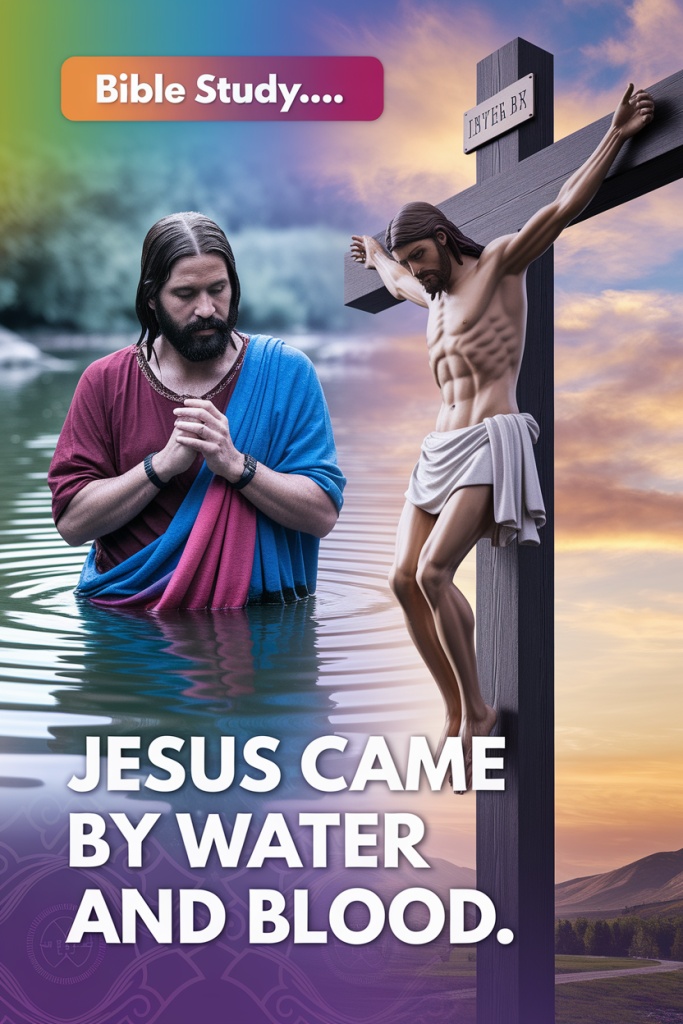
1. Jesus’s Baptism (Water) and Crucifixion (Blood) – Historical Events of His Ministry.
The most widely held interpretation is that “water” refers to Jesus’s baptism in the Jordan River and “blood” refers to His bloody death on the cross (1 John 5:6 Commentary | Precept Austin) (1 John 5:6 Commentary | Precept Austin).
In this view, John is summing up the two terminal events of Christ’s redemptive mission on earth: the inauguration of His ministry at baptism and the culmination of His work in the atoning sacrifice of Calvary (1 John 5:6 Commentary | Precept Austin).
Jesus came by water in that He manifested Himself as Messiah at His baptism, where God publicly testified about Him (cf. Matthew 3:16–17). He came by blood in that He accomplished salvation by His death, where God again testified by signs (the temple veil torn, the earth quaking, cf. Matthew 27:51–54).
These two events serve as historical bookends to Jesus’s work, and both validate who He is.
As one commentary notes, “Baptism and death were the two termini of our Lord’s ministry” (1 John 5:6 Commentary | Precept Austin), each providing divine testimony: at the baptism the Spirit and Father testified to Jesus’s Sonship, and at the crucifixion the centurion and supernatural events testified (Matt. 27:54).
John emphasizes “not by water only” because some in his time accepted Jesus’s baptism but denied the necessity or reality of the cross (1 John 5:6 Commentary | Precept Austin).
By stating water and blood, John insists that Jesus was the Christ in both His baptism and His crucifixion, fully divine and fully human throughout.
This interpretation is considered the “oldest and most natural view” of the text (1 John 5:6 Commentary | Precept Austin), and is supported by Church Fathers like Tertullian and by the vast majority of modern scholars (What Is the Meaning of 1 John 5:6–8? | Redemption of Humanity) (What Is the Meaning of 1 John 5:6–8? | Redemption of Humanity).
It also fits the context of witness: the baptism and the crucifixion each bore witness to Jesus (cf. John 1:32–34, 19:34-35). We will see more on this below, as it is likely the primary intended meaning.
2. The Sacraments – Baptism (Water) and the Lord’s Supper (Blood).
Another interpretation sees “water and blood” as a sacramental reference. In this view, John may also be alluding to the ongoing ministry of Jesus to the Church through the two sacraments He instituted: water baptism and the Eucharistic cup (His blood).
Notably, even the Protestant Reformers Martin Luther and John Calvin understood the verse this way – that Christ “comes” to us continually through the ministry of baptism and the Lord’s Supper (What Is the Meaning of 1 John 5:6–8? | Redemption of Humanity).
They saw “water” as pointing to baptism and “blood” to the communion cup, “a perpetual process by which Jesus came to us in the sacraments” (What Is the Meaning of 1 John 5:6–8? | Redemption of Humanity).
In support of this view, one can note that John’s wording “came by” (Greek dia) could be understood as “with” or “accompanied by,” implying that Jesus brought or instituted water-baptism and blood-sacrifice as means of grace.
The sacraments bear witness to Christ’s work: in baptism we receive the sign of cleansing and new life, and in the Lord’s Supper we receive the sign of His shed blood for our sins.
Many Church Fathers also saw a sacramental symbolism in “water and blood” (especially when paired with the Spirit as in 1 John 5:8, reflecting Spirit, water, and blood in Christian initiation and worship) (1 John 5:6 Commentaries: This is the One who came by water and blood, Jesus Christ; not with the water only, but with the water and with the blood. It is the Spirit who testifies, because the Spirit is the truth.) (1 John 5:6 Commentaries: This is the One who came by water and blood, Jesus Christ; not with the water only, but with the water and with the blood. It is the Spirit who testifies, because the Spirit is the truth.).
While this might not be the primary meaning in John’s context (since John refers to past events by saying “came” in the aorist tense (1 John 5:6 Commentary | Precept Austin)), it is certainly a theologically rich application.
John’s own Gospel notes that when Jesus’s side was pierced, “blood and water” flowed out (John 19:34), which many have seen as symbols of the sacraments of Eucharist and Baptism flowing from the crucified Christ.
The sacramental reading, therefore, complements the historical view: the baptism in the Jordan and the sacrifice on the cross are the events by which Jesus accomplished salvation, and the Church’s sacraments of water and wine are the continuing signs and witnesses of that same salvation in the community of faith (1 John 5:6 Commentaries: This is the One who came by water and blood, Jesus Christ; not with the water only, but with the water and with the blood. It is the Spirit who testifies, because the Spirit is the truth.).
3. The Blood and Water from Jesus’ Side (John 19:34) – Proof of His Death and Life-giving Sacrifice.
A closely related interpretation (held by St. Augustine and others) is that “water and blood” directly reference the water and blood that physically flowed from Jesus’s side when the soldier pierced Him at the crucifixion (What Is the Meaning of 1 John 5:6–8? | Redemption of Humanity).
John is the only Gospel writer who records this detail: “One of the soldiers pierced His side with a spear, and immediately blood and water came out” (John 19:34).
John emphasizes he was an eyewitness to this, stressing its importance (John 19:35). Augustine and certain commentators believed that in 1 John 5:6 the apostle is alluding back to this beloved Gospel memory (What Is the Meaning of 1 John 5:6–8? | Redemption of Humanity).
The order in 1 John (“water and blood”) is reversed from John 19:34 (“blood and water”), but proponents note John might list water first in the epistle for a theological order (baptism then atonement).
According to this view, the presence of both water and blood from Jesus’s side is a crucial testimony that Jesus truly died (refuting any notion that His death was an illusion) (1 John 5:6 Commentaries: This is the One who came by water and blood, Jesus Christ; not with the water only, but with the water and with the blood. It is the Spirit who testifies, because the Spirit is the truth.).
It also carries symbolic meaning: the Church has historically seen in the blood and water from Christ’s side a sign of the birth of the Church, much as Eve came from Adam’s side.
The water symbolizes cleansing (baptism) and the blood symbolizes redemption (Eucharist), the two primary gifts Christ pours out for our salvation (1 John 5:6 Commentaries: This is the One who came by water and blood, Jesus Christ; not with the water only, but with the water and with the blood. It is the Spirit who testifies, because the Spirit is the truth.) (1 John 5:6 Commentaries: This is the One who came by water and blood, Jesus Christ; not with the water only, but with the water and with the blood. It is the Spirit who testifies, because the Spirit is the truth.).
Even if 1 John 5:6 isn’t directly about the spear wound, John’s Gospel and Epistle together give a full picture: Jesus’s entire coming – from baptismal waters to flowing blood – testifies to His divine-human reality and saving mission (1 John 5:6 Commentaries: This is the One who came by water and blood, Jesus Christ; not with the water only, but with the water and with the blood. It is the Spirit who testifies, because the Spirit is the truth.) (1 John 5:6 Commentaries: This is the One who came by water and blood, Jesus Christ; not with the water only, but with the water and with the blood. It is the Spirit who testifies, because the Spirit is the truth.).
4. Purification and Atonement (Symbolic Reading).
Some interpreters focus on the symbolic meanings of water and blood. In Scripture, water often symbolizes cleansing, purification, and the life-giving work of the Spirit (e.g. Ezekiel 36:25–27, John 7:38-39).
Blood symbolizes sacrificial death, atonement for sin, and redemption (Leviticus 17:11, Hebrews 9:22).
Therefore, one can read “water and blood” in 1 John 5:6 as shorthand for the cleansing and redeeming aspects of Jesus’s work (1 John 5:6 Commentaries: This is the One who came by water and blood, Jesus Christ; not with the water only, but with the water and with the blood. It is the Spirit who testifies, because the Spirit is the truth.) (1 John 5:6 Commentaries: This is the One who came by water and blood, Jesus Christ; not with the water only, but with the water and with the blood. It is the Spirit who testifies, because the Spirit is the truth.).
Jesus “came” to purify us and to atone for our sins. One commentator explains that the water from Jesus signifies “the purifying grace of which he is the fountain, cleansing those who believe in Him from all filthiness”, and the blood signifies “His own sufferings, whereby He made atonement for the sins of the world and procured our justification” (1 John 5:6 Commentaries: This is the One who came by water and blood, Jesus Christ; not with the water only, but with the water and with the blood. It is the Spirit who testifies, because the Spirit is the truth.) (1 John 5:6 Commentaries: This is the One who came by water and blood, Jesus Christ; not with the water only, but with the water and with the blood. It is the Spirit who testifies, because the Spirit is the truth.).
In other words, Christ came to be our Cleaner and our Redeemer. This interpretive emphasis dovetails with the theological point that both holiness and forgiveness are provided by Jesus.
We need the water (new birth and sanctification) and the blood (sacrifice for forgiveness) for full salvation (1 John 5:6 Commentaries: This is the One who came by water and blood, Jesus Christ; not with the water only, but with the water and with the blood. It is the Spirit who testifies, because the Spirit is the truth.).
John may not explicitly spell out these symbols in the epistle, but they are certainly implied in the gospel message. The next verse (1 John 5:7–8) says the three witnesses “agree as one,” pointing to the unified testimony of Christ’s Spirit, cleansing power, and atoning death in declaring Him Savior.
This symbolic reading doesn’t contradict the historical events – rather it highlights the spiritual significance of the baptism and crucifixion: through the “water” Jesus cleanses us by the Spirit, and through the “blood” He justifies us by His sacrifice (1 John 5:6 Commentaries: This is the One who came by water and blood, Jesus Christ; not with the water only, but with the water and with the blood. It is the Spirit who testifies, because the Spirit is the truth.) (1 John 5:6 Commentaries: This is the One who came by water and blood, Jesus Christ; not with the water only, but with the water and with the blood. It is the Spirit who testifies, because the Spirit is the truth.).
5. Jesus’s True Humanity – Evidence of Incarnation (Anti-Docetic View).
A less common interpretation (but worth noting) is that “water and blood” refer to the basic elements of human birth and death, highlighting that Jesus was fully human.
Ancient readers understood “water” as a reference to natural birth (as a baby emerges from the fluids of the womb) and “blood” as a reference to death (shedding blood).
Some early commentators (like Wetstein) suggested John meant that Jesus came with all the normal aspects of humanity – “the watery humors and the blood” – refuting the Docetist claim that Jesus only seemed human (1 John 5:6 Commentaries: This is the One who came by water and blood, Jesus Christ; not with the water only, but with the water and with the blood. It is the Spirit who testifies, because the Spirit is the truth.) (1 John 5:6 Commentaries: This is the One who came by water and blood, Jesus Christ; not with the water only, but with the water and with the blood. It is the Spirit who testifies, because the Spirit is the truth.).
In this view, “water” = Jesus’s human birth (or His having a living body of water and blood), and “blood” = His mortal death. This interpretation aligns with John’s polemical aim against those who denied Jesus’s real bodily existence.
However, it has fewer proponents, as “water” in this context is more naturally understood as an event (baptism) rather than amniotic fluid. Still, the underlying truth it points to is important:
Jesus the Son of God truly became flesh, participated in normal human experiences (birth, baptism, death), and thus had both water and blood as any man – contra the Docetists (What Is the Meaning of 1 John 5:6–8? | Redemption of Humanity).
The apostle’s insistence on water and blood does underline the physical reality of Jesus’s life and death.
6. Regeneration (Faith) and Public Martyrdom – Clement of Alexandria’s view.
One of the more unusual interpretations comes from the Church Father Clement of Alexandria (late 2nd century).
Clement taught that “water” in 1 John 5:6 signifies the regeneration of the believer and faith, while “blood” signifies the public acknowledgment of that faith (perhaps alluding to confessing Christ even unto death) (1 John 5:6 Commentaries: This is the One who came by water and blood, Jesus Christ; not with the water only, but with the water and with the blood. It is the Spirit who testifies, because the Spirit is the truth.).
This is a highly allegorical reading: it takes “water” to mean the inward cleansing of becoming a Christian (being born again by water/Spirit) and “blood” to mean the outward confession, possibly in persecution (since shedding one’s blood was the ultimate testimony of faith).
Clement’s view did not gain much traction elsewhere, but it shows how early Christians sometimes extended the symbolism of the text.
It is likely guided by the broader New Testament idea that believers are born of water and Spirit (John 3:5) and that true faith may require a willingness to shed blood (Revelation 12:11).
While this interpretation is not about Jesus’s own baptism or death at all, it creatively sees “water and blood” as the pattern of Christian conversion and witness. Most scholars today would say this was not John’s intended meaning, but an application by Clement.
In summary, the primary, straightforward meaning of “water and blood” in 1 John 5:6 is Jesus’s baptism and Jesus’s crucifixion, as key events that testify to His Sonship and saving work (1 John 5:6 Commentary | Precept Austin) (What Is the Meaning of 1 John 5:6–8? | Redemption of Humanity).
This view inherently carries the truths of the other interpretations (Jesus was truly human, His death was real, His work cleanses and atones, and the sacraments testify to that work).
Other interpretations – sacramental, symbolic, or allegorical – have been proposed by respected teachers (including Augustine, Luther, Calvin, etc.), and these often emphasize the theological and ongoing significance of the “water and blood” even if they are not the direct historical reference.
It is valuable to consider all these layers, as John’s writings often operate on multiple levels of meaning (historical event and spiritual truth).
We will now explore in more depth the biblical connections and typology behind this phrase, and then its theological significance, which will further illuminate why “water and blood” together are so important.
Old Testament Typology of Water and Blood
John’s assertion that Jesus came by water and blood not only looks back to events in Jesus’s life, but also echoes patterns established in the Old Testament.
Throughout salvation history, water and blood appear as two critical elements in God’s cleansing and covenant rituals.
These Old Testament “types” (foreshadowings) find their ultimate fulfillment in Jesus Christ, who by water and blood brings the realities those symbols only prefigured (1 John 5:6 Commentaries: This is the One who came by water and blood, Jesus Christ; not with the water only, but with the water and with the blood. It is the Spirit who testifies, because the Spirit is the truth.).
1. Ritual Cleansing and Atonement in the Law:
Under the Mosaic Law, purification water and sacrificial blood were both used in the worship of Israel. For example:
Priestly Consecration:
When God established the priesthood, Aaron and his sons were first washed with water, then anointed and marked with the blood of a sacrifice (Exodus 29:4, 29:20-21).
This combination of washing and blood-sprinkling consecrated them for service. Jesus fulfills this as our ultimate High Priest who is perfectly pure and offers His own blood for us.
Sin Offerings and Cleansings:
In many rites, water was used for ceremonial washing (to remove uncleanness) and blood was used for atonement.
Leviticus 14, for instance, in the cleansing of a leper, required the priest to kill a bird over fresh water, mingling blood and water, then sprinkle the cleansed person with that blood-water mixture (Lev 14:5–7).
This strange ritual symbolized that cleansing from defilement came through death (blood) applied via water. Jesus “came by water and blood” in that He provides true cleansing by His death.
Day of Atonement:
The high priest on the Day of Atonement would bathe in water before entering God’s presence (Lev 16:4) and then bring the blood of the sacrifice into the Holy of Holies to sprinkle on the mercy seat for atonement (Lev 16:15-16).
Thus Israel’s greatest atonement ritual prominently featured water (for purity) and blood (for forgiveness).
Hebrews 9:19 also notes that when Moses inaugurated the covenant, he took blood mixed with water and sprinkled it on the people and the book of the law (1 John 5:6 Commentaries: This is the One who came by water and blood, Jesus Christ; not with the water only, but with the water and with the blood. It is the Spirit who testifies, because the Spirit is the truth.), declaring, “This is the blood of the covenant” (Exodus 24:8).
These were “types and ceremonies of the law performed by water and blood”, which Christ would fulfill (1 John 5:6 Commentaries: This is the One who came by water and blood, Jesus Christ; not with the water only, but with the water and with the blood. It is the Spirit who testifies, because the Spirit is the truth.).
In Jesus’s coming, He fulfilled the purification symbolized by washings and the expiation (atonement) symbolized by blood sacrifices (1 John 5:6 Commentaries: This is the One who came by water and blood, Jesus Christ; not with the water only, but with the water and with the blood. It is the Spirit who testifies, because the Spirit is the truth.).
Where the law provided temporary cleansing and forgiveness through water and blood rituals, Christ provides lasting cleansing by the Holy Spirit (“water”) and complete atonement by His shed blood (1 John 5:6 Commentaries: This is the One who came by water and blood, Jesus Christ; not with the water only, but with the water and with the blood. It is the Spirit who testifies, because the Spirit is the truth.).
The Paschal Lamb and the Red Sea:
We can also see a tandem of water and blood in Israel’s foundational salvation story, the Exodus. On the night of Passover, the Israelites were saved by the blood of the lamb on their doorposts (Exodus 12:13).
Shortly after, they were delivered through the waters of the Red Sea (Exodus 14:29-30). The New Testament likens the Red Sea crossing to a form of baptism for Israel (1 Corinthians 10:1–2) and the Passover lamb to Christ’s sacrifice (1 Corinthians 5:7).
In effect, Israel was saved by blood and by water: the blood spared them from judgment, and the water brought them out of slavery.
This double imagery finds its fulfillment in Jesus, the Lamb of God: by His blood we are freed from sin’s penalty (like Passover), and through the water of baptism we are brought into new life, out of bondage.
Thus Jesus “came by water and blood” to accomplish a new exodus for believers – freeing us by His blood and leading us through water into covenant with God.
2. Prophetic Imagery of Cleansing Water and Forgiving Blood:
The Old Testament prophets combine images of cleansing water and atoning blood in depicting the future salvation:
Ezekiel 36:25-27 is a key prophecy
God promises, “I will sprinkle clean water on you, and you shall be clean… I will give you a new heart and put a new Spirit within you”.
This “water” is linked with the Spirit’s work of inward cleansing. In the same context (Ezek. 36:33), God also speaks of cleansing “from all iniquities”, which elsewhere in Ezekiel and Isaiah is tied to atonement (cf. Isaiah 53:5 – the Messiah pierced for our transgressions, shedding blood).
Jesus fulfills the sprinkling of clean water by giving the Holy Spirit (John 7:38-39) and the cleansing from iniquity by shedding His blood (1 John 5:6 Commentaries: This is the One who came by water and blood, Jesus Christ; not with the water only, but with the water and with the blood. It is the Spirit who testifies, because the Spirit is the truth.) (1 John 5:6 Commentaries: This is the One who came by water and blood, Jesus Christ; not with the water only, but with the water and with the blood. It is the Spirit who testifies, because the Spirit is the truth.).
When John says Jesus came by water and blood, it resonates with the promise of a Messianic cleansing (water/Spirit) and atonement (blood) foretold by the prophets (1 John 5:6 Commentaries: This is the One who came by water and blood, Jesus Christ; not with the water only, but with the water and with the blood. It is the Spirit who testifies, because the Spirit is the truth.).
Zechariah 12:10 – 13:1 intriguingly links the two as well:
Zech. 12:10 predicts, “They will look on Me whom they have pierced and mourn for Him,” a prophecy often applied to Christ’s crucifixion (piercing = shedding blood).
Then Zech. 13:1 says, “On that day a fountain shall be opened… to cleanse them from sin and impurity.” Christians have long seen the “piercing” as the cross and the “fountain” of cleansing as the water of life (the flow of water and blood from Jesus can be seen as that fountain opened).
The water and blood from Jesus’s side literally fulfilled this image – a fountain of cleansing and atonement opened at Calvary.
In summary, the Old Testament provides multiple “types” of water and blood working together in God’s redemptive rituals: water for cleansing and blood for atonement.
These patterns were “representations in the old ceremonial sacrifices and cleansings” of the twofold way God deals with sin (1 John 5:6 Commentaries: This is the One who came by water and blood, Jesus Christ; not with the water only, but with the water and with the blood. It is the Spirit who testifies, because the Spirit is the truth.).
Jesus, by coming with water and blood, fulfilled all these types in His single Person and work.
As one commentary puts it, He “manifested Himself to be the Son of God, the promised Messiah, by fulfilling those types and ceremonies of the law which were performed by water and blood” (1 John 5:6 Commentaries: This is the One who came by water and blood, Jesus Christ; not with the water only, but with the water and with the blood. It is the Spirit who testifies, because the Spirit is the truth.).
In Him, the reality has arrived: “By the water, our souls are washed and purified… By the blood, we are justified, reconciled, and presented righteous to God” (1 John 5:6 Commentaries: This is the One who came by water and blood, Jesus Christ; not with the water only, but with the water and with the blood. It is the Spirit who testifies, because the Spirit is the truth.).
Thus, any Jewish background reader of John’s letter would recognize water and blood as the hallmarks of how God purifies and forgives – now accomplished fully by Jesus Christ.
Theological and Christological Significance
John’s declaration that Jesus “came by water and blood” is packed with theological significance. It is not a random pairing of elements, but a revelation of the comprehensive work of Christ and an affirmation of true doctrine about His person.
In this section, we distill the key doctrinal implications and symbols behind “the water and the blood,” and address the “who/what/why/how” questions in theological terms:
1. Complete Salvation: Cleansing and Atonement – Our purification and our pardon.
“Water and blood” together represent the full scope of salvation benefits in Christ. In Jesus, God provides both inner cleansing from sin’s corruption and forgiveness of sin’s guilt.
The water symbolizes the washing, regenerating, sanctifying work of Christ, and the blood symbolizes the forgiving, justifying, atoning work of Christ (1 John 5:6 Commentaries: This is the One who came by water and blood, Jesus Christ; not with the water only, but with the water and with the blood. It is the Spirit who testifies, because the Spirit is the truth.) (1 John 5:6 Commentaries: This is the One who came by water and blood, Jesus Christ; not with the water only, but with the water and with the blood. It is the Spirit who testifies, because the Spirit is the truth.).
We need both to be saved. As Matthew Henry succinctly wrote, “This water and blood include all that is necessary to our salvation. By the water, our souls are washed and purified... By the blood, we are justified, reconciled, and presented righteous to God.” (1 John 5:6 Commentaries: This is the One who came by water and blood, Jesus Christ; not with the water only, but with the water and with the blood. It is the Spirit who testifies, because the Spirit is the truth.).
John’s insistence on water and blood means that Jesus’s mission was not only to teach holiness or only to grant pardon, but to do both.
Some sects might focus on moral purification (water) and ignore the need for atonement, while others might claim forgiveness (blood) without transformation – John will allow no such division in Christ’s work.
Who came by water and blood? Jesus Christ, the Son of God – and why? To provide a full salvation, granting us a new life by the Spirit and a cleansed record by His sacrifice (1 John 5:6 Commentaries: This is the One who came by water and blood, Jesus Christ; not with the water only, but with the water and with the blood. It is the Spirit who testifies, because the Spirit is the truth.).
As 1 John 5:6 goes on to say, the Spirit testifies to this truth in the gospel: the Holy Spirit convinces our hearts that we need both the washing of regeneration and the cleansing of Christ’s blood, and that both are found in Jesus (1 John 5:6 Commentaries: This is the One who came by water and blood, Jesus Christ; not with the water only, but with the water and with the blood. It is the Spirit who testifies, because the Spirit is the truth.).
This is a profoundly reassuring doctrine: Christ is entirely sufficient, having taken care of every aspect of our sin-problem. “Water and blood” also echo the new covenant promise – “I will forgive their iniquity” (blood) “and remember their sins no more” and “I will put My Spirit within you” (water/Spirit) – see Jeremiah 31:34 and Ezekiel 36:27.
How did Jesus accomplish this? By first identifying with us in baptism (though He had no sin, He “fulfilled all righteousness” on our behalf) and ultimately dying for us on the cross, then sending the Spirit. This twofold achievement is the heart of the gospel (1 John 5:6 Commentary | Precept Austin).
2. The Incarnate Reality of Christ – True God, True Man, True Sacrifice.
John’s teaching guards the Christological truth that Jesus is one divine Person who fully became human and really died for us.
By saying Jesus came by water and blood, John emphasizes the real historical humanity of Jesus against any notion that His flesh was an illusion (Docetism) or that “the Christ” was separate from the man Jesus (Cerinthian Gnosticism).
The “who” here – Jesus Christ – is one and the same in baptism and death (1 John 5:6 Commentaries: This is the One who came by water and blood, Jesus Christ; not with the water only, but with the water and with the blood. It is the Spirit who testifies, because the Spirit is the truth.).
As a Church Father wrote, “John assures us that there was no such severance. The Divine Son Jesus Christ came not by water only at His baptism, but by blood also at His death.” (1 John 5:6 Commentaries: This is the One who came by water and blood, Jesus Christ; not with the water only, but with the water and with the blood. It is the Spirit who testifies, because the Spirit is the truth.).
The theological importance is huge: the one who was declared God’s Son in baptism is the very one who shed His blood; therefore, that shed blood is of infinite value (the blood of the Son of God – see Acts 20:28) and truly able to save.
It also means that Jesus’s humility (seen in His baptism among sinners and in His crucifixion among thieves) is an authentic part of His coming.
God really entered our condition (“water” signals Jesus identifying with sinful humanity in baptism) and God really suffered unto death (“blood” signals the extremity of the Incarnation – the Immortal dies in the flesh).
The when and where of these events matter: Jesus’s baptism took place in history (around AD 27) at the Jordan River; His crucifixion took place around AD 30 at Jerusalem (Golgotha).
The how is the wonder of the Incarnation: the Word became flesh (John 1:14) so that He could undergo both the water and the blood.
As one Reformed study puts it, John’s statement underscores that “Jesus remained the God-Man even in His death and thus had a true incarnation” (Three That Testify | Reformed Bible Studies & Devotionals at ...).
Therefore, any teaching that splits Jesus’s deity from His humanity or that claims the “Christ-Spirit” abandoned Jesus before the cross is firmly rejected by 1 John 5:6 (1 John 5:6 Commentary | Precept Austin).
Why is this so important? Because if Jesus is not fully human, He could not fully redeem humans by dying for us; and if He is not fully divine, His blood would not have infinite worth to save.
“Water and blood” testify that Jesus is fully qualified as Savior – He is the Son of God who came down (water baptism marking His manifestation) and also the Lamb of God who laid down His life (bloodshed on the cross).
As the next verses say, this is God’s own testimony about His Son, and accepting it is vital to our faith (1 John 5:9-10).
3. The Unified Work of Christ – No Christ without the Cross.
John may also be making a subtle doctrinal point: Christ’s work cannot be taken in parts; it’s a package. Some of John’s opponents evidently loved the idea of Jesus’s enlightening teaching and perhaps His healing and baptism, but balked at the scandal of the crucifixion.
The apostle therefore stresses not by water only! In Christian theology, we cannot have the benefit of Christ’s life and teaching (the “water” part, including baptism) unless we also embrace the necessity of His atoning death (the “blood”).
It is the blood that completes the work. As one commentary notes, “These things must go together; because it will not avail us to be enabled to avoid sin and live holy for the time to come, unless the sins of the past be expiated.” (1 John 5:6 Commentaries: This is the One who came by water and blood, Jesus Christ; not with the water only, but with the water and with the blood. It is the Spirit who testifies, because the Spirit is the truth.).
This has doctrinal import: it guards against a purely moralistic or exemplar view of Jesus (which might focus only on baptism/purification) and against a lawless claim of forgiveness without new life.
The water and blood together ensure we have a holistic gospel – Christ for us (in atonement) and Christ in us (by cleansing and new birth). Theologically, the cross (blood) is as essential as the incarnation and baptism (water) for our salvation.
John’s original readers had to be reminded that any “Christ” that sidesteps the cross is a false Christ. The true Jesus Christ came to die – “by blood” – as much as He came to teach and heal.
As later Christian doctrine developed, this verse supports both Christ’s substitutionary atonement (He truly shed blood for sin) and the necessity of baptism (He established the pattern that one must be born of water and Spirit to enter the Kingdom, cf. John 3:5, and He Himself underwent baptism to “fulfill all righteousness”).
It is noteworthy that John, who wrote this epistle, also records Jesus saying on the cross, “It is finished” (John 19:30) just before the soldier pierces His side and out flows water and blood. The finished work of Christ is thus marked by both the water and blood.
Any teaching that tries to separate these (e.g. saying we only need Jesus’s moral influence, or conversely, that we can claim salvation without repentance and baptism) is incomplete.
4. Testimony and Witness to Christ – Assurance for Believers.
John’s emphasis on water, blood, and Spirit as witnesses has a pastoral purpose: to assure believers that their faith in Jesus is grounded in real, God-given testimony.
Who testifies that Jesus is the Son of God? Not merely man, but God Himself – through the Spirit, the baptism of Jesus, and the death of Jesus. The Gospel accounts of Jesus’s baptism (the heavens opened and God’s voice heard) and crucifixion (darkness, veil torn, etc.) are objective witnesses that God provided in history.
Additionally, the Holy Spirit’s ongoing work is a living witness in the church. John says effectively, “These three agree”, giving a triple attestation that Jesus is who He claimed to be.
The “when” of this testimony spans Jesus’s entire ministry (from Jordan to Calvary) and continues “now” by the Spirit (5:6, “it is the Spirit who testifies,” present tense).
The “how” is by both observable events (water baptism and bloody death) and inner conviction (Spirit of truth).
This gives believers a robust foundation: our faith in Christ isn’t based on myth or a single person’s claim, but on public divine acts and the Holy Spirit’s confirmation (1 John 5:6 Commentary | Precept Austin) (1 John 5:6 Commentaries: This is the One who came by water and blood, Jesus Christ; not with the water only, but with the water and with the blood. It is the Spirit who testifies, because the Spirit is the truth.).
Doctrinally, this contributes to the concept of the witness of the Spirit and the idea that sacraments themselves “testify” to Christ’s grace.
Some theologians even correlate 1 John 5:7–8 with the concept of the Trinity bearing witness (though the famous Johannine Comma addition in later manuscripts made that explicit, the authentic text still has the Spirit, and by extension the Father who spoke at baptism and the Son who shed blood, all involved in testimony).
For our purposes, “water and blood” as witnesses mean that the facts of Jesus’s life and death are God’s testimony to the gospel. This should bolster our confidence: Christianity rests on solid historical and spiritual testimony.
As John says in the next verses, “If we receive the testimony of men, the testimony of God is greater… And this is the testimony, that God gave us eternal life, and this life is in His Son” (1 John 5:9,11).
The water and the blood are part of God’s own witness about His Son, and believing this witness leads to life (5:10-13).
5. Sacramental and Ecclesial Significance – Life of the Church.
While 1 John 5:6 primarily points to Jesus’s baptism and death, it also carries ongoing significance for the Church’s practices and spiritual life. As noted, many see in “water and blood” a reference to baptism and the Lord’s Supper, the two ordinances Christ gave.
The who/what here would then refer to the elements that Jesus uses to “come” to His people today: He comes to us by the waters of baptism (where we are born of water and Spirit into His Body) and by the cup of His blood (the Eucharist by which we participate in His one sacrifice).
The early Church Fathers often spoke in this manner. For instance, St. John Chrysostom commented on the blood and water from Christ’s side as symbols of baptism and the eucharistic cup, likening them to the birth of the Church from the side of the new Adam (Christ) just as Eve came from Adam’s side.
The Church is thus formed and sustained by these two streams of grace. Tertullian, as we saw, explicitly connected 1 John 5:6 to this idea: Jesus was “baptized with water and glorified with blood” and He made blood a second font of baptism for those who missed water (Necessity of Baptism — Church Fathers).
In practical terms, the why of Christian baptism and communion can be traced to Jesus’s own “water and blood.” He sanctified the waters by being baptized, and He sanctified (indeed instituted) the new covenant in His blood at the Last Supper and cross.
Therefore, when believers partake in baptism and the Lord’s Supper, they participate in the reality of Jesus’s coming by water and blood. The Spirit makes these means effective witnesses to our hearts.
Calvin noted that through the sacraments, Christ “comes” to us continually, which is a beautiful thought: we meet the once-crucified, now-risen Christ in the water of baptism and the wine of communion, receiving the benefits of His cleansing and sacrifice (What Is the Meaning of 1 John 5:6–8? | Redemption of Humanity).
Thus “water and blood” remain living realities in the church’s experience. They also call the church to hold both elements together. An overemphasis on one sacrament to the neglect of the other (or neglecting sacraments entirely) would be imbalanced.
But Christ gave us both, flowing from His side, as perpetual reminders of His grace. In worship, we remember the water (our baptism into Christ, by which we are washed and Spirit-indwelt) and proclaim the blood (Christ’s death, whenever we drink the cup, 1 Cor 11:26).
John’s wording hints that these are “the elements in which Jesus came” (some manuscripts say “in the water and in the blood”) and which remain as “sacred and well-known symbols” of His presence and work (1 John 5:6 Commentaries: This is the One who came by water and blood, Jesus Christ; not with the water only, but with the water and with the blood. It is the Spirit who testifies, because the Spirit is the truth.).
The Spirit, the water, and the blood still agree in one within the life of the church (1 John 5:6 Commentaries: This is the One who came by water and blood, Jesus Christ; not with the water only, but with the water and with the blood. It is the Spirit who testifies, because the Spirit is the truth.) – the Spirit works through the preaching of the Word and the administration of baptism and communion to testify of the Savior.
Conclusion
In 1 John 5:6, the apostle John condenses a profound amount of truth into the simple phrase “the water and the blood.” Our study has shown that this phrase, referring to Jesus Christ’s baptism and crucifixion, carries multiple layers of biblical meaning.
Historically, it anchors Jesus’s identity in two observable events that testify to Him as the Son of God – His baptism in the Jordan and His atoning death at Calvary (1 John 5:6 Commentary | Precept Austin) (1 John 5:6 Commentary | Precept Austin).
Theologically, it safeguards the true doctrine of the Incarnation (Jesus is one Person, fully divine and human, who truly died for us) (1 John 5:6 Commentaries: This is the One who came by water and blood, Jesus Christ; not with the water only, but with the water and with the blood. It is the Spirit who testifies, because the Spirit is the truth.), and it illustrates the complete salvation He accomplished (both purification from sin’s defilement and propitiation for sin’s guilt) (1 John 5:6 Commentaries: This is the One who came by water and blood, Jesus Christ; not with the water only, but with the water and with the blood. It is the Spirit who testifies, because the Spirit is the truth.) (1 John 5:6 Commentaries: This is the One who came by water and blood, Jesus Christ; not with the water only, but with the water and with the blood. It is the Spirit who testifies, because the Spirit is the truth.).
Symbolically, water and blood echo the entire biblical story of how God saves – from the water and blood of Old Testament sacrifices and deliverances to the blood and water that poured from Christ’s side fulfilling Scriptures (1 John 5:6 Commentaries: This is the One who came by water and blood, Jesus Christ; not with the water only, but with the water and with the blood. It is the Spirit who testifies, because the Spirit is the truth.).
We also saw how the Church Fathers and later scholars have meditated on this text: from Tertullian’s affirmation of the baptism and cross (What Is the Meaning of 1 John 5:6–8? | Redemption of Humanity), to Augustine’s focus on the piercing, to the Reformers’ sacramental interpretation (What Is the Meaning of 1 John 5:6–8? | Redemption of Humanity) – all adding richness to our understanding.
Above all, John’s emphasis serves to exalt Jesus Christ. Jesus is the one who came by water and blood, meaning He alone is the Mediator who joins heaven and earth, divinity and humanity, cleansing and atonement, in His own person and work.
And the Holy Spirit continues to bear witness to this truth in Scripture and in believers’ hearts (1 John 5:6 Commentaries: This is the One who came by water and blood, Jesus Christ; not with the water only, but with the water and with the blood. It is the Spirit who testifies, because the Spirit is the truth.).
For the earnest student of the Bible, “water and the blood” stands as a shorthand for the gospel: the humble baptism and the holy blood of Jesus, which together testify that God’s Son has come and given us life (1 John 5:11-12).
John wrote these things so that we may know that we have eternal life in Christ (1 John 5:13) – a knowledge grounded in the sure witness of the water, the blood, and the Spirit.
Sources: This study has drawn on a range of biblical references and scholarly insights, including scriptural cross-references (John’s Gospel, Hebrews, Exodus, etc.), early church writers (e.g. Tertullian (Necessity of Baptism — Church Fathers), Augustine), classic commentaries (Matthew Henry (1 John 5:6 Commentaries: This is the One who came by water and blood, Jesus Christ; not with the water only, but with the water and with the blood. It is the Spirit who testifies, because the Spirit is the truth.), JFB (1 John 5:6 Commentaries: This is the One who came by water and blood, Jesus Christ; not with the water only, but with the water and with the blood. It is the Spirit who testifies, because the Spirit is the truth.)), and modern biblical scholarship (1 John 5:6 Commentary | Precept Austin) (What Is the Meaning of 1 John 5:6–8? | Redemption of Humanity).
These sources collectively affirm the multifaceted meaning of 1 John 5:6 and its importance for Christian doctrine and life. John’s seemingly cryptic phrase “water and blood” thus opens up into a wellspring of theological truth when examined against the whole canon of Scripture.
It invites us to marvel at the unity of Christ’s work and to hold fast the confession that Jesus Christ, the Son of God, has come in the flesh, with the water of cleansing and the blood of redemption – thanks be to God.