Quick Overview of This Bible Study…
Short on time? I have created a short slide show presentation of some key takeaways in our study. The complete, more comprehensive Bible study is below…
The Book of Daniel (in the King James Version) is a unique blend of inspiring hero stories and mysterious prophecies. It chronicles Daniel’s unshakable faith during the Jewish exile in Babylon and Persia, and unveils sweeping visions of future kingdoms and the coming Messiah.
In this study, we’ll explore Daniel’s prophetic visions (and how they echo into the New Testament), draw practical lessons from Daniel’s character, and give an overview of the book’s structure and themes.
Daniel’s Prophetic Visions: Symbols and New Testament Fulfillment
Daniel is famous for his vivid prophetic visions filled with symbolism. These prophecies not only spoke to his time but also pointed forward to Jesus and the New Testament. Here are the major visions in Daniel and how they connect to later Scripture:
Nebuchadnezzar’s Statue (Daniel 2)
In chapter 2, King Nebuchadnezzar dreams of a colossal statue made of gold, silver, bronze, iron, and clay.
God reveals through Daniel that these metals represent a succession of world empires: Babylon (the golden head), Medo-Persia, Greece, and a fourth kingdom as strong as iron (commonly understood as Rome).
The statue is smashed by a “stone cut out without hands” that grows into a mountain filling the earth – a symbol of God’s eternal kingdom triumphing over all human kingdoms.
New Testament Connection:
This prophecy finds fulfillment in Jesus Christ and His kingdom. The “stone” arriving during the fourth empire came true when Jesus was born during the Roman Empire, inaugurating God’s kingdom “in the days of those kings”.
Jesus often spoke of the Kingdom of God arriving, and indeed “the God of heaven” set up an indestructible kingdom in Christ’s coming. One day, at Jesus’ return, this kingdom will shatter all remaining opposition and fill the whole earth completely.
In other words, Daniel’s stone points directly to Jesus’s reign – “the reign of Jesus Christ and his eternal Empire” that will outlast all others.
The Four Beasts and the Son of Man (Daniel 7)
Chapter 7, written in Aramaic, contains Daniel’s own dream of four great beasts rising from the sea. These beasts (a winged lion, a bear, a four-headed leopard, and a terrifying beast with ten horns) represent the same four empires seen in the statue dream.
They signify the worldly kingdoms in their beastly, brutal aspects. But the vision doesn’t end there:
- Daniel sees the heavenly court where “the Ancient of Days” (God) takes His seat and books of judgment are opened. Then comes “one like the Son of man” riding on the clouds of heaven, whom God invests with eternal authority and an everlasting kingdom for “all people, nations, and languages” (Dan 7:13–14).
This “Son of Man” is a Messianic figure – a human-looking ruler who is given divine honor and an everlasting reign.
New Testament Connection:
The impact of this vision on the New Testament is profound. Jesus explicitly identified Himself with Daniel’s Son of Man.
- In His teachings about the end times, Jesus referred to “the Son of man coming in the clouds with power and great glory” (echoing Dan 7:13) and even cited Daniel by name when warning about the “abomination of desolation” (Matt. 24:15, 30; Mark 13:14, 26).
- At His trial, Jesus told the high priest, “ye shall see the Son of man sitting on the right hand of power, and coming in the clouds of heaven” – a direct reference to Daniel 7.
The priests understood the claim and condemned Jesus for blasphemy. By calling Himself the Son of Man from Daniel’s vision, Jesus was saying: “I am the promised king in Daniel’s prophecy.”
The Book of Revelation also draws imagery from Daniel 7.
- For example, John’s vision of Christ describes Him with hair white as wool and fiery eyes (Rev. 1:14), just as Daniel described the Ancient of Days.
Remarkably, Revelation presents Jesus both as the Son of Man and with the attributes of the Ancient of Days, underscoring Christ’s divine identity.
- Furthermore, the beasts of Revelation (like the seven-headed beast in Rev. 13) combine features of Daniel’s beasts, indicating that Daniel’s vision lays a foundation for understanding the end-times forces in Revelation.
In short, Daniel 7’s promise – that God’s holy people will receive an everlasting kingdom after beastly empires pass – is fulfilled and expanded in the New Testament through Jesus, who is “Daniel’s Messiah” and will one day judge the beasts and reign forever.
The Ram, the Goat, and the Little Horn (Daniel 8)
In chapter 8, Daniel has a vision of a two-horned ram violently overthrown by a one-horned goat.
An angel explains that the ram signifies the Medo-Persian Empire and the goat is the Greek Empire, whose single great horn (its first king, Alexander the Great) is broken and replaced by four horns (his divided kingdom) (Dan 8:20–22).
From one of these emerges a “little horn” that magnifies itself against God, stops the daily sacrifices, and defiles the sanctuary (8:9–12).
Historically, this corresponds to Antiochus Epiphanes IV, a Seleucid Greek king who in the 2nd century B.C. persecuted the Jews and desecrated the Temple (setting up an idol of Zeus and sacrificing unclean animals – an abomination to God’s people).
New Testament Connection:
Although Daniel 8 was largely fulfilled before New Testament times (in the Maccabean period), its imagery foreshadows the ultimate enemy of God in the end times.
The arrogant “little horn” who desecrates the temple is a type of the Antichrist figure later described in the New Testament.
- Jesus, in His Olivet Discourse, likely alluded to the kind of event Antiochus caused when He warned of “the abomination of desolation, spoken of by Daniel the prophet” standing in the holy place (Matt. 24:15).
- The apostle Paul similarly describes a “man of sin” or “lawless one” who “exalteth himself above all that is called God” and profanes the temple of God (2 Thess. 2:3–4) – language that echoes Daniel’s little horn prophecies.
- And the book of Revelation picks up this thread with its “beast” who speaks blasphemies and persecutes the saints (Rev. 13:5-7), much like the little horn was said to do (Dan. 7:25, 8:24).
Thus, Daniel’s vision in chapter 8 had an immediate historical fulfillment and a longer-range echo, pointing to patterns of persecution that would recur.
It reassures believers that arrogant powers have only limited time before God intervenes – a truth Revelation affirms in depicting Christ’s ultimate victory over the final “little horn” power.
The Seventy Weeks Prophecy (Daniel 9)
In chapter 9, Daniel is given one of Scripture’s most remarkable prophecies. After Daniel prays fervently for his people and confesses Israel’s sins, the angel Gabriel brings an answer about the future of Jerusalem and the Jewish people.
He speaks of “seventy weeks” (literally seventy sevens of years) decreed to accomplish God’s redemptive plan (9:24-27). These 70 “weeks” (interpreted by many as a total of 490 years) include the rebuilding of Jerusalem, the coming of “Messiah the Prince,” the Messiah’s being “cut off,” and a final period of desolation and ultimate restoration.
New Testament Connection:
Christians see in this prophecy a direct prediction of Jesus the Messiah’s mission.
Gabriel said that by the end of this period, God would “finish the transgression, make an end of sins, make reconciliation for iniquity, and bring in everlasting righteousness”.
These phrases sound exactly like the work of Christ on the cross. Indeed, Jesus fulfilled every one of those tasks:
- by His death and resurrection He atoned for sin
- defeated the power of iniquity
- and opened the way for everlasting righteousness for believers.
- The prophecy also stated “Messiah shall be cut off, but not for himself” (9:26) – a clear foreshadow of the Messiah dying for others.
- Jesus was “cut off” in crucifixion, not for His own sins but for ours.
Gabriel’s message even pinpointed the general timing: the Messiah would appear a certain number of “weeks” after the command to rebuild Jerusalem.
Many Bible historians have calculated that this timeline brings us to the era of Jesus’ public ministry (around A.D. 27-33), fulfilling Daniel’s words to the letter.
In the midst of the final “week,” the prophecy says “he shall confirm the covenant with many… and cause the sacrifice and the oblation to cease” (9:27).
- Jesus did exactly that: through His shed blood He established the New Covenant with many (Matt. 26:28), and by His once-for-all sacrifice He made the old temple sacrifices obsolete (Heb. 9:26).
After Jesus’ sacrifice, within a generation, the earthly Temple in Jerusalem was destroyed (A.D. 70), effectively ending the sacrificial system – a striking fulfillment of Daniel’s words.
Jesus Himself referenced this prophecy when He warned that after Jerusalem is surrounded by armies, “the abomination of desolation” would be near (Luke 21:20, cf. Matt.24:15).
While interpretations vary on some details of Daniel’s 70 weeks, the core message is clear to Christians:
God sent the promised Anointed One (Messiah/Christ) right on time, and through Him achieved the salvation of His people.
Daniel’s prophecy even uses the term “Messiah” (Hebrew Mashiach, meaning “anointed one”), one of the only Old Testament passages to do so explicitly. The Greek equivalent of Mashiach is Christos, giving Jesus the title “Christ”.
This explicit link between Daniel’s prophecy and Jesus of Nazareth is a powerful testimony of Scripture’s unity – as Daniel predicted, the Christ delivered us from sin and inaugurated a new era of righteousness.
The Vision of the Heavenly Messenger and the End Times (Daniel 10–12)
The final section of Daniel (chapters 10–12) is essentially one long vision that Daniel receives in his old age.
In chapter 10, Daniel is visited by a glorious heavenly being (possibly the angel Gabriel again, or even a pre-incarnate appearance of Christ according to some interpreters) after a period of prayer and fasting.
This messenger lifts the curtain on spiritual warfare, describing angelic conflict behind the scenes of earthly empires – he was delayed 21 days by the “prince of Persia” (a demonic power) until the archangel Michael came to help (10:13).
We catch a rare glimpse of battles in the spiritual realm, reinforcing the New Testament idea that “we wrestle not against flesh and blood, but against… spiritual wickedness in high places” (Eph. 6:12).
In chapters 11–12, the angel reveals future events in detail.
- Chapter 11 predicts a sequence of conflicts between the “king of the North” and “king of the South” – which historically match the wars between Seleucid and Ptolemaic dynasties after Alexander (many of these detailed prophecies have been fulfilled with stunning accuracy in history).
- The latter part of chapter 11 seems to shift to a final evil ruler who exalts himself above every god and persecutes the faithful (11:36–45).
- As noted, this description has strong parallels to the New Testament Antichrist (compare Dan. 11:36 with 2 Thess. 2:4 and with the blasphemies of the beast in Rev. 13:5-6).
- Finally, chapter 12 wraps up with end-times events: a time of unparalleled trouble, the deliverance of God’s people whose names are found written “in the book” (12:1), and the resurrection of the dead – “many of them that sleep in the dust of the earth shall awake, some to everlasting life, and some to shame and everlasting contempt” (12:2).
- This is one of the clearest Old Testament statements of the resurrection, and the New Testament echoes it.
- Jesus speaks of the resurrection of life versus damnation (John 5:28-29), and Revelation describes the final judgment of the righteous and wicked (Rev. 20:12-15).
- Daniel 12:3 adds that “they that be wise shall shine as the brightness of the firmament; and they that turn many to righteousness as the stars for ever.”
- Centuries later, Jesus alluded to this very verse, saying “then shall the righteous shine forth as the sun in the kingdom of their Father” (Matt. 13:43) – directly quoting Daniel and applying it to the ultimate reward of the saints.
New Testament Connection:
- The closing promise to Daniel is that he will one day “stand in [his] lot at the end of the days” (12:13), i.e. be raised to receive his inheritance. The hope given to Daniel is the same hope given to all believers in Christ.
- In Revelation, we see Michael warring against the dragon (Rev. 12:7, recalling Dan. 12:1) and we see the consummation of all that Daniel foresaw: the defeat of evil empires, the resurrection and reward of God’s people, and the everlasting reign of the Lamb.
- No wonder Jesus in Revelation identifies Himself as “Alpha and Omega,” tying together all prophecy.
- The angel in Daniel told him to “seal the book until the time of the end” (12:4), whereas in Revelation, John is told “seal not the sayings” for “the time is at hand” (Rev. 22:10).
- What was a long-distant vision in Daniel’s day comes to fulfillment in Christ’s revelation. The New Testament completes the picture Daniel started: it assures us that every trial and prophecy will culminate in Jesus’s victory and our resurrection glory.
As we’ve seen, Daniel’s prophecies form a backbone for biblical prophecy.
They are intricately woven into the New Testament narrative. Jesus and the apostles “let Scripture interpret Scripture,” repeatedly pointing back to Daniel to explain what was happening in their time and what will happen at the end of the age.
Daniel foresaw both the First Coming of Christ (as the Messiah to be cut off after 69 weeks, bringing atonement) and the Second Coming of Christ (as the Son of Man coming in glory to establish God’s kingdom fully).
In sum, “the book of Daniel proves two things: God provides and God saves”, and it “finds its fulfillment in Jesus the Messiah”.
Through Daniel’s visions, God assured the Jewish exiles – and now assures us as Christians – that despite present troubles, God is sovereign over history.
Earthly kingdoms will rise and fall, but the Kingdom of our Lord Jesus Christ will last forever (Rev. 11:15). This prophetic perspective gives us hope and confidence as we await the final fulfillment.
Lessons from Daniel’s Life: Faithfulness and Integrity in Exile
Prophecies weren’t the only remarkable aspect of Daniel’s book – the person of Daniel is a stellar example of godly living. As believers, we find in Daniel’s story a treasury of practical lessons on faith, integrity, and hope.
Daniel lived almost his entire life in a pagan society, yet he remained deeply faithful to God. Let’s look at some key qualities of Daniel’s character and how we can apply them today:
Uncompromising Faith and Obedience:
Daniel was taken to Babylon as a youth, given a new name and immersed in a foreign culture, yet he “purposed in his heart that he would not defile himself” with the king’s unclean food and wine (Dan. 1:8).
He politely refused the royal menu to keep God’s dietary laws, and God honored his integrity. This seemingly small act of obedience set the tone for Daniel’s life – he put God’s law first, even when no one else from his people was watching.
For Christians today, Daniel’s resolve is an inspiring model of personal holiness. In our world, we too face pressure to “fit in” with secular norms that conflict with our faith.
Daniel encourages us to lovingly resist those pressures and stay true to our convictions, trusting God with the results. Indeed, God gave Daniel favor and wisdom, and he rose to great influence without ever sacrificing his principles.
Consistent Prayer and Devotion:
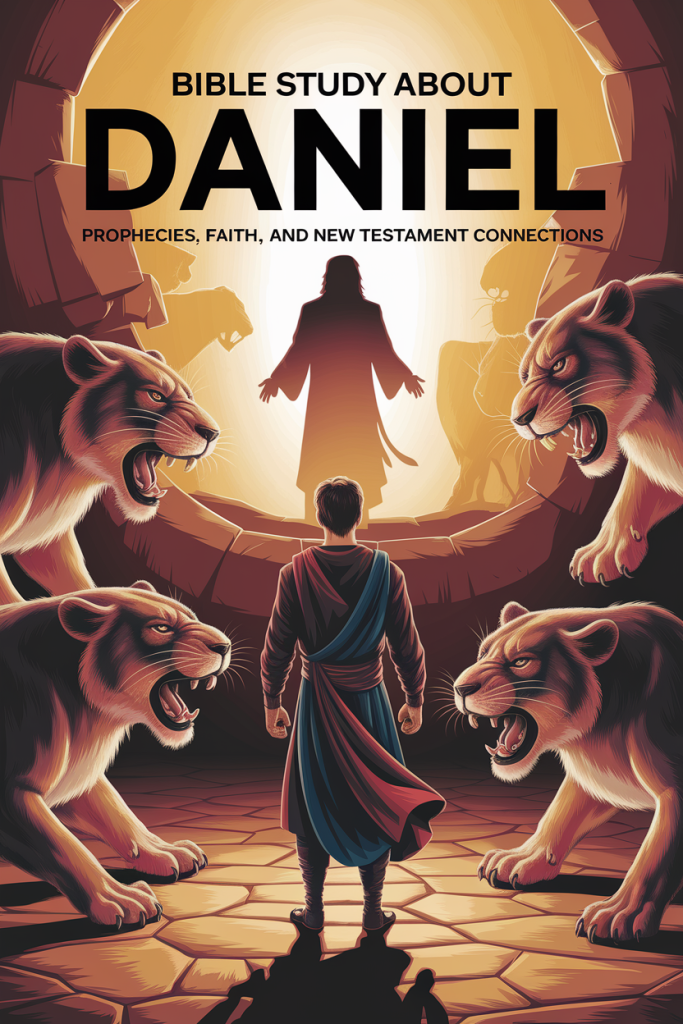
One of the most famous stories is when an 80+ year-old Daniel was thrown into a den of lions for praying to God.
- Daniel’s enemies in King Darius’s court could find no fault in him – except his prayer life! (Dan. 6:4-5).
- Knowing a decree forbade prayer to anyone but the king, Daniel “kneeled upon his knees three times a day, and prayed, and gave thanks before his God, as he did aforetime” (Dan. 6:10).
- He didn’t make a show of it; he simply would not give up praying, even at risk of death. This steadfast devotion resulted in a miraculous deliverance – God sent an angel to shut the lions’ mouths (6:22).
For us, Daniel’s example shouts “pray continually” and don’t abandon spiritual disciplines when trials come. He treated prayer as his lifeline to God. We learn that routine fellowship with God gives strength to face any crisis.
Daniel walked so closely with God that when danger arose, he had peace (notice that Daniel spent a calm night in the lions’ den, while King Darius spent a sleepless night in the palace!).
Maintaining a habit of prayer and thanksgiving (as Daniel did) is crucial for a life of faith.
Courage and Trust in God’s Deliverance:
Daniel and his friends showed astonishing courage in the face of death. Whether it was Daniel in the lions’ den or his three friends in the fiery furnace, they trusted God no matter the outcome.
Shadrach, Meshach, and Abednego told King Nebuchadnezzar, “our God whom we serve is able to deliver us from the burning fiery furnace… but if not, be it known unto thee, O king, that we will not serve thy gods” (Dan. 3:17-18). That “even if not” kind of faith is truly inspiring.
They believed God could save them, but even if He chose not to, they wouldn’t bow to the idol. In their case God did intervene – a fourth figure (divine in appearance) appeared in the flames to protect them, and they emerged unharmed, not even smelling of smoke (Dan. 3:25-27).
As believers today, we’re called to the same “even if not” resolve: Even if God does not remove the trial, we will still trust and obey Him. We might not always be spared from suffering, but we know God is with us in the fire (Isaiah 43:2).
Daniel’s friends literally experienced God’s presence in their fire, and many Christians testify that in our hardest trials, Jesus “walks with us” even if He doesn’t immediately take us out.
Their story encourages us to face persecution or hardship with faith and courage, knowing that God is able to deliver – and ultimately will deliver us, whether now or in eternity.
Integrity and Witness in a Secular World:
Daniel spent his career serving in the courts of pagan kings, yet he never compromised his integrity. He performed his civil duties so faithfully that his enemies “could find none occasion nor fault; forasmuch as he was faithful” (Dan. 6:4).
He was trustworthy, diligent, and incorruptible.
When summoned to interpret King Belshazzar’s mysterious writing on the wall, Daniel boldly told the truth of God’s judgment without fear, even though it was bad news for the king (Dan. 5:22-28).
Earlier, under Nebuchadnezzar, Daniel consistently gave credit to God for his wisdom.
“This secret cannot the wise men show unto the king; but there is a God in heaven that revealeth secrets,” Daniel declared, making sure Babylon’s king knew where the interpretation came from (Dan. 2:27-28). He showed humility, never seeking glory for himself.
Amazingly, through Daniel’s influence and God’s miraculous signs, even pagan kings came to acknowledge the true God.
- King Nebuchadnezzar was humbled (living like a beast for a time) and later praised “the King of heaven” (Dan. 4:37).
- Darius, after the lions’ den, decreed that “in every dominion of my kingdom men tremble and fear before the God of Daniel” (Dan. 6:26).
Daniel’s public witness was most powerful because it was backed by consistent personal integrity.
For Christians today, Daniel is a model for living out our faith in a secular workplace or society. We’re reminded to work “as unto the Lord,” to be honest and excellent in our duties, and to graciously point others to God.
A life of integrity gives credibility to our testimony. Jesus said let your light shine before men – Daniel’s light certainly shone in Babylon!
Hope in God’s Sovereignty and Promises:
Throughout his long life, Daniel never lost hope that God was in control. He had seen Jerusalem destroyed and lived through the rise and fall of empires, yet his confidence in God’s sovereignty was unshaken.
- “Blessed be the name of God for ever and ever: for wisdom and might are his: and he changeth the times and the seasons: he removeth kings, and setteth up kings,” Daniel prayed after God revealed Nebuchadnezzar’s dream to him.
He understood that God is the true King over earthly kings. This theological anchor gave Daniel boldness in front of powerful rulers – he knew their power was fleeting and subject to God’s decree.
Moreover, Daniel devoted himself to Scripture and prayer for understanding God’s plans.
In Daniel 9 we find him studying Jeremiah’s prophecy about the 70-year exile and praying for God’s mercy to bring Israel home. He appealed to God’s past promises and covenant love.
In response, God not only reassured Daniel of the restoration of Jerusalem, but even unveiled the larger redemptive plan (the coming of the Messiah).
Daniel’s hope was ultimately in the future Redeemer and the restoration God would bring. As modern readers, we’re encouraged by Daniel’s example to trust God’s plan even when current events seem chaotic.
God’s timeline may not be fully clear to us, but we have His promises. Just as Daniel clung to Jeremiah’s words, we cling to the promises in Scripture (like Christ’s return and the resurrection to come).
Daniel witnessed partial fulfillments in his lifetime (for instance, he lived to see King Cyrus decree the Jews’ return home – see Dan. 1:21, 10:1), but some promises were for the distant future.
Likewise, we live in the “already and not yet” – Christ has come and given us salvation, yet we await the final consummation of His kingdom. Daniel’s enduring hope and patience encourage us to wait on the Lord.
We also learn the value of intercessory prayer for our nation and people, as Daniel fervently prayed for Israel. God heard and answered, reminding us that “the effectual fervent prayer of a righteous man availeth much” (James 5:16).
In short, Daniel’s life shows that it’s possible to live a pure, faithful life in the midst of a corrupt world. He wasn’t a priest or a preacher; he was a government official – yet what a ministry he had!
His righteousness, commitment to prayer, and courage under pressure made a difference in the hearts of kings and commoners alike.
Even the New Testament highlights Daniel’s faith: Hebrews 11:33-34 celebrates those who “through faith… stopped the mouths of lions, quenched the violence of fire” – a clear nod to Daniel and his friends.
The message to us is that God honors those who honor Him.
We might summarize Daniel’s example in a few instructions for Christians today:
- Don’t give in to the world’s temptations (stand firm in your identity as God’s child)
- stay consistent in prayer and Scripture (even when it’s counter-cultural)
- be brave and leave the results to God
- and shine with integrity so that others see the reality of God in you.
Such a life will not be easy (it certainly wasn’t for Daniel), but the same God who stood by Daniel stands by us.
As He delivered Daniel from the lions, He is able to carry us through any trial – and even if our trials remain, He gives us the grace to endure. In all of it, God is glorified. Daniel’s story assures us that a life of faithful witness can impact even those around us who do not yet know God.
Finally, Daniel teaches us about humility.
Despite his extraordinary gifts and high positions, he always pointed back to God.
- He is even quick to confess the sins of his people as if they were his own (Dan. 9:5-19) – demonstrating a humble, contrite heart.
- God “resists the proud, but gives grace to the humble” (James 4:6), and we see this in Daniel’s life.
- No wonder he is called “greatly beloved” by God’s angel (Dan. 10:11).
May we strive for that same humble devotion, knowing that our names are written in the Lamb’s Book of Life and we too are greatly beloved in Christ.
Structure, Themes, and Message of the Book of Daniel
The Book of Daniel is artfully organized, with a clear structure that highlights its key themes. It splits neatly into two halves: chapters 1–6 are primarily historical narratives, and chapters 7–12 are apocalyptic visions Daniel received. Understanding this structure helps us grasp the book’s message.
Narratives (chapters 1–6): These chapters contain the famous stories of Daniel and his friends living out their faith under Gentile kings.
Chapter 1 sets the scene with Daniel’s training in Babylon and his resolve not to defile himself. Chapters 2–6 then present a series of dramatic incidents at the royal court:
- In ch.2, Daniel interprets Nebuchadnezzar’s dream of the statue (showing God’s revelation of future empires).
- In ch.3, Shadrach, Meshach, and Abednego are delivered from the fiery furnace.
- In ch.4, King Nebuchadnezzar is humbled by God (driven to live like an animal) until he acknowledges God’s sovereignty.
- In ch.5, King Belshazzar sees the handwriting on the wall during a blasphemous feast, and Daniel interprets God’s judgment; that very night Babylon falls to the Medes and Persians.
- In ch.6, under the Persian administration (Darius), Daniel is thrown into the lions’ den for his prayers and miraculously saved.
Interestingly, the narrative section is written partly in Hebrew (ch.1) and then Aramaic from 2:4 through ch.7.
Aramaic was the lingua franca of the time, hinting that the stories of God’s sovereignty over the nations (chapters 2–7) were meant for a worldwide audience.
Within these narratives, there’s a pattern: the chapters pair up in theme.
- Chapter 2 and 7 (one a dream of Nebuchadnezzar, one a vision of Daniel) mirror each other, both revealing the succession of four kingdoms ending in God’s eternal kingdom.
- Chapter 3 and 6 also correspond – in each, God miraculously delivers His faithful servants (from fire, and from lions) who refused to compromise worship.
- Chapter 4 and 5 form another pair – each shows a proud Gentile king being judged by God (one is humbled to repentance, the other (Belshazzar) is slain).
These stories “all serve a similar purpose: to give concrete examples of how God provides and protects his people … and to demonstrate God’s sovereignty over earthly kingdoms, whom he will humble as He desires”.
In other words, the first half of Daniel isn’t just Sunday-school adventure tales; it’s a theological statement.
- When you read about fiery furnaces and lions, you’re meant to see God’s faithfulness to those who stand for Him.
- When you read about boastful kings eating grass or trembling at handwriting on the wall, you’re meant to see God’s absolute control over the mightiest of men.
The consistent theme is that “the Most High ruleth in the kingdom of men” (Dan. 4:17) – God is sovereign over nations and rescues those who trust in Him.
Visions (chapters 7–12):
With chapter 7, the book shifts back to Hebrew and to Daniel’s first-person accounts of symbolic dreams/visions given by God. We have already discussed the content of these prophecies in depth above.
Structurally, chapter 7 is the hinge of the book, both looking back (paralleling chapter 2’s message) and looking forward to the further details in chapters 8–12.
In these visions, God pulls back the curtain of time to show future events:
- the rise and fall of empires
- the coming of the Messiah
- times of persecution
- and the ultimate victory of God’s people.
Apocalyptic literature like this is characterized by vivid imagery (beasts, angels, numbers, etc.) and can be challenging to interpret.
But the central themes of Daniel’s visions are clear and reinforce what the narratives taught: God is in control of history, human evil will be judged, and God’s kingdom will prevail.
There are a few recurring motifs and symbols worth noting:
Four Kingdoms:
Both the statue and beast visions emphasize four successive earthly kingdoms, which historically correspond to Babylon, Medo-Persia, Greece, and Rome (with possibly Rome’s legacy continuing in some form).
The important point is that earthly kingdoms are transient – “here today, gone tomorrow” – but God’s kingdom is everlasting.
By the time we reach the New Testament, the Romans (fourth empire) are ruling and Jesus proclaims “the kingdom of God is at hand”, fulfilling the timing Daniel foresaw.
The “Son of Man” and the Saints:
Daniel 7 not only introduces the Son of Man but also speaks of “the saints of the Most High” receiving the kingdom (Dan. 7:18, 27).
This predicts the New Testament truth that the Messiah shares His victory and authority with His people. Jesus, the Son of Man, will return in glory, and the saints (those redeemed by Him) will reign with Him (2 Tim. 2:12, Rev. 20:4).
Thus, Daniel’s visions connect to New Covenant realities: the coming of Christ’s kingdom and the inclusion of the holy ones (believers) in that reign. We see a foretaste of this when Jesus sends out disciples with authority and in how the church inherits God’s promises in Christ.
Conflict Between God’s People and World Powers:
Whether it’s the furnace, the lion’s den, the little horn persecuting the holy ones, or the end-time tribulation in Daniel 12, the book frankly shows that faith will be tried.
But it also shows that God limits the trials (“for a time, times, and a half a time”) and ultimately delivers His people.
This theme resonates with the New Testament teaching that we will have tribulation in the world but should take heart because Christ has overcome the world (John 16:33).
The book’s visionary sections, especially, were meant to prepare God’s people for hardships under tyrants like Antiochus (and later trials under Roman persecution or even last-day events), with the assurance that God’s deliverance is certain at the end of the age.
The Messiah and the New Covenant:
Daniel explicitly prophesies the Messiah (Christ). We’ve seen how the 70-weeks prophecy outlines the atoning work of Christ and the establishment of a new covenant community.
Daniel even mentions a “most holy” being anointed (Dan. 9:24).
While interpretations vary, Christians see in this the consecration of a new Holy Place – not a temple made with hands, but the people of God indwelt by the Holy Spirit. In the New Testament, believers are called the temple of God.
By His sacrifice and resurrection, Jesus anointed the new covenant Temple (the Church) and ushered in a new way to approach God, fulfilling in a spiritual, ultimate sense what the Jerusalem temple rituals only foreshadowed.
Daniel’s visions thus bridge the Old and New Covenants: they point from the era of animal sacrifices and exile to an era of Messiah’s sacrifice and spiritual restoration.
Angelic Realm:
Daniel is one of the few books that gives us names and roles of angels (Gabriel and Michael are named in ch.8-12). We see angels as messengers of God’s revelations and as warriors in spiritual conflict.
The New Testament continues this understanding, speaking of Michael contending with the devil (Jude 9) and warring in heaven (Rev. 12:7) and Gabriel announcing the births of John the Baptist and Jesus (Luke 1:19, 26).
Daniel’s experiences remind us that our struggles on earth are often mirrored by battles in the heavenly realms – but God’s forces are at work for us.
Elisha’s prayer “open his eyes” to see the angelic hosts (2 Kings 6:17) could well apply here: Daniel’s eyes were opened, and by faith, so are ours, to the reality that God’s army stands behind His people.
Hebrew/Aramaic Words and Links:
A quick note on language and word connections: As mentioned, Daniel is written in two languages.
The Aramaic sections (Dan. 2–7) use Aramaic terminology for God (e.g. Elah for “God”) and for titles like “Ancient of Days” (Attiq Yomin in Aramaic).
Some phrases from Daniel have echoed through Scripture and culture. For example...
- “the writing on the wall” from Daniel 5 has become a proverbial warning of judgment.
- The “abomination of desolation” (Hebrew shiqquts shomem) from Daniel is directly quoted by Jesus as a sign to watch for.
- The title “Messiah” (Heb. Mashiach) in Daniel 9 connects straight to the New Testament title “Christ”.
- And the self-description “Son of Man,” used around 80 times by Jesus in the Gospels, harks back to Daniel’s vision of the heavenly Son of Man – a constant reminder that Jesus is the fulfillment of Daniel’s prophecy.
All these threads weave together into the tapestry of Daniel’s main message:
Our God is sovereign, He cares for those who remain faithful to Him, and He will ultimately deliver and exalt them in His eternal kingdom.
Daniel’s book was meant to encourage the Jews in exile that God had not abandoned them – in fact, He was actively working among the Gentile powers and would restore His people.
Likewise, for us as Christians living as “strangers and pilgrims” in this world, Daniel reassures us that God is in charge of who’s in charge. Kingdoms of this world come and go according to His plan, but His kingdom is coming and will never pass away.
The glory of God and the ultimate triumph of righteousness shine through every chapter.
In summary, the structure of Daniel (stories followed by visions) first shows us God’s dominion in personal stories, then tells us in prophetic visions what God will do on a grand scale.
The narratives build our faith with examples of God’s deliverance and sovereignty in the past, while the visions build our hope with promises of God’s deliverance and sovereignty in the future.
Together, they proclaim a timeless truth: “The LORD reigns!” Daniel’s God – the Lion-Tamer, Fire-Quencher, Dream-Revealer, and History-Writer – is our God too.
And just as He blessed and protected Daniel, He will bless and preserve all who trust in Him.
Conclusion:
Studying Daniel can feel like standing on holy ground. We see prophecies made hundreds of years before Christ that unfold precisely in the New Testament.
We see a man of God who prays on his knees and brings kings to their knees. Daniel encourages us to be faithful in a faithless world and to keep our eyes on God’s grand plan of salvation.
In a very real sense, Daniel joins the Old and New Testaments together, with one hand holding onto Israel’s story and the other pointing to Jesus and the end of the age.
No wonder Jesus loved to call Himself “Son of Man” – He was consciously fulfilling Daniel’s vision and assuring us that the victory is His.
As believers today, we can take heart that the same God who shut the lions’ mouths is with us.
We know how the story ends: Jesus, the greater Daniel, walks out of the tomb alive (just as Daniel came out of the lions’ den), and He invites us into His everlasting kingdom.
The Book of Daniel thus leaves us with both challenge and comfort: Stay faithful to God like Daniel did, stand for truth even if you stand alone – and trust that God most high will never forsake you.
He is working out His purpose in history, and His kingdom is coming in all its fullness. “Even so, come, Lord Jesus!”
Citations
- modernreformation.org
- modernreformation.org
- modernreformation.org
wordbymail.com - wordbymail.com
- modernreformation.org
- modernreformation.org
- enterthebible.org
- modernreformation.org
- modernreformation.org
- modernreformation.org
- preceptaustin.org
- biblehub.com
- biblehub.com
- christianitymalaysia.com
- christianitymalaysia.com
- christianitymalaysia.com
- christianitymalaysia.com
- christianitymalaysia.com
- biblegateway.com
- derekzrishmawy.com
Call to Action: The Question That Demands an AnswerIn Acts 2:37 Peter and the Apostles were asked the question – What Shall We do? And in Acts 2:38 Peter answered, Repent, and be baptized every one of you in the name of Jesus Christ for the remission of sins, and ye shall receive the gift of the Holy Ghost. For the promise is unto you, and to your children, and to all that are afar off, even as many as the Lord our God shall call. Do you understand this? After hearing the gospel and believing, they asked what should would do. The answer hasn’t changed friend, Peter clearly gave the answer. The question for you today is, Have you receieved the Holy Spirit Since you believed? If you’re ready to take that step, or you want to learn more about what it means to be born again of water and Spirit, visit: Come, and let the Spirit make you new. |